Multipolarity The Podcast

999 posts

Multipolarity The Podcast banner
Multipolarity The Podcast

Multipolarity The Podcast

@MultipolarPod

Charting the rise of a multipolar world order. Podcast. Hosted by @philippilk and @admcollingwood. Produced by @gavhaynes https://t.co/jyENnSiiak

가입일 Ocak 2023
56 팔로잉8.6K 팔로워
Multipolarity The Podcast 리트윗함
Collingwood 🇬🇧
Collingwood 🇬🇧@admcollingwood·
Last night, I recorded a thrilling episode of @MultipolarPod with @policytensor. I was buzzing for hours afterwards and couldn't sleep. But it won't be to everybody's taste. Why? Because I wanted to be one of the first to have a serious discussion on public record about the geopolitical consequences of the Iran War. These are huge and are simply not being discussed or even recognised. It is as though people just cannot grasp it. Therefore, I got giga-brain @policytensor to basically walk me, and thus the listeners, through the academic literature on all of this—the basis of American power, the postwar role of the US in the Middle East, how regional orders respond upon the emergence of a dominant power, the US position in East Asia/the Western Pacific, warfighting doctrines, and much more. As we went through this, I asked my dumb questions to try to coax out how it would apply to the current situation. Through this process, we built a picture, as best we could for such a non-linear situation, of the strategic contours of the coming years. Not a usual episode of @MultipolarPod. Those of you who like to move above and beyond the usual level of discourse, or those of you who would like a more serious intellectual framework for what's happening, or those of you who just like nerding out, will love it as much as I did. But I'll confess that those who like easy listening, or feel happy to have left the tutor room behind at university, probably won't. I think it was a necessary conversation. I hope it sets the foundation for a serious discussion (as much as any such episode involving an ignoramus like me could), because it really feels that nobody, even in the specialist end of the legacy media, have quite grasped what has happened.
English
14
33
261
18.6K
Multipolarity The Podcast 리트윗함
Policy Tensor
Policy Tensor@policytensor·
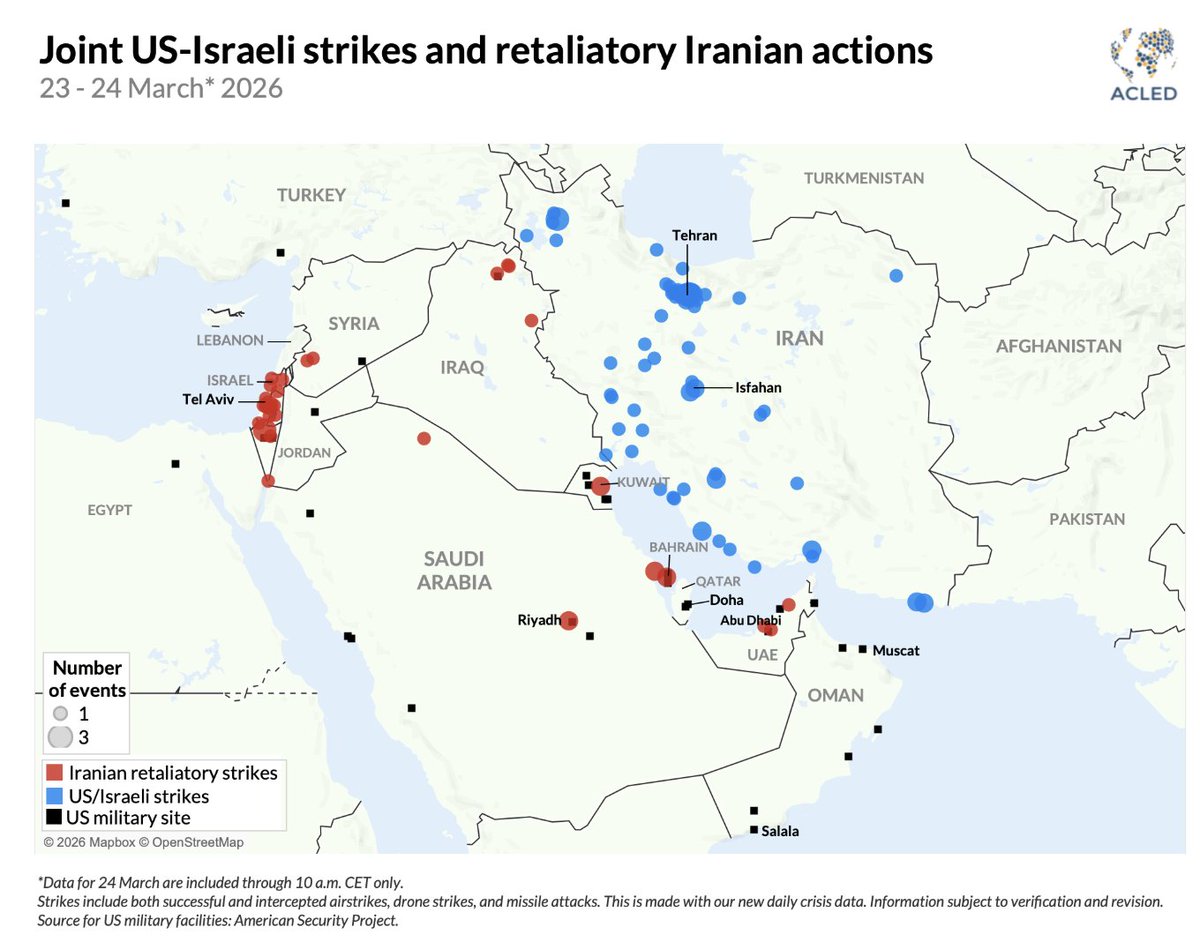
Seconded for the most part. Let me add a few notes. — There are three theories of air power. We know Douhetist terror bombing has never destroyed the will of the enemy to fight. Decapitation has now failed. As long as the US remains ‘up in the air’ there is only one path to avoiding strategic defeat: winning the interdiction war to disarm Iran. — The interdiction theory of victory is ‘analytically attractive’ because it empirically testable in real time. If Iranian strike tempo is dwindling to zero, the US is winning; otherwise it is losing outright. — The all-important interdiction war is going very poorly. I look at the attached map every day from ACLED, the gold standard of conflict data (acleddata.com/iran-crisis-li…). Iranian strike tempo shows no sign of dwindling. To the contrary, depletion of interceptor inventories and the use of heavier missiles has dramatically increased the effectiveness of Iranian missile strikes, as we are seeing in the strikes on Israel. — The Iranians’ interdiction/counterforce campaign has been surprisingly successful. At least 10 radars have been destroyed, partially blinding US forces and interceptor systems. US bases in the region have been largely evacuated, forcing the US to use European bases. — There have been some big kills. Two dozen heavy drones and a half a dozen manned aircraft have been lost to Iranian fire/accidents, not clear which, including an F-35. A mighty carrier group has been put out of business. — Iran enjoys escalation dominance. This was confirmed when Trump had to walk back his ultimatum. Iran has a very powerful threat at the top of the escalation ladder: the O&G infrastructure and water desalinization systems in the gulf are both under Iranian fire control. — Iran holds horizontal escalation options in reserve. The Houthis have their ‘fingers on the trigger.’ That is a deterrent to keep the Saudis out of the war, and may be used at any time to expand the war and impose greater costs on the West. — Iran retains a firm grip on the Hormuz weapon. No serious military option to retake Hormuz exists as long as the interdiction war is not won. No matter where you land the marines, they will be fully exposed to Iranian fire, including artillery fire. US force protection requirements, ultimately a function of casualty intolerance, mean that the Kharg idea etc are just not going to fly. — The United States is at a crossroads. Either it swallows this military humiliation and accepts a ceasefire largely on Iranian terms, or it must send in ground forces to in a bid to retake Hormuz and restore US military prestige. — If the US chooses a negotiated ceasefire, Iran will emerge as a regional hegemon with the Hormuz weapon firmly in its hands; and, having defeated the US in a high-intensity conventional war, as a great power in the international system. — If the US chooses to escalate to a ground war, the war will last for years. This is because both force protection and the overriding objective of fire suppression will drive ever greater commitment of ground forces. But the US cannot win the ground war under any circumstances because the division math (x.com/policytensor/s…) is even more forbidding than the drone math (x.com/policytensor/s…). This means that the choice facing the aggressor is between accepting strategic defeat now at limited costs, or later at far, far higher costs. — So the United States has already suffered a catastrophic military defeat. The multipolar world was a hypothesis until last month. Now it is a demonstrated military fact. It has obtained due to the diffusion of military technology (x.com/policytensor/s…). The US monopoly in precision-strike is now gone. Deterrence in Asia is now dead. This cannot but fail to have far-reaching geopolitical consequences, which I will lay out in detail in a forthcoming interview on @MultipolarPod with @admcollingwood later today.
Policy Tensor tweet media
Rosemary Kelanic@RKelanic

Wars reveal information about countries' relative military capabilities and interests. That's one of the most important insights from the bargaining model of war. Iran believed before the war that fighting the U.S. would strengthen its bargaining position -- and Iran was correct. This war has revealed that Iran wouldn't topple after Khamenei's death, that Iran is highly resolved, and it can inflict damage across the Gulf at low cost, indefinitely. It revealed that Iran can gain massive leverage -- and perhaps even collect "tolls" -- from controlling shipping through the Strait of Hormuz. By contrast, the war has *hurt* U.S. & Israeli bargaining power compared to where it was before the Geneva talks in February. That means we'll get worse terms now than if we'd accepted Iran's proposal then. Why is the U.S./Israel position worse? Decapitation strikes failed to induce Iran to surrender (always an unlikely prospect), nullifying the U.S./Israeli theory of victory by day 3. No new plausible theory of victory has emerged, and it's doubtful one will. That hurts the U.S. position. Trump has proven highly sensitive to oil market swings, and even *removed sanctions* on Iranian oil. As @edwardfishman noted, Iran gained more sanctions relief from closing Hormuz than through any diplomatic means, including the JCPOA. The disruption to oil markets, and Trump's concern about them, also hurts the U.S. position. Now that the war has bogged down into an attrition battle, where Iran can impose costs with cheap means like drones and missiles and Israeli interceptors seem to be running low, the U.S. and Israel are on the losing end of the damage and casualties curve. Costs and casualties will get worse, not better, over time, and that further hurts U.S./Israeli bargaining leverage. Trump is now considering, frankly, foolhardy military gambits, potentially to seize Kharg, islands in Hormuz, or perhaps the highly enriched uranium trapped somewhere under rubble in Iran. These would be significant escalations putting U.S. troops on the ground. None are likely to end the war, and all would likely cause U.S. casualties. In the business lingo, Trump's BATNA (best alternative to a negotiated agreement) is way worse -- not least because of the shadow of Afghanistan. The U.S. forces being surged to the Middle East (2 MEUs plus some airborne units) are comparable to what George W. Bush used to invade Afghanistan in the autumn 2001. What started out as a limited mission to topple the Taliban and capture Osama bin Laden, who instead escaped through the Tora Bora mountains, evolved into a ground campaign that eventually ballooned to over 100k U.S. troops in 2011. The clear imperative here is for Trump to deescalate, credibility costs be damned. This war is existential for Iran but not for the United States, Iran will keep fighting with cheap means like drones, and it will eventually outlast the U.S. just like the Taliban did in Afghanistan. That, or Iran could fracture into chaos, creating refugee flows and breeding terrorism for decades to come. (Terrorism isn't an existential threat to the U.S., but we shouldn't be creating the conditions for it.) Trump doesn't like backing down, but that is what needs to happen here, and stat, before ill-fated escalation leads to more needless deaths. @defpriorities

English
56
622
2.1K
215.6K
Multipolarity The Podcast
Multipolarity The Podcast@MultipolarPod·
Please keep enjoying the Multipolarity Brief - 800 hot words of analysis from @admcollingwood ever week, in your inbox, on Substack. Link below.
Multipolarity The Podcast tweet media
English
1
3
13
1.9K
Multipolarity The Podcast 리트윗함
Collingwood 🇬🇧
Collingwood 🇬🇧@admcollingwood·
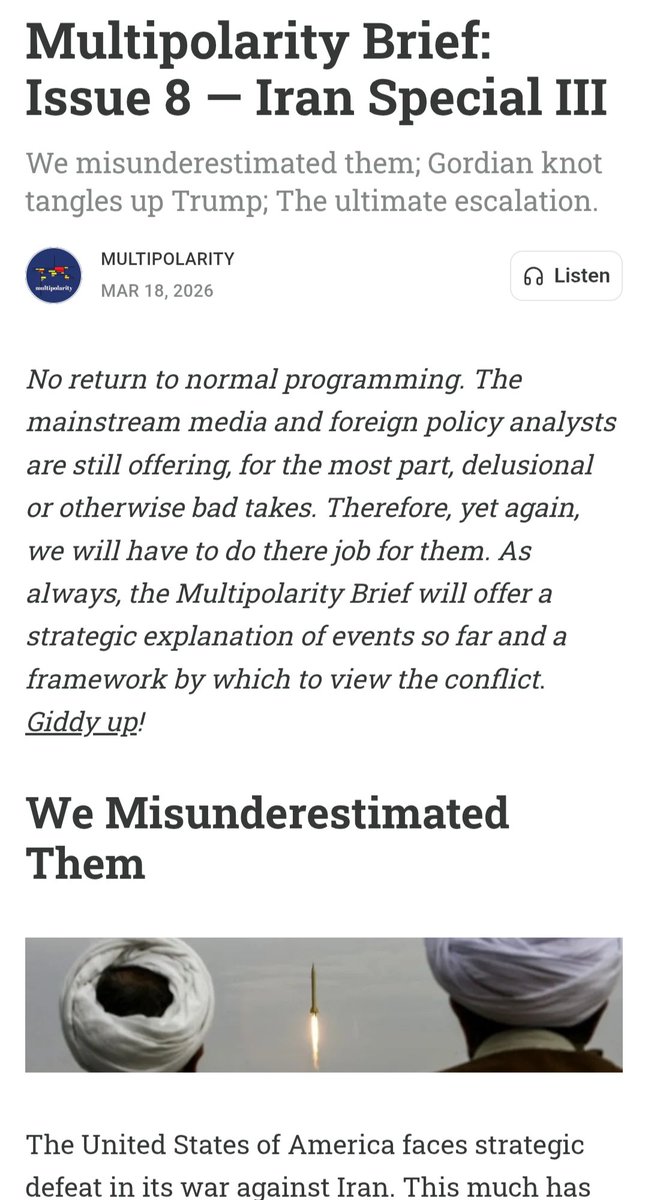
Issue 8 of the Multipolarity Brief is now live. 🇮🇷We underestimated Iran's reconnaissance-strike complex 🎃Trump has no good options left ⚠️Why Trump is likely to escalate even though it will make things worse ☢️Why nuclear weapons probably won't be used Link next post.
Collingwood 🇬🇧 tweet mediaCollingwood 🇬🇧 tweet mediaCollingwood 🇬🇧 tweet mediaCollingwood 🇬🇧 tweet media
English
4
8
56
6.2K
Multipolarity The Podcast 리트윗함
Philip Pilkington
Philip Pilkington@philippilk·
On @MultipolarPod Substack I wrote a brief but I think concise overview of the overall structure of the war. 🇺🇸🇮🇷
Philip Pilkington tweet media
English
2
7
38
4.3K
Multipolarity The Podcast 리트윗함
Wifejak
Wifejak@Wifejaksolana·
"Don't listen to them, babe. You do know a lot about geopolitics."
Wifejak tweet media
English
43
813
12.1K
288.3K
Multipolarity The Podcast 리트윗함
Collingwood 🇬🇧
Collingwood 🇬🇧@admcollingwood·
We need more than the vapid takes of legacy media and remain X accounts. IN HALF AN HOUR: Academic- and pro-level deep analysis from @firasmodad and @policytensor 🇮🇷Iran strategic calculus 🇺🇸Trump Admin position 🇨🇳Secondary effects — Russia; China x.com/i/spaces/1nKOL…
English
6
12
71
45.8K
Multipolarity The Podcast 리트윗함
Philip Pilkington
Philip Pilkington@philippilk·
It looks like @FCDOGovUK might be forced to run with this. If it is accepted as true then British diplomacy has been completely compromised by Russian intelligence, as was the Blair and Brown government and the @UKLabour party generally. 🥵🌶️
The Telegraph@Telegraph

🔴 Poland to examine ‘increasingly likely possibility that paedophilia scandal was co-organised by intelligence services’ in Moscow Read the full story below 🖇️ telegraph.co.uk/world-news/202…
English
39
15
95
15.1K
Multipolarity The Podcast 리트윗함
Philip Pilkington
Philip Pilkington@philippilk·
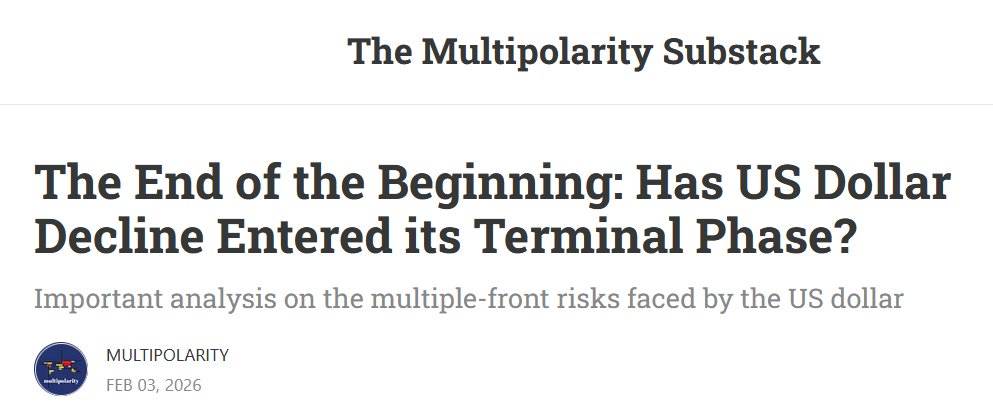
1/ On the @MultipolarPod Substack I have just posted the definitive analysis of how the USD has now entered its terminal phase of decline as the hegemonic currency. Here is a brief thread summarising, but if you're interested read the entire post. CC @Brad_Setser.
Philip Pilkington tweet media
English
4
53
165
30.4K