Ryan O'Keefe

1.6K posts

Ryan O'Keefe

Ryan O'Keefe

@ROKeefeMD

MD/MBA @PennMedicine @Wharton | Hospitalist | Creator @pointofcaremed | Follow for clinical threads and pearls

Philadelphia, PA 가입일 Aralık 2011
1.1K 팔로잉5K 팔로워
Ryan O'Keefe
Ryan O'Keefe@ROKeefeMD·
Daily Pearl(s): Invasive hypervirulent Klebsiella pneumoniae (hvKP) hvKP is a distinct clinical entity caused by specific hypermucoviscous strains of Klebsiella. Unlike classic Klebsiella infections, which are often nosocomial and affect immunocompromised hosts, hvKP can affect healthy community-dwelling individuals. The typical presentation begins with a pyogenic liver abscess, which serves as the primary focus for hematogenous dissemination. The hallmark of the syndrome is metastatic infections to distant sites. Examples of devastating complications can include endogenous endophthalmitis, which can cause rapid and permanent vision loss, meningitis, brain abscesses and septic pulmonary emboli which present as multiple cavitary lung nodules. The triad of pyogenic liver abscess, endogenous endophthalmitis, and metastatic septic emboli is pathognomonic for invasive hypervirulent Klebsiella pneumoniae syndrome. The "string test," where a bacterial colony forms a viscous string >5 mm when lifted with a loop, is a classic bedside indicator of the hypermucoviscous phenotype. Source: NEJM - Case 2-2026 A 63-Year-Old Man With Pulmonary Nodules, Liver Mass, And Vision Loss
English
1
0
2
49
Ryan O'Keefe 리트윗함
Elliot Tapper
Elliot Tapper@ebtapper·
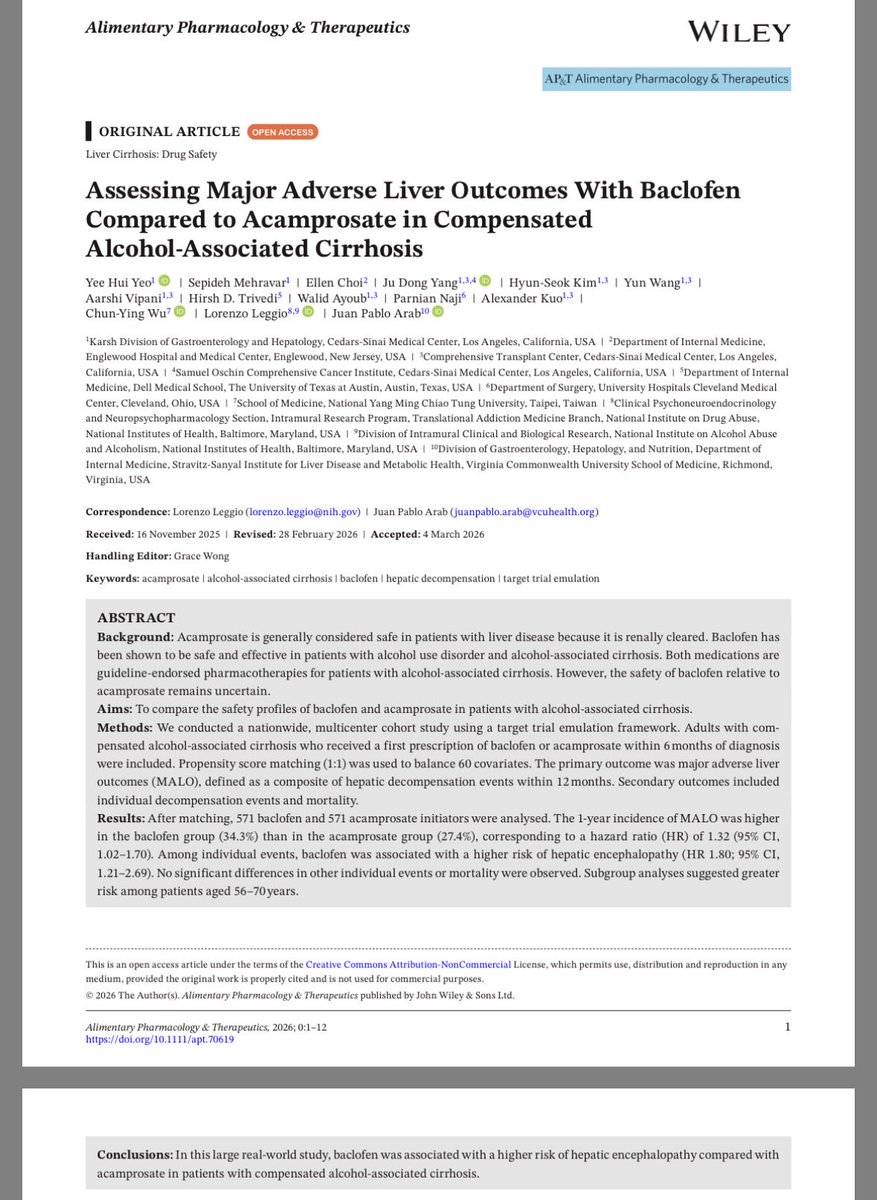
Naltrexone should be first line for AUD in people with cirrhosis It is increasingly uncomfortable to see baclofen mentioned alongside it, or even acamprosate
Elliot Tapper tweet media
English
4
31
114
8.4K
Ryan O'Keefe
Ryan O'Keefe@ROKeefeMD·
Daily Pearl(s): Meningococcemia Although disseminated meningococcal disease is classically associated with a petechial or purpuric rash, some serotypes, particularly serogroup W, can present atypically with prominent gastrointestinal symptoms, such as severe abdominal pain or diarrhea, which can potentially delay the diagnosis. Hallmarks of the disease include leukocytosis with prominent left shift, severe thrombocytopenia, and evidence of DIC. Anatomic or functional asplenia, complement deficiencies, and travel to endemic areas increase the risk for invasive disease with encapsulated bacteria like N. meningitidis. Source: NEJM - Case 1-2026 A 50-Year-Old Woman With Fever And Abdominal Pain
English
1
7
25
1.3K
Ryan O'Keefe
Ryan O'Keefe@ROKeefeMD·
Daily Pearl(s): Ketoacidosis and NAGMA Ketoacidosis, commonly seen in conditions like diabetic ketoacidosis (DKA) and alcoholic ketoacidosis, classically presents as a high anion gap metabolic acidosis due to the accumulation of unmeasured ketone anions (beta-hydroxybutyrate, acetoacetate). However, in rare instances where renal function is preserved, the kidneys can compensate. This occurs via enhanced excretion of the negatively charged ketone bodies in the urine. To maintain electroneutrality, the renal tubules increase the reabsorption of chloride, leading to a hyperchloremic metabolic acidosis, which manifests as a NAGMA. Thus, you should always check a serum beta-hydroxybutyrate level, regardless of the calculated anion gap. Source: CPS - RLR Case Challenge #163
English
2
14
53
2.6K
Ryan O'Keefe
Ryan O'Keefe@ROKeefeMD·
Daily Pearl(s): Gabapentin Toxicity Gabapentin toxicity can cause significant central nervous system and respiratory depression, particularly in vulnerable populations. This syndrome is classically associated with drug accumulation in the setting of acute or chronic kidney disease but can also occur in patients with underlying respiratory compromise, such as COPD, obesity hypoventilation syndrome, or severe restrictive chest wall disease. The combination of hypoactive encephalopathy (somnolence) and myoclonus should raise immediate suspicion for a toxic-metabolic cause, with medication toxicity being a primary consideration. Source: CPS - RLR Case Challenge #161
English
1
12
50
3.8K
Ryan O'Keefe
Ryan O'Keefe@ROKeefeMD·
Daily Pearl(s): Abdominal inflammation is often visualized on a CT scan by the presence of fat stranding. However, in patients with very little intra-abdominal adipose tissue, there often isn’t enough fat to become inflamed and signal the problem. This can create a false negative CT scan in cachectic patients. Source: CPS - RLR Case Challenge #160
English
1
8
59
4.1K
Ryan O'Keefe
Ryan O'Keefe@ROKeefeMD·
Daily Pearl(s): Alcohol-related Neuropathy Alcohol-related neuropathy results from a dual mechanism - the direct neurotoxic effects of alcohol and its metabolites on peripheral nerves, and secondary nutritional deficiencies, most notably of thiamine (Vitamin B1) but also folate, B6, and B12. The classic presentation is a distal, symmetric, painful, sensory-predominant polyneuropathy that follows a length-dependent (”stocking-glove”) pattern. Patients typically complain of burning, tingling, and numbness in the feet, which gradually ascends. Motor symptoms like weakness and muscle atrophy appear later in the disease course. Labs may show macrocytosis with a high MCV, an AST to ALT ratio >2, elevated GGT, deficiency is in folate, magnesium, and thiamine. Specific biomarkers like phosphatidylethanol (PEth) are highly sensitive and specific for recent (2-4 weeks) heavy alcohol consumption. EMG is the key diagnostic test to characterize the neuropathy which classically shows a length-dependent, sensory greater than motor, axonal polyneuropathy. Source: CPS - Episode 435 Neurology Vmr Weakness And Numbness
English
2
3
33
1.7K
Ryan O'Keefe
Ryan O'Keefe@ROKeefeMD·
Daily Pearl(s): The diagnosis of sarcoidosis is one of exclusion; the presence of non-caseating granulomas on biopsy is necessary but requires a thorough workup to rule out infectious and malignant mimics before confirming the diagnosis. In cases of suspected infiltrative disease with organomegaly and systemic symptoms, imaging (CT/PET) is critical to identify biopsy targets, but the principle “the tissue is the issue” holds true, as a definitive diagnosis almost always requires pathology. Source: CPS - Episode 432 Spaced Learning Series Subacute Inflammation
English
1
6
24
1.4K
Ryan O'Keefe 리트윗함
Papa Heme
Papa Heme@Papa_Heme·
Papa's Pod is finally coming back! This is a hematology podcast with a focus on clinical care (not just data) and what you actually have to know to care for patients! I plan to do one episode a week (first will be CART in myeloma) and open to requests! podcasts.apple.com/us/podcast/pap…
Papa Heme tweet media
English
8
23
170
7.6K
Ryan O'Keefe
Ryan O'Keefe@ROKeefeMD·
Daily Pearl(s): Reactive Arthritis The triad of arthritis, urethritis/pelvic symptoms, and a preceding infection is classic for reactive arthritis, which is the form of spondyloarthropathy. Although this is typically triggered by gastrointestinal (salmonella, campylobacter) and genitourinary infections (chlamydia), COVID is an increasingly recognized trigger. Enthesitis is the pathologic hallmark of spondyloarthropathies. Pain at tendon/ligament insertions (plantar fasciitis, epicondylitis) is a diagnostic clue. MRI findings showing insertional tendinopathy can provide crucial evidence for enthesitis when an exam is nonspecific. Spondyloarthropathies are often sero-negative, thus the diagnosis can and should be made on clinical grounds, even when there’s normal inflammatory markers and a negative HLA-B27. Source: CPS - December 30, 2025 Rheumatology VMR with Greg Kirschen & Jeffrey Shen - Altered Mental Status
English
1
2
19
847