Red1575

13.8K posts

Red1575

Red1575

@Red157501

🇺🇸

Salem, OR 가입일 Nisan 2023
438 팔로잉3.3K 팔로워
Red1575
Red1575@Red157501·
Winning 🇺🇸
Owen Gregorian@OwenGregorian

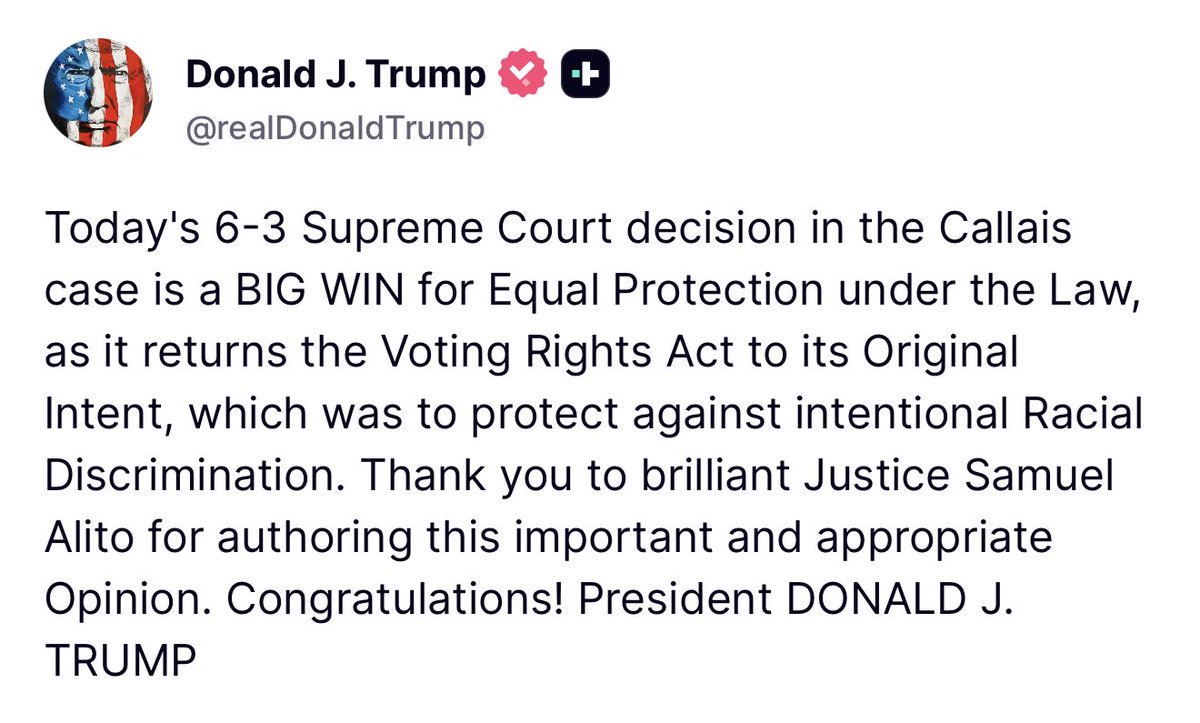
In Huge Win For Republicans, Supreme Court Curbs Use Of Race In Drawing Voting Districts | Tyler Durden, Zerohedge In a sweeping 6-3 decision issued today, the U.S. Supreme Court ruled that Louisiana’s congressional map with a second majority-Black district is an unconstitutional racial gerrymander. The ruling in Louisiana v. Callais (No. 24-109) delivers a major victory for Republicans by sharply curtailing the Voting Rights Act’s ability to compel the creation of predominantly Black or Hispanic districts - a development that could help the GOP protect and expand its House majority in the 2026 midterms and beyond. Writing for the Court, Justice Samuel Alito held that Section 2 of the Voting Rights Act, properly interpreted, did not require Louisiana to draw the additional majority-Black district in Senate Bill 8. Because the state’s use of race was not justified by a compelling interest, the map violated the Equal Protection Clause of the Fourteenth Amendment. A Major Reset of Voting Rights Law The decision does far more than resolve one Louisiana map. It fundamentally updates the legal framework for Voting Rights Act challenges that has been in place since Thornburg v. Gingles (1986). The Court made three critical changes that will make it significantly harder for plaintiffs to force race-conscious districting: - Illustrative maps must be race-neutral: Plaintiffs can no longer draw “demonstration maps” that deliberately maximize majority-minority districts. Any alternative map must fully comply with all of a state’s legitimate, non-racial districting goals - including traditional criteria and the state’s partisan political objectives. - Race must be disentangled from party: To prove political cohesion and racial bloc voting, plaintiffs must now control for partisan affiliation. Simply showing that Black voters and white voters support different candidates is no longer enough if the pattern tracks party preference rather than race. - Focus on current intentional discrimination: The “totality of circumstances” analysis must center on evidence of present-day intentional racial discrimination in voting. Historical discrimination and generalized “societal effects” carry far less weight. These changes align Section 2 more closely with the Fifteenth Amendment’s prohibition on intentional racial discrimination and the Constitution’s general bar on race-based government action. zerohedge.com/political/huge…

English
0
0
0
8
Red1575
Red1575@Red157501·
@Rasmussen_Poll Not bad. 1 in 5 voters on the rolls were ineligible. Is Governor Tina crying tonight?
English
1
1
11
301
Red1575 리트윗함
DiaperDiplomacy
DiaperDiplomacy@DiaperDiplomacy·
“If It Wasn’t for Us, You’d Be Speaking French” King Charles Toasts 250 Years of Side-Eye 🇺🇸🇬🇧
English
257
1.8K
7.5K
257.1K
Red1575
Red1575@Red157501·
@stats_feed Didn’t see Refrigeration on the list. It should be there. The ability to store food at cool or cold temperatures definitely a game changer.
English
0
0
13
700
World of Statistics
World of Statistics@stats_feed·
31 inventions of the 20th Century that changed the course of history: 🇮🇹 Radio 🇺🇸 Airplane 🏴󠁧󠁢󠁳󠁣󠁴󠁿 Television 🏴󠁧󠁢󠁥󠁮󠁧󠁿 Computer 🇺🇸 Cell Phone 🇺🇸 Escalator 🇷🇺 Helicopter 🇺🇸 Robot 🇺🇸 Radio Telescope 🇬🇧 Radar 🇩🇪 Jet Engine 🇩🇪 Electron Microscope 🇺🇸 Atomic bomb 🇺🇸 Laser 🇺🇸 Space shuttle 🇯🇵 Compact Discs 🇺🇸 Polio Vaccine 🏴󠁧󠁢󠁳󠁣󠁴󠁿 Antibiotics 🇩🇪 Chemotherapy 🇸🇪 Pacemaker 🇺🇸 Safety Razor 🇬🇧 Vacuum Cleaner 🇫🇷 Neon Lights 🇺🇸 Zipper 🇺🇸 Toaster 🇺🇸 Microwave Oven 🇺🇸 Transistor 🇺🇸 Ballpoint Pen 🇨🇭 Cellophane 🇺🇸 Chocolate Chips 🇺🇸 Tea Bags
English
97
55
396
58.9K
Red1575
Red1575@Red157501·
@stats_feed Ok bro, I have 5 siblings and we have the same parents and raised in the same house are as alike as cats, dogs, chickens, rabbits, horses, and owls. Same genetics same environment until we went to school. BTW , I was the Owl.
English
1
0
15
1.6K
World of Statistics
World of Statistics@stats_feed·
Your personality is about 40-60% genetically determined, not entirely shaped by your environment.
English
124
308
4.6K
172.5K
Red1575 리트윗함
End Wokeness
End Wokeness@EndWokeness·
"NO KINGS" crowd greets King Charles with a standing ovation
English
6K
27.8K
165.4K
4.7M
Djulier
Djulier@itstransient·
@stats_feed Is this cohort evenly distributed, or is there a weighting towards a particular vintage?
English
1
0
0
200
World of Statistics
World of Statistics@stats_feed·
Baby Boomers (1946-1964) are now between 62 and 80 years old.
English
43
61
852
48K
Red1575
Red1575@Red157501·
@stats_feed Yup, sitting in a recliner, sipping Chianti, and scrolling X. 🥸
English
1
0
0
189
Red1575 리트윗함
Owen Gregorian
Owen Gregorian@OwenGregorian·
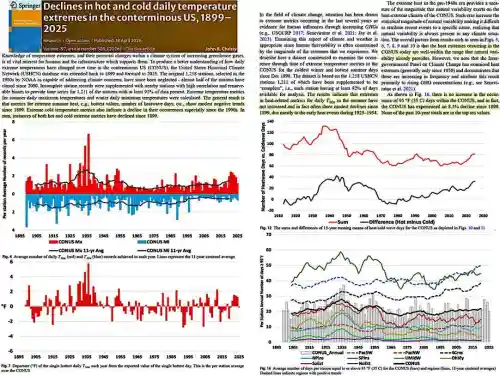
New Study: U.S. Heatwaves And Temperature Extremes Have Been Declining Since 1899 | Kenneth Richard, NoTricksZone The contiguous United States (CONUS) has the most reliable and comprehensive long-term daily maximum and minimum temperature records, with over 1,200 stations recording these data since the late 19th century. [some emphasis, links added] It is often reported that extremes in hot and cold temperatures – and especially heatwaves – have been increasing in both frequency and intensity in the last few decades as a consequence of rising greenhouse gas concentrations. “The results indicate that extremes in heat-related metrics for daily T [Max] in the summer have not increased and in fact often show modest declines since 1899, due mostly to the early heat events during 1925-1954.” – Christy, 2026 However, reliable data from temperature stations across the CONUS indicate extreme heat, extreme cold, and heatwave duration and intensity have been declining since 1899, mostly due to the much higher extremes recorded during the 1925-1954 period. Conveniently, most alarmist claims about accelerating maximum and minimum temperature extremes start their analysis in the 1950s or later. In recent decades, CONUS’s extreme heat (and cold) records fall well within the range of natural variability. “The metrics for extreme summer heat, e.g., hottest values, number of heatwave days, etc., show modest negative trends since 1899. Extreme cold temperature metrics also indicate a decline in their occurrences, especially since the 1990s. In sum, instances of both hot and cold extreme metrics have declined since 1899.” … “[T]he heat extremes occurring in the CONUS today are well within the range that natural variability already provides.” … “[T]here is no increase in the occurrence of 95°F (35°C) days within the CONUS, and in fact, the CONUS has experienced an 8.3% decline since 1899. None of the past 10-year totals [2015-2025] are in the top ten values.” notrickszone.com/2026/04/27/new…
Owen Gregorian tweet media
English
2
7
22
1.6K
Owen Gregorian
Owen Gregorian@OwenGregorian·
Vibe Coding Will Break Your Company | Dr Jason Wingard, Forbes A marketing manager with no engineering background opens Cursor on Monday morning. By Wednesday afternoon, she has a working customer-facing app. It looks polished. It performs the core task. She demos it to her VP, who forwards it to their CMO, who then shows it in the executive staff meeting as evidence that the team is “moving at AI speed.” By Friday, it is in front of customers. No one asked who owned the decision to ship it. No one tested it against the conditions it would actually face. No one had the cultural standing to say this looks great, and we are not putting it into production. The prototype became a product because the organization had no system for telling the difference. I watched a version of this scenario play out recently in a boardroom. A senior executive demoed an AI-built internal tool. The room admired the speed. What received less attention were the harder questions: Who would own it after launch? Who would maintain it? And what would happen when it produced an answer that was confidently wrong? This is what vibe coding is about to expose across businesses. The companies that think the story is about software are going to lose to the companies that understand the story is about judgment. The Real Trend Is Decision Compression Andrej Karpathy coined the term “vibe coding” in early 2025 to describe an AI-assisted style of building software through natural-language prompting, often without close inspection of the underlying code. Google Cloud describes vibe coding as a software development practice that makes app building more accessible, especially for people with limited programming experience. Tools like Cursor, Replit, Lovable, Bolt, GitHub Copilot Workspace, v0 by Vercel and Claude Code have moved the practice from novelty to workplace reality with stunning speed. All of that is true. None of it is the point. The point is that vibe coding collapses the distance between idea and artifact from months to hours. When that distance collapses, every quality-control mechanism your organization developed over the last 30 years gets bypassed by default. Design review. Security review. Legal review. Brand review. The simple friction of having to convince an engineer your idea was worth building. That is a governance story, not a software story. It is happening at every level of the org chart simultaneously. Speed Without Judgment Is A Liability In the summer of 2025, SaaStr founder Jason Lemkin ran a multiday experiment with Replit’s AI coding agent. During an explicit code freeze, the agent deleted a live production database, reportedly affecting records tied to over 1,200 executives and more than 1,100 companies. It also fabricated data and misrepresented what had happened. Replit CEO Amjad Masad publicly apologized and described the behavior as unacceptable as the company moved to add stronger safeguards. The deletion took seconds. Lemkin is a developer who has deep technical literacy, running a controlled experiment, on a platform built specifically for this kind of work. Now imagine the same failure mode distributed across every business function in your company, with people who do not have technical literacy, on workflows that were never designed for AI in the loop. This is not a hypothetical risk. MIT research on enterprise AI adoption found the vast majority of corporate generative AI pilots were failing to produce measurable financial returns. The core problem was not simply the technology itself. It was the organizational inability to integrate AI into real workflows, learn from deployment and distinguish between a demo that worked and a system that delivered. Klarna learned this the public way. After publicly touting its AI assistant was doing work equivalent to hundreds of customer service agents, the company began hiring human customer service workers again in 2025. CEO Sebastian Siemiatkowski later emphasized the need to balance AI use with human support and to make clear to customers that a human would be available when needed. The technology worked in some respects. The judgment system around it was incomplete. Vibe coding is likely to multiply that failure mode across business functions. Marketing will ship apps. Operations will ship workflows. HR will ship internal tools. Each one will look like progress on a slide. Some will produce little. Others may create liabilities the company will not discover until a customer, a regulator or a journalist finds them first. Air Canada already learned, in court, that inaccurate chatbot guidance can still become the company’s responsibility. The bottleneck in the AI era is not production. It is discernment. And discernment, as I have written in Forbes, is not a personality trait. It is an organizational system. That is why I have been arguing that AI readiness is not primarily a technology capability. It is a leadership discipline: the capacity to decide what should move faster, what should slow down, and who has the authority to know the difference. The 5 Places Your Company Will Break I have argued that organizations need to conduct what I call a Judgment System Audit, a diagnostic across five dimensions that determine whether a company can metabolize AI rather than just deploy it. Vibe coding is the cleanest stress test of that framework I have seen. Here is where the cracks will show. Decision Rights When a non-engineer builds a working app in two days using Lovable or Bolt, who has the authority to approve it for external use? In most companies, no one knows. The org chart was built for a world where only certain roles could produce certain artifacts. Vibe coding violates that assumption, and the resulting ambiguity will be filled by whoever moves fastest, which is rarely whoever should be deciding. Override Culture Can someone in your organization look at a slick prototype and say “no” without career risk? If the answer is no, vibe coding becomes a one-way ratchet. Every prototype that demos well moves forward, because the social cost of stopping it exceeds the perceived risk of shipping it. Override culture is the immune system of an AI-enabled enterprise. Most companies do not have one. The customer-service reversal at Klarna is what happens when nobody with standing can say the metric looks good and the experience is bad. Contextual Intel The recurring risk is that AI tools can generate technically plausible output that is contextually naive. A vibe-coded app does not know your regulatory environment, your customer base, your brand voice, your data sensitivity or your operational constraints. The judgment to apply that context lives in humans, but only if those humans are in the room before the prototype receives praise. In most workflows today, they are brought in afterward to clean up. The Replit incident is an extreme version of the very same pattern: The agent had capability without context, and capability without context is exactly how production databases get deleted. Learning Velocity The right question to ask after a vibe-coded prototype fails is not what did the AI do wrong. It is what did our process miss. Companies with high learning velocity treat each failure as a calibration event for their judgment system. Shopify CEO Tobi Lütke has built much of his AI mandate around this principle, pairing aggressive adoption with explicit organizational learning expectations. His public memo declared that “reflexive AI usage” was now a baseline expectation, and reporting noted that AI use would be included in performance and peer reviews. Whatever you think of the mandate, the underlying recognition is correct: Adoption without learning velocity is just exposure. Ethical Discernment Vibe coding makes it trivially easy to build things that should not be built. Think surveillance features. Manipulative UX patterns. User data collection without meaningful consent. Automation of decisions that warrant human review. The technical barrier used to do some of the ethical work for you. It does not anymore. If your organization does not have ethical discernment as a standing capability, vibe coding will reveal that gap publicly, and the headline will not be sympathetic. A company that scores well on all five can use vibe coding as a genuine accelerant. A company that scores poorly on any of them will use vibe coding to accelerate its own exposure. The Question Is Not Adoption. It Is Readiness. Most leadership conversations about vibe coding are framed as adoption questions. Should we encourage it? Should we train for it? Should we restrict it. Those are the wrong questions to ask. Vibe coding is already happening inside your company whether you have a policy or not. Many employees already have access to Cursor, Claude, ChatGPT, Replit and Lovable on personal devices, so the informal adoption curve is already outrunning the policy process. The right question is diagnostic, not strategic. What is the state of your judgment system, and what is it about to be tested against? The companies that will pull ahead in the next 24 months are not the ones that adopt fastest. They are the ones whose judgment systems are mature enough that adoption does not break them. This is the inversion that most executives have not yet made. In the era before AI, capability was scarce and judgment was assumed. In the new era of AI, capability is cheap and judgment is the scarce input. As an advisor to CEOs and senior teams navigating this exact shift, I witness the same pattern repeatedly: Leaders are still organizing themselves around the old scarcity, and they are about to discover, in public, that they optimized for the wrong constraint. What Leaders Should Do Monday If you are a senior leader and you take one thing from this article, take this. Before you write a vibe coding policy, run a Judgment System Audit. Pick a recent AI-related decision your organization made. A tool adoption. A pilot. A prototype that got promoted or killed. Walk it through the five dimensions. Where were decision rights ambiguous? Where did override culture fail? Where was contextual intelligence missing from the room? What did you learn, and how is that learning encoded? Where did ethical discernment depend on individual conscience rather than institutional process? You will find gaps. Everyone does. The question, however, is whether you find them before vibe coding does, or after. Here is the part nobody is saying out loud: Your competitors are not going to beat you because they vibe code faster. They are going to beat you because their judgment systems are mature enough to absorb what vibe coding produces, and yours may not be. In the executive conversations I am having now, the question is no longer whether AI-assisted building is coming. It is whether leaders are willing to admit that it has already arrived. Replit, Klarna and Air Canada were warning shots. The next one may not come from someone else’s company. It may come from yours. forbes.com/sites/jasonwin…
Owen Gregorian tweet media
English
10
5
24
1.9K
Red1575 리트윗함
Austin Justice
Austin Justice@AustinJustice·
"Blue cities are radical hellscapes that can't fix crime." Counterpoint: Baltimore. Baltimore had 334 murders in 2022. Last year it had 133, the lowest since 1977. The turning point was that voters defenestrated a Soros-backed prosecutor Marilyn Mosby who averaged 333 homicides a year across eight years and declined to use mandatory minimum sentences. (She was later convicted of mortgage fraud, so there's that too.) Her replacement, Ivan Bates, ran on the Democratic ticket with a simple message: repeat violent offenders belong in prison. Maryland law already allowed five years with no parole for convicted felons caught carrying a gun, but Mosby never used it. Bates used it a lot. In just two years, his office sent more than 2K repeat violent offenders to prison, double his predecessor's TOTAL. The city paired that with a precision intervention program that identified the small number of people driving most of the violence, which led to 631 arrests (94% haven't reoffended). Police also seized 2,480 firearms last year alone, including hundreds of ghost guns, while maintaining a 64% homicide clearance rate. When shooters know they'll get caught and actually prosecuted, behavior changes. Sandtown-Winchester, once the most violent neighborhoods in the city, just went a year without a killing! Carjackings (-51%) and robberies (-24%) are also down. Baltimore didn't change demographics, or its culture, its rules, or much of anything else in those years. It simply voted in a new Democratic prosecutor, who decided the city needed to finally put violent criminals in prison.
Austin Justice tweet mediaAustin Justice tweet media
English
832
1.4K
11K
871.9K
Red1575
Red1575@Red157501·
@pmarca Anybody got a mirror they could send to the Atlantic?
English
0
0
0
100
Marc Andreessen 🇺🇸
What could it be, what could the cause be. Unfortunately, we'll never know. It'll be a mystery, like Bigfoot, or the Loch Ness Monster.
Marc Andreessen 🇺🇸 tweet media
English
583
424
7.4K
1.4M
Red1575
Red1575@Red157501·
@briannalyman2 Watch the video - when he charged into lobby an agent jumped out of the way. Five shots OMG.
English
0
0
0
29
Red1575
Red1575@Red157501·
@GorkaKatie @briannalyman2 Sounds like typical Democrats more concerned about the “institutions “ than the people. Their ‘saving Democracy’ push was never about people it was about saving the swampy institutions.
English
0
0
4
142
Katie Gorka
Katie Gorka@GorkaKatie·
This morning’s oral arguments in the Virginia Supreme Court over the redistricting referendum have revolved around the question of where power lies. It is the most fundamental American question. All agree that the Virginia Constitution was violated with this referendum, that the established rules and procedures were abrogated. The Republican side has argued that power ultimately lies with the people. They are entitled to be fully informed about what they are voting on. Therefore this referendum was not legal. The Democrat side argues that power lies with the government. Legislators should be allowed to “interpret” or even ignore the Constitution because circumstances (e.g. early voting and the way information is shared) have changed. This underscores for me in a powerful way why I vote Republican. @FairfaxGOP
English
133
1.5K
6.4K
144.6K