Simon L

30.6K posts

Simon L

Simon L

@SnupSnus

Interested in the Biotech &Pharma industry! #aging too. Occasional math(s). Not investment advice etc etc,

가입일 Ocak 2013
1.3K 팔로잉1.8K 팔로워
고정된 트윗
Simon L
Simon L@SnupSnus·
This thought by Tom Kirkwood probably makes a good &hopeful closing message #WhyWeAge2020.Should have tweeted it last.I think I tweeted a summary of what I found striking in all talks you can find them under the hastag #WhyWeAge2020, I have more pictures from the slides just ask!
Simon L@SnupSnus

#WhyWeAge2020 RT: Tom Kirkwood points out that we are not biological programmed for aging&not programmed to die - it's just that our repair mechanisms don't work well enough to maintain our bodies indefinitely. A very hopeful message!

English
2
1
9
0
Simon L
Simon L@SnupSnus·
Fun recap!
Adu Subramanian@plainyogurt21

****2025 BioX Year in Review**** Not to be taken seriously: $XBI A long time ago in a galaxy between San Diego and Boston, a traveler arrived at the gates of BioX on January 1st, 2025. The feeling was uneasy. Against all common wisdom to jump on the next big AI startup, Bitcoin, or index in big tech, they'd felt a calling to biotech. One clinical trial readout sending a stock up 100% and now they’re hooked. But aimless. "Welcome, young traveler," came a voice from the shadows, like a Jedi master who'd seen a thousand battles. @sports_bios emerged, dressed in robes the color of tulips, his presence radiating the wisdom of the Old Republic. "Fear not the names and pay attention to only the information," he said, his voice carrying the weight of many market cycles. "Charlatans and masters come in many forms. The dark side and the light are not always where you expect. You may learn something from the jedis such as @BiotechElmo @Vulpescap @Biopharmaddict @BayAreaBiotechI, @Biohazard3737 and others who walk these paths. Some analyze in the light, some retracted by compliance: both have their place with the Force." Sports took the traveler to a Jedi temple where holographic cherry blossoms bloomed year-round, each petal inscribed with molecular structures. "The XBI has been flat for five years while NASDAQ has outperformed," he said. "Palantir investors who know nothing of the company make millions while Jedi PhDs toil day and night to predict clinical trials. This is the imbalance in the Force you've entered. But there is opportunity in the chaos, if you learn to see it." As the year began, the FDA was under turmoil but biotech operated like usual. Some stocks went up, some went down. Overall, M&A had slowed. Capital flowed to tech. The traveler received transmissions from friends minting money with any startup containing ".ai" in their name. The jedis shake their head: "The market rewards narrative over substance, until suddenly it doesn't. Trust in the Force, trust in the data. Our time will come." But beneath the calm, something was stirring. A shadow growing. Foreboding a downturn in March, a patient died with $SRPT's gene therapy, Elevydis. (this wasn't the end of that saga) Then as we entered March, $ARVN blew up down 50% in a single day. And sentiment took a turn for the worse in April. The number of negative enterprise value companies peaked. At the bottom, XBI was flat over a 10-year period. The traveler read the threads on BioX and worse than despair was desolation. All the analysis was dried up. We used to analyze trials and now we congratulate CEOs for CLOSING their business $THRD @adamfeuerstein Sarepta killed a patient in March, another in June. (Turns out it was actually two in June, but they didn't feel it necessary to announce it). The FDA places a hold on shipments as they wait to resolve it. Once a $200 stock now down 90%, iffy data came back to bite them, a recurring theme in biotech. Sadly, everyone lost a few IQ points listening to the company in the summer. "The kind of drop I've had in the past two days has been extremely rare for my style, no leverage, the type of names I own, so we are definitely at some kind of liquidation extremes." It was April 1st. The date felt like a cruel joke from the Force itself. $LXEO reported unprecedented data and raised money at all-time lows. $STOK partnered with a company for a deal worth more than the company itself and the stock dropped. Everyone on BioX was redacted by compliance or left the platform entirely. And worst of all: Sports_bios was gone in April. The traveler stood alone in the empty temple, an ObiWan like presence gone from the force. They had a choice: fold under the pressure or lean into the potential rally. “The bear market killed biotech”. No Luke. The bear market IS biotech” But in the depths of despair, in an almost poetic way, Sports' sacrifice flipped a switch in the market. It was one readout, a buyout, then another. The Rebellion was beginning. $RGLS was bought out April 30th for 10x the stock price. $ALNY was starting to commercialize in ATTR-CM $INZY was bought out May 16th. $BBIO reported strong earnings in May 2025. End of part 1 Before a noisy September approached, the traveler needed more training in the summer They found @A_May_MD in his swamp, a corner of BioX where he'd been analyzing data for years. Fighting off trolls from $HIMS and $VKTX. Bold enough to take them on when no one else had the right combination of fire and intelligence. "Rezpegged, you will be," Adam said in his peculiar way. "Nektarded, many become. Hmmm. Learn from this, you must." The traveler didn't fully understand, but he listened. They joined @houndcl to learn med chem, @Prof_Oak_ to learn gene therapy, @Sanctuary_Bio to learn a steady hand and testing their skills with @bingbingbom @drug_smolecules @LY4101174. "understand their posts to be a true jedi". Make sure you understand who is serious among the crowd: @MelvinRiskMgmt @TheBiotechBear @ESG_Biotech may say unserious things meant not to be taken seriously. The most dangerous training was with the bounty hunters: @Biotenic @jesse_brodkin. The downturn didn’t phase them: "What if the company doesn't survive? He's worth a lot to me." - These bounty hunters seeked the frauds and charlatans to send them to 0. Beware them short your company. And things started to break the right way in the summer $CDTX seemed too obvious but the stock was up 100% on the phase 2 results. The anti vaxx movement and a heavy flu season provided an opportunity for a flu prevention treatment to be huge. The traveler trained in Adam's swamp, learning to see beyond the obvious, to trust in unexpected outcomes. $NKTR was a positive Risk Reward heading into phase 2b results in atopic dermatitis trading at cash. And boom it reads out positive. Better than dupi? Maybe not, but the phase 2b established proof of concept for the nobel prize winning TReg hypothesis. And in July, Adam released a thesis on $ABVX. The next day, they released phase 3 results in Ulcerative Colitis. The stock was up 500%. As if that wasn't enough, $CELC released phase 3 breast cancer results that same month sending it up 300%. A few readouts went right and was Biotech Back? @CloisterRes was finally able to order fries with his mcgriddle And from ABVX and NKTR emerged @seedy19tron , not a jedi, but a rogue high risk pilot caught up in the ARVN blowup. Originally thought to be dead, he came back from the frozen carbonite. The rebellion needed a leader and h̶a̶n̶ ̶s̶o̶l̶o̶ ̶ Seedy started to step up with weekly reviews of his portfolios. Seedy would soon become the face of BioX even as a rogue, untrained risk seeking pilot. People sometimes look at him as like a shill but September rolled around. XBI was finally flat year-to-date. It was time for the epic September/October that would define the year. Kicked off by an unexpected $UTHR win. Maybe FVC doesn’t measure just fibrosis….. $RAPP somewhat positive data in FOS, up 100% $DNTH somewhat positive data in gMG, up 100% Everyone’s getting an FGF21 like Oprah ($ENTB, $AKRO). Overpay? Who cares? $MBX disappoints with hypoPTH data? Doesn’t matter, $MTSR bought out and the stock is up (one of the last parting gifts from sports_bios). $CYTK proves to use Beta blockers are Doodoo for oHCM $TRML acquired $SRRK CRL? Libtayo CRL? Catalent plants have rats? Doesn’t matter, stock is not down. $QURE up 300% because they hit the bar set by the FDA in a 12 person externally controlled phase 1ish trial without biomarkers to demonstrate efficacy IONS shows unprecedented efficacy in sHTG. @bigpharmaguy drops in for a second “$PRAX didn’t actually fail an interim” and disappears into the shadows. That ET phase 3 is a success. Do you have a UC drug? Sure, time to get funded $PALI $EQ. We’re looking for the next ABVX $SPRB was 1 month from running out of fuel when the FDA gave them clearance to file and it pumped 20x in one day. @MSollender caught this early as it was happening It’s not all wins for everyone. $MLTX is a complete failure, wiping out some huge positions. Butit’s okay because we’ll just buy $Zura and $AVTX instead for HS. Some clear shorts with their stock up 300% into a readout fail (oh no who could have predicted $ATYR $KALA). $NTLA kills a patient and gene therapy for ATTR is DoA. And we round out the year with extreme bullishness: Do you have a drug in a clinical trial? Are you a complete dogshit company? If yes and no, your stock is up 100%. Amidst all this, m̶o̶s̶ ̶e̶i̶s̶l̶e̶y̶ ̶c̶a̶n̶t̶i̶n̶a̶ the FDA is in turmoil Who shot first? Prasad, Makary, pazdur, or the FDA? We don't know but 90% of leadership is gone. Heads of CBER, CDER all leaving. $REPL kept their head on a swivel with a CRL, potential reversal, and a reversal again: where are they in the process? Vinay Prasad left and came back. Pazdur changed roles, took pictures with everyone and then departed. For Uniqure, a unique hope for Huntington’s disease, the FDA reverts prior guidance and asks for more than 12 patients with an external control on highly variable endpoints. In an act of virtue?desperation?greed? Quality investors and shitco CEOs band together to call out the flip flopping. "We're okay if you don't like the data (we don't either), but you can't keep flip flopping". Yet how short our memory is in the fog of war: we’re quickly onto the next. The FDA turmoil is put aside as biotech churns forward. The buyout spree continues: $RNA $CDTX $FOLD $DVAX all billions for a buyout. If @JoseRestonVA is in a company, watch out it might be bought out tomorrow. Big pharma is feeling the pressure of Billions in loss of expiry. Ater October and September, The year returns back to a normal cadence: readouts from a predictable failure in $AGIO, success in $FULC in SCD, $DBVT in Allergies, $COGT in GIST, and unpredictable failure in $RZLT for cHI Exiting 2025 and bioX has been through a lot. Sports Bios level headed takes ring in our Hero’s ears and he looks out at the landscape: “Are buying too much?” Phase 0 companies worth 1̶.̶5̶B̶ ̶1̶.̶8̶B̶ 2.2B $GLTO. If you do a PIPE with crazy warrant coverage, you get bought. Phase 1b Atopic dermatitis data rewarded with billion dollar valuations. The acquisition and data spree has catalyzed extreme bullishness. $KYMR Any biotech is up 100% in 6 months. $CAPR with a successful phase 3 The techbros have started to take aim at biology. “We’re going to solve biology”. Uh oh. Do they know what a clinical trial requires? Do they realize that $JSPR failed because the investigators didn’t enroll patients with the right disease? Retro Bio is now worth 5 Billion to target "aging"……What does that even mean? China is fast on the US tail and reg bros are pleading with the FDA to modernize their process. Maybe it’s time to take a step back. We reflect on the year.Obesity is at the forefront but eerily, the king stays the king: Lilly and tirzepatide are taking over and a temporary blip in oral GLP1 data gives way to all time highs for $LLY. 2026 brings the first round of IRA negotiations, biosimilar competition, MFN pricing but will this truly impact us? A new wave of biotech IPOs is ready to mark the top. Seedy found our hero overlooking the therapeutic landscape "Poetic, wasn't it? The master falls, and in his falling, the market finds its floor." "we are beyond back," the traveler said. "It's taken a toll, but we fought a battle with high highs and low lows. "We've lost some truly valiable onesSports is gone. Michelle Solly is gone." "and gained som quality new faces @idalopirdine @BalaBioResearch @3rdFloorCapital @mickeychiku @rezfszubagoly "And now?" "Now it's time to enter the new year and prepare for round two. Time to look at ASCVD, wAMD, HS, NSCLC, IPF readouts and start anew." Seedy nodded. "You sound like you've learned something." - Always understand the trial design - Never invest in a "shitco" - never become a single stock account - Placebo controlled data is king. Phase 3 data is king. - Admit when you're wrong. - Most of all: Don't be an asshole. Then they turned and walked back into the marketplace, ready for whatever 2026 would bring. From the Chronicles of BioX, Year of Transformation Recorded by a Padawan.

English
0
0
0
65
Simon L
Simon L@SnupSnus·
@STL_Biotech @CloisterRes Lack of perceived differentiation at the time of purchase, the others all have that ($MTSR LA-injectable) (idk why Tern is here aren't the obesity assets DOA?). This is why I think $GCPR (3nd oral pill!) will go before $VKTX time will tell
English
0
0
0
85
STL Biotech
STL Biotech@STL_Biotech·
@CloisterRes Not a VKTX hater, owned it for half a decade. But pfe-MTSR, mrk-TERN, roche-zaeland... Every large pharma has shopped around and done their homework, what's the best reason for why everyone passed on VKTX
English
3
0
5
594
Ali Mortazavi
Ali Mortazavi@AAMortazavi·
INHBE as an obesity target is dead, move on. Human Genetic Validation is nice to have but best selling drugs aren’t $wve
English
2
1
16
2.5K
Simon L
Simon L@SnupSnus·
@articainaBF @MelvinRiskMgmt Certainly one has to be careful not to hold this into a unpartnered launch vs AMGN, small bios struggle with second in class vs big Pharma (sorry AMGN we all know you are a law firm with fermenters not a Pharma :D !)
English
0
0
0
6
Simon L
Simon L@SnupSnus·
@articainaBF @MelvinRiskMgmt Recent Chinese YTE looked terrible and those from Paragon might all be very well done that's a bit of the implied gamble here with $VRDN
English
1
0
0
8
Simon L
Simon L@SnupSnus·
Could someone give me their bear 🐻 thesis on $VRDN ?
English
1
0
1
2.5K
Simon L
Simon L@SnupSnus·
When the headline said $MAZE meets its own expectations I could have sensed something amiss and it's down quite a bit-what do people specifically dislike
English
1
0
1
1.1K
Simon L 리트윗함
Eugene Perelshteyn
Eugene Perelshteyn@EugenePerel·
I just saw this letter by Spassky to President Bush, wow!
Eugene Perelshteyn tweet media
English
43
348
1.8K
156.1K
Simon L
Simon L@SnupSnus·
$GLPG is impacted too they are the partner
Persimmon Tree Investments@PersimmonTI

Breaking: $GILD to acquire Ouro Medicines for up to $2.18 billion @bloomberg “Under terms of the deal, Gilead will pay $1.68 billion in cash up front to buy Ouro, plus as much as $500 million more contingent on meeting certain milestones. The deal would provide Gilead access to Ouro’s antibody drug gamgertamig, which received so-called “Fast Track” designation from the US Food and Drug Administration in January. It’s in early-stage trials for autoimmune hemolytic anemia, immune thrombocytopenia and other autoimmune conditions.” Editor: And interesting re: $GLPG..

English
0
0
0
670
Simon L 리트윗함
Persimmon Tree Investments
Breaking: $GILD to acquire Ouro Medicines for up to $2.18 billion @bloomberg “Under terms of the deal, Gilead will pay $1.68 billion in cash up front to buy Ouro, plus as much as $500 million more contingent on meeting certain milestones. The deal would provide Gilead access to Ouro’s antibody drug gamgertamig, which received so-called “Fast Track” designation from the US Food and Drug Administration in January. It’s in early-stage trials for autoimmune hemolytic anemia, immune thrombocytopenia and other autoimmune conditions.” Editor: And interesting re: $GLPG..
Persimmon Tree Investments tweet mediaPersimmon Tree Investments tweet mediaPersimmon Tree Investments tweet media
Persimmon Tree Investments@PersimmonTI

$GILD nears deal for [private] Ouro Medicines: $xbi 🎩 @FT and quoting @Bloomberg: “Gilead Sciences Inc. is in advanced talks to acquire Ouro Medicines, a closely held company testing novel antibody drugs against autoimmune diseases, according to a person familiar with the negotiations. A deal would provide Gilead access to Ouro's antibody drug gamgertamig, which received so-called "Fast Track" designation from the US Food and Drug Administration in January. It's in early-stage trials for autoimmune hemolytic anemia, immune thrombocytopenia and other autoimmune conditions.” .

English
1
2
12
4.3K
Simon L
Simon L@SnupSnus·
@Joshthe3rd_ Thanks 🙏 you made your daily random internet critic happy haha!
English
0
0
1
22
JT3
JT3@Joshthe3rd_·
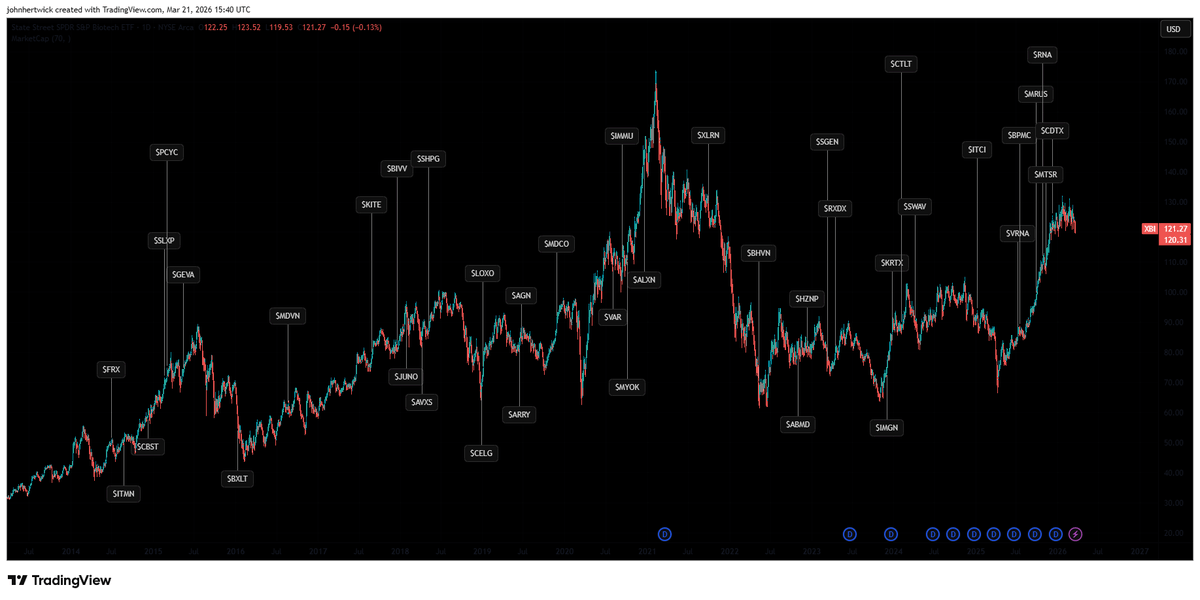
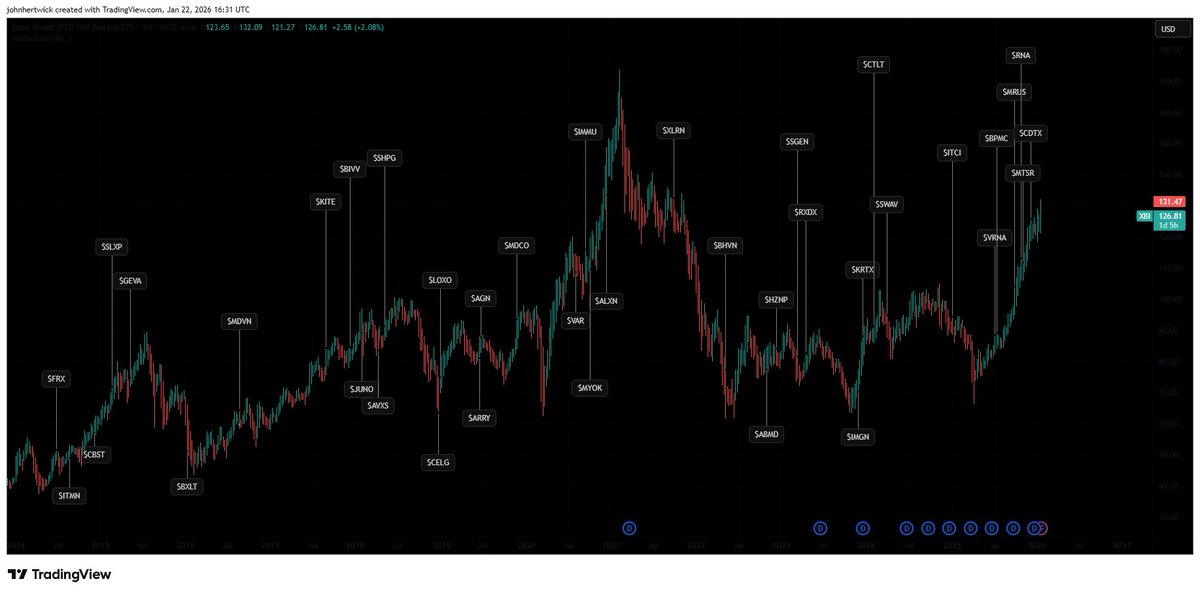
@SnupSnus My bad, I have no idea how PCYC slipped through, here is an updated chart for you. It shows announcements only.
JT3 tweet media
English
1
0
2
70
JT3
JT3@Joshthe3rd_·
$XBI $IBB $BBC 2014-2025 All 8 Billion+ public biotech M&A transactions charted (UPDATED)
JT3 tweet media
English
2
0
2
2.6K
Stardust
Stardust@Sentient_Atoms·
My NO system is genetically bottlenecked at every level, so when the veins/arteries constrict, I don't natively get the normal endothelial pushback that buffers it. Plus I have multiple 100% coronary blockages maintained by collaterals at their flow ceiling, so narrowing the pipes is not ideal. Even before I developed ASCVD, it was always genetically a bad idea (though I had no clue back then), and I was a smoker for about 10 years. I do have to keep graft durability in mind personally, but, an otherwise healthy person with impaired eNOS/BH4/cGMP genetics could supplement their way into narrowing the gap enough for limited nicotine use. I'd venture to say most people have never researched their nitric oxide related genetics to know if they are even putting themselves at risk.
English
1
0
1
21
Max Marchione
Max Marchione@maxmarchione·
Just about every >150 iq person I know uses nicotine. Nicotine is underrated and misunderstood
English
161
23
628
625.7K
Simon L
Simon L@SnupSnus·
@bingbingbom I can spoiler you for WH: He has an earing! Back in the day😱 Don't you dare spoiler me for Hoppers I actually have to see that one on Wednesday!
English
1
0
1
264
૮ ˶ᵔ ᵕ ᵔ˶ ა⋆౨ৎ˚⟡˖ ࣪
$COGT. Serious post. Read until end. Bezu for GIST only. part 1 – known material nontiming factors part 2 – known material timing factors part 3 – scenarios analysis based on known material nontiming + timing factors A brief look into unexhaustive factors I find important or interesting. Theres few typos. Part 1.0: factor of concern: brief overview of drug activity : (1) the drug caused tryptase to decline alot, consistent W/ mast cell reduction, and this physio signal is the foundation for credibility. (2) in pbo, n1 showed that tryp drop—0 hit—so the on-trt effect looks clean. (3) even if pts guessed tx arm from skin sx, you can’t fake a blood read; under worst-case imputing (wk24 missers = nonresp), the ~87 vs 0 gap still leaves ample margin over pbo -> efficay concern decreased. (4) prespec labs + tissues line up: tryp, KIT-vaf, bm mast cells all stat-sig and consistent—plausible biol, no red flgs. (5) net in a pbo-controlled frame: the drug shifts disease in blood/tissue by a big margin; surface read = credble, enuf to lean long so far. (6) earlier GIST reads lack rndmzd ctrl, so no formal comp adv yet, but the ~19.4-mo mPFS in heavily pre-tx pts is a real actv signal for the combo—true on its face. (7) post-imatinib resis is common; bezu hits KIT exons 9/11/17/18 and suni/sub hits 9/11/13/14—spectrum coverage looks logical. Ok looking good. part 1.1 factor of concern: prior efficacy signal + plausible effect size: (1) ph1 shows mPFS 10.2mo (95% ci 7.4–19.4) overall w/ orr 27.5%, and in the 1-prior-tki bin mPFS 19.4mo (95% ci 1.0–ne) w/ orr ~33.3%. (2) vs a 2l suni/sun benchmark ~8–9mo mPFS, this leans towards a feasible p3 ranomized effect, hr ~0.67–0.80 (low-teens combo medain) not some extreme ~0.50 (16–18mo), which is rare in randomized 2l settings. (3) the single-arm “floor” ~10mo despite ~⅔ being suni-expected provides basis for directional plausiblity of separation once the p3 pop is cleaned to randomized 2l suni-naive pts. (4) net: looks like a real signal, expect decent delta, not moonshot, well, anything goes. But looking fine part 1.2 factor of concern: control arm: (1) a credible prediction needs a credible control anchor; the expected second-line suni median pfs of 8- 9 months (conservative control range to bracket variability, and to avoid over attrit to any cal delay to drug effect, basically upper bound strees test, not base case, though yes 7-8 may be more reasonable; and if control goes to ~9–10 mos and the combo underdelivers (dose-intensity loss, operational drag), you can land at ~9.3 v~9.3 , hr ~ 1.0 - consistent with timing? less so, with q8–12-week scans and typical bicr/lock, a >13-month lpi to topline gap is directionally inconsistent with hr ~1.0 unless operations are unusually slow + a true null usually hits the event trigger roughly on schedule) serves that anchor. (2) if ph3 reproduces a ctrl mPFS in that ~8–9mo band, an hr ~0.70–0.80 implies a low-teens combo median—quant-consistent w/ part1 actvty and the evt-math. (3) conversely, a ctrl inflatn toward ~12mo compresses eff sz and raises non-sig risk; this is watched by checking stratif vars (lot, mut mix) and keeping censorng/exponsure symmtry across arms. (4) net: credible anchor = feasible effect. Looking good. part 1.3 factor of concern: crossover + os interpretability: (1) prespec crossover implies the first intention-to-treat os analysis is expected to be neutral even when pfs is positive. (2) W/ x-over baked in, the 1st itt os readout likely nets ~null despite a +pfs; model-based adjstmts (eg rpsft/ipcw) can be directionally supportive but not decisve for a near-term “success” call. (3) so, a neutral itt os at the initial cut remains compatble w/ a real pfs benefit under allowed xover, esp if censorng/expousre stay symmetric. (4) net: no need to focus too much on early os; pfs wins stand on their own in this crossover design. Neutral. part 1.4 factor of concern: safety, dosing, and exposure: (1) dose reductions and interruptions in the mid-20% range (approx 24 to 29%) represent a realistic pathway to exposure loss. (2) if these cluster in the combo arm, 2 things follow: 1 lower bio efficacy and 2 more missed scans/censorng, which can artifactually tug the KM shape; net effect = damped signal + funky km steps. (3) a credible prog-free-surv read needs broadly similar dose intensity across arms (approx W/in ~10%) and tiny early-window censor deltas (approx <=2–3% over initial assess windows), ie keep dosintensiy and early censr stable arm-to-arm. (4) these quant thresholds address whether observed sep’n is real biology vs ops-driven censoring; if di/censor gaps stay tight, the speration looks bio not operational. part 1.5 factor of concern: case mix + biology: (1) diffs p1 p3 in molecular subsets (for ex, the distribution of resistant biology such as KIT exon 9), prior therapy exposure, and suni-naive purity materially influence effect size. (2) in p1 vs p3, shifts in mut-mix (eg kit ex9 load), prior tx exp, and suni-naiv % all move eff sz; p3’s rndmzd 2l suni-naive design strips a confound that p1 had (approx⅔ suni-exp), so expct clr’r sep if ctrl sits ~8–9mo. (3) all-else-equal, the p3 purif’d pop should bias the hr down (better sep), whereas p1’s 2/3 suni-exp made the bar higher—ie more resis bio, less headroom; hence the delta vs ctrl was probly damped there. (4) net: cleaner randmzd 2l, suni-naive frame -> clearer seperation; any miss vs ~8–9mo ctrl would more likely be ops/assay noise than true lack of actvty. part 1.6 factor of concern: endpoint coherence: (1) W/ 6 -12–wk imaging, the segmentation of hazard produces stepwise km patterns. (2) under q6–12wk scans the haz gets “chunked,” so km curves step; robustness is better when pfs dirctnality is mirrored by actvty readouts like orr and, if avail, dor/ttr. (3) part1’s orr 27.5% overall and 33.3% in the 1-prior-tki bin sets a quant prior; in ph3, any orr uplift vs suni—even nominal if alpha is spent—so long as it’s consistent w/ pfs, strenghtns the bio infernce. (4) net: stepwise km is expected from assess windows; the key is pfs + orr/dor/ttr lining up, if so then signal looks biologic, not just schedulng artifacts. It’s fine. part 1.8 factor of concern: ddi risk: (1) a mech concern is cytochrome p450 3a4 induction that lowers suni exposure, W/ reported steady-state area under the curve reductions on the order of -26 to -35 % in relevant combos. (2) if present at scale, such a ddi would accel progress (earlier evnts) and blunt efficay; net = attenuated signal. (3) in the current framwrk, a protracted path to maturty is directionally inconsstent w/ a dominnt negative ddi, and there’ve been no protocol level ddi amendmnts disclosed—ie no smoking-gun ops change. (4) absent cntrevdnce, ddi is unlikely the prim drv of any aparent effcacy delta. So pretty good. part 1.9 factor of concern: external comparators + floor/ceiling effects: (1) in later treatment lines, regorafenib’s approx 4-month median pfs frames a lower-bound reference; in second line, suni’s approx 8 to 9 months frames the control expectation, while part 1’s roughly 10 month overall median (W/ a suni experienced majority ) and roughly 19.4 month 1-prior-tki subset signal set a realistic ceiling and indicate that a hazard ratio in the ~0.67–0.80 range is consistent W/ historical patterns for targeted add-ons in second line; a hazard ratio near ~0.50 would exceed typical randomized experience. (2) in later lines, rego’s ~4mo mPFS = low-bd ref; in 2l, suni’s ~8–9mo is the ctrl bar; p1’s ~10mo overall (w/ suni-exp maj) + ~19.4mo 1-prior-TKI bin give a real “ceiling” (3) so an hr ~0.67–0.80 tracks hist pattns for tgt add-ons in 2l—ie expect low-teens combo med—whereas an ~0.50 hr (16–18mo vibe) would be outlier vs rndmzd exp; not the base-case, more like unicorn. (4) net: floor = rego ~4mo, ctrl = suni ~8–9mo, ceil = p1 ~10/19.4; the plausible band is hr ~0.7–0.8, not ~0.5. Very good. part 1.1a factor of concern: sample size, maturity, power: (1) an 412 pt design targeting roughly 290 evts at approx 75% maturity concentrates power at this boundary. (2) in numbers: n=412 w/ ~290 evts (~75% maturty) stacks powr right at the info edge, so the test bites when the curve seperation actually shows. (3) power sensitivty to hazard ratio mags in the 0.67–0.80 matches p1 priors + the ctrl anchor; ie the band we care about is prespec’d by p1 and the suni ctrl, not some fantasy. (4) net: samp-sz + maturty + prior sigs -> pfs-pos expec w/out needing an extreme eff sz; hr ~0.7–0.8 is enough, no need for ~0.5 moonshots. It’s fine. Part 1 summary: nontiming factors for efficacy leaning bullish: (1) taken together—part 1 efficacy (median pfs 10 .2 months overall; 19.4 months in the 1 prior tki subset; orr 27.5 and 33.3%), a credible second-line suni control anchor of approx 8 to 8 months, crossover dampening of early os, acceptable safety + exposure symmetry thresholds (dose intensity W/in approx 10%; early censoring W/in approx 2 to 3%), and the low likelihood that a strong negative ddi dominates—the non-timing evidence points toward a stat sig pfs in p3 W/ a hazard ratio around 0.67 to 0.80 and a low-teens combo media (2) in p3 terms: expect pfs+, hr ~0.67–0.80, low-teens combo mPFS; 1 key 2% could hit if alpha was preserved, otherwise 2%s land as descrptive but dir-aligned w/ pfs (3) os at the first itt cut is ~neutral under x-over; don’t over-read early os—this is baked into the design, not a red flag (4) net: these conclsuons rest on NON-timing evidence (exp symmetry, early-censr bal, ept cohernce) and allign W/—rather than depend on—the separate timing-based inference (maturty/evt accrual) part 2.0 timing: brief overview of timing on efficacy: we want to gauge, before topline, what p3 results are most likely; the trial is evt-driven on pfs, W/ a primary analysis once a prespec no. of “progression” evts are confirmed by a blinded indep central review, and bc imaging happens on a schedule (not continuously) the cal time from last-pt-in to topline carries info about how quickly evts accrue—longer intervals are directionally consistent W/ slower evt accrual (supportive of efficacy on the experimental arm), shorter intervals fit faster accrual (weaker efficacy); this timing signal is directional, not evidentiary (3) safety + data modulate meaning: dose reducs/interrupts/discons -> exposure loss; missed/delayed scans increase early censr; if 1 arm misses more early scans (eg AEs), the KM can look better w/out true biol—ie artfctl steps; so any timing hint must be read alongside exp symmtry and early-window censr balance. (4) rule-of-thumb: if dose-intensity W/in ~10% and early-interval censor deltas <=2–3% and epts cohere (pfs <-> orr/dor/ttr), the dirctnl timing read is credbl; if not—eg higher AE-driven early censors on combo—apparent sep may be ops-artifact even if nominally sig; net: interpret timing w/ exp+censr context or risk a mis-call. something to follow. part 2.1 timing: evt driving pfs trial mechanics: (1) how an evt-driven pfs trial behaves in mechanics is straightforward: progressions are only observed at scheduled imaging visits, many true progressions occur between visits and are recorded at the next scan, early after randomization few participants have reached their 1st assessments so evt accrual begins slowly and then ramps, and central review plus database lock add calendar lag W/out changing the underlying biology; the primary trigger is an evt count at a target maturity, and bc accrual is staggered the early months after last-pt-in are enriched for participants too early in follow-up to contribute many evts, so stepwise KM drops accumulate later as more participants reach the at-risk windows (2) in short: evts are “seen” only at scans; w/ q6–12wk imaging, true prog’s land btwn visits and get stamped at nxt scan, so early post-rndmz accrul is slow then ramps as more pts hit assess windows; bicr + db-lock add ops lag (uploads, dates, queries, lock) = time stretch, not biol change (3) the triggr is an evt cnt at target maturty (eg ~75%: 290/412); if late, either evts slower (tx eff and/or scan cadence) or ops slower—or both; under an ~expo-like proc the instnt haz can be ~const, yet observed evt cnt over calendar time is discretized by the visit grid, so equal biol effs can yield diff cal lags under q6 vs q12 imaging (4) net takeaway: the LPI->topline gap blends biology (slower prog on exp arm) and ops (bicr + db-lock); while not dispositve, a longer gap lines up more w/ slower prog on exp vs null/neg, provided ops tempo is “typical”—ie no odd site slowness or censor blips skewing the clock part 2.2 timing: expontial approx: (1) a standard approx for time‑to‑evt under roughly exp1ntial hazards is: mPFS_combo approx mPFS_control / hr. if control mPFS approx 8–9 months and hr approx 0.80, combo mPFS approx 10–11.25 months. if hr approx 0.70, combo mPFS approx 11.4–12.9 months. If hr approx 0.50, combo mPFS approx 16–18 months (uncommon for randomized 2L designs (2) : If LPI occurred ~09/03/2024 and >13 months have elapsed W/out reaching ~75% evts, simulations W/ control approx 8 months indicate combo mPFS must be ≳11 months; otherwise, the 75% trigger would likely have been reached by ~September - you do not need hr to be approx 0.50 (approx 18‑month median) to explain several extra months of cal delay; hr approx 0.67–0.80 (low‑teens combo mPFS) can do so once scan timing and bicr/lock lag are included. the longer this interval extends (W/in customary central‑review timelines), the more it tilts toward hr approx 0.7–0.8 rather than a null; conversely, inferring hr approx 0.5 would require an extreme delay well beyond typical operational lag and is historically unlikely in this line (3) evts do not accrue linearly bc assessment windows separate the hazard. under q8–12‑wk imaging W/ bicr, a ~4‑month extension from LPI to topline can be fully explained by hr in the 0.7–0.8 range W/out invoking outsized efficacy. do, a low‑teens combo mPFS is consistent W/ the observed calndar signal, while ~18‑month median would over‑explain the delay part 2.3 timing: ddi and why it matters for efficacy and timing: if the investigational drug induces cytochrome p450 3a4 and lowers suni exposure (for ex decreases area under the curve), combo efficacy could be attenuated and adverse evts could increase from the added agent; in short, if cyp3a4 increase and suni AUC decreas, combo effcy dips and AEs tick up, and a neg ddi that cuts suni exposre should accel evnt accrual (earlier progs), shortening—not lengthening—the lpi->topline gap, so a longer calendar gap is directionally inconsstent w/ a strong neg ddi (2) operational things: a pharmk or ddi substudy W/ pk objectives typically does not gate the primary pfs topline unless it forces a protocol changes such as a dose adjment for exposure; in short, pk/ddi substudy =/= gate unless there’s a prot changes—std designs tie topline to evt maturty + bicr proc, not pk paperwork; tl;dr: timing follows evts + bicr/lock, not pk (3) safety linkage: exposure is the bridge between safety and efficacy, so if the combo arm sees more dose reductions or interruptions, exposure falls and missed scans can rise, which both lowers true efficacy and inflates censoring that can artifactually flatten or separate KM curves; in short: lower DI on combo -> less biol punch + more early censr, so km can look “prettier” w/out real bio; thus, if calndr delay coexists w/ balanced dose-intensity (approx W/in ~10%) and similar early-window censor deltas (approx <=2–3%), the delay aligns w/ true effcy, but if delay pairs w/ asym dose mods + higher early censr on combo, the lag may be ops not biol (4) additional material nuances: prior observations in similar settings that co-administered can reduce suni steady state areaunder curve by roughly 25 35 %, if present here at scale, to bring evts so1r; put simply, ~25–35% suni AUC hit should pull evts forward, so today’s later-than-linear lpi->topline pattern leans away from a dominant ddi-attenuation story; net: longer gap + exp symmetry + tidy early-censr = bio wins, not pk drag. Part 2 summary: final thoughts on material timing factors leaning bullish: structure of evt-driven pfs, the segmentation imposed by 6-to-12–wk imaging, and the greater-than-13-month last-pt-in to topline interval together support a forward expectation of a pfs–positive outcome W/ a hazard ratio in the roughly 0.67-0.80 range and a combo median in the low teens; in abbrev: evt-drvn pfs + q6–12wk grid + >13mo LPI->TL => expect pfs+ w/ hr ~0.67–0.80 and combo mPFS low-teens—no need for ~0.50; the calndr delay is explained by modest–mod hazard cut once bicr/lock lags are in (2) os framing: under typ x-over, first intention-to-treat os likely reads ~neutral regardless of pfs; i.e., xover dampens early os even when pfs is pos—don’t over-worry the 1st os pass (3) safety gate: the calendar-based inf’rnce stays credbl if dose intensity btwn arms is broadly similar (approx W/in ~10%) and early-interval censor deltas are small (approx <=2–3% across the first 2 windows); big early d/cs, materially lower exposre, or asym early censr on combo would weaken the biol read of any pfs edge. (4) net: absent those safety/exposure asym’s, the dirctnl timing signal aligns w/ a biol-grounded pfs improvmt and a neutral os at the initial readout; if DI/censr symmetry holds, call leans true effcay, not ops artifact. Part 3.0 scenario A 50% - PFS win; OS nonsig (crossover allowed); at least 1 hard secondary endpoint (orr or dor/ttr): interval exceeding 13 months from last‑pt‑in (approx 09/03/2024) to the present, W/ a planned primary analysis at ~75% maturity (illustratively 290 evts among 412 randomized pfs), is directionally consistent W/ slower‑than‑expected accumulation of centrally confirmed evts. Under the expintial approx mPFS_combo approx mPFS_control / hr, if control mPFS is approx 8–9 months and the true hr lies around 0.70–0.75, the projected combo mPFS sits in the low‑teens (approx 11–13 months). That hr range accounts for several months of cal delay W/out requiring an extreme hr approx 0.5 (approx 16–18 months). non‑timing anchors increase confidence: Part 1 reported mPFS 10.2 months (95% CI 7.4–19.4) overall W/ orr 27.5%, and in the 1‑prior‑TKI subgroup mPFS 19.4 months (95% CI 1.0–NE) W/ orr 33.3%. this signals define a feasible direction of effect that, if reproduced in a randomized 2L suni‑naive pop, supports a stat sig PFS (95% CI for hr entirely <1). if the multiplicity strat preserves alpha beyond the primary, 1 of orr, dor, or ttr can also reach sig; an orr uplift would be consistent W/ the Part 1 orr (27.5% overall; 33.3% in 1‑prior‑TKI). re safety and exposure, this scenario presumes dose intensity diffs bt arms remain W/in ~10% and early interval censoring diffs W/in ~2–3% across the first 2 KM intervals; larger early AE‑driven discont on the combo would incrs risk that censoring rather than biology contributes to KM separation. W/ prespec crossover, itt os is expected to be non‑sig at the initial cut bc post‑progression targeted therapy compresses survival diffs; adjment methods (e.g rpsft ipcw) may show directionally favorable effects but are typically not evidentiary. The non‑timing evidence strengthens Scenario A beyond timing... Part 1’s 10.2‑month overall mPFS despite a ⅔ suni‑experrienced mix, the 19.4‑month mPFS signal in 1‑prior‑TKI, and orr 27.5%/33.3% increase the plausibility that, in a purely 2L suni‑naive randomized setting, a low‑teens mPFS W/ hr ~0.7–0.75 is reproducible and at least 1 alpha‑protected secondary can clear sig if alpha was reserved Part 3.1 scenario B 25% - PFS win; OS nonsig: same >13‑month LPI ->topline timing aligns W/ a real PFS effect even if all alpha is allocated to the primary endpoint. W/ control mPFS approx 8–9 months and hr around 0.70–0.80, combo mPFS lies in the low‑teens W/out invoking extreme effect sizes. 2ndary endpts (orr/dor/ttr) may show only nominal improvements aligned W/ prior activity (orr 27.5% overall; 33.3% in 1‑prior‑TKI) but lack evidential weight. safety is the gatekeeper: confidence that PFS reflects biology rises if dose‑intensity is balanced (W/in ~10%), early discont is not concentrated in 1 arm, and early censoring imbalances are modest (more than ~2–3% across initial intervals). given prespec crossover and limited death evts at the PFS analysis, OS is again expected to be non‑sig on iittt at the first look. Part 3.2 scenario C – 15% PFS trend only (CL crosses 1) or fail: short LPI->topline interval would fit faster evt accrual and weaker effect, though operations can confound. if hr >= ~0.85 or the 95% CI includes 1.0, the dataset is non‑confirmatory. contributors include early‑interval censoring imbalance (e.g missed scans or ae‑related drop‑outs concentrated in the combo arm). prior ddi observations in analogous settings describe suni AUCss reductions on the order of −26% to −35%; such attenuation would be expected to accelerate evts (shorten time to maturity), not delay them, and therefore cannot explain a protracted LPI->topline interval. safety wise, higher early discont or larger dose‑intensity gaps in the combo arm both diminish true efficacy and inflate censoring, weakens KM read even if nominal separation appears. Part 3.3 scenario D – 10% PFS win but operational artifacts fuck up credibility: nominal PFS positivity could be driven by nonbi o artifacts: early censoring deltas favoring the combo by several % points in first assessment windows; stepwise KM drops aligned W/ batched visits (q6–12‑wk imaging) rather than continuous hazard; or internal inconsistency where PFS improves but orr/dor/ttr do not move consistently despite adequate exposure. this scenario is less consistent W/ a >13‑month LPI->topline unless the delay is dominated by operations (eg., prolonged bicr queue aetc etc leaning bullish given the rationales mentined above. check references. too lazy to attach. this is a brief look and not exhaustive, so do your own diligence. btw, I took a jerk break after part 1.6. swear on grandma’s life. Thought you should know...
English
11
4
69
16.7K