Michael Heraghty

2.3K posts

Michael Heraghty banner
Michael Heraghty

Michael Heraghty

@UserJourneys

🤓 UXer | ✍️ Lazy blogger @ https://t.co/7Qdg8jAHO4 | 🐒 Status-seeking monkey | 🌟 Thoughts on UX, AI, and random

Dublin 가입일 Temmuz 2009
253 팔로잉1.3K 팔로워
고정된 트윗
Michael Heraghty
Michael Heraghty@UserJourneys·
Nice - I just discovered that I can ask Codex to make quick wireframe mockups (separate to the product) to help me evaluate different design directions. This is really useful when you're trying to make a design decision but don't want to have to do serial trial-and-error evaluation directly in the coded prototype or product.
Michael Heraghty tweet media
English
0
0
0
49
Michael Heraghty
Michael Heraghty@UserJourneys·
I asked Gemini to create a transparent background for the logo it made for me. It faked a "transparent" background grid.
Michael Heraghty tweet mediaMichael Heraghty tweet media
English
0
0
0
37
Pedro Domingos
Pedro Domingos@pmddomingos·
Mythos wipes the floor with GPT-5.5.
Pedro Domingos tweet media
English
346
37
713
329.5K
Michael Heraghty
Michael Heraghty@UserJourneys·
@chamath "Phone" has long stopped being a meaningful description of the computer you carry in your pocket. Phoning other people is just one small thing that some people sometimes do with this computer. So it's a phoney name!
English
0
0
3
376
Chamath Palihapitiya
This is the way. The past 50 years of computing was about inventing form factors to interact with information. Retrieve information. Search for information. Edit information. Save information. AI is about interacting with knowledge. It's completely different. Agents and models are there to do the dirty work aka interact with information). We need a new layer - more executive function, less tactical tools. So instead of trying to jam AI into old form factors, its time to imagine a new form factor. From scratch. From first principles. It's probably not a phone tbh, but what it is, I have not a clue. That said, like most breakthroughs we'll know it when we see it though. Good luck to the teams building this.
NoLimit@NoLimitGains

🚨 OpenAI is reportedly building a phone designed to replace the iPhone. And it’s further along than anyone realized. Analyst Ming-Chi Kuo, the same man who predicted every major Apple product cycle for 20 years, just dropped this. Important details: 1: OpenAI is partnering with Qualcomm AND MediaTek to develop custom smartphone processors, not one chip partner, but two competing giants simultaneously 2: Luxshare has been named the exclusive system co-design and manufacturing partner, the same company that assembles Apple products 3: Mass production is targeted for 2028, the hardware roadmap is already in motion 4: The phone will run OpenAI’s own OS, replacing traditional apps entirely with AI agents that complete tasks autonomously, without you ever opening a single app 5: The processor is being designed around on-device AI performance, with complex tasks offloaded to OpenAI’s cloud infrastructure for seamless integration 6: OpenAI’s core thesis: users don’t want apps, they want results. The phone will continuously understand context, habits, and preferences in real time This isn’t a gadget. It’s a direct attempt to replace the operating system layer that Apple and Google have owned for 20 years. I’m doing more research, and what I’m about to post will blow your mind. You’ll wish you followed me sooner, trust me.

English
202
101
1.4K
580.4K
Michael Heraghty
Michael Heraghty@UserJourneys·
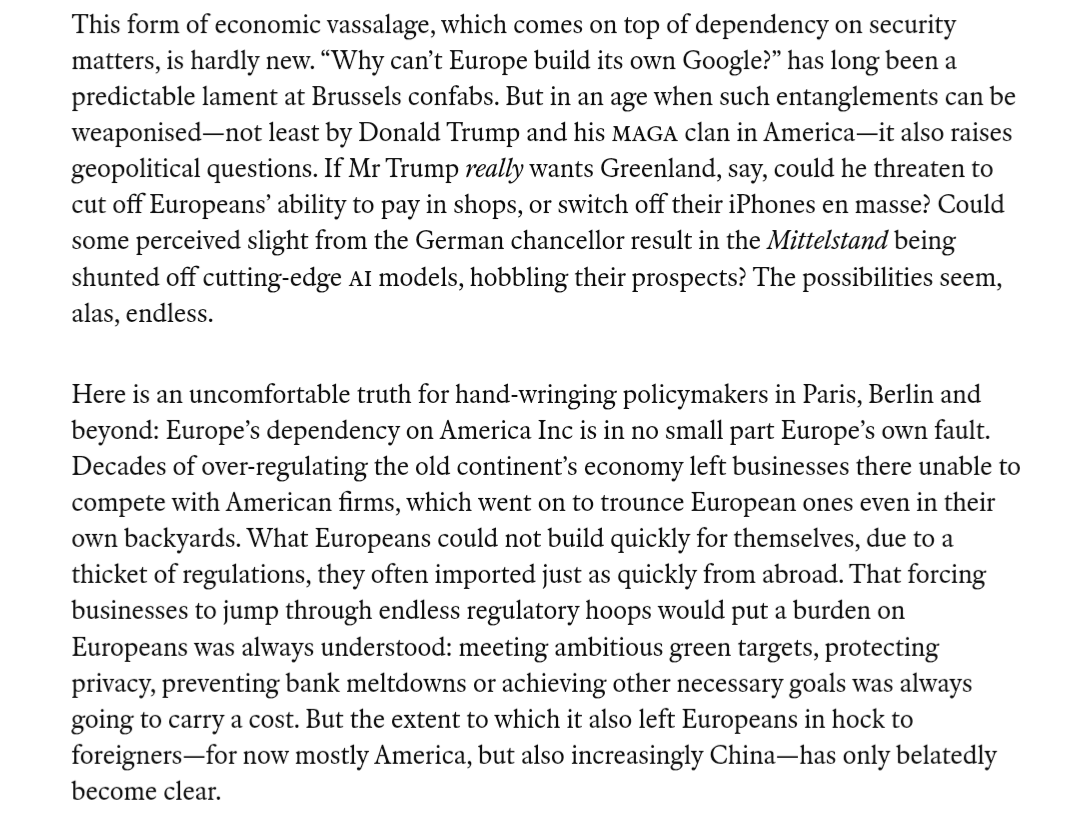
"How Europe regulated itself into American vassalage" - article in The Economist. I hear Irish politicians talk about "weaning" ourselves off US dependency, with little understanding of what that would actually entail, or how that dependency is, in fact, rapidly deepening.
Michael Heraghty tweet media
English
1
0
0
41
Michael Heraghty
Michael Heraghty@UserJourneys·
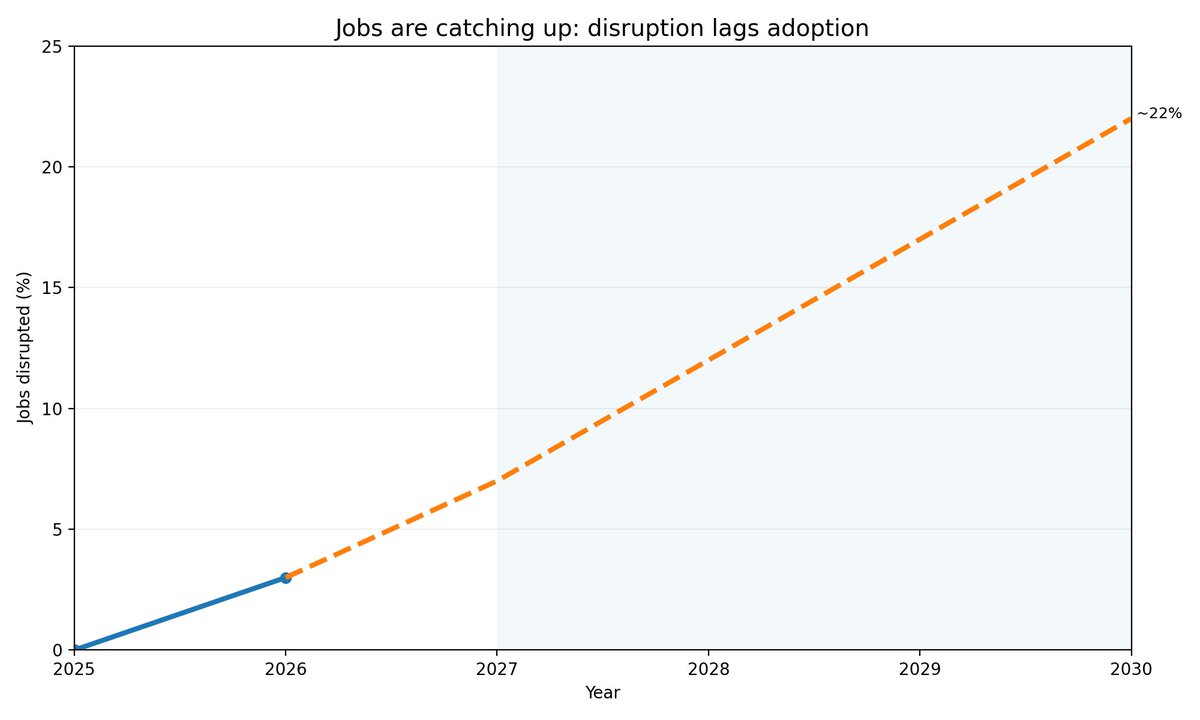
The interesting part of AI in the workplace right now is ... what happens next? Companies moved quickly. You can see it in the data. Hiring has been impacted. But jobs haven’t changed at the same speed. People are experimenting. But the structure of work is mostly still intact. The next phase is when that gap closes. Not suddenly, perhaps, but gradually. Roles will get reshaped. New ones will appear. I asked ChatGPT to pull the data together using: - adoption data (McKinsey / Stanford) - hiring signals (Indeed) - job projections (World Economic Forum) Then split it into two charts: what’s already happened, and what looks likely to happen next.
Michael Heraghty tweet mediaMichael Heraghty tweet media
English
0
0
0
14
Stefan Schubert
Stefan Schubert@StefanFSchubert·
People love sharing the OkCupid chart where women find most men unattractive, and the rumour that one in ten children has a different father than they think. But some stories are too juicy to be true. update.news/p/women-dont-t…
English
14
31
239
173.5K
Joscha Bach
Joscha Bach@Plinz·
our timeline has only llms because the resistance sent someone back in time to prevent the birth of everyone who was going to build actual ai
English
44
14
321
17.8K
Michael Heraghty
Michael Heraghty@UserJourneys·
“Vibe coding” sounds like a gimmick, right? But it actually is the new designing. And it feels magical. You can wake up with a feature idea, open your laptop, and by lunchtime you’ve got something real. Screens, components, flows, the whole thing hanging together. Just a few years ago that would have been: - spec - backlog - sprint - maybe a demo in a couple of weeks, at best Now one person can get to something solid, demoable, in hours, if not minutes. Where many go wrong is treating the first, second, or third output as something to ship. It works much better if you treat vibe coding like sketching and iterating. Try something. Throw it away. Try again. Keep the parts that feel right. Try again. Etc. Like I said, just designing.
English
0
0
0
32
Michael Heraghty
Michael Heraghty@UserJourneys·
It's the denial stage of a technology revolution. Example: When photography emerged (Daguerreotype in the 1830s/40s), many established artists and critics dismissed it as "not real art." They called it mechanical, soulless replication, that lacked the skill, imagination, feeling, and hand-crafted genius of painting. Of course, we still have painting, but its role has changed. We'll see similar shifts with AI.
English
1
0
1
12
Michael Heraghty 리트윗함
Layton Gott
Layton Gott@Layton_Gott·
I don’t care if using AI to code is not “real coding” I care if the product works. Nobody opens your app and asks how many lines you wrote manually. They click around for 10 seconds and decide if it sucks or not.
English
170
28
485
14.9K
Michael Heraghty
Michael Heraghty@UserJourneys·
@MohapatraHemant Genuine question, what will we do with all this intelligence? Already, there are only so many questions that I feel I need to ask the "oracle", and I consider myself a heavy user vs. my peers
English
0
1
6
1.3K
Hemant Mohapatra
Hemant Mohapatra@MohapatraHemant·
99.9% of the world is completely unaware what is going to hit them in <5yrs: incredibly powerful, cheap intelligence. The way we are all addicted to information, glued to our screen 24x7, we are about to get addicted to hyper-intelligence. Work is growing 10x from here, unf, not reduce.
English
139
173
2K
406.5K
Michael Heraghty
Michael Heraghty@UserJourneys·
China's NEO brain implant was recently approved for commercial sale, making it the world's first invasive brain implant device available outside clinical trials. (Elon Musk's Neuralink is still in trials.) Developed by Neuracle Medical Technology, working with Huashan Hospital, the coin-sized chip reads motor signals to control a pneumatic glove for grasping in patients with spinal cord injuries. Clinical results from 32 patients showed all regained the ability to perform hand grasps with the glove after implantation and training. Described as "minimally invasive" the surgery (about 1 hour 40 minutes) places electrodes on the brain's surface without deep penetration, with patients typically discharged within a week. China has a national BCI strategy, that aims for industry dominance by 2030. It targets breakthroughs in a range of applications, including consumer non-invasive devices like headbands.
Ole Lehmann@itsolelehmann

i don't think people realize what just happened with brain implants in china for the first time in history, a brain implant has been approved for commercial sale. you can actually buy one. it's called neo. costs around $15,000. the question everyone asks first: does it actually work? here's what the implant does. a coin-sized chip gets placed on the surface of the brain, right over the area that controls movement. when a paralyzed patient imagines moving their hand, the chip reads that signal, sends it to a computer, and the computer drives a mechanical glove that moves for them picking up objects, gripping utensils, handling daily tasks. all from thought alone. the whole surgery takes an hour and 40 minutes. surgeons thin the skull, open a small window, and place two electrodes directly on the surface of the brain. then they close it up, patients go home within a week. 32 patients with spinal cord injuries were implanted in a clinical trial led by huashan hospital > ALL 32 regained the ability to grab objects through the glove. > 100% improvement rate. > zero adverse side effects. no other brain implant company on earth has received approval to sell their device commercially. elon's neuralink is still in clinical trials. side effects from their more invasive approach have stalled any path to regulatory clearance. china is the only country where you can buy a brain implant right now. this is by design. months before the approval, china published a national policy document with 17 steps to dominate the brain implant industry within 5 years. they want brain-reading devices to be as common as hearing aids. headbands, visors, earpieces that pick up brain signals... all mass-produced for consumers. and the government is coordinating the whole thing. funding the research, building the manufacturing, clearing the regulatory path, all at once. the West is moving painfully slow in comparison...still running controlled trials one patient group at a time. china already has a commercial product, a 72-year-old moving his leg on state television, and a national playbook to own the entire category.


English
0
0
0
49