
Abdullahi Khalif

4.7K posts

Abdullahi Khalif banner
Abdullahi Khalif

Abdullahi Khalif

@_Khalif01

Lawyer & Economist | Managing Partner at A.A.Khalif Advocates LLP

Nairobi, Kenya 가입일 Ağustos 2011
1.8K 팔로잉4.5K 팔로워
고정된 트윗
Abdullahi Khalif
Abdullahi Khalif@_Khalif01·
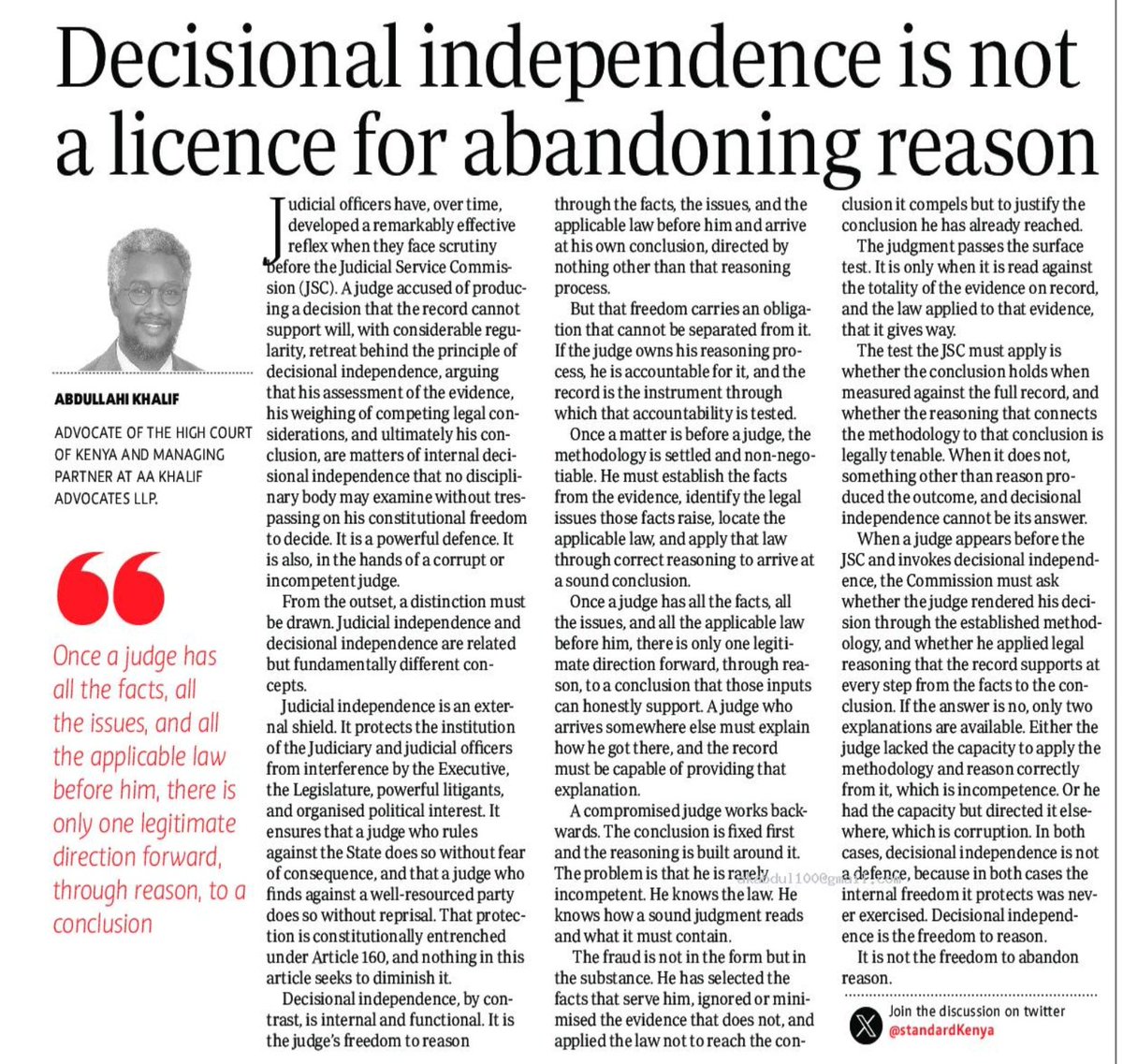
In today's Standard newspaper, I argue that; 1. Once a judge has all the facts, all the issues, and the applicable law, there is only one legitimate direction; forward, through reason, to a conclusion that those inputs can honestly support. A judge who arrives somewhere else must explain how he got there, and the record must be capable of providing that explanation. 2. Decisional independence doesn't mean applying the law mechanically. It means applying the correct legal reasoning for the correct output. 3. Decisional independence is the freedom to reason. It is not the freedom to abandon reason. 4. Appeal corrects the error for the litigant but does nothing to hold the judge accountable for producing the wrong decision in the first place. @NelsonHavi @ehdande @ahmednasirlaw @joshuamalidzo @Ndonglaw043 @StandardKenya
Abdullahi Khalif tweet media
English
25
232
1.2K
302.7K
Abdullahi Khalif 리트윗함
Raj_Lachhi IRS
Raj_Lachhi IRS@raj_irs·
Major problem is the varying schools of interpretation- one strong school is “strict literal n textual” interpretation which goes strictly by the letters of law; other school is “ purposive interpretation” - this is where there is no limit to the imagination of the judge n finally “ in letter n in spirit” or contextual interpretation, which is somewhat in between.. any judge of today is not a purist or a legal luminary following a particular school of interpretation- it changes with the case, with the constitution of bench n also with the face who is arguing the case .. so we are in a mess..
Abdullahi Khalif@_Khalif01

In today's standard paper, I ask; 1. Given that a judge holds office by reason of his capacity to reason, can a judge then err in reasoning? 2. I ask whether a judge is permitted to use a particular school of jurisprudence as a fixed and determinative position 3. Does the constitution combine the various schools of legal reasoning (jurisprudence)? 4. Does the constitution have a framework for legal reasoning (a basic structure for reasoning)? Enjoy reading, and let me know your feedback.

English
0
1
1
89
Abdullahi Khalif 리트윗함
Legal Syndicate Advisory
Legal Syndicate Advisory@advisory_legal·
@_Khalif01 Thought-provoking questions—really highlights how judicial reasoning is both an art and a discipline, shaped by principles yet open to interpretation.
English
0
1
1
28
Abdullahi Khalif 리트윗함
Hoeys
Hoeys@Hoeys_Consult·
@_Khalif01 The baseline is clear that a Judge can err in reasoning and yes many do that when they stick to precedence and refuse to examine the uniqueness of a case. Each case must be informed by circumstances and only guided by jurisprudence. Many fear backlash if they challenge it. 🤠
English
0
1
3
127
Lucas Gikungu
Lucas Gikungu@Luki_Des·
@_Khalif01 Like I have said before, you write very well. This is a thought provoking article. And judicial incompetence cannot also be called judicial independence.
English
1
0
0
361
Abdullahi Khalif
Abdullahi Khalif@_Khalif01·
In today's standard paper, I ask; 1. Given that a judge holds office by reason of his capacity to reason, can a judge then err in reasoning? 2. I ask whether a judge is permitted to use a particular school of jurisprudence as a fixed and determinative position 3. Does the constitution combine the various schools of legal reasoning (jurisprudence)? 4. Does the constitution have a framework for legal reasoning (a basic structure for reasoning)? Enjoy reading, and let me know your feedback.
Abdullahi Khalif tweet media
English
16
120
549
127.7K
Abdullahi Khalif 리트윗함
The Standard Digital
The Standard Digital@StandardKenya·
OPINION: Legal reasoning can be described as the bridge between the material before the court and the conclusion reached. It is the process by which the court moves from the facts and the issues through the applicable law to reach a sound decision; it is the thread that stitches the facts, the issues, and the law into a coherent whole. ow.ly/QnLL50YTShg
English
0
2
3
1.1K
Abdullahi Khalif
Abdullahi Khalif@_Khalif01·
@InaSaney Counsel, the battle has many fronts. Seniors like @NelsonHavi are leading on the JurisPesa front. Mine is reconnaissance. The surest way to detect JurisPesa is to trace the judge’s reasoning.
English
1
1
6
360
Abdullahi Khalif 리트윗함
Mahmud
Mahmud@InaSaney·
@_Khalif01 Great article wakili. I thought you will address the human fallibilities of a judge and issues of JurisPESA 🙈🤣. Again the argument is succinctly presented on the biases in legal philosophy of a judge.👌👌👍👍
English
1
1
5
503
Abdullahi Khalif 리트윗함
Abdullahi Khalif
Abdullahi Khalif@_Khalif01·
The title is: Can a judge err in reasoning? (Standard edited it)
English
0
0
7
696
Citizen TV Kenya
Citizen TV Kenya@citizentvkenya·
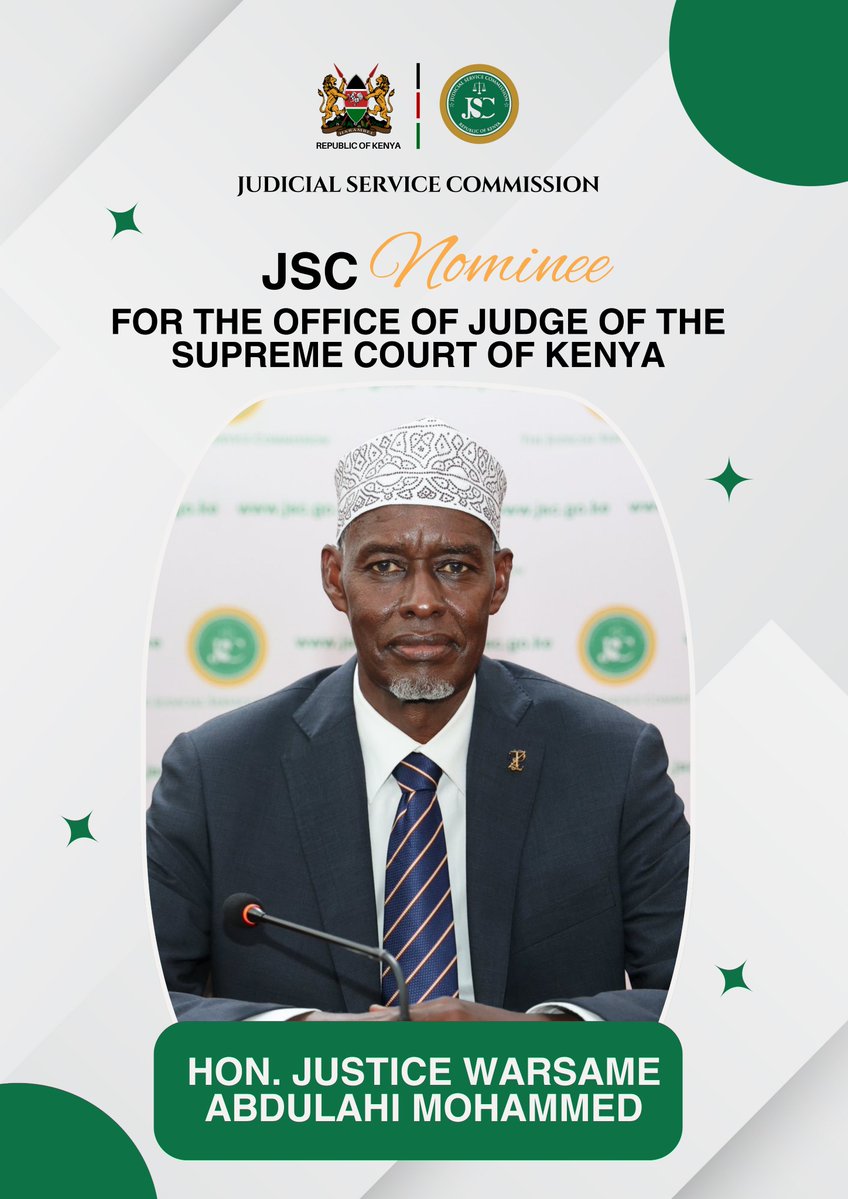
Justice Warsame Abdulahi on his gubernatorial aspiration: I said I’d run for Mandera Governor seat when I retire from the Judiciary. I don’t see a problem because maybe I’ll want to be governor of Mandera one day if my people call me but that has not and will not affect my responsibilities as a judge. I am the most impartial judge with an impeccable character
English
22
58
626
108.3K
Abdullahi Khalif 리트윗함
Abdullahi Khalif
Abdullahi Khalif@_Khalif01·
The key legal questions surrounding the impeachment of the Deputy President (DP) are summarized as follows: 1. Whether holding the DP’s office is a right or a privilege: Holding political office, including that of the DP, is a privilege that arises from election. However, this privilege does not negate the inherent constitutional rights of the individual occupying the office. The DP enjoys both the privileges of the office and the protection of personal constitutional rights. 2. Whether impeachment is exclusively political or both  political and legal process: Impeachment is a hybrid process, blending political and legal elements. While initiated by Parliament (a political body), the process must strictly adhere to the Constitution. Charges for impeachment must be specific and supported by substantial evidence. Issues of public participation, fair hearing, etc, are critical constitutional safeguards that must be complied with. 3. Whether courts can intervene in the impeachment of the DP: Courts can intervene in the impeachment process if there is a violation of constitutional rights or procedural unfairness. The courts have jurisdiction to review whether the impeachment followed due process, adhered to constitutional standards, and respected the DP's rights. However, while courts can declare infringement/violation of certain constitutional rights, they are unlikely to reinstate an impeached DP, as doing so would interfere with the separation of powers. 4. The legal or evidential threshold for impeachment: The evidentiary threshold for impeachment lies between the civil standard (balance of probabilities) and the criminal standard (beyond a reasonable doubt). This means that while the evidence must be stronger than in civil cases, it does not need to meet the stringent requirements of criminal cases. A standard of proof above 50% but below 100% is required. 7. Whether IEBC has a role in the nomination of a new DP: If the office of the Deputy President becomes vacant due to impeachment, the President nominates a replacement, who must be approved by a majority of the National Assembly. The (IEBC) does not have a direct role in this process, as it is an executive and legislative function. Remember, Parliament is well trusted by the Constitution to test the eligibility of all the other presidential nominees holding critical public offices, including the Cabinet, IG, NIS DG, etc. However, involving IEBC would be the best practice. END.
Abdullahi Khalif tweet media
English
2
5
5
903
Abdullahi Khalif 리트윗함
Dr Sylvia Kangara
Dr Sylvia Kangara@SylviaKangara·
This life… I have attended meetings in Kenya and elsewhere. I have noticed something and it is a bit embarrassing especially when we have wageni wa ng’ambo in our midst. At break time, someone always asks, without fail, “will this boardroom be locked or should we carry our bags with us?” 🤣🤣. Happens in the poshest of venues. I am sure even at church🤣 I am sure other countries have their own issues, but this one is as Kenyan as it gets, even admitting it could be a stereotype. ❤️🇰🇪🙏🏽
English
25
25
144
29.6K
Abdullahi Khalif
Abdullahi Khalif@_Khalif01·
@joshuamalidzo the more fundamental question is; can a judge err in reasoning? (assuming the facts and the law are clear)
English
0
0
2
84
Joshua Malidzo Nyawa
Joshua Malidzo Nyawa@joshuamalidzo·
'Reading recent judgments of the Constitutional Court can be a rather unpleasant task...One’s impression is of a court that not only reasons badly, but no longer cares to reason well'. Leo Boonzaier, 'A decision to undo' (2018)
English
1
5
19
1.7K