
Mike Swanson

6.2K posts

Mike Swanson

Mike Swanson

@anyware

Technologist, immersive/spatial video enthusiast, iOS award-winning app developer, and former Microsoft employee of 12 years (among many other geeky things).

Sammamish, Washington 가입일 Mart 2008
36 팔로잉2.5K 팔로워
Dave W Plummer
Dave W Plummer@davepl1968·
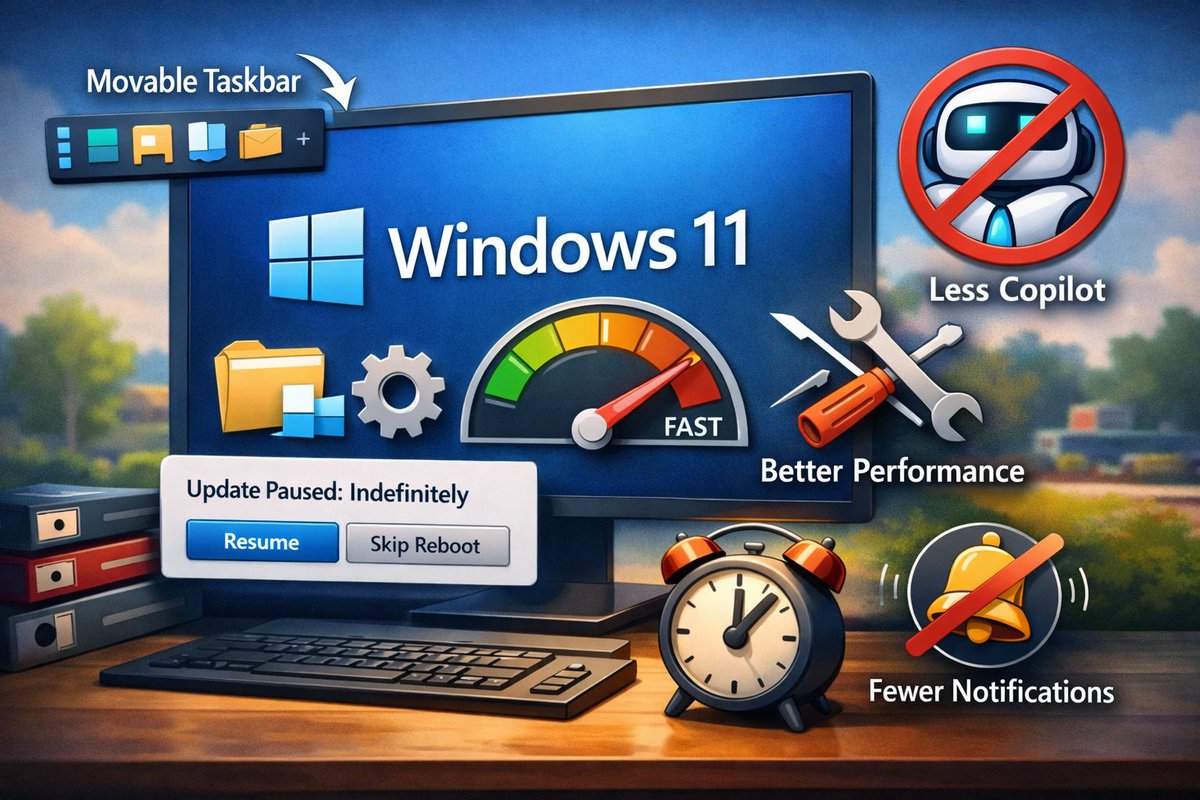
Microsoft is apparently finally admitting that what many users have wanted all along is a faster, quieter, more dependable operating system. Not more Copilot. In a new Windows Insider post, Microsoft’s Pavan Davuluri laid out a broad quality push for Windows 11 centered on performance, reliability, and what the company calls “craft.” More likely, it's what Steve Jobs called "taste", if you remember THAT interview... And honestly, a lot of it reads like Microsoft finally sat down, opened Feedback Hub, and decided to take the complaints seriously. The headline changes are exactly the kind of practical fixes power users have been asking for: taskbar repositioning to the top or sides of the screen, fewer forced update interruptions, more control over when updates install, faster File Explorer, lower baseline memory usage, better search responsiveness, fewer notifications, and more reliable drivers and wake behavior. Microsoft also says it is reducing “unnecessary Copilot entry points,” starting with apps like Snipping Tool, Photos, Widgets, and Notepad. The Windows Update story is interesting.... Microsoft says it wants updates to be less disruptive, with a move toward a single monthly reboot, the ability to restart or shut down without being forced to install u-pdates, and the option to pause updates for as long as needed. That is a major philosophical shift from the old “we know what’s best, enjoy your reboot” era, even if the real test will be how consistently Microsoft follows through in shipping builds. Performance also seems to be getting real attention instead of marketing lip service. Microsoft says Windows 11 will reduce its own resource usage, improve memory efficiency, make File Explorer quicker and more dependable, and lower latency by moving more core experiences to WinUI 3. The company specifically calls out Start menu responsiveness, search consistency, faster file operations, and a smoother overall feel under load. That is the sort of engineering work users notice every single day, even if it doesn’t make for a shiny keynote demo. My personal benchmark is to be able to type 'Download" into the Start menu and have it find my Downloads folder. Not a Bing search for a Copilot download. The Copilot pullback is equally interesting because it suggests Microsoft has realized there is a difference between useful AI and AI sprayed across every available surface. The company is not abandoning Copilot, but it is dialing back what it describes as unnecessary integration points. That sounds a lot less like “AI everywhere” and a lot more like “maybe Notepad didn’t need to become a sentient billboard.” The most encouraging part of all this is the tone. Microsoft is not pitching this as a revolution. It is pitching it as a cleanup, stabilization, and giving users more control. And that may be exactly what Windows 11 needs. After years of feeling like the operating system was being used to push services, experiments, and mandatory behavior, this looks like a return to a simpler idea: Windows should serve the user, not manage them. I, for one, still advocate for Windows Pro having NO advertisements, bloatware, or needless telemetry. Make people pay, then quit asking for more. But I've been barking up THAT tree for years. Now the obvious catch: these are commitments and previews, not a completed turnaround. Microsoft has promised a lot here, but Windows users have long memories. This is probably still the best Windows news in a while, because it focuses on the fundamentals: Faster. More reliable. Less noisy. More customizable. Less pushy.
Dave W Plummer tweet media
English
320
123
1.5K
64.9K
Mike Swanson
Mike Swanson@anyware·
@perrikaryal I was subjected to this at SIGGRAPH years ago. They basically asked me to walk a straight line, and they "steered" me with a controller. Freaky.
English
0
0
1
349
Perri
Perri@perrikaryal·
I can control your balance I made a device that sends DC current through my head to stimulate my vestibular nerve (called galvanic vestibular stimulation or GVS) and, in doing so, can make me feel completely destabilised. By changing the direction of the current, it can make me fall in that direction. Hook that up to keyboard controls or a joystick, and suddenly you could have your own remote control human. Naturally, my first thought was man I wanna play trackmania with this. What else should I do? I do not have enough self-preservation, clearly lol #gvs #technology #science #trackmania
English
221
678
7.4K
482.1K
Lenny Rachitsky
Lenny Rachitsky@lennysan·
My biggest takeaways from @sherwinwu: 1. AI is writing virtually all code at OpenAI. 95% of the engineers use Codex, and engineers who embrace these tools open 70% more pull requests than their peers, and that gap is widening over time. 2. The role of a software engineer is shifting from writing code to managing fleets of AI agents. Many engineers now run 10 to 20 parallel Codex threads, steering and reviewing rather than writing code themselves. 3. The average PR code review time has dropped from 10-15 minutes per PR to 2-3 minutes. Every pull request at OpenAI is now reviewed by Codex before human eyes see it, and Codex surfaces suggestions and catches issues up front. This allows engineers to focus on more creative and strategic work while dramatically increasing productivity. 4. The models will eat your scaffolding for breakfast. When building AI products, don’t optimize for today’s model capabilities. The field is evolving so rapidly that the scaffolding (vector stores, agent frameworks, etc.) that seems essential today may be obsolete tomorrow as models improve. 5. Build for where the models are going, not where they are today. The most successful AI startups build products that work at 80% capability now, knowing the next model release will push them over the line. 6. Top performers become disproportionately more productive with AI tools. AI tools amplify the productivity of high-agency individuals, so the gap between top performers and everyone else is widening. The ROI on unblocking and empowering your best people compounds faster than ever in an AI-augmented environment. 7. Most enterprise AI deployments have negative ROI because they’re top-down mandates without bottom-up adoption. Success requires both executive buy-in and grassroots enthusiasm. Sherwin recommends creating a “tiger team” of technically-minded enthusiasts (often not engineers) who can explore capabilities, apply AI to specific workflows, and create excitement throughout the organization. 8. The one-person billion-dollar startup is coming, but with unexpected second-order effects. As AI makes individuals more productive, we’ll see not just billion-dollar solo founders but an explosion of small businesses: hundreds of $100M startups and tens of thousands of $10M startups. This will transform the startup ecosystem and venture capital landscape. 9. Business process automation is an underrated AI opportunity. While Silicon Valley focuses on knowledge work, most of the economy runs on repeatable business processes with standard operating procedures. There’s massive potential to apply AI to these workflows, which are often overlooked by the tech community. 10. The next two to three years will be the most exciting in tech history. After a relatively quiet period from 2015 to 2020, we’re now in an unprecedented era of innovation. Sherwin encourages everyone to engage with AI tools and not take this moment for granted, as the pace of change will eventually slow. 11. AI models will soon handle multi-hour tasks coherently. Today’s models are optimized for tasks that take minutes, but within 12 to 18 months we’ll see models that can work on complex tasks for upward of six hours. This will enable entirely new categories of products and workflows. 12. Audio is the next frontier for multimodal AI. While coding and text get most of the attention, audio is hugely underrated in business settings. Improvements in speech-to-speech models over the next 6 to 12 months will unlock significant new capabilities for business communication and operations.
Lenny Rachitsky@lennysan

"Engineers are becoming sorcerers" @SherwinWu leads engineering for @OpenAI’s API platform, which gives him a unique view into what’s going, where things are heading, and what the future of software engineering looks like. Over 95% of engineers at OpenAI use Codex daily, each works with a fleet of 10-20 parallel AI agents, and he's seeing the productivity gap between AI power users and everyone else widening. In our conversation, discuss: 🔸 Why the next 12-24 months are a rare window of opportunity 🔸 Why “models will eat your scaffolding for breakfast” 🔸 What OpenAI did to cut code review times from 10mins to 2mins 🔸 How AI is starting to change the role of managers 🔸 Why most enterprise AI deployments have negative ROI Watch below and find it on YouTube here 👇 youtu.be/B26CwKm5C1k

English
85
249
1.8K
437.8K
Mike Swanson
Mike Swanson@anyware·
YouTube launched a native app for Vision Pro: apps.apple.com/us/app/youtube…. With 3D 360 and VR180 support. Also signed-in experiences with subscriptions, playlists, watch history, etc.
English
0
1
21
960
Siddhant Khare
Siddhant Khare@Siddhant_K_code·
AI was supposed to make us more productive. So why is everyone more exhausted? Each task gets faster. So you do more tasks. Your brain doesn't scale like a GPU. Wrote about it honestly. siddhantkhare.com/writing/ai-fat…

English
21
26
139
34.9K
Mike Swanson 리트윗함
Justin Ryan ᯅ
Justin Ryan ᯅ@justinryanio·
This is wild. Arcturus Studios is capturing real sports in full volumetric so you can explore the action from any angle. They surround the field with cameras and use Gaussian splatting to turn the game into a 3D experience. This is the future of sports.
English
18
90
799
61.4K
Marko Anastasov
Marko Anastasov@markoa·
The paradox is that many companies practice this approach thinking it's what will brings success. But visionaries who built enduring companies start with user experience and work backwards. Great post by Mike. My full notes: markoanastasov.com/signals/backse…
Mike Swanson@anyware

Imagine your car pulling over mid-drive to ask, “How’s your experience so far?” Ridiculous…until you realize that’s exactly how many apps behave now. How we normalized being interrupted by the products we bought to do work. Backseat Software: blog.mikeswanson.com/backseat-softw…

English
1
0
1
214
Mike Swanson
Mike Swanson@anyware·
Hugh with another great immersive tutorial.
Hugh Hou@hughhoufilm

Apple just expanded its immersive creation pipeline with Apple Creator Studio, and Compressor is now a key part of delivering high-quality Apple Immersive Video for Apple Vision Pro. Full tutorial: youtu.be/Fz9KYhaaPVE In this quick breakdown, I show the real-world workflow pros are using to turn a DaVinci Resolve ProRes Bundle into a final AIVU file, complete with Apple Spatial Audio (ASAF), lens metadata, and XML—clean, fast, and optimized for Vision Pro playback. Comment “Compressor” and I’ll DM you the exact render settings. #applecreatorstudio #immersivevideo
English
0
0
1
285
Mike Swanson
Mike Swanson@anyware·
OpenImmersive 1.6: now playing side-by-side and over-under: @portemantho/openimmersive-1-6-now-playing-side-by-side-and-over-under-7389c340d29d" target="_blank" rel="nofollow noopener">medium.com/@portemantho/o…
English
0
0
4
290
Tim
Tim@timheuer·
@anyware How likely are you Mike to recommend this drive to a friend? 1 2 3 4 5 6 7 8 9
English
1
0
1
108
Mike Swanson
Mike Swanson@anyware·
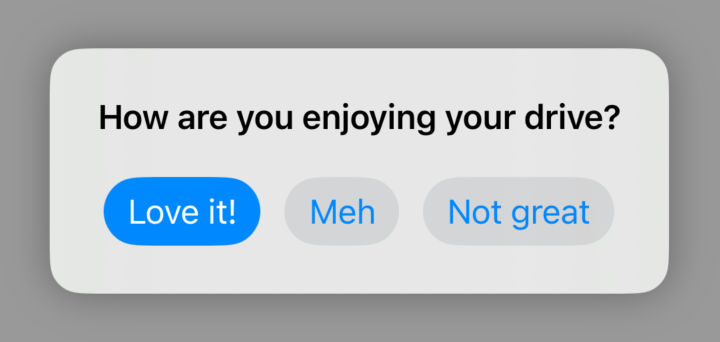
How we normalized being interrupted by the apps we bought to do work. It's like your car pulling over to ask, "how are you enjoying your drive?" Ridiculous, until you realize that's exactly how many apps behave today.
Mike Swanson tweet media
English
2
2
3
263
ruslan
ruslan@ruslanjabari·
made an app that shows a live $ counter burning during meetings based on attendees's salaries
English
67
80
2.2K
257.6K
Mike Swanson
Mike Swanson@anyware·
Imagine your car pulling over mid-drive to ask, “How’s your experience so far?” Ridiculous…until you realize that’s exactly how many apps behave now. How we normalized being interrupted by the products we bought to do work. Backseat Software: blog.mikeswanson.com/backseat-softw…
English
0
0
5
540
Mike Swanson
Mike Swanson@anyware·
Live + immersive is like teleporting into an experience with seats that you probably couldn't get (or afford), as if you're actually there. We've wanted this level of immersion for a long time, and Apple has delivered.
Justin Ryan ᯅ@justinryanio

You can now watch the full two hour and twenty two minute replay of the first Apple Immersive NBA game. Here’s how to launch the experience inside the NBA app on Vision Pro. It’s incredible. Sports broadcasting just changed forever.


English
3
5
72
5.3K
Mike Swanson
Mike Swanson@anyware·
@gruber Hard agree! And a note about that last sentence: "Alas, that’s how how the world has proceeded." Assuming that first "how" = "not".
English
0
0
0
109