TheValueist@TheValueist
$SIMO EXECUTIVE CALL SUMMARY: Silicon Motion Technology Corp (02/04/26)
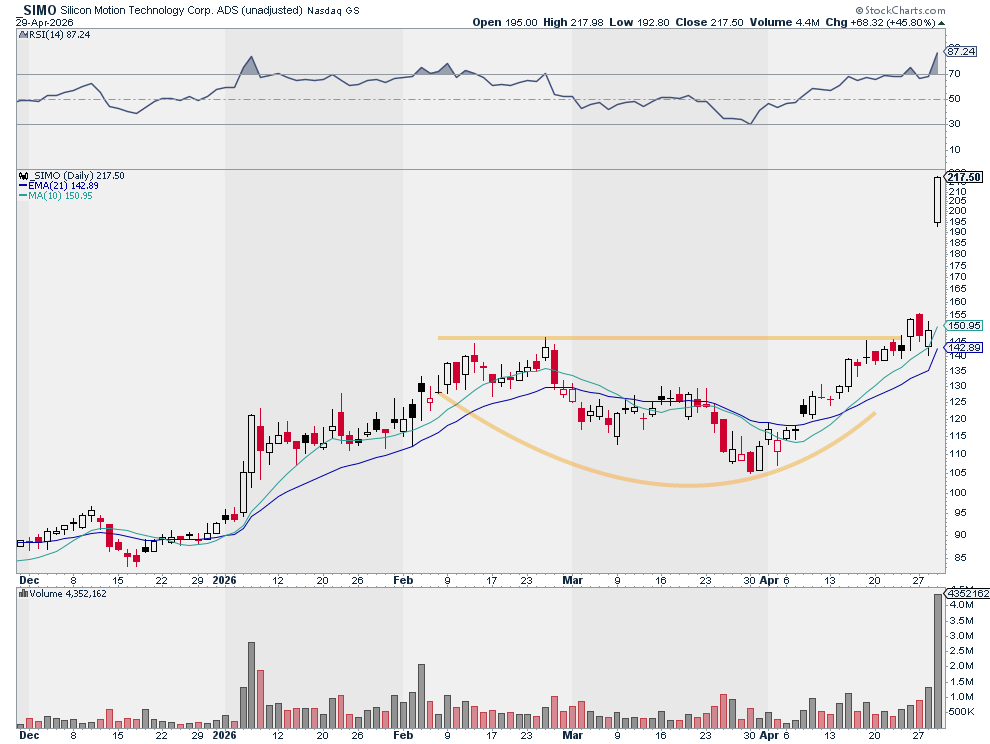
Q4 2025 results and Q1 2026 guidance materially altered the near-term growth profile implied by typical seasonality and prior company guidance. Q4 revenue of $278.5 million rose 15% Q/Q and 46% Y/Y, exceeding the prior Q4 guidance range of $254 million to $266 million by 4.7% at the high end, with non-GAAP gross margin of 49.2% (up 0.5 points Q/Q and up 3.2 points Y/Y) and non-GAAP operating margin of 19.3% (up 3.5 points Q/Q and up 3.8 points Y/Y). Q1 2026 revenue was guided to $292 million to $306 million, implying 5% to 10% Q/Q growth and 76% to 84% Y/Y growth, versus Bloomberg consensus of $230.9 million. The guidance implies a demand and share-gain trajectory strong enough to more than offset normal Q1 seasonal weakness and suggests elevated backlog visibility into 2026, with management reiterating an expectation for sequential revenue growth across all quarters of 2026 and positioning 2026 as a record revenue year.
QUARTERLY PERFORMANCE AND WHAT DROVE THE BEAT
Q4 execution reflected simultaneous strength in mobile storage controllers and a step-function improvement in client SSD controllers, with an additional emerging contribution from SSD solutions. Management attributed the outperformance to strong demand across markets, new controller introductions, and market share expansion, particularly in eMMC/UFS and client SSD. Company-reported product-line indicators implied that the primary sequential growth engine was SSD controllers, which increased 25% to 30% Q/Q, while eMMC+UFS controllers increased 0% to 5% Q/Q and SSD solutions increased 125% to 130% Q/Q. The magnitude of SSD solution growth from a small base is consistent with the commentary that Q4 included initial sales of boot drive storage products to a leading GPU maker, introducing a new vector of revenue that is structurally different from the core controller model due to NAND procurement and potential pass-through mechanics.
The quarter also demonstrated material operating leverage. Non-GAAP operating income increased to $53.8 million from $38.3 million in Q3 2025, with non-GAAP operating expenses rising to $83.2 million from $79.5 million, reflecting intensified investment in enterprise SSD and boot drive initiatives. The net result was operating margin expansion to 19.3%, establishing a significantly higher profitability exit-rate versus the full-year 2025 non-GAAP operating margin of 14.9%. This margin step-up is a key datapoint for assessing whether the business is transitioning from cyclical recovery toward a more structurally higher earnings power profile driven by richer mix (PCIe5, enterprise) and improved scale.
GUIDANCE AND CHANGE VERSUS PRIOR GUIDANCE
Q4 2025 actuals materially exceeded the company’s prior Q4 revenue guide of $254 million to $266 million, while profitability landed within the prior guided ranges. The key incremental information from the call was the magnitude and composition of Q1 2026 strength relative to normal seasonality and the embedded assumption that Q1 will be the low point of the year. Management explicitly framed the profile as “revenue will be the lowest of 2026,” despite Q1 still being guided higher than Q4. This is a meaningful shift from the historical pattern where Q1 typically declines sequentially, as seen in Q1 2025 revenue of $166.5 million versus Q4 2024 revenue of $191.2 million.
Q1 2026 gross margin guidance of 46% to 47% implies a 2.2 to 3.2 point sequential decline from Q4’s 49.2%, with management attributing the near-term pressure to product mix and specifically to stronger mobile controller contribution (which was described as below corporate average margin). Operating margin guidance of 16% to 18% implies a 1.3 to 3.3 point sequential decline from Q4’s 19.3%, reflecting the combined effect of lower gross margin and elevated operating expenses. Importantly, management also indicated expectations for gross margin to recover toward the 48% to 50% target range through the year as newer products (PCIe5 and enterprise) scale, while acknowledging that additional tape-out and development costs in Q2 and Q3 (notably the planned 4-nanometer tape-out) will temporarily elevate operating expenses.
Relative to prior-year Q1 benchmarks, the Q1 2026 guide implies substantial year-over-year profitability expansion. Q1 2025 non-GAAP operating margin was 8.9%; Q1 2026 guidance of 16% to 18% implies a near-doubling of margin, consistent with the mix shift toward higher ASP client SSD controllers and early enterprise contributions, albeit partially offset by the mobile mix headwind and higher enterprise investment.
MACRO AND INDUSTRY CONTEXT AS PRESENTED ON THE CALL
A central call theme was the tension between accelerating AI-driven demand for memory and storage and the resulting supply constraints and price inflation in NAND and DRAM. Management asserted that AI cloud service providers are attempting to lock up DRAM and NAND supply through 2026, contributing to tight supply, intra-quarter price increases, and a more cautious outlook for unit growth in smartphones, PCs, and automotive due to elevated component costs. This framing matters because the company’s growth thesis is positioned as being driven more by share gains and product cycle transition than by end-market unit growth. Management indicated that even if overall PC unit shipment declines 5% to 10% in 2026, share gains and ASP uplift from PCIe5 should still support growth. The specific statement “PC unit shipment will decline 5% to 10%” provided a quantitative anchor that implicitly sets a higher bar for share and mix-driven outperformance.
SEGMENT-LEVEL IMPLICATIONS AND TECHNICAL READ-THROUGH
Mobile (eMMC/UFS): The call reinforced the structural shift from integrated NAND makers toward module makers in mobile embedded storage, with NAND makers increasingly reallocating resources away from mobile toward AI-centric DRAM/HBM and enterprise needs. Management characterized Silicon Motion as the primary meaningful independent controller provider positioned to benefit from this shift, describing the mobile controller business as gaining share across mainstream and value tiers and targeting expansion into higher-end tiers by late 2026. A notable Q&A datapoint clarified the internal mix: UFS controllers remain majority smartphone-driven, while eMMC controllers skew toward non-smartphone markets such as IoT, streaming devices, set-top boxes, and automotive; combined, management described an approximate 50% smartphone and 50% non-smartphone split across these controller categories. This matters for cyclicality and margin expectations because the non-smartphone eMMC demand base is generally more stable but may be more sensitive to supply allocation and qualification dynamics in automotive/industrial channels.
Client SSD controllers (PCIe5): The call emphasized that PCIe5 is the core product-cycle driver, with 8-channel PCIe5 controllers (high-end) already established across multiple flash makers and module makers, and a newer 4-channel DRAM-less PCIe5 controller positioned for mainstream adoption. The technical crux is that DRAM scarcity can constrain high-end SSD BOMs; a DRAM-less architecture lowers dependency on DRAM availability and cost, potentially accelerating PCIe5 penetration at the mainstream tier even if the high-end segment slows. Management explicitly indicated that the 8-channel PCIe5 ramp may slow in 2026 due to DRAM shortage, while the 4-channel DRAM-less PCIe5 controller is expected to ramp more meaningfully, particularly in 2H 2026. This implies a mix shift within PCIe5 that could temper the maximal ASP uplift otherwise expected from an 8-channel dominated transition, while still maintaining a positive ASP step versus PCIe4. CFO commentary supported this by stating the 4-channel PCIe5 controller carries materially higher ASP than comparable PCIe4 offerings.
Enterprise SSD controllers (MonTitan): The enterprise narrative advanced from roadmap to execution milestones. Management stated end-user qualification of TLC-based high-performance compute SSDs using MonTitan began in the December quarter with multiple customers, with qualification continuing through 1H 2026 and commercial ramp expected in 2H 2026. In parallel, QLC-based warm storage SSD was positioned as the largest addressable opportunity, with qualification expected in 2026 and demand potentially accelerated by HDD supply constraints. This is strategically important: compute SSD and warm storage SSD are differentiated workloads with different controller feature requirements (latency, endurance, capacity efficiency, power), and success in either can expand the company’s TAM and improve customer stickiness. Management also reiterated an intent to tape out a 4-nanometer PCIe6 MonTitan targeting hyperscalers and Tier 1 customers, with design wins already claimed and a ramp expected in 2028. The longer-dated PCIe6 plan suggests a willingness to invest ahead of the adoption curve, but also increases execution risk given the long qualification cycle and the need to bridge near-term revenue with the current MonTitan generation.
Enterprise boot drive SSD solutions: The boot drive business was presented as a rapidly scaling strategic expansion with direct exposure to AI infrastructure platforms. Management described volume shipments in Q4 to a leading AI GPU maker for its current GPU platform and active qualification efforts for the next-generation DPU plus NVLink and Ethernet switches expected to launch in 2H 2026. In Q&A, management characterized the 2026 boot drive revenue opportunity as meaningful and gave an approximate revenue figure of $50 million for the year, while also emphasizing that the program is not sole-sourced and that the growth rate could accelerate in 2027 and 2028 depending on NAND supply and commercial terms. The key mechanical distinction is that boot drive solutions require Silicon Motion to procure NAND; management noted a need to “pass through the cost increase” in a market where NAND pricing is rising and customers maintain multiple suppliers. This creates a fundamentally different earnings quality profile versus controller-only revenue: higher revenue per unit but higher COGS volatility, higher working capital needs, and potential gross margin compression if cost pass-through lags.
Automotive and Ferri embedded solutions: The call reiterated strong demand from automotive and industrial customers, with management expecting automotive to reach roughly 10% of total business by end of 2026. The dominant constraint is again NAND procurement and allocation. Automotive is typically lower priority for memory suppliers, increasing supply-chain friction and elevating the value of Silicon Motion’s long-term NAND relationships. However, the company explicitly described a willingness to bypass certain opportunities if margins do not meet targets, while selectively accepting lower-than-corporate-average margin for strategically important programs. This suggests revenue growth may be intentionally constrained to protect profitability, creating a potential mismatch between headline demand signals and realized shipments.
COMPETITIVE AND GEOPOLITICAL DYNAMICS DISCUSSED
The competitive discussion focused on Chinese controller vendors. Management argued that access to advanced-node foundry capacity beyond 12-nanometer represents a gating factor for competitors, particularly in the context of regulatory approvals and supply availability at leading foundries, while domestic Chinese fabs remain limited to more mature nodes that constrain performance and power competitiveness for leading-edge controllers. This viewpoint implies that competitive intensity in high-performance client SSD and enterprise controllers may remain manageable in the near to mid term, though it does not eliminate competition from established non-Chinese merchant controller suppliers. The broader geopolitical and supply-chain risks cited in the Safe Harbor language remain relevant given Taiwan operational exposure and the strategic nature of memory supply allocations.
FINANCIAL QUALITY, CASH FLOW, AND BALANCE SHEET CONSIDERATIONS
Cash, cash equivalents, and restricted cash ended Q4 at $277.1 million, up modestly Q/Q despite $16.7 million of dividend payments and an inventory build to support anticipated ramp. The explicit inventory increase is a double-edged indicator: it can reflect prudent supply assurance in a constrained NAND environment, but it also introduces higher inventory and obsolescence risk if demand weakens or if product mix shifts faster than expected. Capex remained modest at $7.8 million in Q4, consistent with an asset-light model, though the planned 4-nanometer tape-out implies higher near-term R&D and engineering expense. Stock-based compensation was $15.8 million in Q4, materially higher than earlier quarters, widening the GAAP-to-non-GAAP divergence and implying continued dilution pressure even if cash costs are limited.
The presence of “dispute related expenses” in the non-GAAP reconciliation and in Q1 2026 guidance (included alongside stock-based compensation in the excluded expense range of $10.8 million to $11.8 million) suggests ongoing non-operational cost noise, with potential tail risk to cash flows depending on outcomes. While non-GAAP presentation strips these costs to highlight core operations, investment conclusions must incorporate the fact that elevated legal/consultant costs can persist unpredictably and can influence GAAP profitability and reported cash conversion.
KEY TAKEAWAYS FROM Q&A THAT SHIFT THE INVESTMENT FRAME
Mobile controller diversification was characterized as approximately balanced between smartphone and non-smartphone end markets when combining UFS and eMMC, with UFS still predominantly smartphone-driven and eMMC predominantly non-smartphone.
PC market expectations were explicitly framed as negative for units in 2026, with discussion of de-speccing at the value tier (capacity reductions) and differentiated impact by OEM depending on supply access; the growth thesis rests on share and ASP rather than unit expansion.
PCIe5 adoption was acknowledged as bifurcating: high-end 8-channel PCIe5 may slow due to DRAM constraints, while mainstream DRAM-less PCIe5 is expected to become the stronger volume driver in 2H 2026.
Boot drive opportunity was framed as strategically large but gated by NAND procurement, customer multi-sourcing, and the ability to maintain margin via pass-through, with an approximate $50 million revenue level discussed for 2026 and larger potential in 2027+.
Long-term supply agreements were described as not currently in place, with supply secured more through relationships and case-by-case decisions, reinforcing that supply assurance remains a material uncertainty rather than a solved issue.
INVESTMENT IMPLICATIONS
The call strengthened the bull case that Silicon Motion is in the early to mid phase of a multi-pronged product-cycle expansion, with PCIe5 client SSD controllers providing near-term growth and margin uplift, mobile controllers benefiting from structural outsourcing and market share gains, and enterprise (MonTitan and boot drive) creating a plausible path to larger TAM access and a higher strategic multiple. The magnitude of Q1 2026 guidance relative to consensus and typical seasonality suggests that near-term demand is being driven by a combination of share capture, product transitions, and supply-secured backlog rather than purely cyclical end-market improvement, which can support a higher confidence level in the 2026 sequential growth narrative if supply holds.
At the same time, the call increased the importance of monitoring supply chain execution and margin quality. The expansion into SSD solutions and boot drives introduces direct exposure to NAND pricing, procurement, and working capital. Even with cost pass-through mechanisms, there is a structural risk that higher solution mix dilutes gross margin volatility and reduces the predictability of earnings versus a controller-centric model. Q1 gross margin guidance already reflects mix pressure, and future quarters must demonstrate the promised recovery toward 48% to 50% while sustaining sequential revenue growth and absorbing elevated enterprise R&D costs. The stated willingness to bypass low-margin opportunities partially mitigates the downside risk to profitability but can cap upside to revenue and share capture if competitors accept lower margins.
A balanced interpretation is that the call shifted the principal debate from “is the cycle turning?” to “how durable is the company’s ability to grow sequentially through a supply-constrained, price-inflating memory environment while expanding into procurement-heavy solutions without structurally compressing margins?” The outcome will likely be determined by 3 variables: 1) sustained PCIe5 penetration and ASP uplift in client SSD controllers despite PC unit headwinds; 2) successful conversion of MonTitan qualifications into 2H 2026 revenue at the implied 5% to 10% exit-rate contribution (excluding boot drives); and 3) securing sufficient NAND supply and pass-through economics to scale boot drive and automotive solutions without disproportionate gross margin erosion.
NEAR-TERM CATALYSTS AND MONITORING POINTS
Q1 2026 results: validation of the unusually strong seasonal profile, with particular focus on whether strength is broad-based versus concentrated in mobile.
Gross margin trajectory: confirmation that the Q1 mix-driven decline is temporary and that the recovery toward 48% to 50% begins by Q2 or Q3 despite rising NAND costs.
PCIe5 mix: evidence of accelerating DRAM-less 4-channel PCIe5 adoption and whether 8-channel constraints meaningfully reduce the net ASP uplift.
Enterprise execution: concrete updates on MonTitan qualification progress, initial customer ramps in 2H 2026, and any refinement to the 5% to 10% exit-rate target.
Boot drive economics: clarity on NAND sourcing stability, the degree of price pass-through, and whether boot drive revenue scales beyond the implied $50 million level in 2026 without material gross margin dilution.
Working capital: continued inventory build versus normalization, as an indicator of supply assurance strategy and potential risk of overbuild in a volatile pricing environment.
COMPANY EMPLOYEES ON THE CALL
Wallace C. Kou, President & Chief Executive Officer
Jason Tsai, Chief Financial Officer
Tom Sepenzis, Senior Director of Investor Relations & Strategy
RESEARCH ANALYSTS ON THE CALL
Mehdi Hosseini, Susquehanna International Group
Neil Young, Needham & Company
Craig Ellis, B. Riley Securities
Suji Desilva, ROTH Capital Partners
Gokul Hariharan, J.P. Morgan
Matthew Bryson, Wedbush Securities