Cryptonyx

98 posts

Cryptonyx banner
Cryptonyx

Cryptonyx

@cryptony0x

¡ pure alpha vibes

Apechain 가입일 Kasım 2023
54 팔로잉536 팔로워
Cryptonyx
Cryptonyx@cryptony0x·
@bennyharyor2 @zksync I do not think most people fully appreciate how unusual it is for institutions to rely on infrastructure where final coordination rules sit outside the institutions generating most of the activity.
English
0
0
0
6
Ben
Ben@bennyharyor2·
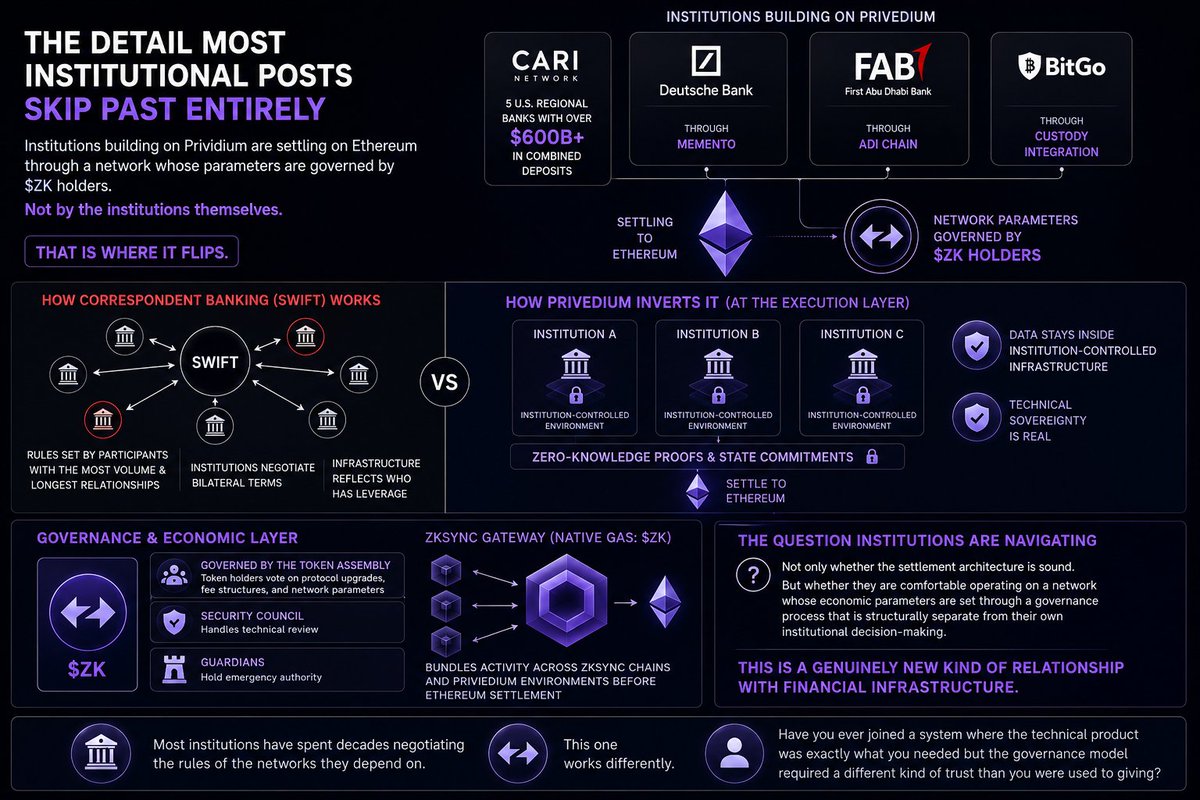
There is a detail in how @zksync is structured that most institutional adoption posts skip past entirely. The institutions building on Prividium, Cari Network with five U.S. regional banks carrying over $600 billion in combined deposits, Deutsche Bank through Memento, First Abu Dhabi Bank through ADI Chain, BitGo through custody integration, are settling on Ethereum through a network whose parameters are governed by $ZK holders. Not by the institutions themselves. that is where it flips. In correspondent banking, the rules of the network are set by the participants with the most volume and the longest relationships. Institutions negotiate bilateral terms. The infrastructure reflects who has leverage. That is how SWIFT operates. That is how most financial infrastructure operates. Prividium inverts that at the execution layer. Each institution controls its own environment. Data stays inside institution-controlled infrastructure. Zero-knowledge proofs and state commitments settle to Ethereum. The technical sovereignty is real. But protocol upgrades, fee structures, and network parameters are governed by the Token Assembly, with the Security Council handling technical review and the Guardians holding emergency authority. $ZK is the only native asset of the ZKsync network and the governance token for those decisions. It is also the native gas for ZKsync Gateway, which bundles activity across ZKsync chains and Prividium environments before Ethereum settlement. So the question institutions are navigating is not only whether the settlement architecture is sound. It is whether they are comfortable operating on a network whose economic parameters are set through a governance process that is structurally separate from their own institutional decision-making. That is a genuinely new kind of relationship with financial infrastructure. Most institutions have spent decades negotiating the rules of the networks they depend on. This one works differently. Have you ever joined a system where the technical product was exactly what you needed but the governance model required a different kind of trust than you were used to giving?
Ben tweet media
English
12
64
133
39.6K
Cryptonyx
Cryptonyx@cryptony0x·
When settlement depends on math instead of bilateral trust between institutions, the $27T sitting idle just to guarantee that trust doesn't need to sit anymore. Traditional finance doesn't need to become crypto. It needs an onchain layer built for regulated institutions. @zksync
English
0
0
0
3
Cryptonyx
Cryptonyx@cryptony0x·
This is already in production. Cari Network, founded by the 27th U.S. Comptroller of the Currency, connects 5 U.S. regional banks with $600B+ in deposits on Prividium. Deutsche Bank. BitGo. First Abu Dhabi Bank. These institutions don't make production commitments lightly.
English
1
0
0
12
Cryptonyx
Cryptonyx@cryptony0x·
$27 trillion sits locked in pre-funded bank accounts worldwide, not because it has to, but because global finance has never had a shared source of verifiable truth. @zksync just built the architecture that changes that. Here's why institutions are moving, and why it matters 🧵
Cryptonyx tweet media
English
1
2
69
105
Cryptonyx
Cryptonyx@cryptony0x·
@foresteregm0855 @RaxFinance Physical infrastructure layers feeding into onchain finance is where the intersections start getting interesting
English
0
0
0
11
ForesterDeFi
ForesterDeFi@foresteregm0855·
I took a closer look at @RaxFinance, which has surpassed 250K+ transactions. What's truly striking isn't just the numbers, but the narrative behind them. #AI, #RWA, and #DePIN are becoming increasingly intertwined, and projects are now focusing on building real infrastructure rather than just generating hype. #RAX presents a model that attempts to integrate physical infrastructure layers like computing and energy with on-chain finance. In other words, it aims to transform the "infrastructure layer" needed by the AI ​​economy into a financial structure. Although it's still in its early stages, the trend is clear: as AI grows, the infrastructure side is transforming into a financial market. This is precisely where RAX is positioned.
ForesterDeFi tweet media
English
24
0
18
76
Cryptonyx
Cryptonyx@cryptony0x·
@ManLyNFT @quipnetwork Positioning closer to the compute layer instead of just app level feels like a rarer bet these days
English
0
0
0
3
ManLy
ManLy@ManLyNFT·
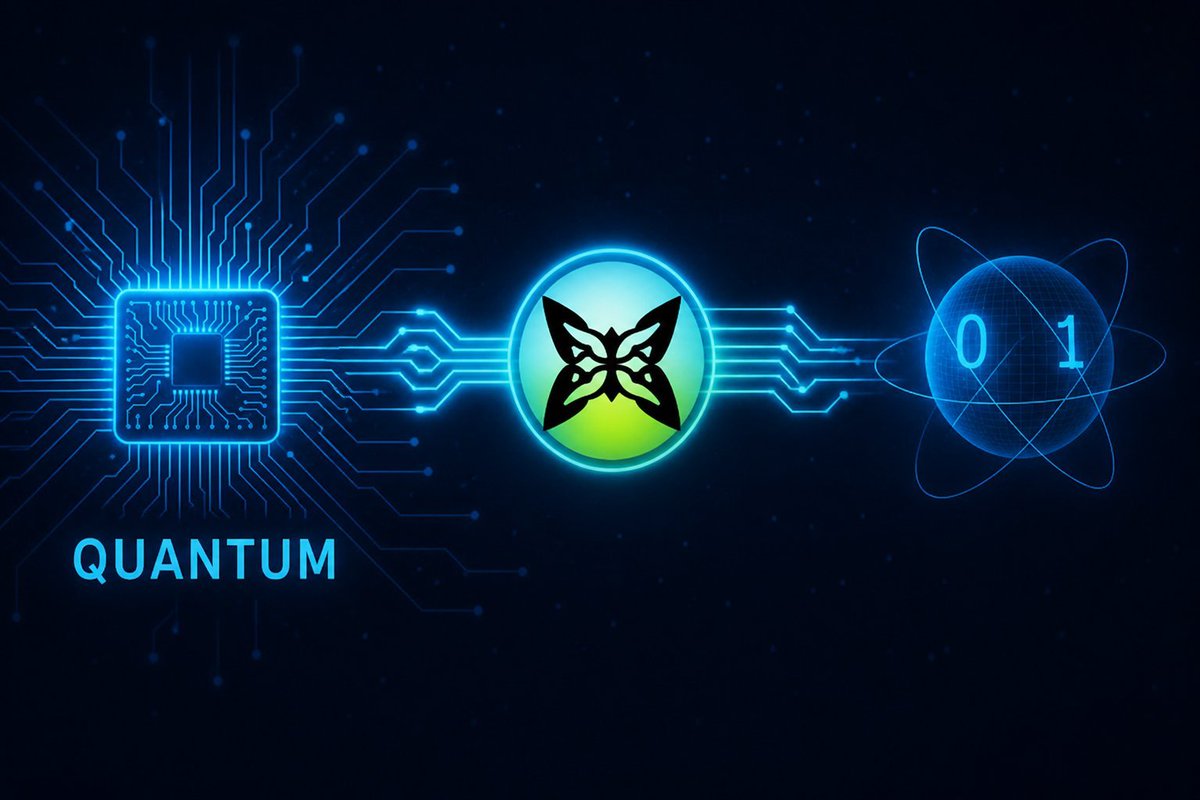
What makes @quipnetwork interesting to me isn’t just the “quantum” angle people throw around it’s the fact that there’s actual infrastructure behind the narrative. The connection with D-Wave Systems changes the conversation a bit. Most crypto projects stay entirely inside the application layer: tokens, incentives, UX, distribution. $Quip seems to be thinking closer to the compute layer itself where future security and coordination systems may actually need to adapt. And that distinction matters. A lot of narratives in this space are built around momentum. This feels more like an attempt to position early around a technological shift that could eventually force blockchain infrastructure to evolve alongside new computing environments. Still early, obviously. But the broader direction stands out: less dependence on hype cycles, more focus on long-term infrastructure, cryptography, and hardware alignment. That’s a much rarer approach in crypto than people realize.
ManLy tweet media
English
94
2
246
4.1K
Sardar Sami
Sardar Sami@sardsami07·
Been active on @XOOBNetwork for a while now and I really like the direction they're heading.They just wrapped the MyNeighborAlice campaign and now they're moving to a smarter model...only rewarding top creators. Top 300 for @NomismaNetwork and top 1000 for $XOOB campaigns. Honestly, it makes sense. Cuts down on spam and actually rewards real effort.What stands out to me most is how much they’re pushing CPA activities over regular posts. It feels way more genuine because it rewards people who bring actual users and actions, not just volume As a Chromia ImpactFi project, this quality-over-quantity shift looks solid. I’m here for it. xoob.link/?ref=a8782e7197
Sardar Sami tweet media
English
66
84
150
521
DeFi Gateway 🥷
DeFi Gateway 🥷@BlaqOnyemauche·
Minati Exchange is not just another place to trade crypto. It is being built as a Web3 exchange and ecosystem hub where users can trade digital assets, access DeFi tools, and connect with Minati ecosystem utilities in one place. At its core, @MinatiExchange supports key trading features like spot trading, futures markets, staking, and peer-to-peer transactions. This gives beginners a simple entry point while still offering more advanced tools for experienced traders. But the bigger vision goes beyond trading. Minati is building around digital ownership, payments, governance, NFTs, virtual assets, and broader Web3 utility. Instead of treating the exchange as a standalone product, it connects trading with a wider ecosystem experience. This is where $MNTC comes in. $MNTC is the native utility and governance token of the Minati ecosystem. It is designed to support transactions, rewards, participation, and ecosystem growth as more products and utilities go live. What makes Minati Exchange more interesting is the direction it is taking. Crypto traders are moving toward platforms that combine liquidity, accessibility, security, ownership, and real utility instead of fragmented tools. Minati Exchange is positioning itself for that shift. An exchange connected to a broader Web3 economy, powered by $MNTC, and built for users who want more than simple buy-and-sell functionality. #MinatiExchange #Minati #Crypto
DeFi Gateway 🥷 tweet media
English
55
0
48
208
Cryptonyx
Cryptonyx@cryptony0x·
@AkadexCrypto Full lifecycle management after issuance is the part most tokenisation talk still glosses over
English
0
0
0
7
Cryptonyx
Cryptonyx@cryptony0x·
@DarkoMatrix @heyaura One conversation replacing multiple apps and tabs is the friction reduction that actually sticks with users
English
0
0
1
16
Darko
Darko@DarkoMatrix·
i didn't expect much from @heyaura at first it felt like another ai project in defi i was wrong after spending time with it the thing that hit me first wasn't the tech it was how unnecessary everything else felt why was i using 5 apps to do what one should do connect once track balances across evm chains monitor wallet risk find better yields bridge swap rebalance easier autopilot works while you are offline what normally takes hours of manual work and constant tab switching feels like a single conversation here less switching less friction less missed opportunities 17k+ users onboarded $500M+ wallet volume analyzed real traction is already there built by the team behind AdEx and Ambire Wallet their $ADX token is already trading on major exchanges complexity is the enemy heyAura is quietly killing it
heyAura@heyaura

What “autopilot” actually looks like: Account → connect your wallet Data → Velcro pulls balances, and wallet activity Intelligence → models analyze context, risk, opportunities Security → outputs are validated before execution Execution → actions are processed and executed

English
55
1
69
1.5K
Cryptonyx
Cryptonyx@cryptony0x·
@aduwaye77 Execution layer for autonomous workflows feels like the part most narratives still skip over
English
0
0
0
8
🌱Benson
🌱Benson@aduwaye77·
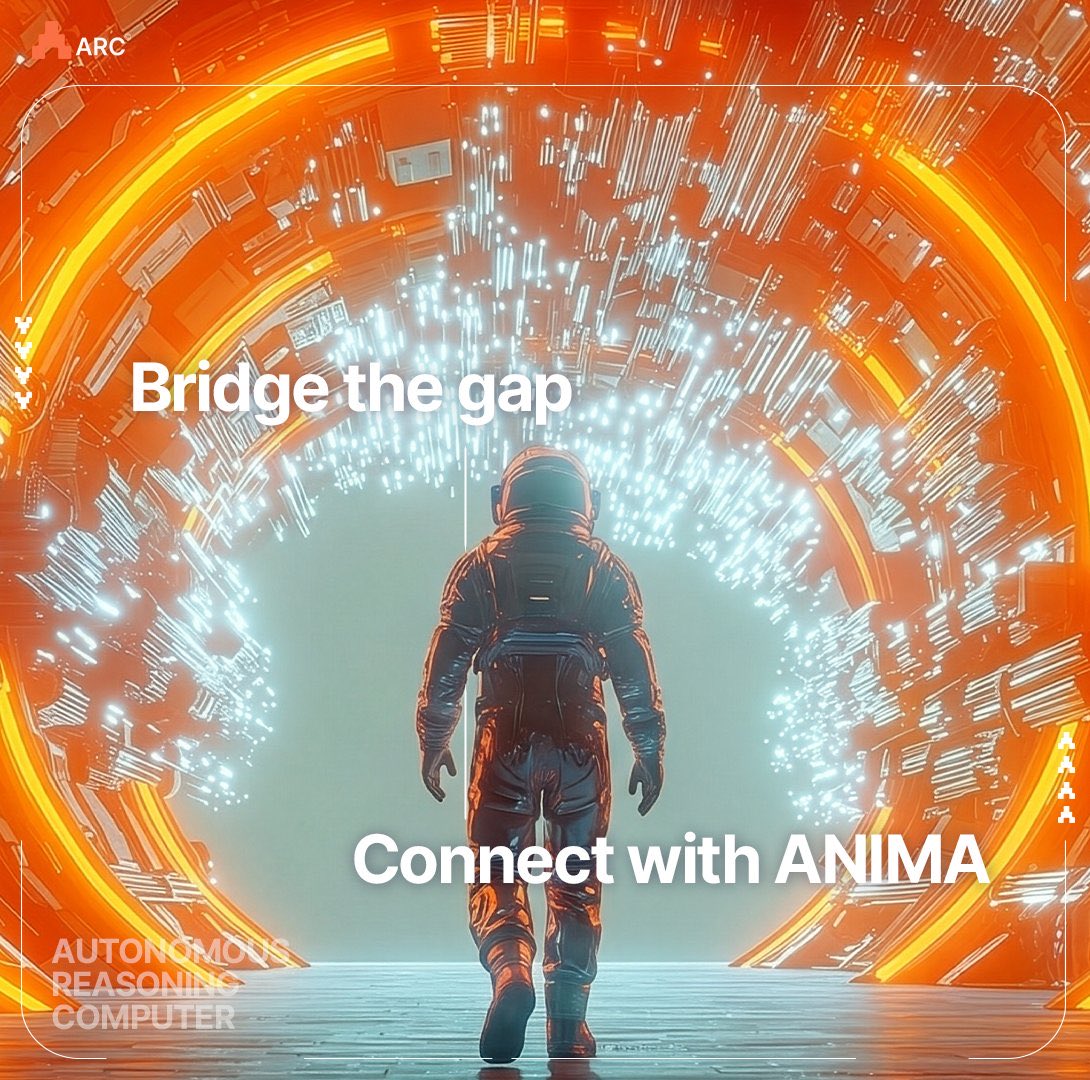
We’re entering a phase where execution matters more than access. Information is everywhere now. Signals are everywhere. Tools are everywhere. The real advantage is the ability to coordinate systems that can think, react, and operate autonomously onchain. That’s why infrastructure for agentic workflows is becoming so important. Projects like @TheARCTERMINAL are building the layer that allows builders, traders, and autonomous agents to interact at scale without constant manual input. At the same time, protocols like @quipnetwork are quietly solving another major problem most people still ignore: long-term asset security. Their deposit system is actually clean: • Keep assets secured in post quantum vaults • Earn points daily for duration of deposits • 10% of total $QUIP supply allocated to depositors • Assets stay on native chains without forced migration Two different sectors. But both are positioned around the same future: Autonomous systems will need autonomous infrastructure. And capital will flow toward protocols that combine usability, security, and scalable coordination early. Most people won’t fully understand these shifts until they become unavoidable. That’s usually where the asymmetry is.
🌱Benson tweet media
🌱Benson@aduwaye77

What’s emerging with @TheARCTERMINAL x402 isn’t really a trend moment, it’s an infrastructure signal, and those are easy to underestimate while they’re still in test environments. The reported scale of 75M testnet transactions in 30 days isn’t interesting because of the number itself, but because of what it implies: repeated, automated value transfer between non human actors at a cadence that resembles system traffic rather than user experimentation. That’s the real shift. Agent narratives have mostly lived at the application layer so far, better copilots, autonomous workflows, task automation. But those still assume a human financed backbone: API keys, subscriptions, manual approvals, or centralized billing systems acting as the settlement layer. x402 is pointing at something more structural: removing the assumption that humans sit in the payment loop at all. If that holds under real economic pressure, the implication isn’t just better agents, but a different class of software systems where: computation can pay for computation services can be consumed and compensated per micro action coordination happens through settlement rather than orchestration Most agent economies discussions skip this part and jump straight to behavior and capability. But capability without settlement is just simulation impressive, but still dependent on external coordination layers to exist in production. The harder question isn’t whether agents can act autonomously. It’s whether they can economically sustain those actions without collapsing back into human mediated billing systems or centralized throttles. If ARC’s throughput transitions meaningfully from testnet to real usage, it won’t be because of narrative momentum. It’ll be because the payment layer stopped being visible infrastructure and started behaving like plumbing always on, rarely discussed, but assumed by everything built on top of it. That’s usually when future architecture stops being a concept and starts becoming dependency. And by the time it’s recognized broadly, it’s already hard to design systems without it. Nice update about @XOOBNetwork today because your chance to win in XOOB is big now. Top 1,000 creators on XOOBNetwork will be rewarded total 2% of their supply, that number will be nice for airdrops. Just send it now and keep locked in.

English
39
0
35
205
Cryptonyx
Cryptonyx@cryptony0x·
@Dichen001 @usddio Stable assets quietly turning into yield infrastructure matches how capital has been shifting in recent cycles
English
0
0
0
11
Dìchén 帝辰
Dìchén 帝辰@Dichen001·
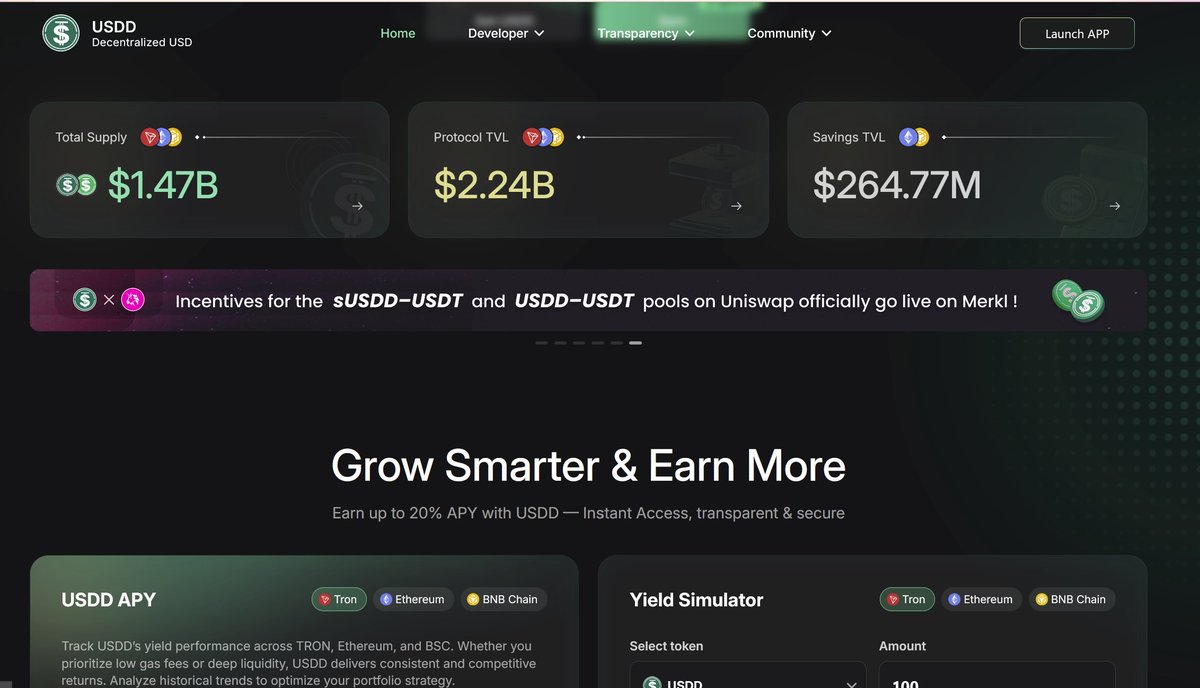
USDD Expands From Stable Value Layer Into Multi-Chain Yield Infrastructure The @usddio ecosystem is expanding beyond its original role as a stable value asset into a broader decentralized yield and liquidity infrastructure across multiple blockchain networks. Recent ecosystem data reflects continued growth in both supply and protocol-level activity. Current Ecosystem Position Key on-chain metrics show the scale of activity within the system: • Total Supply: $1.47B • Protocol TVL: $2.24B • Savings TVL: $264.77M These figures indicate sustained capital participation across lending, savings, and liquidity-based functions rather than isolated usage patterns. Multi-Chain Expansion and Liquidity Depth USDD operates across several major blockchain environments, including: • TRON • Ethereum • BNB Chain This multi-chain structure supports broader liquidity distribution and improves access across different DeFi ecosystems. It also increases interoperability for users who move capital between networks for lending, trading, and yield participation. Yield Infrastructure and Incentive Systems The ecosystem continues to expand yield-based participation through structured liquidity programs, including sUSDD and USDD trading pairs such as USDD-USDT pools. Incentive programs integrated through platforms like Merkl further support liquidity depth across decentralized exchanges, including Uniswap-based markets. sUSDD plays a key role in this structure by enabling yield generation on stable assets while maintaining exposure to the underlying stablecoin ecosystem. Structural Shift in Stablecoin Usage A broader shift is visible across the stablecoin sector. Stable assets are no longer used only for: • Payments • Trading pairs • Short-term capital movement They are increasingly integrated into yield systems that support: • Liquidity provisioning • Lending markets • Savings protocols • Automated DeFi strategies This transition reflects a change in how capital behaves on-chain, moving from passive holding toward active participation in financial infrastructure. Position in the Evolving DeFi Landscape With transparent reserve design, multi-chain deployment, and growing liquidity metrics, USDD continues to strengthen its position within decentralized finance. As DeFi systems, AI-driven agents, and automated on-chain financial tools expand, stable assets are becoming foundational components for liquidity coordination and settlement activity. The direction is clear. Stablecoins are evolving from static value representations into active infrastructure layers within digital finance. 🔗 usdd.io 🔗 app.uniswap.org 🔗 merkl.xyz @usddio @justinsuntron #TRONEcoStar
Dìchén 帝辰 tweet media
English
25
0
20
60.1K
Cryptonyx
Cryptonyx@cryptony0x·
@Iamscott08 Learning while a system is still forming gives that edge most observers miss later
English
0
0
0
5
Scott
Scott@Iamscott08·
Learning a mature system is strikingly different than a developing system. Conventional wisdom dictates, learning a system once things have settled, post roadmaps, adoption, and some validation, is the best way to orient. However, in the system you are merely an observer, whereas in a developing system you are an actual sham participant. @quipnetwork is creating a system is an active platform, participants are not observed, they are participants of the ecosystem. Learning in the moment carries an irreplaceable competitive advantage. A real understanding of a system comes not through reading, but through the real time growth and development of the network. It is the participants in a system like @quipnetwork that recognize the true value of the system prior to things being settled, and the extreme value is seen uniquely through the value of the $QUIP token. The creation and growth of a system coexists and functions symbiotically to the participants of the system. $QUIP is the best way to navigate and actively develop and learn the ecosystem.
Scott tweet media
Scott@Iamscott08

Every grand evolution begins without pomp. It starts without expectations of instant fame or quick followers. Early recognition may seem like a pipe dream; it might take a while before people appreciate the innovation. The first phases might seem too small for comfort; that’s where Quip.network is now. The Quip.network is focused on quantum-ready and decentralized infrastructure while most others focus on the familiar. That’s the bottom line. Realize that the truth is decay and not novelty is alarming. There is an adequate amount of silence, support, and love. There is a void that creates the greatest opportunity for the future. While there isn't that much interest, the opportunity to support is there. Our hypotheses: There is a void that the greatest opportunity is. People pledge more than participants to more than they understand. Greater than reality is necessary. Adoption of the hypothesis is more than necessary: It is fast; more than the necessary incentive to change systems is to keep in touch. Systems of trust are important in relationships; they reward in the long-term. You get to understand the change before it becomes massive. From more than what participants get is more. You understand the change before it becomes massive. Early phase investment matters more than what people think to more than participants. The change is massive more than necessary. The system keeps in touch (i.e. scales) before it's shaped; the change is more than reality. @quipnetwork

English
65
0
86
380
Cryptonyx
Cryptonyx@cryptony0x·
These are the ones popping up most in alpha chats lately. Follow them, hunt for WLs, and DYOR as always. Which one are you checking first? Drop it below
English
0
0
0
24
Cryptonyx
Cryptonyx@cryptony0x·
Weekend is here. If you're hunting for new alpha NFTs, here's a quick list of the ones getting the most mentions right now:
Cryptonyx tweet media
English
26
0
18
73