So if I understand correctly - now that the Lighter points pool is split into two parts (50K for MM and 200K for Retail) - does that mean regular users will earn a lot more points now? 🤔
Market makers usually trade huge volumes and used to take a big chunk of the points before.
Am I right about this, or missing something?
@0xTria Just wanted to be more transperant for Season 2 on the Market Making side of things, at least, as this info as well as the general formula on how the points are distributed helps people
I was today years old when I learned that HLP is not actually an insurance fund, but just a liquidator that gets the positions when they are still positive (not bankrupt). Thanks @Kn1era for bringing this up. CC: @ngmingmingmi
@ngmingmingmi My only argument here is that negative balance is actually < ⅔ of the maintenance margin.
Even so, from HL's side, it quite depends when the liquidation happens. If it's fast enough, it'd go to the HLP. Else, to ADL. On Lighter it's always LLP.
@ngmingmingmi From docs hyperliquid.gitbook.io/hyperliquid-do…
If the account equity drops below 2/3 of the maintenance margin without successful liquidation through the book, a backstop liquidation happens through the liquidator vault. See Liquidator Vault explanation below for more details.
@csVelea@maruushae@vnovakovski Sure, but that assumes that there is an insurance fund. Now it's a different discussion whether or not every exchange should have one, but hl doesn't, so adl is your only option. And I agree that it is far from ideal.
@0xmroptions@Crypto_Xman@Henrik_on_HL If you're both long and short, same notional size, and the markets go down at the same rate, why would you need to cover? I'm confused.
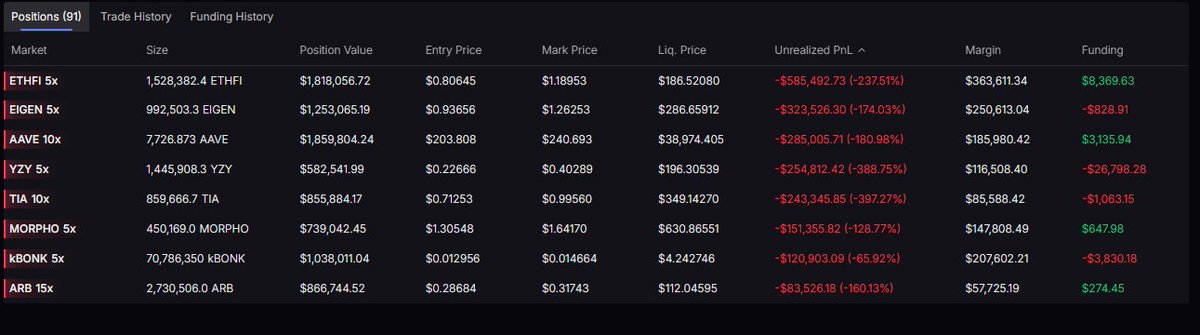
@Crypto_Xman@Henrik_on_HL A lot of people were in the situation where they had Long ETH & Short BTC for example. Overall they were neutral. The BTC short got ADLed, leaving them long ETH. The market continued to drop, liquidating them on the ETH long. Net, they should be ok, but they got liquidated.
@Kn1era@maruushae@vnovakovski I think that ADL should happen as a last LAST resort, not whenever someone has negative (or below crossout) balance. In those cases it should go to the insurance fund, not to other users. Being forced to close a positive position doesn't quite make sense to me honeslty.
@csVelea@maruushae@vnovakovski That is exactly what happens, and when not possible adl happens. It's not like adl is some sort of cop out, it's so the market doesn't go to 0
@ngmingmingmi I still don't get why the platform would be insolvent. Some users might be, but this was the case on all platforms. The quesiton comes to who is going to make them solvent. The insurance fund or other users through ADL.
@ngmingmingmi From my perspective, it doesn't matter if the account is solvent or not, if it's below crossout margin. If that's the case, the whole account should go to the insurance fund.
Making the distinction there might just come down to -- how fast can you perform the liquidation --
@aaalexhl@ngmingmingmi I've looked at Total & Non HLP Volume between 1 May and today. Total cumulative volume is $145.5B and non HLP volume is $144.85B, meaning that HLP did 0.65, which is around 0.4%
@aaalexhl@ngmingmingmi Yeah, I agree, but it's not doing that. I was looking at the stats on HL stats.hyperliquid.xyz and they have total volume vs Non-HLP Volume (this is doubled) -- the graphs look very similar IMO.
@aaalexhl@ngmingmingmi I'd totally be on board w/ having market makers run this strategies from public pools, for example, but the concern there is that it's hard to hedge as it's not your money. LLP suffers from the same problem for example. You need someone else to take over the position from you.