

CryptoXman.hl
3K posts
CryptoXman.hl
@Crypto_Xman
Really into crypto.... since 2013
Earth... maybe Katılım Eylül 2020
3K Takip Edilen2.4K Takipçiler

If you can reply to this, you're gonna make it and are part of Hyperliquid fam
If you can't reply, leave a like if you want to be part of $HYPE twitter so I follow you
Testing something.

katexbt.hl@katexbt
If you can reply to this, you're gonna make it. If you can't reply, leave a like so I know who you are. Testing something.
English
CryptoXman.hl retweetledi

@hiteshceon @mr_mayank you thought J6 was a tourist visit, and you still do
you have understood absolutely NOTHING. 🤣
English


Just shipped hyperliquid-mcp - an open-source, local MCP server that lets you trade perps and spot on Hyperliquid.
Enable your agent to check your positions, place orders, or analyze the market. No UI or scripts needed, just English.
github.com/0xikalgo/hyper…
English

Very happy to announce that PartyDAO is joining Stripe.
Building products with this team has been the experience of a lifetime. Thank you to everyone who has supported us along the way.
Excited for what's next!
PartyDAO@prtyDAO
PartyDAO is joining Stripe. We believe the most meaningful crypto products are yet to come, and we’re excited for what’s next. Read more in the full post below.
English

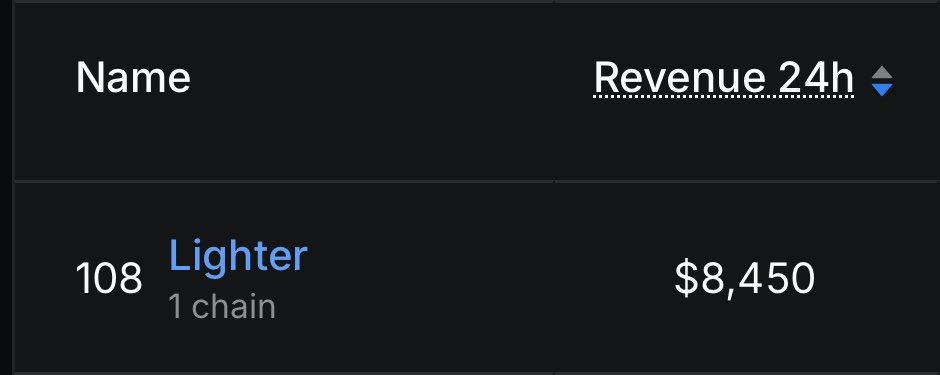
"nobody will use hyperliquid if they can trade on a 0% fee perp DEX"
2 weeks after TGE, lighter announces they're going to increase their fees
can't make this stuff up
English

English


Ledger is cooked after this
it might be wise to pay someone to make yourself disappear from the internet (not kidding)
this is a bigger issue than people think
with LLMs its now trivial for ANYONE to analyze huge data sets
ledger breach in 2020 dataset
crossreferenced with
ledger breach in 2025 dataset
you can find out which names overlap
which states they're from - do they overlap
hey ChatGPT tell me which one of the customers in these leaks i am most nearby to
then they find you online - stalk your socials, your family's socials
oh, you're still in crypto 6 years later? it means you must have made money and have some saved for a rainy day
perfect - odds of you having money suddenly shot up to 99% probability
its a matter of time

Cointelegraph@Cointelegraph
🚨 ALERT: ZachXBT flags a Ledger data breach linked to Global-e, impacting customer names and contact info.
English
English

This incident was directly related to Global-e and remains separate to the operations of any Ledger hardware device, software or platforms. For the avoidance of doubt, as the Ledger product is self-custodial, Global-e does not have access to your 24 words, blockchain balance, or any secrets related to digital assets.
Learn more: support.ledger.com/article/Global…
Always remember: Ledger will never call, DM, or ask for your 24-word recovery phrase. If someone does, it's a scam. Stay cautious, keep your crypto safe and always Clear Sign transactions where possible.
English
@roth_edgar @CryptoPicsou You want to brag about no fees then it’s all fair
English

No offense but it’s a bit unfair to Lighter.
Not every crypto startup can be self funded. In most startups, having investors is the norm.
50% allocation to the community is still much better than 95% of projects in the space.
Comparisons should only be made through the lens of the product
English

$HYPE vs $LIT
And let’s not even talk about buybacks…

English
@NMTD8 Finally can stop seeing all the troll posts about how lighter is going to flip hype
English


I love HL and Lighter, but why do so many people keep coming to the conclusion that most people going to leave Lighter? There’s an awesome value prop for medium sized bankrolls to keep using a fee-less exchange, especially when scalping.
HL and Lighter cover different grounds.
Sam@0xCryptoSam
My simplest answer for why I think $HYPE outperforms $LIT on a low-to-medium time frame is that: > Hyperliquid presented a compelling investment opportunity in Nov 2024 as the "endgame perp DEX." > Lighter threatened that value prop, but that threat is diminishing as investors realize 90% of Lighter vol was from farmers. > HYPE will reprice back to the "endgame perp DEX." > HYPE investors won't have to worry about fee compression for the foreseeable future.
English
@VictorTopDefiG @Henrik_on_HL People finished farming lighter and migrating back to the OG
English


Hyperliquid just added another ~$400M of Open Interest in the last 24h

Henrik@Henrik_on_HL
Since the beginning of December, Hyperliquid has increased Open Interest from $5.6B to $7.35B, a gain of +31%. Lighter, by contrast, has seen Open Interest decline from $1.84B in early December to $1.48B today, a decrease of -20%.
English
@RaccoonThe12th @zkTuring Cope from .hl revealing Vlad’s inability to speak says it all
English


@Anakim_Dream @HyperFND @HyperliquidX these are the ones bought from the market using profit... the future emissions are still all there...
English

@HyperFND @HyperliquidX RIP 🪦 “future emissions” 😂 nice troll for ev1 last few months.
English

HYPE in the Assistance Fund system address of 0xfefefefefefefefefefefefefefefefefefefefe has been formally recognized as burned.
The governance vote was based on stake-weighted consensus, with 85% of stake voting for burning, 7% against, and 8% abstaining.
Hyper Foundation@HyperFND
The Hyper Foundation is proposing a validator vote to formally recognize the Assistance Fund HYPE as burned, removing the tokens permanently from the circulating and total supply. For context, the Assistance Fund converts trading fees to HYPE in a fully automated manner as part of the L1 execution. The Assistance Fund uses the system address 0xfefefefefefefefefefefefefefefefefefefefe. Similar to the zero address, the Assistance Fund system address has never had a private key with control over its funds. Funds are mathematically irretrievable without a hard fork. By voting “Yes,” validators agree to treat the Assistance Fund HYPE as burned. No onchain action is required, as the tokens are already in a system address with no private key. This vote is binding social consensus to never authorize a protocol upgrade to access this address. Voting process: + Validators should signal their intent in the governance forum by December 21 at 04:00 UTC (i.e., reply with Yes or No) + Users can stake to a validator who matches their view by December 24 at 04:00 UTC + The result will be based on stake-weighted consensus as of December 24 at 04:00 UTC
English
English

@munchPRMR Who else is besides CZ saying dark pool is a good thing?!?! Retardio
English

I think a lot of people discount how big of a deal transparency actually is
It is in my opinion one of the reasons open interest never left Hyperliquid for Lighter
Undoubtedly more important than zero fees is feeling comfortable on the exchange you're using
Hyperliquid@HyperliquidX
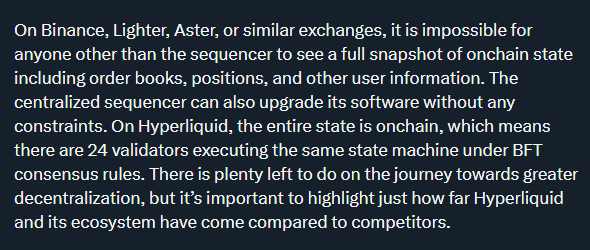
Hyperliquid is built on a foundation of onchain transparency. A recent article made several claims that are factually incorrect: + Solvency: Every dollar is accounted for; the author failed to count native HyperEVM USDC. + Integrity: Testnet functions are exactly that - testnet only for testing. They cannot be executed on mainnet. + Transparency: Hyperliquid is more transparent and decentralized than all other major venues for perps trading. The entire state is independently maintained by a permissionless validator set and verified through BFT proof-of-stake consensus by each node. Every order, trade, and liquidation is available in real time during execution. Anyone can run a node and index the chain’s state and transitions. No major perps platform comes close to this guarantee for users. See our response to the writer’s individual points below. Claim: The system is undercollateralized by $362M False: The Hyperliquid blockchain state is fully and verifiably solvent. The author excluded the HyperEVM USDC (a publicly announced and much anticipated integration), which exists in parallel to the Arbitrum bridge. Every USDC in circulation on HyperCore is accounted for transparently, by summing up the balances of arbiscan.io/address/0x2df1… and hyperevmscan.io/address/0x6b9e…. At the time of writing, this amounts to 3.989B + 362M = 4.351B USDC on HyperCore. USDC on the HyperEVM can be computed by subtracting 362M from the 421M on the HyperEVM USDC contract (hyperevmscan.io/token/0xb88339…), totaling another 59M USDC on HyperEVM. The sum of the Arbitrum bridge and native USDC balances can be compared against the sum of user balances on HyperCore. As highlighted in the introduction, this exercise of verifying complete system solvency against user balances is uniquely possible on Hyperliquid compared to competitors. The current Arbitrum bridge was an important stepping stone in bootstrapping the Hyperliquid network and will be deprecated as the migration to native USDC is complete, bringing Hyperliquid to parity with other major L1s. Claim: There is retroactive volume manipulation via TestnetSetYesterdayUserVlm False: This is a testnet-only function to allow for comprehensive testing. The author states that “the function’s presence is the problem…capability alone violates the trust model.” Testnet-only features that enable more rigorous testing of edge cases do not undermine the chain’s integrity. The fee schedule on Hyperliquid interacts in a complex way with inputs: user volume, aligned quote token status, maker vs taker, HIP-3, etc. It’s important to test these interactions on testnet, and therefore the testnet chain has a set of admin testing functions that do not exist on mainnet. The related TestnetAddMainnetUser action is to mark a testnet user as having corresponding mainnet state, to avoid DDOS and other attacks that are “free” on testnet. None of these functions are callable on the mainnet state. While the execution source is not available, anyone can verify every trade onchain by running a node, and sum up the values to confirm that volume numbers are reflected accurately in onchain state. Similar to onchain solvency verification against the sum of all user account values, this is possible on Hyperliquid but not on most competitive platforms. Given that this code path is entirely unreachable on mainnet, future development work will entirely compile out this testnet-only logic on mainnet nodes to avoid any possible misunderstanding or misinterpretation. Claim: Some users have special privileges such as fee exemptions or retroactive volume manipulation used to influence the airdrop False: Like system solvency, user balances, and individual trades, the fees paid by any address is available onchain. Each trade along with its fees paid or rebates received are transparently indexed by nodes, API servers, and third party analytics providers. There are no such mechanisms to distort fees, and no such mechanisms could have influenced the HYPE airdrop. Furthermore, the genesis distribution of HYPE is fully available onchain, and users can verify the historical behavior of every such address. Claim: “CoreWriter” godmode can mint tokens, move user funds without signatures, crash random validators and basically do whatever it wants False: The CoreWriter spec is fully documented here hyperliquid.gitbook.io/hyperliquid-do… and replicable in the open source HyperEVM execution. CoreWriter is a way for smart contracts on HyperEVM to send HyperCore actions as part of HyperEVM block execution. It supports various actions that are normally sent by EOAs such as staking and placing orders, but has no such features to “mint tokens, move user funds without signatures, crash random validators and basically do whatever it wants.” This is a fundamental misunderstanding of how HyperCore interacts with the HyperEVM. Claim: Chain can freeze via governance, and no undo function exists Misinterpreted: The chain freezes during network upgrades. There is no undo function because the validators adopt a new binary at that height. This is analogous to how other networks perform hard forks at future heights determined by social consensus. Suspicious activity on POPCAT in Nov 2025 did not cause the L1 to freeze, nor were any user funds frozen. The L1 was entirely operational, and any observer can see the blocks that were produced during this time. The Arbitrum bridge was automatically locked after the incident due to abnormal variation in account balances. As explained above, the Arbitrum bridge is not as secure as natively minted USDC, and therefore requires several conservative automated locking mechanisms as safeguards. The Arbitrum bridge’s locking mechanism is audited and open sourced, and the bridge is being deprecated with the transition to native USDC. Claim: A single private key can set any oracle price instantly: no timelock, no limits Misinterpreted: The author is likely mistaking the HIP-3 oracle updater logic with the validator-operated perps. HIP-3 oracle updates are indeed set by a single address, but this is up to the deployer to configure. The updater address need not be an EOA. For example, current HIP-3 deployers use a combination of MPC and CoreWriter architecture. For validator-operated perps, multiple validators can submit oracle price updates. The final prices are a robust weighted median across major centralized exchanges. There is no timelock and no limits explicitly because these limits make the system less, not more, safe. The events of 10/10 show the danger to solvency if ADL is not accurately triggered in a timely manner during high volatility. Hyperliquid was one of the only venues without performance degradation or a network outage during this time. If Mango Markets or a similar protocol with oracle rate limits were active during 10/10, they would have likely accrued bad debt. Further decentralization will involve other validators actively running independent and open-sourced oracle update binaries. Claim: 8 undisclosed addresses control all transaction submission False: Some transactions are already sent directly from the validators. Some such as orders are not, in order to minimize MEV, but a future upgrade will incorporate this logic for all transactions in a mechanism that is both MEV- and censorship-resistant. The careful consideration of MEV is in response to trader and researcher feedback based on predatory behavior observed on other chains. There is almost unanimous agreement that toxic transaction ordering degrades the end user experience. Ultimately, the validator set is permissionless, and there is no guarantee that validators in the mainnet set are always fully aligned with the ecosystem. A major milestone in decentralization will be solving this problem, including a multiple-proposer block building setup. Claim: There is a liquidation cartel with unfair advantages Misinterpreted: Only HLP may backstop liquidate users, and HLP subvaults are the only addresses in this set. However, depositing into HLP is permissionless, so HLP is a community-owned liquidity vault supporting the protocol. The fact that HLP has privileges is no different from other protocol liquidity vaults. Relatedly, all liquidations are first attempted against the order book, which handles the vast majority of liquidated positions without backstop liquidation. This allows users to keep any remaining collateral, and allows all other users to compete in providing the best price to the liquidation flow, benefitting the liquidated user. Claim: There is a hidden lending protocol with $1M+ supplied and no documentation False: Portfolio margin, borrow lend, and the HLP supplied value were all publicly announced and are currently in pre-alpha rollout. The current documentation can be found at hyperliquid.gitbook.io/hyperliquid-do… and has been progressively fleshed out over the past several weeks. Claim: ModifyNonCirculatingSupply allows changes to token supply False: The full supply of HIP-1 tokens on HyperCore is fixed at deployment. The non-circulating supply is a purely informational number that can optionally mark addresses as “non-circulating” for display purposes. Whether an address is marked as “non-circulating” does not affect execution. This is an example of onchain information that might make more sense offchain, but is not a vulnerability. Thank you to the author for spending the time to verify the execution of Hyperliquid. The fact that this investigation could be done at all proves the transparency and decentralization that Hyperliquid has already achieved. Concretely, Hyperliquid is the only major perps venue where the entire state and every input diff is transparently available to anyone running a node. A similar analysis on any of the other top perp DEXs is impossible. For example, Lighter uses a single centralized sequencer whose execution logic and ZK circuits are unavailable. Aster uses centralized matching and even offers dark pool trading, which is only possible with a single centralized sequencer without verifiable execution. Other protocols with some open source contracts do not have a verifiable sequencer. On Binance, Lighter, Aster, or similar exchanges, it is impossible for anyone other than the sequencer to see a full snapshot of onchain state including order books, positions, and other user information. The centralized sequencer can also upgrade its software without any constraints. On Hyperliquid, the entire state is onchain, which means there are 24 validators executing the same state machine under BFT consensus rules. There is plenty left to do on the journey towards greater decentralization, but it’s important to highlight just how far Hyperliquid and its ecosystem have come compared to competitors. Decentralization is progressive, and Hyperliquid will ultimately be fully open sourced. Hyperliquid is the most transparent of all major venues, even though this leaks advantages to competitors (all of whom are closed source), who can copy Hyperliquid’s innovations more easily. We think this is the correct tradeoff to balance value accrual to the community, speed of innovation, and upholding the values of defi. The HyperEVM execution is open source, and Sprites, an independent community member, maintains a full archival node that powers many important integrations. HyperCore will follow the same path as soon as it reaches feature completion.
English
@gajesh @fiddybps1 I would not want socialism on my assets lol
English

@fiddybps1 oh that’s cool
- can u share more info on privacy aspect
- who takes the loss if there is no ADL
English

I'll go
+ zero fees
+ privacy
+ no ADL
appreciate the layup 😂
Max Long@YieldMaxing
Spot 3 differences between @paradex and @HyperliquidX (you can’t)
English
CryptoXman.hl retweetledi

Hyperliquid FUD season
> researcher reverse-engineers code
> claims $362M undercollateralization
> team drops detailed rebuttal within hours
> turns out he just missed native USDC on HyperEVM
> basic ignorance and clickbait-hunt
> "backdoors for manipulation!"
> testnet QA functions that can't be called on mainnet
> team removes them anyway to avoid confusion
> "secret privileges for insiders!"
> all fees for every address available onchain
> anyone can verify anytime
> "hidden lending protocol!"
> it's portfolio margin (BLP) in pre-alpha
> publicly announced months ago
> documentation exists
> "researcher" doesn't read basic docs
> onchain detectives find wallet shorting HYPE
> "team is shorting their own token!"
> team publishes full Trading Policy
> reveals it's an ex-employee fired 9 months before TGE
> every accusation gets a point-by-point response
> with links to contracts, docs, onchain proof
> not "we'll look into it" - instant detailed breakdowns
The funniest part?
Try running this audit on Binance, Lighter, or Aster.
You can't. Closed sequencers. No state verification. Trust me bro architecture.
On Hyperliquid - 24 validators, BFT consensus, every order and liquidation onchain. Anyone can spin up a node and verify.
The FUD is only possible because HL is fully onchain.
That's the difference between "trust me and my VC" and verifiable transparency.

English
@HyperFND @HyperliquidX Stupid FUD will finally be burnt
Hyperliquid
English
The Hyper Foundation is proposing a validator vote to formally recognize the Assistance Fund HYPE as burned, removing the tokens permanently from the circulating and total supply.
For context, the Assistance Fund converts trading fees to HYPE in a fully automated manner as part of the L1 execution. The Assistance Fund uses the system address 0xfefefefefefefefefefefefefefefefefefefefe. Similar to the zero address, the Assistance Fund system address has never had a private key with control over its funds. Funds are mathematically irretrievable without a hard fork.
By voting “Yes,” validators agree to treat the Assistance Fund HYPE as burned. No onchain action is required, as the tokens are already in a system address with no private key. This vote is binding social consensus to never authorize a protocol upgrade to access this address.
Voting process:
+ Validators should signal their intent in the governance forum by December 21 at 04:00 UTC (i.e., reply with Yes or No)
+ Users can stake to a validator who matches their view by December 24 at 04:00 UTC
+ The result will be based on stake-weighted consensus as of December 24 at 04:00 UTC
English