고정된 트윗

If you ain’t creating, you’re just another sheep stuck consuming.
Keep sharding.
the Jacket effect available 👇
t.me/jacketegld

English
JACKET | e/acc
417 posts

@jacketegld
The black leather jacket, the symbol of our truth machine—https://t.co/Qvw7hbcovJ | JACKET-c44ffb |

Today President Trump signed Executive Orders to make the U.S. the global leader in both Crypto and AI. I appeared on @FoxBusiness to discuss.





XOXNO's Liquid Staking DeFi Easily Explained TL;DR - @XoxnoNetwork launched its Liquid Staking protocol, bringing diversity to the @MultiversX DeFi ecosystem; introducing some really interesting features. Sounds on! 🔊 --- TIMESTAMPS Introduction — 0:00:07 DeFi Competition is a good thing — 0:00:56 Everything is Open Source — 0:01:38 Liquid Staking EGLD<>xEGLD — 0:02:18 Liquid UnStaking xEGLD<>EGLD — 0:03:27 Liquid Staking/Unstaking Illustrated— 0:04:28 Liquid Staking Migration sEGLD<>xEGLD — 0:06:12 Liquid Staking $XOXNO<>LXOXNO — 0:07:15 Conclusion — 0:08:40 --- There is a new Liquid Staking player in the MultiversX! According to Dapp Radar, that recently integrated $EGLD, XOXNO is the third-largest application by unique active addresses. This, mostly considering its NFT market and ticketing solution, but things are changing, in a good way. XOXNO now offers decentralized finance services, and I’m positively impressed with what I’ve seen so far. Here’s why. I’ve been exploring XOXNO’s liquid staking and money market (for lending & borrowing) apps. I have to say that I’m really excited with what the team is building there, bringing more options to DeFi users, investors, and traders in the MultiversX ecosystem. First, the most exciting thing about it all is that, as a user, I love some high-quality competition. Before XOXNO’s DeFi launch, we only had one option for liquid staking and money market in MvX. Now, we have one more option, which helps mitigate risks by getting exposure to two different protocols instead of only one. This can be a really smart strategy, considering each protocol has its own set of smart contracts and unique design, with advantages and disadvantages. Here I’ll explain some of the advantages I believe XOXNO has. In summary, they are: 1. Everything is open source All the code can be easily verified in the XOXNO’s repositories on GitHub and the community can independently audit every aspect of it for security threats like bugs and vulnerabilities, without needing to ask permission for that. By being open source, anyone can also permissionlessly learn how to perform specific activities, such as becoming a liquidator for the money market. Open source means more accessibility, more decentralization, and also more security, with more eyes looking at the code. 2. Distributed liquid staking in a non-arbitrary validator’s set XOXNO’s liquid staking does not handpick their validators (or staking providers). The protocol currently delegates to the top 60 providers in the MultiversX ecosystem, according to an automated score system that takes many things in consideration and don’t plan to arbitrarily add or remove anyone, according to the team. Moreover, the delegation is also made in a way that, every time someone stakes EGLD in XOXNO’s liquid staking, this staked amount is distributed to all validators (and not the entire batch given to a randomly selected provider), following the score system to weight the distribution in a way that favors decentralization and the quality of each setup. For example, distributing more to smaller providers with a good uptime. But this is an oversimplification of the design, which anyone can verify in the open-source code for more details. 3. Distributed unstaking and no 10-day unbounding period Just like the distributed staking, XOXNO has a distributed unstaking mechanism, removing their delegation from the entire validator set once a user redeem their EGLD, instead of a single-batch removal from a randomly-picked provider of an arbitrary list. This is great, especially in the case of a whale unstaking significant amounts that could really harm a small staking provider. Furthermore, all staked EGOLD first goes to a buffer (a smart contract pool) before being distributed to the providers. With that buffer, xEGLD holders unstaking from the protocol can immediately receive their EGOLD, without waiting for the 10-day unbounding period, according to the pool’s availability. Let’s illustrate it all here with an example. Alice stakes 1000 EGLD with XOXNO’s liquid staking service. These 1000 EGOLD will be distributed to all the 60 validators, at an average rate of 16.66 EGOLD per staking provider, according to the score system. This prevents a single validator from receiving the entire 1000 EGLD batch, which would be bad for decentralization. Before that, however, the 1000 EGOLD will temporarily sit in the buffer, available for unstakers. Bob is even a larger whale than Alice, already liquid staking with XOXNO. But now, he wants to unstake his 6,000 xEGLD all at once. Using other liquid staking services, this amount would be removed from a single randomly picked provider, which could nuke this provider’s position. Instead, 100 EGOLD is removed from each of the 60 validators. Now, I mentioned a “no 10-day unbounding period,” which is true for most activities, but probably not in this case. At least not integraly. In this example, Bob would probably receive Alice’s just-staked 1000 EGLD, while the protocol resolves the staking<>unstaking dynamics in the background. For the remaining 5000 EGOLD, Bob would probably need to wait the 10-day unbounding period, as usual, receiving his EGLD in due time. 4. Migrate from other liquid staking protocols While trying to increase its market share, XOXNO’s team is offering a seamless migration from other EGOLD liquid staking tokens like sEGLD and HsEGLD, from Hatom. Basically, the protocol will handle the sEGLD unbounding period, while providing xEGLD in return. One point of concern that I have here is that it is not clear whether this xEGLD is fully backed by extra EGOLD being staked to XOXNO’s validators set while the sEGLD is still bounded with Hatom; or if it’s minted under the unbounding expectation alone. That said, another cool feature for the migration module is that the protocol will cover the missing staking rewards from its own revenue, all happening in the background. The users won’t even notice that something is happening. 5. XOXNO’s token liquid staking and revenue sharing Besides the EGOLD liquid staking, the platform also offers the possibility to liquid stake its native token, XOXNO. And that’s another feature that uses the Dapps revenue. So, essentially, XOXNO sends all the protocol revenues to a smart contract account called Accumulator. These rewards are then used to buy the XOXNO token back from the market and distribute all of it to the “Real Yield Staking” smart contract, which increases the intrinsic value of LXOXNO, benefiting all its holders simply by holding this liquid staking derivative in their wallets. --- My plan was to cover all the DeFi features in a single post, but this one got far longer than I expected. Which is why I will leave the money market app for a next video. In the meantime, you can sneak-peak these features via the public devnet and join the community tests. The liquid staking features are already live, but the money market is planned to be launched soon; introducing some cool stuff like the “E-mode”, the Multiply Feature, and also the possibility to easily open longs and shorts with the lending and borrowing functionalities. Let me know if you liked this video, and don’t forget to follow me for more educative content on the decentralized finance or other interesting use cases out there. --- This content was made in partnership with the XOXNO team, but it was created fully independently and without interference. Everything I said here is my real opinion and personal understanding of the project and is made for educational and entertainment purposes, not a financial advice nor an advertising material.


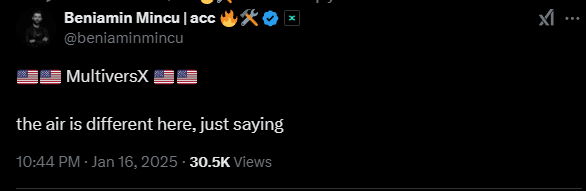

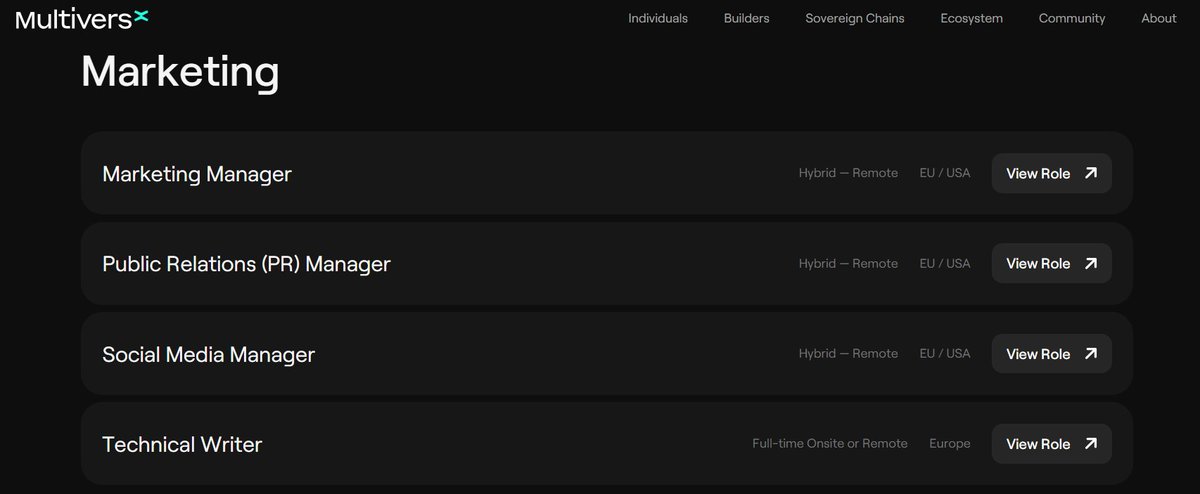
#MultiversX is expanding in the US 🇺🇸. Exciting roles available in marketing, social media and PR.