
고정된 트윗
Jaylene
165 posts

Jaylene
@jaylene
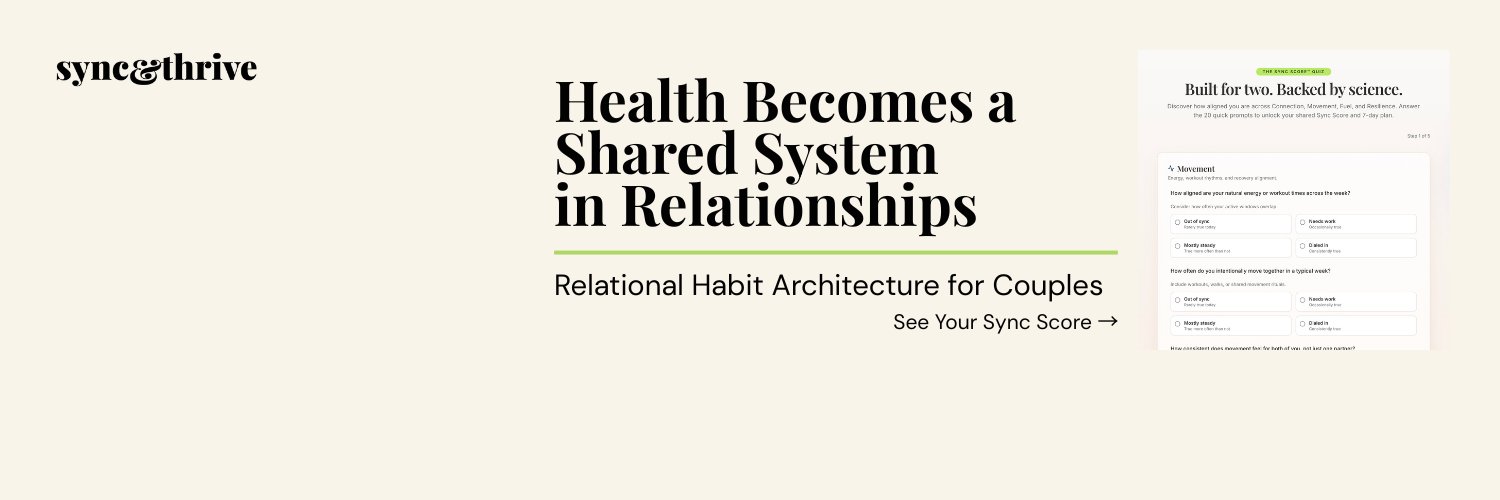
Designing Shared Health Systems for Couples @ Sync + Thrive™ Living & Teaching Relational Habit Architecture See Your Sync Score → Take the Quiz 👇
Portland, OR 가입일 Nisan 2008
98 팔로잉65 팔로워
A retired couple who trains together. A divorced man who said: "I wish we'd done this when we still had the chance."
Two different endings to the same story.
Health habits aren't built in isolation. They're built through the relationship itself, whether you're doing it intentionally or not. (Kiecolt-Glaser & Wilson, 2017)
@fittinsider's 2025 data shows gym members are nearly 2x more likely to be regularly active than non-members. Structure drives consistency.
But the relationship is the deeper structure.
So the question we keep coming back to: where are the couples in their 30s and 40s who are still in that window?
Still forming the habits that will shape the next 30 years. Still deciding whether to do it together or in parallel.
That's exactly who we built Sync & Thrive for.
syncyourwellness.com

English
I do not think every couple needs the same workout.
I do think every couple benefits from having at least one kind of movement that feels like it belongs to both of them.
The goal is not sameness.
The goal is a rhythm both people trust.
Sometimes a shared workout is not even about fitness.
Sometimes it protects the feeling that you are still on the same team.
What would change in your relationship if the two of you had one movement habit that belonged to both of you?
Wrote more about this in today’s Sync & Thrive issue:
syncyourwellness.com/p/your-optimiz…
English
Jaylene 리트윗함

You attract people at the level of your self-worth, not your desire.
ㅤ
Want to get with better people? Become better yourself.
English
Jaylene 리트윗함

Modern wellness is built for individuals.
But health is negotiated inside relationships.
Most couples run on shared habits they never designed.
The Sync Quiz™ shows where your routines are aligned—and where they quietly drift.
Take the 3-minute quiz
syncyourwellness.com/quiz
English
Jaylene 리트윗함

Nobody tells you this: 99% of a successful marriage is just genuinely enjoying each other’s company. People make these long lists of traits they want to find in a partner, but so much of life just comes down to being kind and pleasant to be around.
English
What are you doing today that your future relationship will thank you for?
They’re built when growth happens in tandem, on purpose, in the books you read, the food you eat, and the habits you build.
Lewis Howes@LewisHowes
What are you doing today that your future self will thank you for?
English
High-performing couples don't measure connection by hours spent together.
They measure it by presence.
You can spend an entire evening in the same room and still feel miles apart. Or you can have 30 minutes of undistracted conversation and feel completely seen.
The couples who stay connected aren't the ones with the most free time.
They're the ones who protect the quality of the time they do have.
So they create micro-moments of undivided attention throughout the day.
• A two-minute check-in over morning coffee.
• Eye contact and a real answer to "how are you?" • Phones down for the first 10 minutes after work.
Connection isn't built in quantity. It's built in quality.
And quality doesn't require clearing your calendar. It requires showing up fully in the moments you already have.
English
Your HRV, cortisol rhythm, and immune markers don’t operate in isolation.
They sync with the person you share life (and stress) with.
Learn how to re-sync your body and your bond.
👉 syncyourwellness.com/subscribe
English
I'm an early riser, but my husband gets up even before I do.
I process stress by talking it through, but sometimes I need space before I can articulate what's actually going on.
He recharges with quiet mornings. I need movement to feel awake.
For years, we thought mismatched energy patterns were something to fix. They're not. They're just design challenges.
Resilient couples stop trying to change each other's rhythms and start designing around them.
So we mapped our energy patterns together.
We identified when each of us is at our best and when we're running on empty.
Then we started scheduling important conversations and quality time for when we both have capacity, not just when it's convenient.
We stopped interpreting different rhythms as disconnection and started treating them as data.
Your relationship doesn't need matching energy 100% of the time. It needs mutual understanding.
English
Resilient couples create space for both people to expand while strengthening what they're building together.
So they have quarterly alignment conversations.
Each person shares:
• What they're building right now
• What support they need
• Where their goals intersect and where they diverge
Then they identify how to actively champion each other while growing their shared identity as a team.
You don't always have to want the same things to be on the same team.
But you do have to be clear about what you're each building, how you'll support each other, and what you're creating together.
English
You wouldn't train hard seven days a week without building in recovery.
So why do we expect relationships to operate at full intensity without the same intentional recovery?
Conflict, stress, misalignment; these aren't signs of failure. They're part of the load.
Resilient couples build recovery into their rhythm.
So they create a post-conflict reset ritual.
After a hard conversation, they take time to cool down and process individually. At least 20 minutes, but ideally before the day ends. Then they come back together and ask:
• "What did that bring up for you?"
• "What do you need from me moving forward?"
• "What can we learn from this?"
They don't just move on and hope it resolves. They actively repair.
Your relationship doesn't need to be conflict-free. It needs to recover well.
English

Resilient couples know that small gestures of appreciation compound powerfully.
So they practice the 3-to-1 rule.
For every one thing that frustrates them, they notice and name three things they appreciate.
They say it out loud to their partner, making it specific and genuine.
English
We stopped waking our kids up for school. 4 kids ages 9 - 15 in 4 different schools.
Last week my wife and I woke up and were like "What are we even doing? Why are we waking up our kids for school? Over and over?
Oh, and why are we still making the 9 year old's lunch?"
We want them to be high agency people, and to experience consequences. They all have alarm clocks. And hands.
But sometimes we don't live according to what we believe.
So we stopped waking them up and making them lunch - cold turkey. Kids were late. Panic ensued (for like 2 days). No one died or starved.
We should have done it years ago.
If you let them fail small at home then the failure will be much more manageable outside of the home.
That's the gamble we're taking, anyway. I'll let you know if it works in 30 years.

English
The shift from "my goals" to "our goals" doesn't mean losing yourself.
It means building something bigger together while still honoring what each of you is called to create.
The strongest partnerships aren't built on merged identities or on completely separate paths.
They're built on two whole people who choose to align their ambitions and actively support each other's growth.
English
Mandatory patterns for couples who want to stay connected:
1. Protect one evening on the calendar this month
2. Share one meal without distractions
3. Eat real food consistently
4. Learn one thing together
5. Take five minutes each week to notice what’s working
It starts with one small move. Protect your connection.
English
@myfirstmilpod @denk_tweets @beehiiv @ShaanVP Learning from those that know how to ship fast. Thanks for sharing.
English

@denk_tweets got 400 people to join a waitlist that didn't exist.
With just one tweet calling out Substack's revenue cuts and saying "Want the exact tools I built at Morning Brew?"
Positioning beats everything.
@beehiiv @ShaanVP
Full episode:
YouTube: mfm.oia.bio/TylerYT
Spotify: mfm.oia.bio/TylerS
Apple Podcast: mfm.openinapp.link/TylerAP
English

I was looking for the syrup in the fridge this morning during breakfast and swear I stared at the fridge for 10 seconds before asking my wife "where's the syrup" and she literally reached right in front of my face and grabbed it. It wasn't even behind something. Was right there.
English