karsten

142 posts

karsten banner
karsten

karsten

@karstenalytics

Years of Big4 Consulting Experience. Now on-chain Solana DeFi analytics for emerging projects

가입일 Haziran 2019
739 팔로잉185 팔로워
고정된 트윗
karsten
karsten@karstenalytics·
Some of the projects I am following have high transparency, some don’t. Most share just favourable data. Understandable! And for obvious reasons. This is why I provide an independent source of data, built from on-chain tx from the ground up. Focus on smaller projects, and deeper than platforms like @DefiLlama and @tokenterminal can do it.
English
0
0
0
117
karsten
karsten@karstenalytics·
@redacted_noah the IDL situation is indeed unsatisfying… I started to build an IDL history for the projects I cover myself to solve this. Can still work nicely if you run it automated and potentially even let Claude create issues/ PRs if an IDL change would break something (on my side)
English
0
0
2
3.9K
Noah 🎈
Noah 🎈@redacted_noah·
It's been about a year, so I think it'd be fun to look back and see which of these complaints has been solved. 1. IDL infrastructure is even more of a mess now. There's now two sources of truth, the original PDA and now a metadata program. Unfortunately, the metadata program was built without first class support for IDL versioning. So, next time IDLs change major versions, expect more pain. 2. Parsing historical programs given the lack of IDL versioning/history is still a problem now, and with the added metadata program it's now slightly worse. 3. The read layer has improved substantially. Most rpc providers heavily index gPA, so it's not as bad (still bad). Indexers have gotten unbelievably reliable now, such that I trust running an entire UI off of indexed data. It's heavier, you have devops costs, but at least it works and you can customize to your heart's content. 4. Running an API powered by indexers is still somewhat pricey 5. Transaction sending and landing is more or less solved. I haven't had to think about this in months. Smooth as butter. 6. Anchor has gotten faster and they've fixed a lot of the issues that blow out memory. There's still a lot of improvements to be made here, and new frameworks/anchor v2 are coming. 7. CPI depth limit is set to be increased. So this will not be an issue for much longer. 8. TX size limits are set to be increased. So this will not be an issue for much longer. 9. Rent costs have gone down because SOL price shit the bed. Yay? They are also going to actually cut rent costs soon™ 10. All of the cNFT issues described still exist. These have mostly been solved by just not using cNFTs. Use core or token metadata nfts instead. 11. Errors have, for the most part, gotten better. There are still quite a few useless errors, though. 12. All of the top wallets are still closed source. No progress made there, and seems like no one cares. 13. Rust anchor client still sucks. 14. Explorers still have issues, but thanks to claude I built my own that solves most of the issues (explorer.chewing.glass) 15. The base RPC spec still sucks, but if you're okay with vendor lock-in, Helius has a ton of useful APIs. Transaction history. Ability to only fetch accounts that have changed since a given slot. Etc. 16. I actually haven't had a dependency hell issue in a few months, I also haven't upgraded anything. Maybe it's getting better? 17. I haven't had issues with preflight disabled transactions in a while. Not sure if they fixed these issues, or I just started simulating more often. 18. Running programs on a cron is largely fixed. I wrote tuktuk for this, and it's been running reliably for almost a year. Largely things seem to be getting better. I've noticed that a lot of the pain goes away if you shove all of your solana-related stuff into an API, and use that API from your various clients web2 style. You can leverage indexers for complex queries. You can change your program and IDLs without breaking all clients. You can record your own transaction history. Etc. I always had a dream that blockchain dev was a way to avoid devops costs and burden by running everything on decentralized infrastructure. We seem to have moved far from this ideal, web3 is just web2 with another kind of database. Doesn't look great for protocols outliving their parent companies, but as we've seen that almost never happens anyway.
Noah 🎈@redacted_noah

As requested, all my current complaints in no particular order: 1. Uploaded IDL on-chain management is a mess. It has no versioning history, and when IDLs have breaking changes (like anchor 0.30+) all old clients currently looking at the on-chain IDL break. Why can't I lock a client to an IDL major version? Why is every IDL producer slightly different? Anchor, shank, etc should all produce the same thing. Published IDLs are wonderful in that I can add an account that's referenced by a has_one or PDA without breaking existing TS clients. But they need proper versioning. 2. Related to 1, since there's no IDL history, parsing historic transactions on Solana is impossible. Contract endpoints change, IDLs change, there's no history of it. 3. Read layer. The read layer sucks. You can do a lot to structure your program code to optimize for point-queries using PDAs as a kind of index. Like a crappy redis. But the second you need to do list queries ("get me all governance proposals with this tag") you're hosed. gPA is a terrible thing to use. That means you need an indexer! 4. Indexers. I have spent literal years wrestling with indexing on Solana, trying to get it so you catch every anchor record and insert it into postgres. *Finally* I have a solution that works, thanks to @streamingfastio. But even one stream is ~$500/month. Not really accessible to a dev trying things out in their spare time. Fine for Helium. 5. Transaction sending and landing. This is arguably the ONE thing a blockchain should be good at. Why am I talking to like 5-10 different people to find the optimum way to restructure my tx builder+sender every 3 weeks? Prio fees, stake weight QoS, compute limits, jito, lookup tables, transaction vs VersionedTransaction (the most ugly interface ever in both ts and rust). There's just so much to unpack here. Wrap it all up and throw it in a black box I don't ever have to look at again. Please. 6. Anchor performance. Anchor hogs a bunch of memory, newest versions init_if_needed almost always causes it to blow the heap. It also uses a bunch of CUs. It's the most used framework for smart contracts, let's pour all the resources we have into making it better. Native solana code is seriously so ugly to read it's a security hazard. There's no reason anchor, which is all pretty macros, can't be made to be just as fast. 7. CPI call depth limit. It's arbitrary, and low. Sometimes for composability you need more. CPIs are also super expensive. @blockiosaurus has some nice posts on why composability is a lie. 8. Tx size limits. This is actually the least of my problems, I can almost always find a way to work around this. 9. Rent is TOO DAMN HIGH. Sol is mooning, so rent is getting crazy high. I work for a company with funding, so it's not an issue for me. But if I were trying to do Solana in my spare time, $3000 to deploy a smart contract is ridiculous. 10. cNFTs continue to cause issues. If you need to mint a cNFT, then do something with that cNFT, you need to wait for the cNFT to be indexed so you can get its proof so you can construct the subsequent transaction _doing_ something with that cNFT. Huge headache. I wish Core NFTs had existed when we migrated helium, I would have used those instead. 11. Errors. Solana errors are notoriously unhelpful. #L277" target="_blank" rel="nofollow noopener">github.com/anza-xyz/agave…. This entire list should tell you which account the error came from. This is actively being worked on by Solana devrel. 12. Wallets. Of the top 3 wallets (Phantom, Solflare, Backpack) none of them are open source. One is source available, but usually pretty out of date. Wtf. 13. Rust clients suck. Using things like anchor from typescript are a breeze, because there's dynamic account resolution of has_one's and PDAs. Every time I have to use rust, it's like going back to the stone age. 14. Explorers suck. Why am I still using explorer.solana.com? Because it's the only one that consistently doesn't have broken IDL parsing, and has all the information that I need, and works with localnet devnet and mainnet. But it's notably missing things like seeing all txs on a program and filtering by instruction type. 15. The base RPC spec is missing tons of functionality. For one, it sucks at priority fees. Second, it's missing read level functionality enterprise web apps usually make use of, like incremental updates. I shouldn't need to waste data refetching accounts if they haven't changed. But there's no way to say "getMultipleAccounts that have changed past block x" 16. Dependency hell. ALWAYS with the dependency hell. Semver is never followed, especially on rust clients. So upgrading dependencies is always a nightmare. 17. Error handling when you turn off preflight checks is horrendous. Often times, if you've messed up the tx (too large, don't have enough sol, etc) it'll just hang forever. Hanging forever has to be the least desirable outcome for anything. 18. No ability to easily run txs at a specified time/on a schedule without deploying your own workers/crons. RIP clockwork (dw, I'm building a solution to this) I'm sure there's more, but my build finished to it's back to work. This is just top of mind.

English
9
9
82
22.9K
karsten
karsten@karstenalytics·
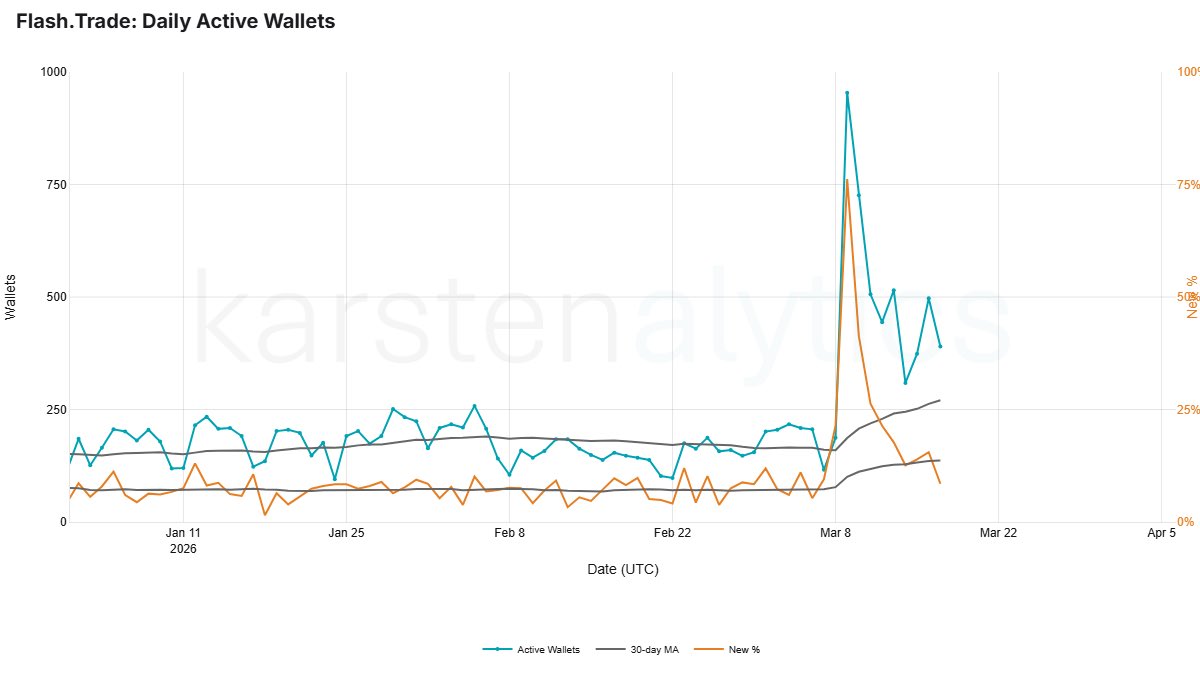
The recent #seeker campaign of @FlashTrade was (for me) surprisingly impactful. They spent ~10k USD for wallet funding and got a massive, and somewhat sticky, inflow of new users. Even the number of $FAF stakers increased a lot. Curious to see how this develops over the next weeks.
karsten tweet media
English
0
0
3
117
karsten
karsten@karstenalytics·
$TUNA stakers have been suffering from a revenue perspective recently (APR <1%) due to low volatility. karstenalytics.com/analysis/defit… I will drop an article tomorrow that shows how @DeFiTuna fee-to-revenue flow works, and how liquidations used to drive majority of protocol revenue.
English
0
0
1
69
Noah 🎈
Noah 🎈@redacted_noah·
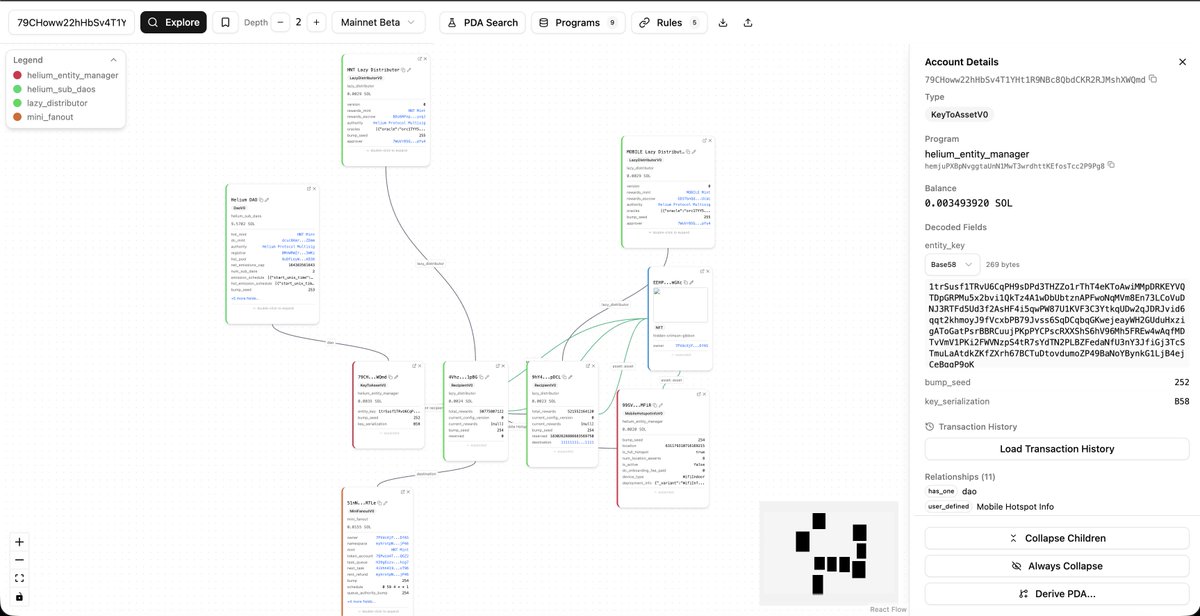
(1/?) Introducing the Chewing Glass Explorer, a Solana explorer built for devs. I got tired of explorers, so this week I decided to vibecode my own. Sol is basically a graph database, devs want to be able to explore the full context of accounts without a million clicks.
Noah 🎈 tweet media
English
20
30
223
25K
karsten
karsten@karstenalytics·
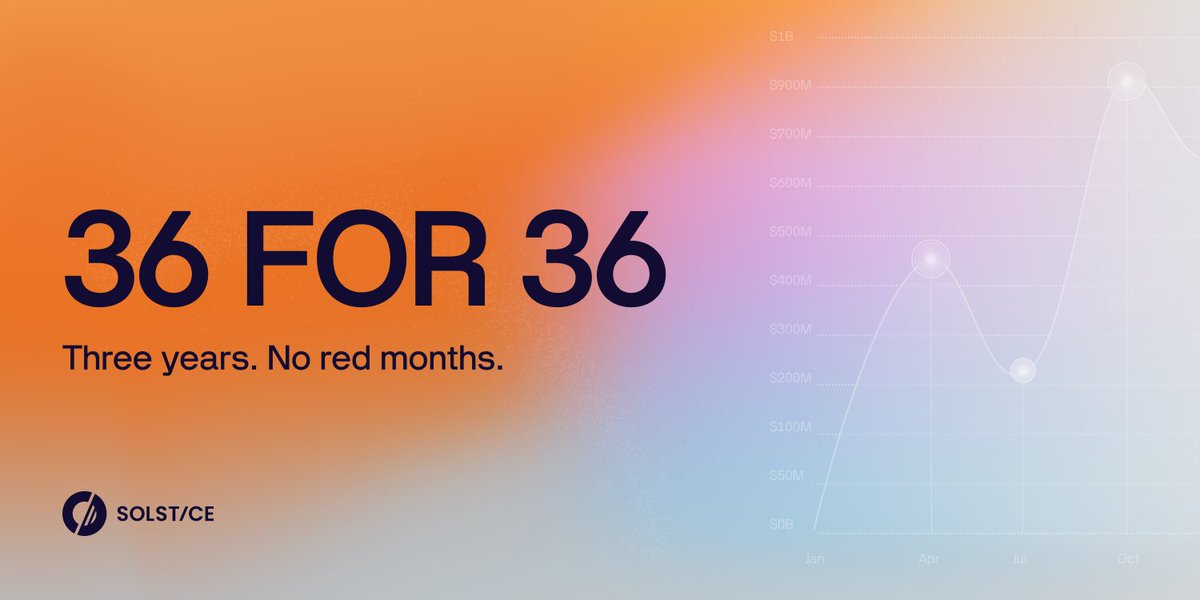
@solsticefi The YieldVault as Solana Program exists since less than a year - so I guess you aren’t talking about $eUSX. Is there documentation of the returns before that?
English
0
0
2
79
Solstice
Solstice@solsticefi·
36 for 36. Three years, no red months. YieldVault has delivered positive returns every month since January 2023. Rate hikes, market crashes - doesn't matter.
Solstice tweet media
English
20
9
129
5.7K
karsten
karsten@karstenalytics·
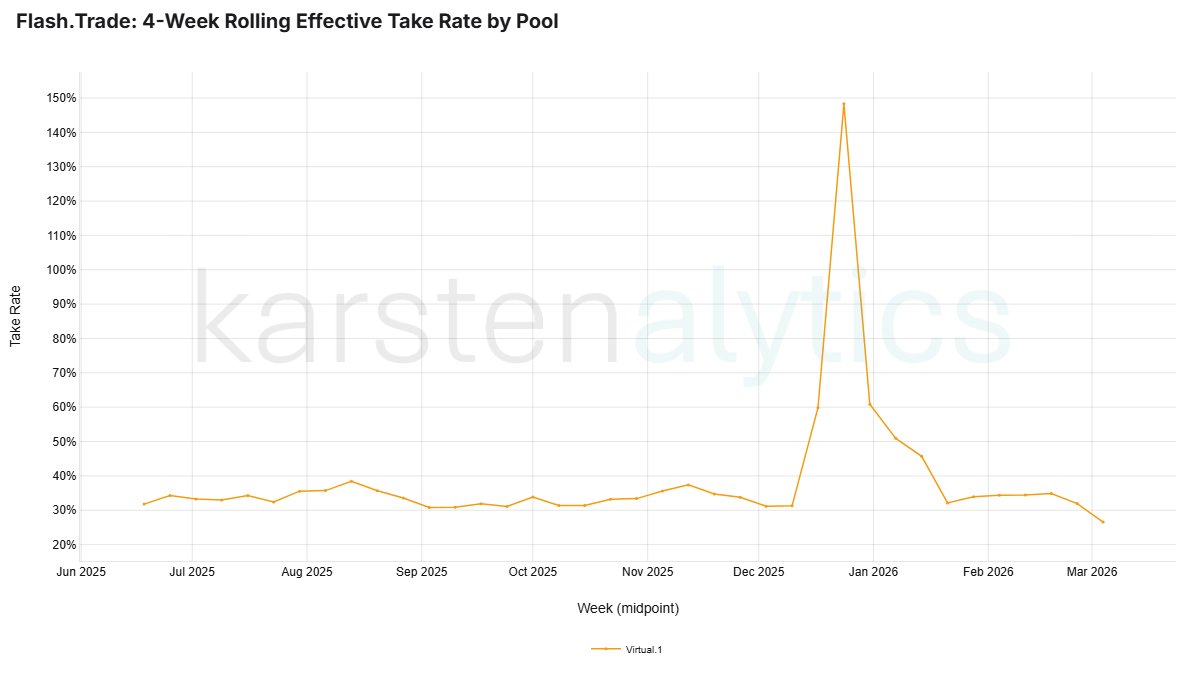
Why are the lines so noisy? Not all. The more stable the blend of vaults, the higher the volume, the more stable the line. There is time lag in revenue distribution. Crypto.1 has same rev share %, high volume - line is stable. Overall, rev share a bit below 30% - makes sense!
English
0
0
0
21
karsten
karsten@karstenalytics·
A wild outlier: Virtual.1 briefly hits ~150% rev share in December, which doesn't make sense. But according to my data, there were some "hiccups" in revenue distribution, and after it resumed, there was a catchup effect of revenue distributed.
karsten tweet media
English
1
0
0
42
karsten
karsten@karstenalytics·
Sharing some second thoughts on this article, because based on it I created this "Effective Take Rate" analysis for @FlashTrade: karstenalytics.com/analysis/flash… It answers: "How much % of fees of a pool went to protocol and $FAF stakers?" Let's check what's going on there -->
karsten@karstenalytics

I wanted to understand how @FlashTrade’s fees reach $FAF stakers, and this article sums it up! It took me quite a while to understand the on-chain mechanics… and most probably it’s still not 100% correct, but I spend a lot of time on verifying it.

English
1
0
2
123
karsten
karsten@karstenalytics·
@ChiiYuen Good question. I’m just observing this from the on-chain data, but from my perspective rPLS does use a 10^6 precision scalar so it’s effectively fixed point, just not as high precision as it could be. The economic impact is negligible so the solution is pragmatic
English
0
0
1
50
Chii Yuen
Chii Yuen@ChiiYuen·
@karstenalytics Why not store pool.reward_per_lp_staked as a fixed point number? That way, dust are properly accounted for, and flooring can be lazily performed during transfers and minimize precision loss from periodic compounding
English
1
0
0
21
karsten
karsten@karstenalytics·
@Innerdevcrypto Where does that quote come from? It’s a great passage.
English
1
0
2
289
Innerdevcrypto
Innerdevcrypto@Innerdevcrypto·
So funny when people get mad in replies because i tell them to take it easy with their kids, relax a bit, beautiful to see how fragile people´s identities are when one pushes the buttons a bit The point of this account is to get you to realize that most humans are stuck in an infantile state of consciousness and can move out of that, but this quote of Mckenna sums it up better so i will just leave you with that 👇
Innerdevcrypto tweet media
English
7
1
72
4.7K
karsten
karsten@karstenalytics·
I wanted to understand how @FlashTrade’s fees reach $FAF stakers, and this article sums it up! It took me quite a while to understand the on-chain mechanics… and most probably it’s still not 100% correct, but I spend a lot of time on verifying it.
karsten@karstenalytics

x.com/i/article/2030…

English
3
1
4
388
karsten
karsten@karstenalytics·
Staking: -Is the amount of staked $FAF growing, and which impact does the unstaking switch 30d > 90d linear have? -What's the APR history and what's my (entry price) APR? -How does the $FAF stake of a certain wallet develop? -What are Vesting & Advisory Wallets doing? -What's the Staker Conviction, are they staking their $FAF Epoch Rewards? Example: karstenalytics.com/analysis/flash…
English
0
0
1
68
karsten
karsten@karstenalytics·
Adoption: -Is the number of wallets using the protocol growing, and what's the share of new wallets? -Which pools drive usage? -Is the number of $FAF stakers increasing or declining? -Who are the largest stakers, and are they adding or unstaking? Example: karstenalytics.com/analysis/flash…
English
1
0
2
65
karsten
karsten@karstenalytics·
My second protocol is live: @FlashTrade! I use it since a while, so I was naturally interested in the details. karstenalytics.com/analysis/flash… I use >1.7M on-chain tx since the $FAF TGE in April 2025, and there's a lot to unpack! Will post details soon. Here is what's in (e.g.) ->
English
1
0
8
707