
고정된 트윗
陳諾・👊🏳️🔥
84.8K posts

陳諾・👊🏳️🔥
@nuochan
18個月以前的推文會被自動刪除。follower不足250的藍勾帳號會被自動屏蔽。
Victoria, British Columbia 가입일 Kasım 2008
3K 팔로잉4K 팔로워
陳諾・👊🏳️🔥 리트윗함

China's oil imports fell almost 30% in April, to the lowest level in a decade, a dramatic drop well highlighted by @JavierBlas. He tries to find a "big" explanation and comes up short - likely because there isn't one: there drop is rather a result of multiple adjustments.
Javier Blas@JavierBlas
COLUMN: China is quietly slashing oil imports, an invisible hand that's rebalancing the market in the middle of the Hormuz closure. (The shift has not only capped benchmark oil prices, but also triggered a collapse in physical differentials) @Opinion bloomberg.com/opinion/articl…
English
陳諾・👊🏳️🔥 리트윗함

Bunun dedesi Leopold, Kongo'da Hitler'den fazla insan öldürdü.
T24@t24comtr
📢 Belçika Kraliçesi Mathilde İstanbul’da
Türkçe
陳諾・👊🏳️🔥 리트윗함

one of my favorite parts of Chinese religion is the culture has had the trappings of what we consider "modern civilization" for such a long time that they've become fully integrated into ritual practices.
like, for a lot of the rest of the world, things like bureaucracy, school exams, or paper money are all new enough that they feel a little too mundane and coarse to be part of the spiritual environ.
but they've existed in China for centuries if not millennia, so even the gods have a bureaucracy, you can pray to a god specifically for straight As, and you burn fake money for your ancestors
Vynn@SurenVynn
This is a very uniquely Chinese monetary practice. No other culture has had as prolonged use of paper money to project its existence into the afterlife.
English
陳諾・👊🏳️🔥 리트윗함

Israel is provoking Jew hatred, not Canada.
Stop whining and stop your pathetic efforts to distract from Israel’s crimes.
Aviva Klompas@AvivaKlompas
From the @TheTorontoSun Editorial Board: “Because Canada has enabled Jew hatred, it has created the impression for already sick and hate-filled minds predisposed to violence that they are justified in attacking Jews in Canada because of the actions of the Israeli government and military in Gaza and Lebanon… If our governments actually cared about what has happened they would be using the laws and maximum prison sentences we already have for those convicted of trespassing, vandalism, public mischief, uttering threats, assault and promoting hatred. They don’t and they won’t, which says everything.” torontosun.com/opinion/column…
English
陳諾・👊🏳️🔥 리트윗함

The first prostitutes were actually 12 year old slaves who were chained up in dark chambers and would subsequently die of chlamydia and malnutrition
masha@masha_slp
the first prostitute ever was so damn powerful she was just like this pussy ain't free
English
陳諾・👊🏳️🔥 리트윗함

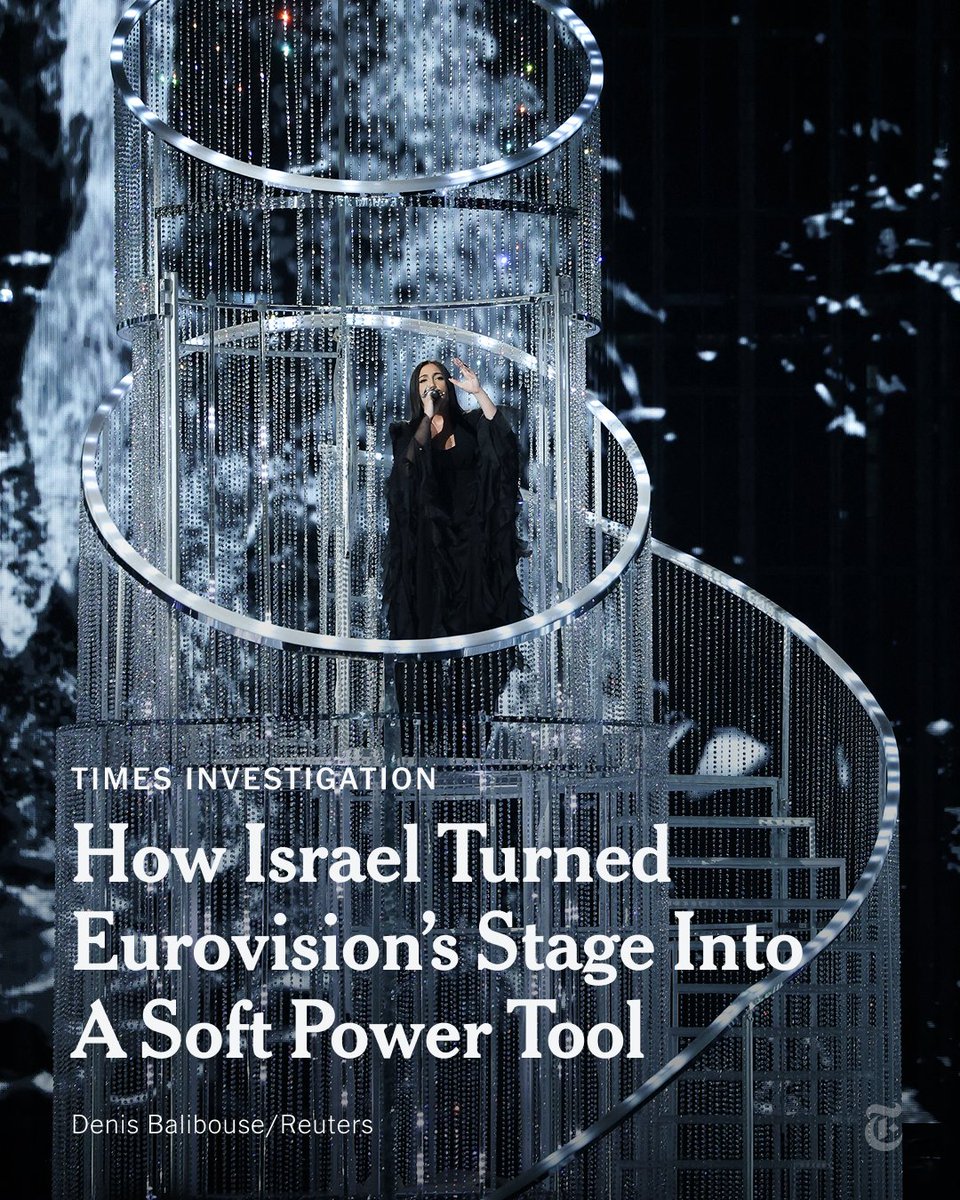
Israel’s efforts to influence the vote for the Eurovision Song Contest were broader and started years earlier than previously known, a New York Times investigation found. Here is the inside story of the controversy that almost broke Eurovision. nyti.ms/42ZR43z
English
陳諾・👊🏳️🔥 리트윗함

The contempt Jacobin expresses for Hamas today tells you how Jacobin would have written about John Brown in the 1800s.
Jacobin@jacobin
Radical abolitionist John Brown was born on this day in 1800. “I acknowledge no master in human form.”
English
陳諾・👊🏳️🔥 리트윗함

That’s bc of China’s efficient public transportation system.
In US, I have a car, my bro has a car, my sister has a car, her husband has a car, my mom has a car, etc.
It’s not uncommon for Chinese households to just have 1 car and everyone takes public transport/electric bikes
Joe@John_Walton_jr
@alvinfoo China is a third world country Far behind the US and Europe
English
陳諾・👊🏳️🔥 리트윗함

I want every Israeli school and summer camp in Canada shut down.
No other "group" has the right to promote foreign armies, or recruit for foreign armies in Canada. Neither should this "group."
Anthony Housefather@AHousefather
The CRA must not be weaponized against any community. Attacks against Jewish schools and Jewish camps is an attack against all of us.
English
陳諾・👊🏳️🔥 리트윗함


陳諾・👊🏳️🔥 리트윗함

The whole province of Qinghai is only 6 million people and Qinghai sits on a rather difficult bit of geography for wealth accumulation. Trying to present Qinghai as the average case for rural China is like trying to cherry pick a small town in Alaska to represent middle America.
Kevin A. Bryan@Afinetheorem
@CBankingEditor Depends where! I traveled the Southern Taklamakan into Qinghai at the same time. The level of development in every way was similar to India today (which makes sense - India's PPP GDP p.c. is about the same as China 20 years ago!)
English
陳諾・👊🏳️🔥 리트윗함

The EU claims that the “Hitler-Stalin Pact of 1939” enabled WWII. It omits ten crucial facts:
- The Soviet Union was not even among the first ten countries to enter into treaties and non-aggression pacts with Nazi Germany. In 1939 alone, Lithuania, Romania, Denmark, Italy, Estonia and Latvia all signed non-aggression pacts with Hitler. Poland entered into one as far back as 1934.
- The Soviet Union tried to form an anti-fascist alliance throughout the 1930s, and was repeatedly rebuffed by European powers.
- Despite that, the Soviet Union was the most powerful bulwark against fascism before the war. The International Brigades in Spain represent the most concrete example of organised antifascist military resistance before Hitler’s invasion of Poland. These Brigades were led by communist parties armed by the Soviet Union, who were abandoned by Western “democracies” and their policies of "non-intervention” which simply left German and Italian intervention uncontested.
- In that same tradition, Stalin offered to send one million troops to deter Hitler’s aggression during the 1938 Sudetenland crisis. Poland and Romania objected, while France and Britain decided to pursue appeasement. That appeasement aimed in part at ensuring that Germany’s energies were directed eastwards, against communism.
- The Soviet Union was the primary target of German imperialism. The USSR’s leadership was aware of this from the early 1930s — and Germany’s leadership did not hide the fact. Hitler had repeatedly promised that Germany would be the “bulwark" of the West against “Bolshevism”, a position that found broad sympathies among the Western ruling classes. Auschwitz was first built to house Soviet POWs, 3.5 million of whom were exterminated during the war.
- Nazi Germany was simply the turning inwards of Western European colonialism. It was in modern-day Namibia that Germany’s Imperial Chancery recorded perhaps the first use of the term Konzentrationslager — the concentration camp — to describe an instrument of mass extermination.
- Adolf Hitler drew particular inspiration from the US settler-colonial model. He remarked approvingly how the US settlers had “gunned down the millions of Redskins to a few hundred thousand and now keep the modest remnants under observation in a cage”. He sent jurists to study the US Jim Crow laws, which formed the basis of the infamous Nuremberg Laws.
- The Red Army liberated Auschwitz, then liberated Europe. If not for the US, which moved quickly to suffocate the rising communist movements on the continent, we might have seen socialism rise at least in Greece, Italy, France and, eventually, Portugal.
- After the war, West Germany quickly reneged on the Potsdam Agreement, filled its security services with former Nazis. NATO, also filled with former Nazis, was founded to wage war on socialism and anti-colonial struggles. In the process it resuscitated the Wehrmacht and paved the way for the German revanchism we are seeing today.
- As a result, we have endured decades of US-led imperial hegemony, whose effects are a dying planet and tens of millions of lives stolen by imperialist wars and sanctions alone. That hegemony has absorbed and expanded the historical mission of fascism, carrying it forward into a new century. Gaza is the clearest expression of that process today — but it is by no means the only one.
EUvsDisinfo@EUvsDisinfo
The Kremlin claims the Soviet Union “liberated Europe” in 1945. It omits one crucial fact: WWII was enabled by the Hitler–Stalin Pact of 1939, which carved up Europe between two totalitarian regimes. For millions in Central and Eastern Europe, Soviet “liberation” meant occupation, repression, deportations, and decades without freedom. The Soviet Union was an occupier. Russia is an occupier in Ukraine today.
English
陳諾・👊🏳️🔥 리트윗함


搞得像出了這份報告中國就不再拋售美元,美元指數就不會下跌,美債收益率就不會暴漲一樣。你們騙騙自己就好了。
UnveiledChina@Unveiled_ChinaX
China has been telling the world it is abandoning the dollar. The Council on Foreign Relations just published a detailed analysis showing that China may actually hold more dollars off its official books than on them. The de-dollarization story is largely a magic trick. Here is how it works in plain terms. China's official foreign exchange reserve, managed by an agency called SAFE, used to hold about 79% of its assets in US dollars back in 2005. By 2019, that number had dropped to 55%. That is the number that gets reported. That is the number that generates headlines about China dumping the dollar. But while China was reducing the dollar share of its official reserves, it quietly stopped growing those official reserves altogether. They have been stuck at roughly $3.3 trillion for eight years. All the new money China accumulated went somewhere else entirely, into the foreign lending of state-owned policy banks like the China Development Bank, into the foreign assets of state commercial banks, and into various state investment funds. None of this is fully disclosed. None of it shows up in the headline de-dollarization numbers. CFR senior fellow Brad Setser ran the math. China's official reserves hold approximately $1.8 trillion in dollars. But Chinese state commercial banks hold an estimated $1 trillion in dollar assets abroad. The policy banks hold close to another $1 trillion in foreign claims, most denominated in dollars. The China Investment Corporation, the country's sovereign wealth fund, holds roughly $450 billion in foreign assets, the majority in dollars. Add it all up and China's total dollar holdings across all state entities likely exceed $4 trillion, more off the official books than on them. Every debt restructuring case where China's policy banks were involved, Zambia, Sri Lanka, Ecuador, Angola, involved dollar-denominated loans. Not yuan. Not euros. Dollars. The de-dollarization narrative serves a specific purpose for Beijing. It signals geopolitical independence from the US financial system, which is valuable messaging for domestic audiences and Global South partners. But the actual financial behavior of Chinese state entities tells a different story. China's banks are still borrowing and lending predominantly in dollars. China's investment funds are still holding predominantly dollar assets. The label changed. The exposure did not. China is telling the world it is exiting the dollar while quietly holding more of it than ever. That is not de-dollarization but a very well-executed press release. #China #CCP #Dollar #DeDollarization #Geopolitics #Finance #CFR #Economy #GlobalFinance #SAFE
中文
陳諾・👊🏳️🔥 리트윗함

Meaningless semantic game of what official reserves are. CN holding of Tsy fell, $1.3T to $693b &assets held abroad are now much more in physical, productive forms than financials. These can’t be classified as reserves assets(ask any res managers), even if held by state entities
UnveiledChina@Unveiled_ChinaX
China has been telling the world it is abandoning the dollar. The Council on Foreign Relations just published a detailed analysis showing that China may actually hold more dollars off its official books than on them. The de-dollarization story is largely a magic trick. Here is how it works in plain terms. China's official foreign exchange reserve, managed by an agency called SAFE, used to hold about 79% of its assets in US dollars back in 2005. By 2019, that number had dropped to 55%. That is the number that gets reported. That is the number that generates headlines about China dumping the dollar. But while China was reducing the dollar share of its official reserves, it quietly stopped growing those official reserves altogether. They have been stuck at roughly $3.3 trillion for eight years. All the new money China accumulated went somewhere else entirely, into the foreign lending of state-owned policy banks like the China Development Bank, into the foreign assets of state commercial banks, and into various state investment funds. None of this is fully disclosed. None of it shows up in the headline de-dollarization numbers. CFR senior fellow Brad Setser ran the math. China's official reserves hold approximately $1.8 trillion in dollars. But Chinese state commercial banks hold an estimated $1 trillion in dollar assets abroad. The policy banks hold close to another $1 trillion in foreign claims, most denominated in dollars. The China Investment Corporation, the country's sovereign wealth fund, holds roughly $450 billion in foreign assets, the majority in dollars. Add it all up and China's total dollar holdings across all state entities likely exceed $4 trillion, more off the official books than on them. Every debt restructuring case where China's policy banks were involved, Zambia, Sri Lanka, Ecuador, Angola, involved dollar-denominated loans. Not yuan. Not euros. Dollars. The de-dollarization narrative serves a specific purpose for Beijing. It signals geopolitical independence from the US financial system, which is valuable messaging for domestic audiences and Global South partners. But the actual financial behavior of Chinese state entities tells a different story. China's banks are still borrowing and lending predominantly in dollars. China's investment funds are still holding predominantly dollar assets. The label changed. The exposure did not. China is telling the world it is exiting the dollar while quietly holding more of it than ever. That is not de-dollarization but a very well-executed press release. #China #CCP #Dollar #DeDollarization #Geopolitics #Finance #CFR #Economy #GlobalFinance #SAFE
English
陳諾・👊🏳️🔥 리트윗함

More than 200 people attend protest opposing data centre in Saint John, N.B. ctvnews.ca/atlantic/new-b…
English
陳諾・👊🏳️🔥 리트윗함

It's my birthday this month btw... and this year I'm serving cake 💕

English