

Jackson
2.8K posts

Jackson
@sandstormcap
Long/Short Equities Intraday Trader + Senior FAANG Software Engineer. Passionate about trading and technology!
New York, NY 가입일 Temmuz 2022
4.8K 팔로잉632 팔로워

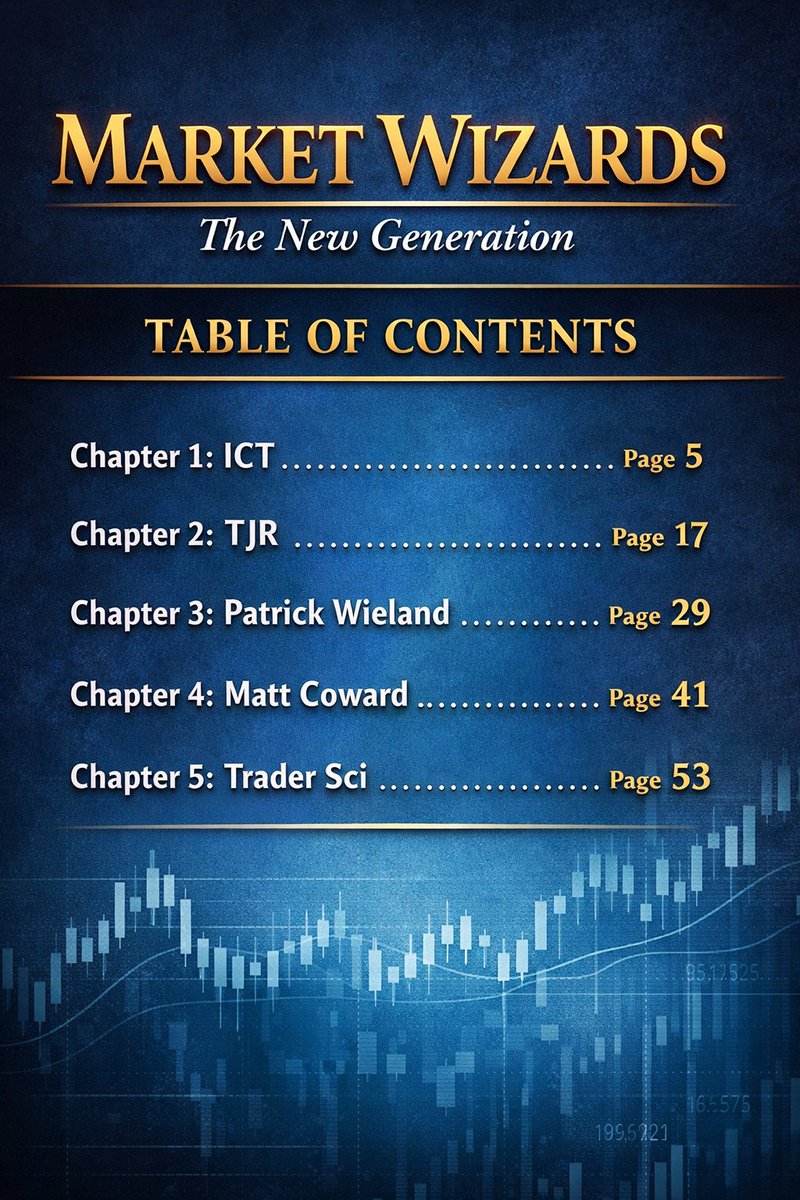
MARKET WIZARDS PRE-RELEASE!
Was able to get an early copy of the next book and so far these interviews are incredible! Nice to see the biggest trading influencers in the space were able to pass the audit process.
Currently reading the chapter about how ICT (Michael Huddleston) was kidnapped by Wall Street and forced to program the algo that controls markets 🔥🤯
English

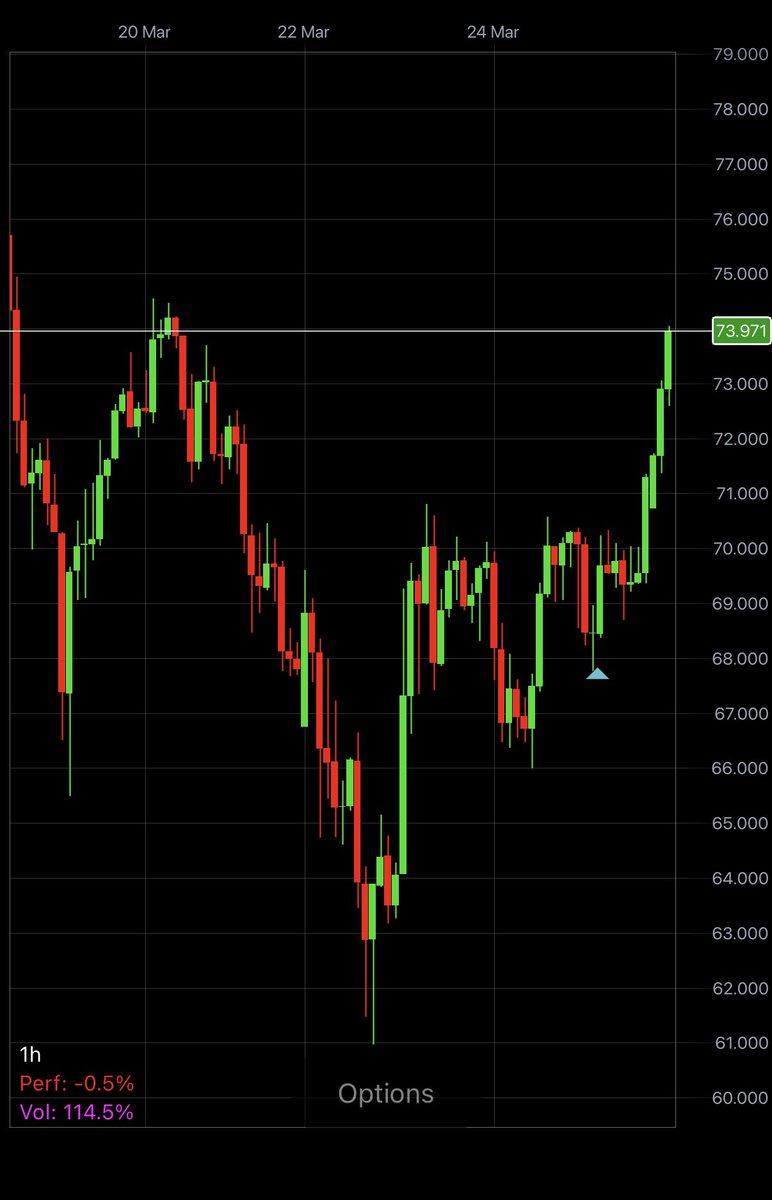
The day I exited my Gold short, Silver closed as a bullish spike, an IDF and SFP, so I went long this morning targeting the stops above the ID high.
I held Gold for 3 weeks while it dropped 18%. Today this Silver position is already up 10% from entry.
The metals have been extraordinary lately.
English

@tjfreeman_95 Thanks for breaking this down! Lance has incredible ideas here.
English

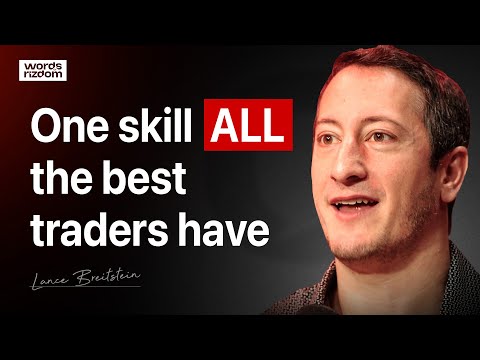
I've been following Lance Breitstein on X for a few months now and somehow only came across this interview today. Two hours in, I had to stop and just sit with it for a minute. This is one of the most honest, dense and genuinely useful conversations about trading I've ever listened to - and I've listened to a lot of them.
Lance was the number one trader at Trillium, one of the oldest and most respected prop firms in the world. He started as one of the slowest learners in his class, struggled for two years, nearly got cut, and ended up becoming one of the best short-term intraday traders on the planet. Fun fact: Lance also did a 10-figure trade live on Twitter during the Yen squeeze in August 2024. The man has earned the right to say everything he says here.
Here's what stayed with me most.
1. The environment you learn in is probably the single most important variable in your development.
Lance said something that I haven't been able to stop thinking about since I heard it - that if he had been on the retail side, he genuinely believes he would not have made it. Not probably. He said he can guarantee it with 99% confidence. The reason is that the feedback loop, the competition, the mentorship, the constant exposure to people performing at a high level - all of that is what actually accelerates learning in a way that sitting alone at a screen simply cannot replicate. He described watching his trainer make six figures on a single trade and thinking: what he did was not that different from what I just did. That moment of proof, of being able to see what's possible from someone operating in the same environment on the same setups, is something most retail traders never get. Finding the closest version of that matters enormously.
2. Deliberate reps beat passive time every single time.
This is the meta-learning concept Lance keeps coming back to throughout the entire interview, and the golf analogy he uses is perfect. Hitting 500 balls with the same broken swing cements the broken swing. Five intentional swings where you actually fix the problem are worth more than the 500. The same principle applies directly to trading. A trader who sits at the screen for 500 days but spends half of it distracted, zoning out, watching Netflix on the side monitor - they might accumulate maybe 20 to 30 genuinely focused, intentional days of real learning. Meanwhile someone who is drilling chart writeups during every slow period, watching tape in half-speed, identifying their weakest patterns and actively working to reprogram them - they could get 100 meaningful reps in a single day. Lance was watching his trading tape in slow motion and then in 2x speed so that by the time the real setup appeared in live trading, his pattern recognition was already trained beyond what anyone else was doing. That's why he went from the slowest in his class to one of the fastest traders in the world. Intentional screen time is the real edge.
3. Edge is positive expectancy, and you need to know exactly where yours lives and where it doesn't.
Lance was emphatic about this, and it connects to something I've been documenting through journaling for months. Every trader has a set of strategies, and almost nobody properly tracks which ones are actually generating returns versus which ones are quietly draining the account. He gave the example of a trainee who was convinced he made money in IPOs, which was technically true, but when he crunched the data he discovered he was making money on two hot IPOs and losing on eight garbage ones, and the losses were offsetting a significant portion of the gains. The fix was simple: stop trading the garbage ones. But without the data, he never would have seen it.
4. Bet big on pocket aces. Build consistency on everything else.
One of the most important frameworks Lance shares in the entire interview is the poker analogy for position sizing and trade selection. The best traders in the world make roughly 90% of their P&L from 10% of their opportunities - the pocket aces, the setups with the highest expected value, the moments where every variable is aligned and the edge is at its clearest. The job during the other 90% of the time is to play the singles consistently, build the cushion, and stay in the game so that when the aces finally arrive you have both the capital and the mental clarity to bet as big as the setup deserves. The traders who flatten their bet sizing across all trades are leaving an enormous amount of money on the table. And the traders who only wait for aces and trade nothing else lose all the compounding value of the consistent singles. Both extremes are wrong. The right framework builds consistency on the easy trades and bets hard when the best opportunities arrive.
5. Untrained intuition is dangerous. Trained intuition is one of your most powerful assets.
This one landed particularly hard for me. Lance's framing is that most amateur traders have intuition working actively against them - when the stock is panicking, the untrained gut says sell, which is almost always exactly when the opportunity is at its highest. When the stock is ripping and feels obvious, the untrained gut says buy, which is often exactly when the move is nearly exhausted. The reason most amateurs lose the more they trade is that the market is specifically designed to punish untrained psychology. The good news is that intuition can be trained. Through enough intentional reps, enough tape review, enough honest self-assessment of where the pattern recognition is wrong and why - the gut starts to flip. The pit in the stomach during a panic becomes signal. The discomfort of a choppy, directionless session becomes a clear directive to stay out. That retraining takes years, and it only happens through the kind of deliberate, reflective work that most traders skip.
6. The learning curve is longer than anyone is telling you and that's the most important thing to accept before you start.
Lance was direct about this in a way that I genuinely appreciated. At a top-tier prop firm like Trillium or SMB, with Professional Resources, experienced traders around you, full-time commitment and firm capital - the learning curve is still roughly two years. For a retail trader doing this part-time with minimal capital, limited mentorship and no professional environment, that learning curve could easily stretch to five or six years. The most harmful thing in the space is that nobody with an affiliate link and a funded account program to sell will ever tell you that. Accepting the real timeline before you start is what allows you to structure your life and capital appropriately, stay in the game long enough for the process to compound, and not abandon something that was working precisely because you ran out of runway before the results arrived.
These were just some of the notes I took and honestly, I could have kept going for another ten lessons without running out of material.
Go watch the full interview in its entirety, and then watch it again - I know I will.
@TheOneLanceB @Wordsofrizdom @smbcapital
youtube.com/watch?v=sMofWA…
YouTube
English


I am hearing tons of complaints from Cursor customers at enterprise companies:
A silent change put almost all models Cursor uses behind Max mode. Devs who used to manage to “spread out” monthly credits over a month see all of it used up in 1-2 days. Are furious + switching.
English

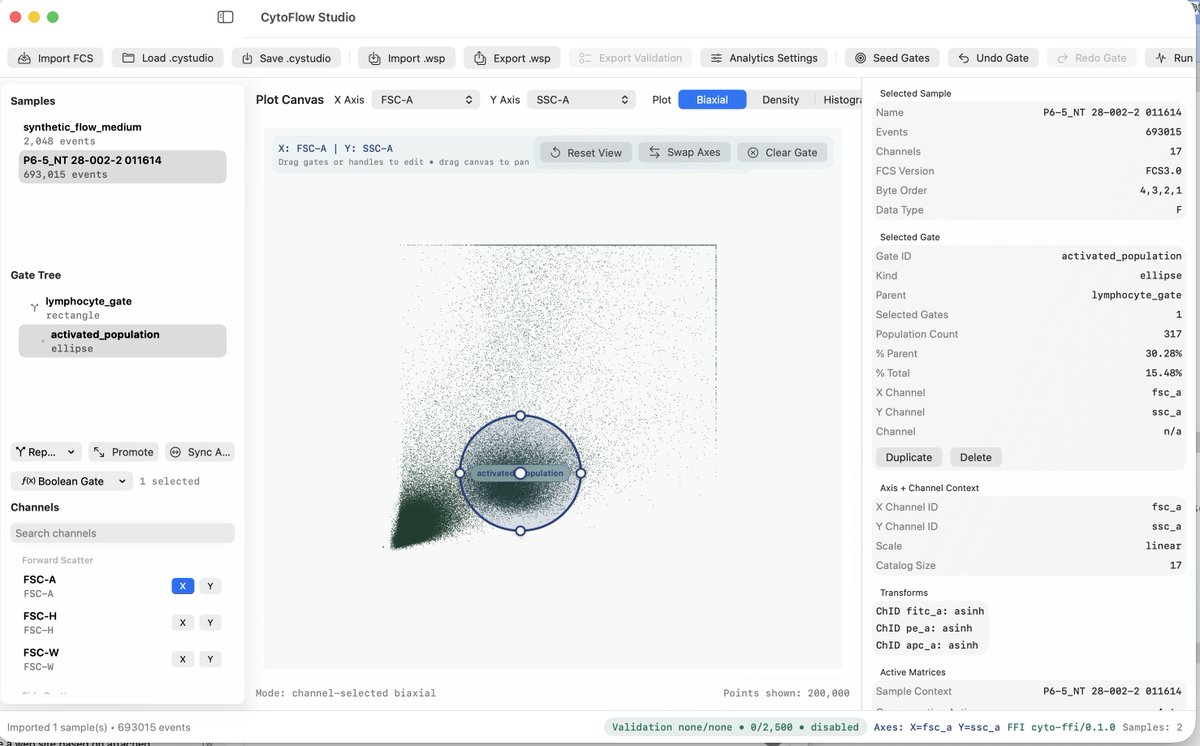
In just two days, using OpenAI Codex app GPT-5.4, I created a fully functional flow cytometry data analysis software, ~20,000 lines of code from scratch! This is a highly sophisticated and specialized biology software tool that every immunologist relies on. The best part is that I can continuously improve it and add new features that are not even available in comparable commercial software, which can cost thousands of dollars per user!
For those not familiar with what flow cytometry software is, here is the detailed explanation from Grok:
Flow cytometry analysis software is like a super-smart graphing calculator for biologists and doctors who study cells.
What the machine does firstImagine you have a sample of blood or tissue with millions of cells. The flow cytometer machine lines the cells up single-file like cars on a highway and shoots lasers at each one as it zooms by (thousands of cells per second). The lasers tell the machine things like:How big is the cell?
How “grainy” or complicated is it inside?
Does it have certain “flags” (proteins) stuck on it? (These flags light up in different colors, like red, green, purple tags.)
The machine spits out a huge computer file full of raw numbers — no pictures, just data.
What the software is forThe analysis software takes that messy pile of numbers and turns it into clear pictures and answers you can actually understand. Think of it as the “translator” or “artist” that draws the story from the data.With a few clicks you can see:Colorful dot plots or graphs that show different groups of cells (like “these blue dots are healthy immune cells, these red dots are cancer cells”).
Exactly what percentage of the cells are a certain type (e.g., “78% of the cells in this blood sample are fighting the infection”).
How strongly a cell is “glowing” with a certain color tag (which tells you how much of a protein it’s making).
Side-by-side comparisons of a patient’s sample before and after treatment.
The magic trick scientists use every dayThe most common thing they do is called “gating.” It’s like drawing a circle around a group of similar dots on the graph and saying, “Only look at these cells.” The software instantly counts everything inside that circle and gives you the numbers. You can keep drawing smaller and smaller circles to zoom in on very specific cell types — kind of like zooming into a crowd photo until you only see people wearing red hats and glasses.
English

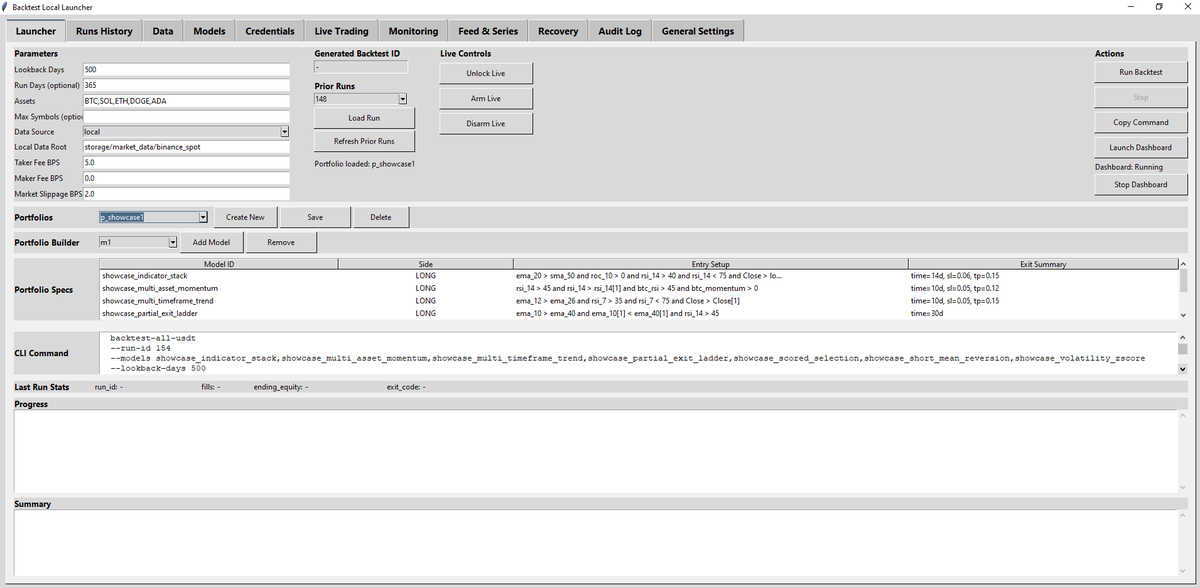
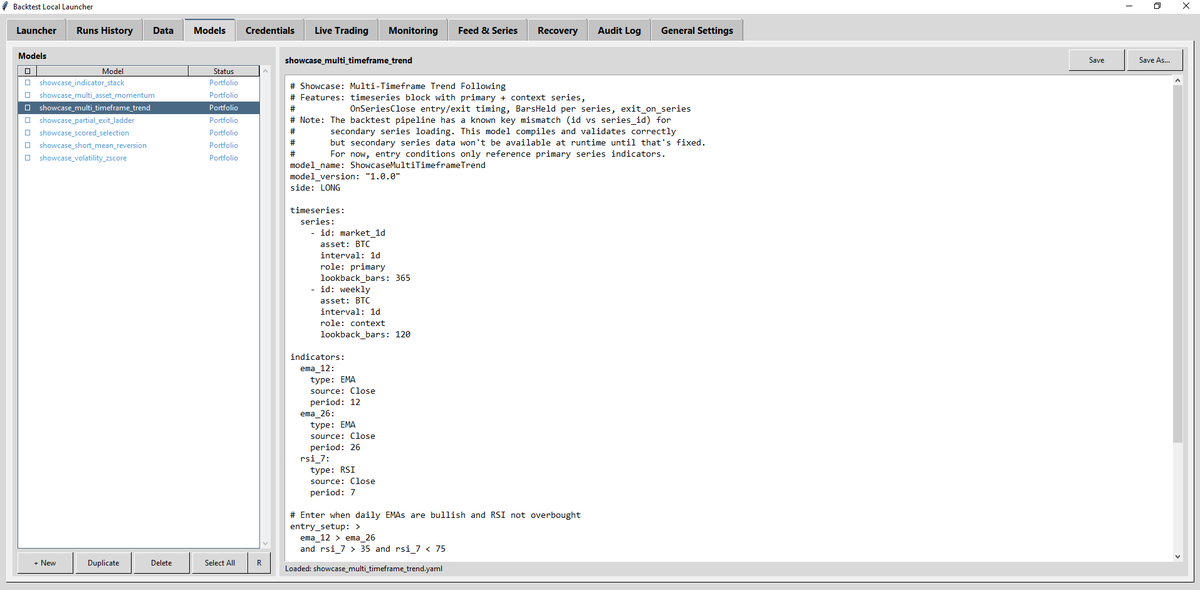
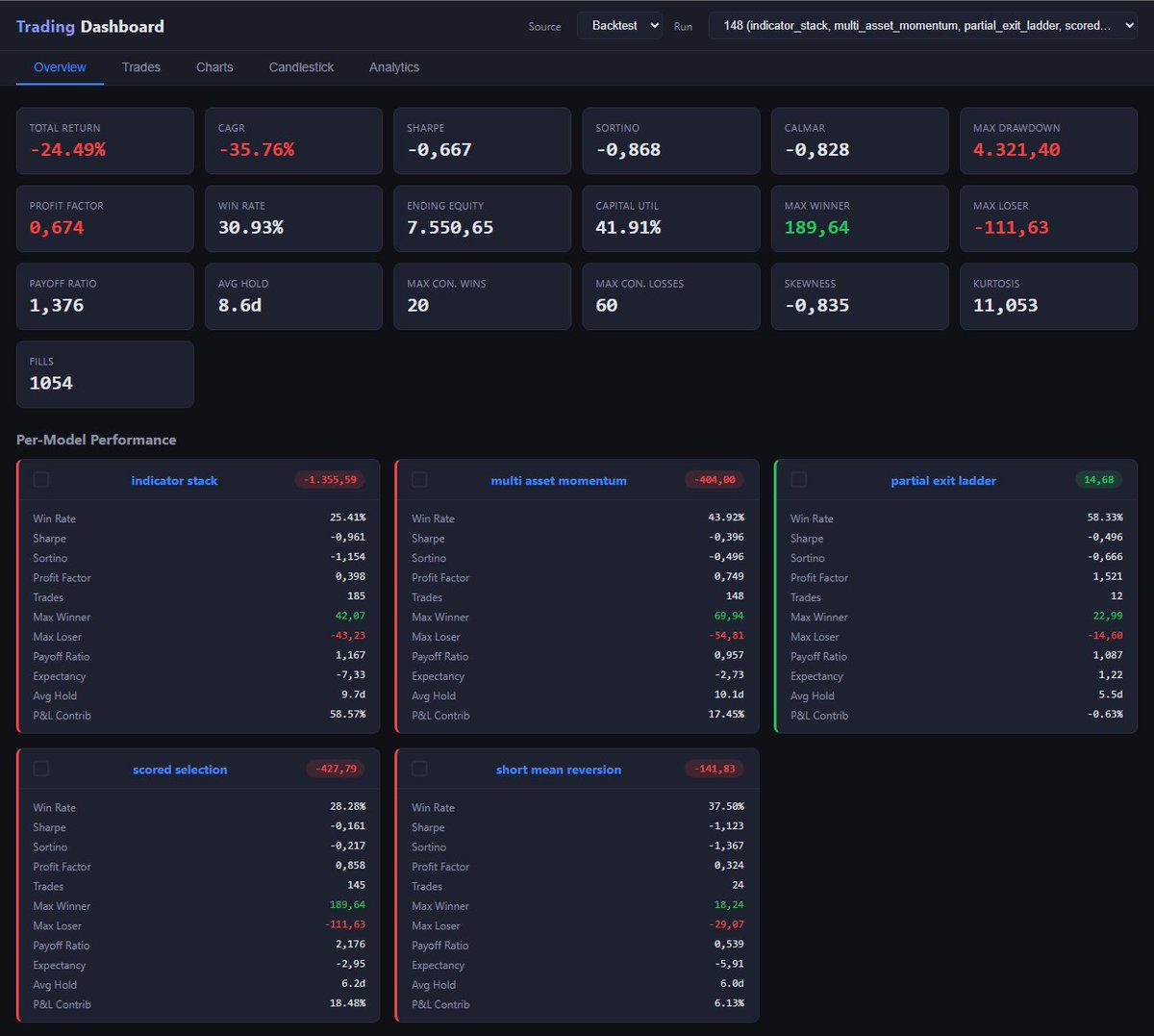
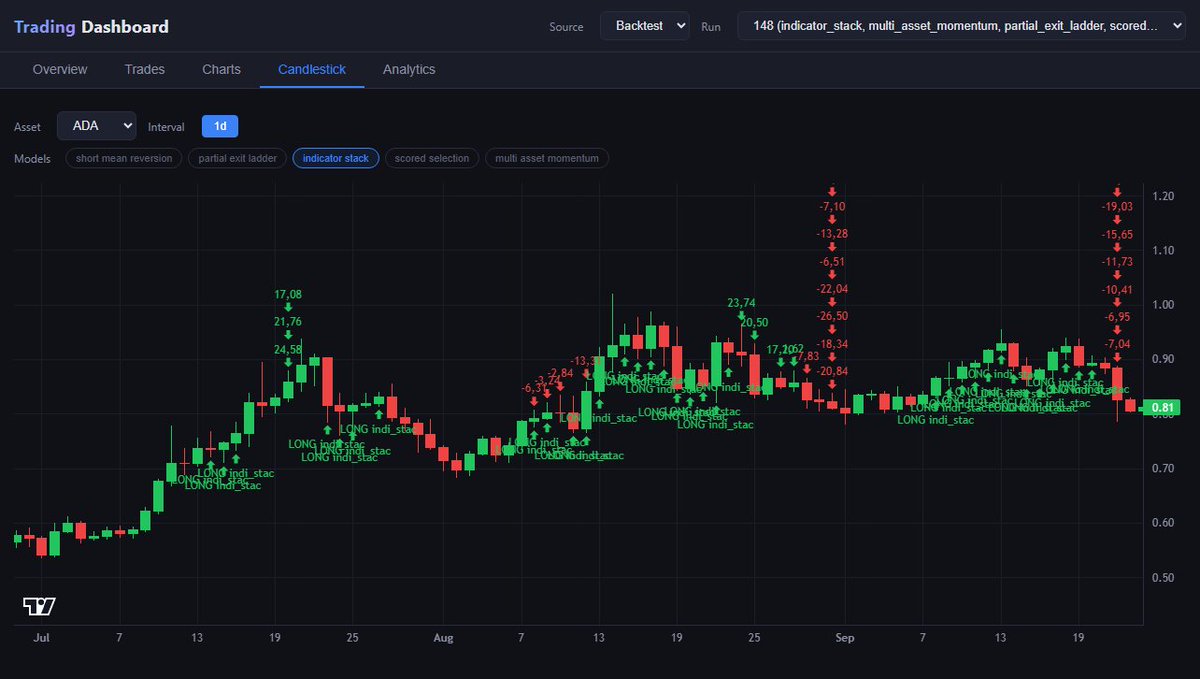
How about a one backtesting / live trading tool that can:
- backtest multiple assets (crypto + stocks)
- trade multiple timeframes (daily, intraday)
- simple script based setups extendable with custom code
- LIVE trade from the same platform
- solid dashboard and analysis functionality
- keep data stored locally
- user friendly UI
Keep it for myself or release it at some point?
English
@SteveDJacobs These tools are so incredible. Can’t believe this is possible right now. Really nice work.
English

📈Stock Allocation - When Scaling-In Beats "Going Big"
Recently I've been working on a systematic algorithm* backtested over 6.2 years (2020 to now) across stocks with a current market cap of $1B+
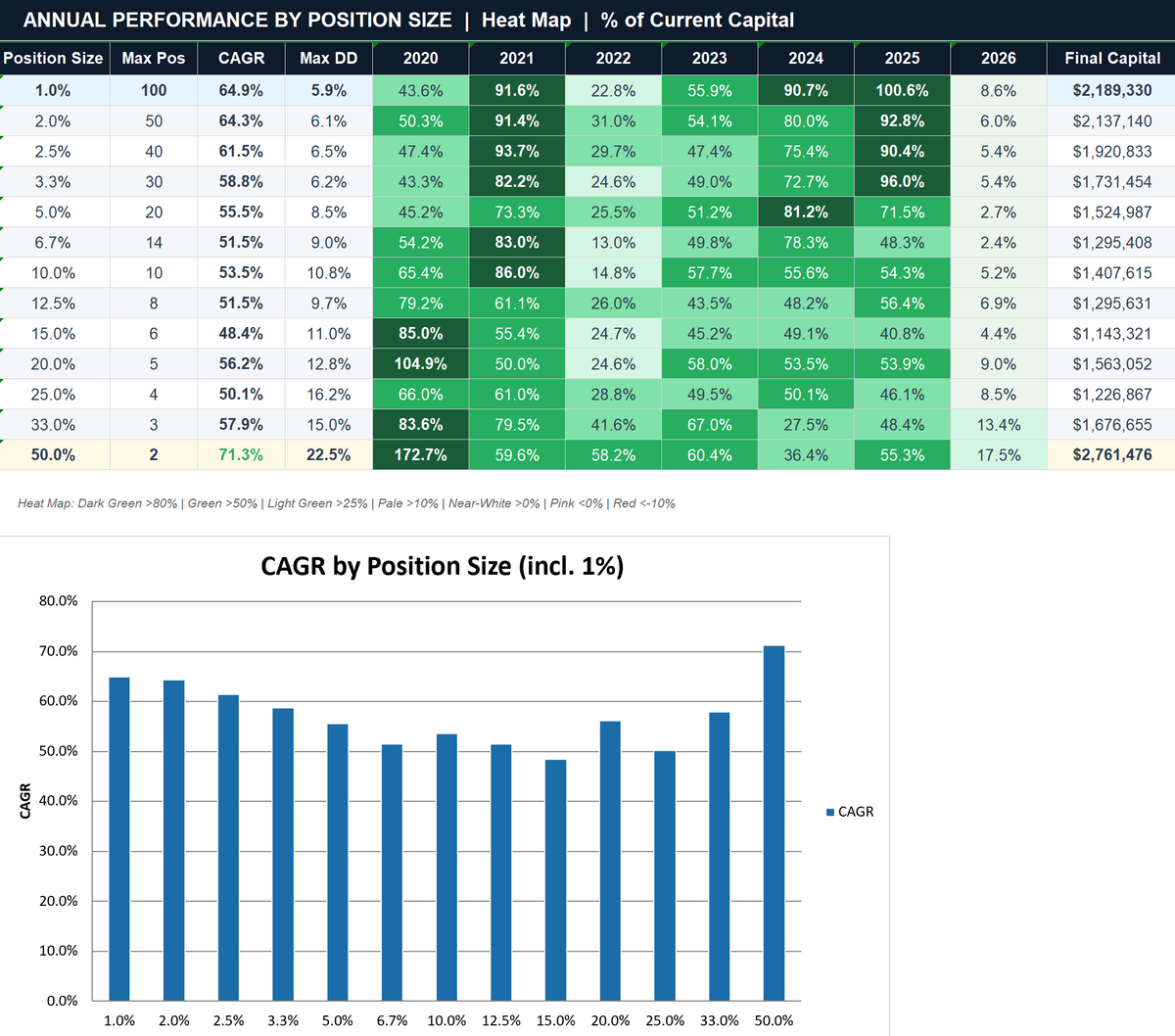
The backtest generated over 18,000 trade signals with an average return of 11.95% per trade. The question was "what allocation % per trade yields the best results?"
It turned out 1–2% was the optimum.
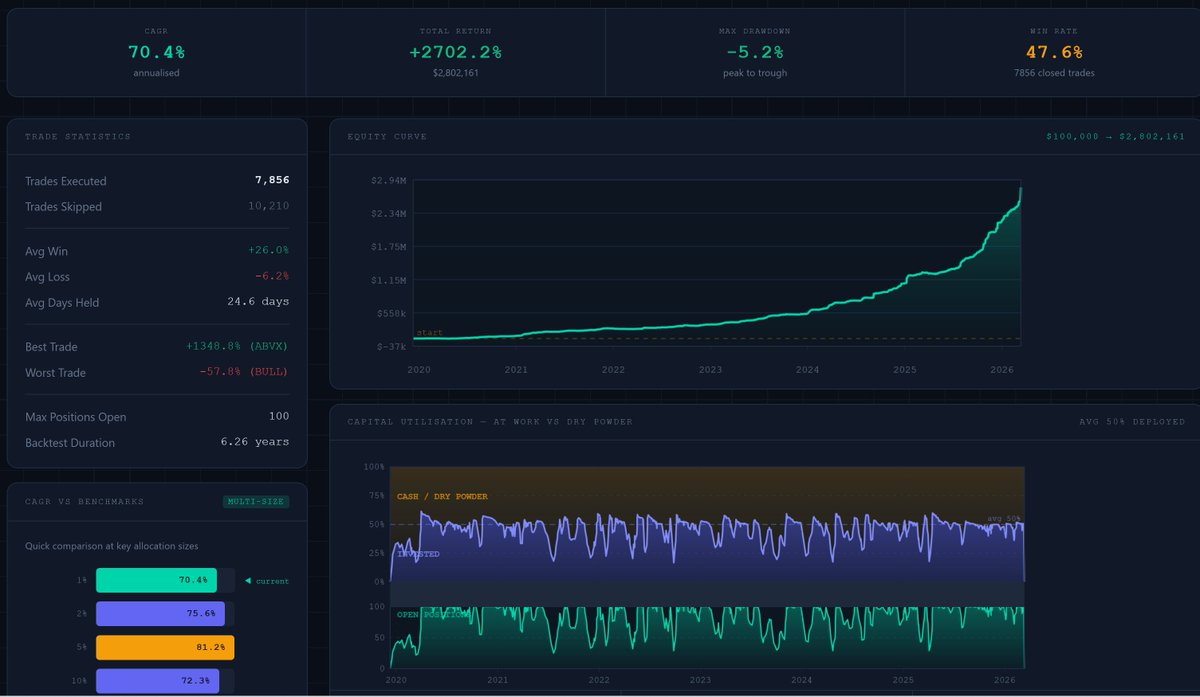
1% produced a CAGR of 64.9% — worst year 2022 (+8.6%), best year 2025 (+100.6%).
Max drawdown was 5.9% with a Sharpe of 1.76. $100,000 became $2,189,300.
Win Rate: ~49–54%
Avg Win: ~+25%
Avg Loss: ~−6.2%
Avg hold: 23.2 days
23 trades returned +500%+. Several exceeded +1,000%.
Why does small sizing win? At 10% (10 slots), the sim skips most trades. At 1–2% (50–100 slots), you're actually there when the big ones hit.
Admittedly this is WIP — there may be errors in the data.
The large winners have been verified manually and with AI, and the raw trade data has been shared with colleagues for peer review.
Next step: run it live with real capital through the rest of 2026 and track out-of-sample results.
* Algorithm is written and executed in Python.
The resulting trades are fed into Claude Pro (Sonnet 4.6) to run Monte-Carlo simulations, walk-forward portfolio analysis etc.


Pyramided_Degenerate@livermore1913
@SteveDJacobs Do you ever get fully invested with this approach?
English
The overarching principle here is that he is agnostic to any one identity.
He is trading futures simply bc that has been where the best opportunities (adjusted for quality, liquidity, taxation, etc.) have been.
As I’ve pointed out for years, we should have no trader identity except for being an Expected Value maximalist (within risk constraints).
peoplewish@Peoplewish
More often lately I’ve been asked, “Are you becoming a futures trader?” The answer is yes, but not because I set out wanting to be one. My mission and system demanded it. I still would not really call myself a “futures trader,” but I do trade futures, and I think anyone with the ability to should seriously consider them for a few reasons: 1. Near-infinite liquidity in the major contracts for the size most traders will ever need. Metals, soy, oil, index futures, etc. 2. 24/5 trading. Many major futures contracts open Sunday night at 6:00 PM ET and only pause for a brief daily maintenance break on weekdays. That matters when macro or geopolitical news hits outside cash equity hours. If your thesis is crude, CL_F is often the cleaner vehicle than an oil equity proxy. 3. The 60/40 tax rule in the U.S. Many regulated futures contracts fall under Section 1256, which generally means 60% of gains and losses are treated as long term and 40% as short term regardless of holding period. That is a huge advantage. 4. Buying power, leverage, and hedging. This does not matter most of the time, but when preserving equities DTBP matters to your strategy, futures can be an extremely efficient tool. They can give you more notional exposure with less capital tied up, and they can also be one of the cleanest ways to hedge without disturbing the core book. Obviously a double-edged sword and something that should be used carefully, but it is there. At the end of the day, I execute based on the opportunity set presented by my system. Futures have been a great unlock for me over the last year. Recent successful trades include: /GC LONG ~ $3,500 avg on 09/02 /NQ SHORT ~ $26,350 avg on 10/30 /ZS LONG ~ $1,100 avg on 10/30 /PL SHORT ~ $2,500 avg on 12/29 /SIL SHORT ~ $115 avg on 01/30 /CL LONG ~ $65 avg on ~02/03 to 02/27 /CL SHORT ~ $117.5 avg on 03/09
English

Claude is POWERFUL!
I read this academic paper on an improved PCA methodology to remove noise from risk factors.
papers.ssrn.com/sol3/papers.cf…
Claude read the paper and built me my own version of this tool. Then it offered to improve it so I can upload my models from Portfolio123 and optimize portfolio weightings based on risk factors.
I feel like I run a company with unlimited resources now. This is crazy!

English
Was working on creating a better weekly & daily report card template
Tried using @claudeai by @AnthropicAI
It built me an extremely clean template and I had it give me a strategic review using the best traders & coaches over the last century
Any other ideas to further improve the report card or AI features?
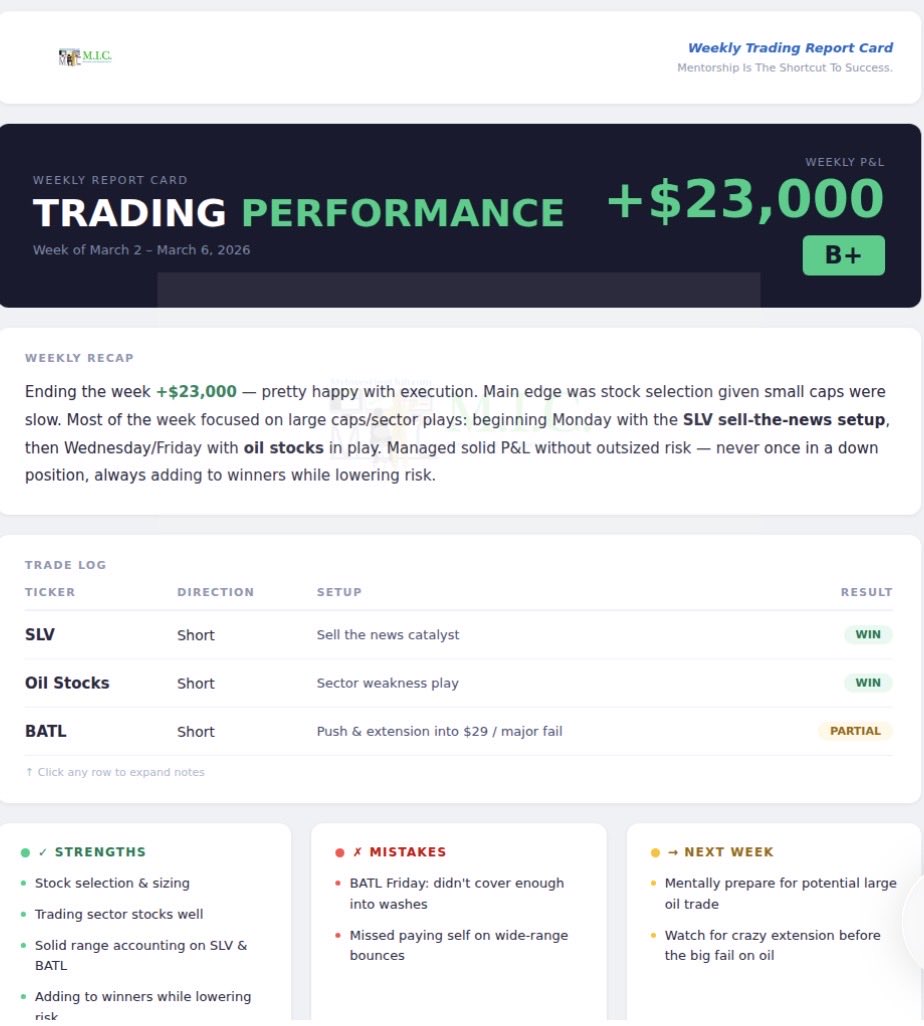
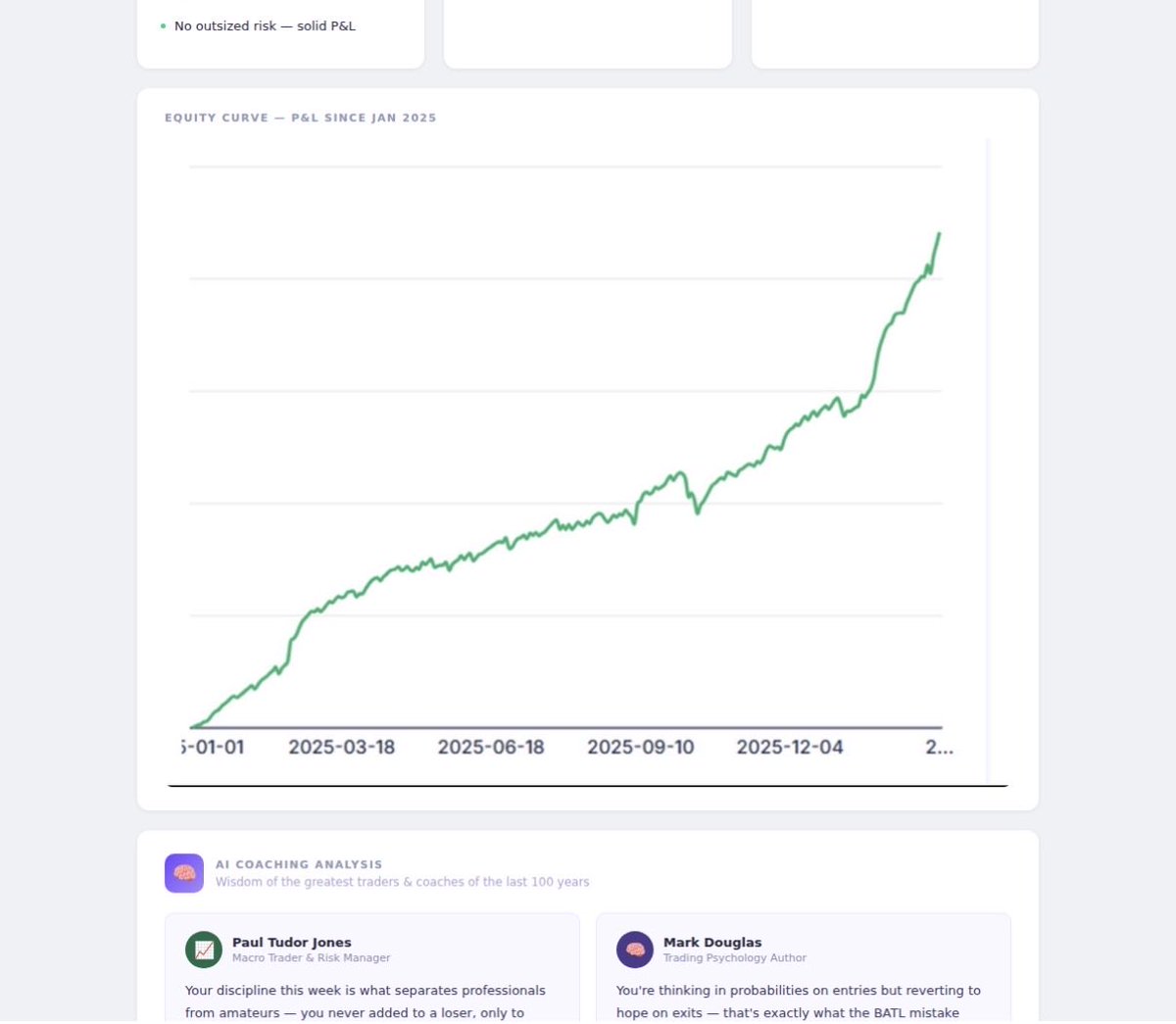
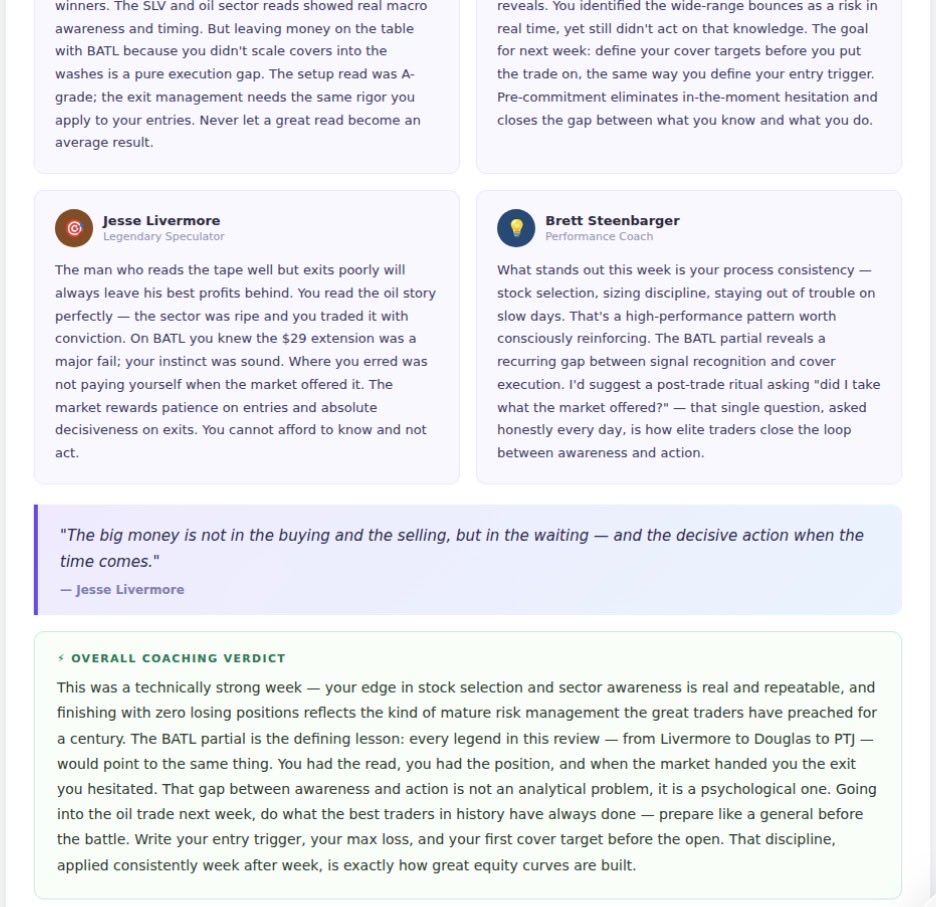
English

I took my normal "exit plan mode" skill and expanded it into a "mega exit plan mode" skill that I find can be quite useful when you are trying to expand scope and/or just want Claude Code to delight you with new ideas.
It's sort of like the expansive CEO to the normal skill's realistic eng manager persona.
They work well back to back: mega skill to be expansive, normal skill to think through the final details.
gist.github.com/garrytan/120bd…
English

Humbled/honored to be included here
George Coyle@gfc4
The upcoming Market Wizards book is approaching completion. As such, @jackschwager and I have decided to release the names of the traders included in the book and their associated X handles. Here they are: Kristjan Kullamägi @Qullamaggie Lance Breitstein @TheOneLanceB Simon Russo @simonrusso__ Lukas Fröhlich @TheShortBear Phil Goedeker @Tradestl Kelvin Chiu @KC_SilverCape Jason Berry @Positive_Equity Kenny Sharkness of @smbcapital (Kenny has no public X account) Rick Bandazian Jr. @Off_The_Tape Looking forward to sharing the book with the world! If you'd like to pre-order the book, you can do so here: lnk.to/marketwizardsn… For discounted bulk orders (US only) go here: bulkbooks.com/products/marke…
English
@__paleologo Give it its own gmail. I would not just give it access to your gmail.
English

how many of link gmail to openclaw? Isn't it a little scary to delegate authority to it?
English
@QuantRob @truth_crab @openclaw Delegate the heartbeat to a very simple model. You don’t need Opus handling this because it will upload too much context on every heartbeat. If you use Opus or Codex for this costs will be way higher than they need to be.
English


passed my new portolio's order execution history, cumulative P&L, benchmarks, etc, to claude and came up with this detailed 13 page report on what to do to improve it.
a lot of it I already was aware of, but idk man, pretty detailed report if you read the entire thing.
there's a few things I don't agree with, like his obsession with hedging out the beta, which is something I don't care that much for right now, as I am fully aware I am just a beta farmer in higher risk markets.
overall pretty neat and added a few reasonable solutions.
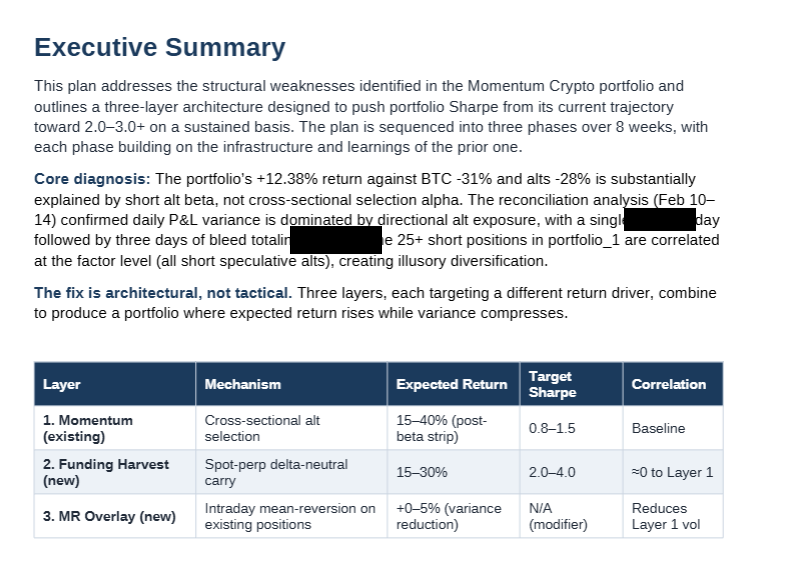

English
@HF_Trader I think you can get the same processing power cheaper with a custom PC build but you need to do a bit of setup and it's likely louder and may use more electricity.
English

Wait what? I need to understand this shit better because I’m about to lay down some serious dough for a Thinkstation.
Emanuele Bashuri@emanuelebashuri
@morganlinton Mac studio M3 Ultra with 512gb unified Ram saved around $35k+ instead of making an AI rig of Nvidia Blackwells for $50k + saving a ton of space and if you want more just add another box and connect them togheter Currently Apple lost Ai software but winning the Hardware AI race
English