GerrySinga

3.1K posts

GerrySinga

GerrySinga

@singa_gerry

Toruk Macto B+, A servant of God and a friend to man

가입일 Kasım 2019
347 팔로잉438 팔로워
GerrySinga 리트윗함
Dennis Kioko - KeNHA Unmarked Bumps Hitter
The root of most Kenyan problems is our huge lack of concern for problems that affect other people and believing those problems will never affect us
English
21
1.3K
2.4K
33.5K
GerrySinga 리트윗함
W
W@Wangariiii_·
There is no sane person that will look at this government and say, yea, we need a second term. No sane person!
English
91
5.2K
13.3K
113K
GerrySinga 리트윗함
BRAVIN YURI
BRAVIN YURI@BravinYuri·
We are going to experience a lot of schools closing down due to students’ unrest. It's always in the pattern.
English
17
612
2.3K
36.7K
GerrySinga 리트윗함
David Maraga
David Maraga@dkmaraga·
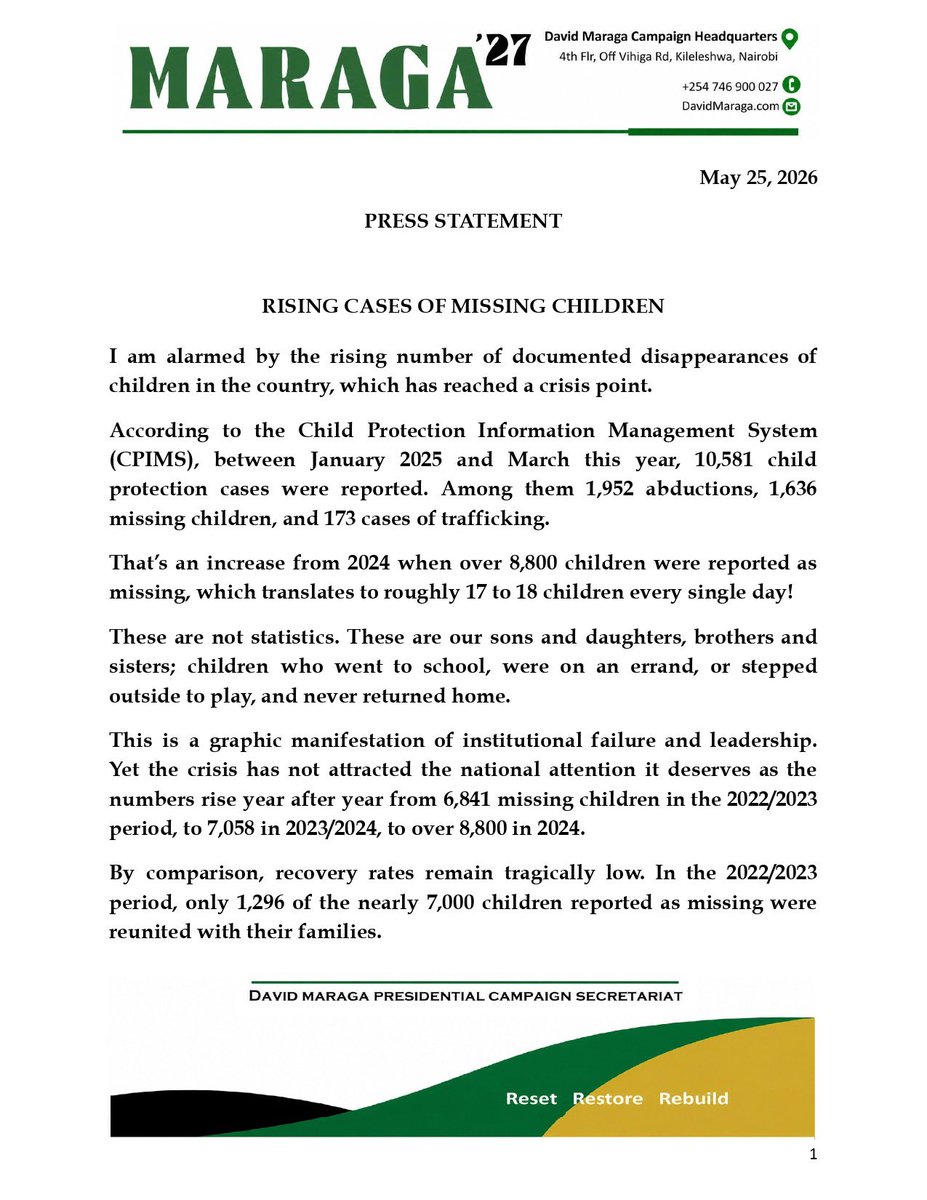
Statement on Kenya’s missing children
David Maraga tweet mediaDavid Maraga tweet mediaDavid Maraga tweet media
English
26
2.5K
4.4K
78.2K
GerrySinga 리트윗함
Mary Kathomi
Mary Kathomi@MaryK2022·
Hi I'm lynet from Komarock I lost my kids date 13 may 2026 please 🙏 who ever see them please call me on these number 0726096432 name ,precious and Zennel
Mary Kathomi tweet media
English
181
11.4K
10.2K
236.6K
GerrySinga 리트윗함
David Maraga
David Maraga@dkmaraga·
Joined faithful at the SDA Lodwar Central Church for worship this morning. I am grateful for the warm reception accorded to us by the church and for the powerful sermon by Pst. Amos Onduso, who shared profound lessons on leadership from King Solomon. I was accompanied by @UGMParty national leaders @NetoAgostinhoMP, @kattoloo, @Lizie2016, Caesar Asiyo, and the Turkana branch leadership led by Johnstone Ekamais.
David Maraga tweet mediaDavid Maraga tweet mediaDavid Maraga tweet media
English
5
106
396
5.3K
GerrySinga 리트윗함
Aúdrey🖤🇰🇪
Aúdrey🖤🇰🇪@luckyaudreyy·
Tumekuwa a society that looks the other way when things are not happening to us. If it doesn't involve you, hujali. Hatufai kuishi hivi.
English
25
2.5K
5.6K
67K
GerrySinga 리트윗함
David Maraga
David Maraga@dkmaraga·
After overtaxing you, drowning you in debt and cooking the shadiest fuel deals in our history, this govt now wants applause for ‘negotiating’ a crisis it created. They hike prices, blame a ‘global crisis’, then compromise a few loud voices into silence and call it leadership. Kenya doesn’t need photo‑ops and KSh10 gimmicks on diesel. We need the extractive cartel state dismantled. We must Reset, Restore & Rebuild Kenya #Ukombozi @UGMParty @Maraga27 @ntvkenya @citizentvkenya @tv47digital @StandardKenya @TheStarKenya @NationAfrica
William Samoei Ruto, PhD@WilliamsRuto

We are fully aware of the frustration, pain and burden that families, businesses, farmers and transporters have endured due to rising fuel prices over the past few weeks. The truth is this: Kenya is facing the effects of a global fuel crisis caused by the ongoing conflict in the Middle East. This challenge is not unique to Kenya. Across the world, countries are grappling with rising fuel prices, supply shortages and disruptions in the global supply chain. Since the beginning of this crisis, we have responded decisively to cushion Kenyans from high fuel prices and to ensure the country continues to enjoy a stable and uninterrupted fuel supply under the Government-to-Government framework. In the April-May and May-June pricing cycles, the Government has spent KSh28.19 billion on fuel price support through direct stabilisation measures and Value Added Tax (VAT) relief of 8 per cent, protecting millions of Kenyans from even greater hardship. Without Government intervention during this period, Super Petrol would retail at KSh230 a litre instead of the current KSh214. Diesel would retail at KSh277 instead of KSh232, while kerosene would retail at KSh270 instead of KSh191. To further cushion Kenyans, I have directed a KSh10 reduction for diesel in the June-July pricing cycle. We call on Kenyans to remain patient as we navigate this crisis. Let us not allow irresponsible political opportunists to politicise a crisis that is global in nature. Together, we shall overcome these challenges. Held talks with transport stakeholders at State House Mombasa and agreed on a series of reforms to address concerns in the transport sector, including the possibility of a temporary relief on lending terms for the transport sector, insurance claims and regulations on minimum fares for digital taxis, as well as allowing the continued use of artwork and graffiti on matatus.
English
113
3.6K
7K
124.8K
GerrySinga 리트윗함
BRAVIN YURI
BRAVIN YURI@BravinYuri·
We are slowly walking into a dangerous future that many people are refusing to acknowledge. If things continue the way they are, schools will become more chaotic, communities more unstable, and we will start seeing more teenagers getting involved in crime, violence, drug abuse, and reckless behavior at levels we are not prepared for as a country. Parenting is collapsing in many homes. Some parents are too absent, too overwhelmed, or have surrendered the role of raising children to phones, schools, and the internet. At the same time, our education system is struggling to shape character, discipline, emotional intelligence, and critical thinking beyond just exams and grades. Then add the drug problem into the mix. Drugs are becoming more accessible within estates, neighborhoods, and even around schools. Young people are experimenting earlier, addiction is increasing silently, and many are growing up without proper guidance, mentorship, or emotional support systems. Now combine that with excessive screentime, social media addiction, exposure to harmful content, short attention spans, online radicalization, and the normalization of aggression and disrespect online. You end up creating a generation that is emotionally overstimulated, mentally exhausted, easily influenced, and increasingly disconnected from reality. That combination is a ticking time bomb. A society cannot survive when children grow up without structure, discipline, purpose, values, or present adults guiding them. If parents do not reclaim their responsibility, if schools continue weakening, if mental health remains ignored, and if drugs continue flooding the streets, then the consequences will not just be felt in homes. They will be felt in classrooms, neighborhoods, workplaces, and across the entire country. The warning signs are already here. The patterns have already formed. Kenya must stop treating this as a small issue before we raise a generation that is angry, lost, addicted, and difficult to control.
English
9
150
299
9.9K
GerrySinga 리트윗함
Farida Bemba Nabourema
Farida Bemba Nabourema@Farida_N·
In my address titled "The Political Economy of Obedience," delivered last month at the Josef Korbel School of Global Affairs at the University of Denver, I identified five key mechanisms through which African populations have been trained into political compliance. I am sharing a summary here because they explain precisely what we are watching play out in real time every day on this continent. The first is colonial education. The curriculum inherited from the French, the Brits or the Portugese administration was not designed to produce critical citizens. It was designed to produce a particular kind of political subject. one who understood authority as something to be respected rather than questioned, and who experienced his own political traditions as a source of shame rather than institutional possibility. As I said in Denver, the most effective political prisons are not made of concrete. They are made of curriculum. The Togolese school I attended taught us the genealogy of French kings with more precision than the history of the governance systems that predated French colonial presence on our territory. The second is the economy of obedience itself. Authoritarian systems endure not primarily through permanent terror but because they structure the relationship between political compliance and material survival so that obedience becomes, for most people most of the time, the rational choice. Access to employment, scholarships, market licenses, import authorizations, health clinic access: none of it politically neutral, all of it conditioned on loyalty. People in these systems do not collaborate with power because they are morally deficient. They collaborate because the scaffolding of their daily lives has been designed to make non-collaboration economically catastrophic. The third is the family as a site of control. In conditions of economic precarity, the individual who considers a dissident act must calculate not only her own risk but the risk she imposes on her parents, her siblings, her children, her cousins etc. I have watched people of intelligence and moral clarity retreat from political engagement not because they were afraid for themselves but because they could not justify the devastating exposure their activism would bring to their families. The authoritarian state does not need to threaten everyone. It only needs to ensure that the threat to one is visible and comprehensible to all. The fourth is religion. In many parts of Africa, religious institutions have been deployed, not by their most honest practitioners but by their most politically convenient ones, to transmit a theology of earthly resignation and otherworldly reward that discourages political engagement. The pastoral instruction to render unto Caesar what is Caesar's sits very comfortably with the interests of Caesars who have no intention of rendering anything to anyone. Liberation theology, which in Latin America produced an extraordinary tradition of religiously grounded political resistance, has had a far more contested reception in much of African Christianity and Islam, partly because of the direct entanglement of many religious institutions with state power, which has made spiritual authority and political compliance structurally allied. The fifth is media. In authoritarian African contexts, state and privately owned media aligned with power do not typically practice crude propaganda. They practice something more subtle and more durable: the selection of what is visible and what is invisible; the framing of social problems as natural phenomena rather than political choices; and the treatment of opposition voices as marginal or foreign-funded. The film industry participates in this discipline in its own way, through the systematic promotion of narratives that depict poverty and wealth as conditions of fate or personal failure, stories in which the distance between the poor and the rich has everything to do with luck, talent or divine favour and nothing to do with power, policy or the deliberate engineering of inequality. The cumulative effect, over decades, is a population whose political imagination has been narrowed to the point where alternatives are genuinely difficult to conceive, not because the alternatives do not exist, but because the political ecosystem has ensured they remain invisible. These are the operating manual of authoritarian systems on this continent. And authoritarianism today is not limited to regimes with a known dictator who has held power for decades. It extends equally to regimes that perform a change of leadership through placebo elections conducted every four to five years, producing a new face every eight to ten years while the same system of impunity, patronage and repression remains structurally intact. I would argue that these are in fact the more dangerous form of authoritarianism because their citizens are deceived into believing they are living under a democracy when they are in reality governed by plutocrats. The citizen under an obvious dictatorship at least knows what he is fighting. The citizen under a rotating plutocracy has been convinced there is nothing to fight at all. He votes, he watches a new face take the oath, and he mistakes the performance of transition for the substance of change. He ends up with no voice, no justice, no agency, and worse, no drive to fight for his own dignity. For one can only fight for liberation after acknowledging one's condition of oppression.
English
40
523
705
76.3K
GerrySinga 리트윗함
Rigathi Gachagua
Rigathi Gachagua@rigathi·
Congratulations Hon. Wandayi on your appointment. You have our full support as you steer the Ministry.
Rigathi Gachagua tweet media
English
45
478
721
96.1K
GerrySinga 리트윗함
Lawrence Kinuthia
Lawrence Kinuthia@kinuthia_lan·
Nimefurushwa juu ya rent. Understandable. 12k rent for the month inclusive of arrears za April. I knew it might reach here but kept working and hoping. For the last time naomba if you have a place wanahire speak up my name. I'll share my CV in the replies as a comment...
English
105
1.7K
5.5K
237.3K
Masta
Masta@abuyamasta·
Sijaskia mkiambia Onyonka ati ako na watoto despite kukua na watoto twenty plus, naona ni kumsifu tu. But wacha sasa ifike ni time yangu na niko tu na watano, weuh. Mko na double standards za kijinga tu.
Indonesia
184
67
725
43.8K
GerrySinga 리트윗함
🍂
🍂@Lovandfear·
“People have beautiful things to say about you, but you must die first.” — Fyodor Dostoevsky
🍂 tweet media
English
12
242
1.3K
29.5K
GerrySinga 리트윗함
Raskin Oyugi
Raskin Oyugi@Raskinoyugi·
Missing child
Raskin Oyugi tweet media
English
7
1.2K
695
13.7K
GerrySinga 리트윗함
Ademba Allans
Ademba Allans@Ademba_47·
Nyamaza tu. Next might be your child, sister, cousin or neighbour #LindaMtoto
Ademba Allans tweet mediaAdemba Allans tweet mediaAdemba Allans tweet mediaAdemba Allans tweet media
English
39
5.3K
5.7K
103.9K
GerrySinga 리트윗함
ramabulem
ramabulem@mphoramabule2·
This is the most accurate Vaseline advert 🤣 I've ever seen
English
200
6.9K
32.4K
811.4K
GerrySinga 리트윗함
xo muthoni🌸
xo muthoni🌸@Miss_muthoni21·
@Confucius_C Picha ya nanny imepatikana.RT widely please 🙏
xo muthoni🌸 tweet media
Filipino
54
2.8K
2.2K
136.1K
GerrySinga 리트윗함
Matt Smethurst
Matt Smethurst@MattSmethurst·
Worth reading slowly.
Matt Smethurst tweet media
English
17
186
993
31.8K