spalatin

3.1K posts

spalatin banner
spalatin

spalatin

@spltn411

My patience has cause

가입일 Şubat 2022
261 팔로잉2.1K 팔로워
spalatin 리트윗함
Wandervogel
Wandervogel@wandervog·
"Whatever voice the gods once had, whatever remains of it still, must now only be heard as it is forced through the painted image-mask of mankind." A piece on the consequences of the religious developments of Homer: anthropomorphism, personal ego, and the problem of evil.
Wandervogel tweet media
English
2
31
268
36K
spalatin 리트윗함
eugyppius
eugyppius@eugyppius1·
A lot of Euros (some are already appearing in comments) appear to believe that there's a political process whereby if we all shout that our countries are totally broken invaded shitholes loud enough the powers that be will make the migroids go away. That's not how anything works, and I very strongly suspect that the people most involved in selling the myth of broken, invaded shithole Europe are pretty hostile to Europeans and don't have our best interests in mind.
eugyppius@eugyppius1

it’s actually not, but what’s crazy is that insisting Europe is total shit - destroyed, ruined, invaded, etc - has become not only an article of faith, but a required doctrine for so much of the online right. why is that, and what’s going on?

English
23
20
348
16.2K
spalatin
spalatin@spltn411·
@CenturionXXVIII Socrates himself did not produce a single book (unlike Jünger, Mishima and Venner). And Plato was very well aware on the superiority of the oral over the written (see Plato’s Unwritten Doctrines). So wasn’t convinced on Humanism as evil root. Otherwise interesting read.
English
1
0
5
157
spalatin 리트윗함
fleur inverse
fleur inverse@fleur_inverse·
A short bit I found interesting from major legal historian and philosopher Michel Villey, on Saint Thomas' method and on some issues he sees with the thomistic renaissance that followed Aeterni Patris. fleurinverse.substack.com/p/michel-ville…
fleur inverse tweet media
English
1
5
35
4.1K
spalatin 리트윗함
Leo Caesaris
Leo Caesaris@leo_caesaris·
There will be statues to that man whose name no praise can ever be truly worthy of, that man who toiled under the Tuscan sun with no rewards nor esteem from his contemporaries. Time heals all wounds, for one’s true children come only centuries later if one’s good fortune lasts.
English
0
5
83
3.2K
spalatin
spalatin@spltn411·
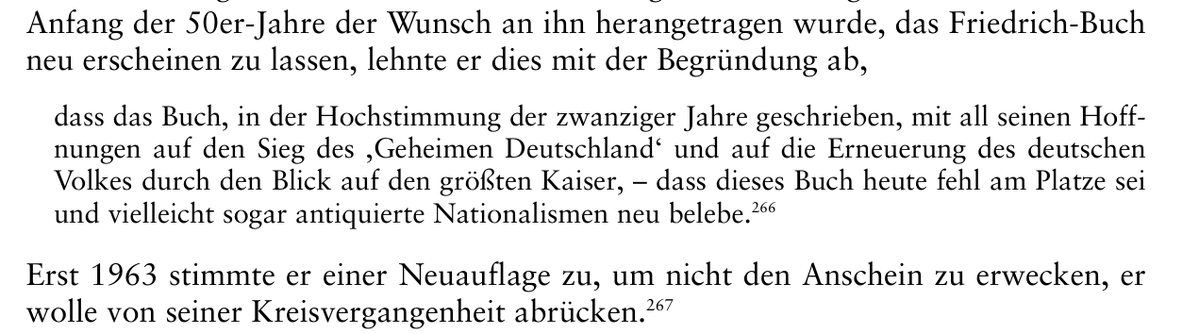
It’s indeed complicated and I have my own way of reading this. Kantorowicz said when he was asked later to sign his Frederick II book that the man who wrote it died many years ago; and I take this not as distancing himself or betrayal but rather as an encapsulating statement of what happened to him when you read his biography from 1934 onwards; that is when he left or had to leave Germany for good. It’s not like his life afterwards was uneventful or unproductive, it’s rather devoid of any true meaning, especially as a George disciple. He never felt at home nor was he really happy in the US or anywhere else for that matter, but he couldn’t go back to Germany either and visited only reluctantly and when he had to; after all that happened to Germany, coupled with his life in exile, I think things just ended for him on a deeply personal level. One could argue that this is even reflected to an extent in his professional work: The King’s Two Bodies is an outstanding work in terms of scholarship, but it’s not a work of art, at least not according to the standards of a George disciple. His Frederick II book is. — One could also argue that despite or alongside all that, he never really stopped being a George disciple (he kept a portrait of George until his death) and that his professional work is a direct continuation of Frederick II and Secret Germany through an esoteric mode of writing..
English
1
0
4
110
Fors
Fors@Seikilos5·
@spltn411 What is the Author of this Bio? Do you know why after the war he wanted to distance himself from his Friedrich II book? Reading that first page of him fighting on actual street for his ideals and then jewed out to the KWA makes me feel disappointed at him.
Fors tweet media
English
2
0
3
186
spalatin
spalatin@spltn411·
From the Kantorowicz biography
spalatin tweet mediaspalatin tweet media
2
2
47
11.6K
spalatin
spalatin@spltn411·
Of course I’m joking; and one only needs to compare it to Jens Halfwassen’s dissertation on the Parmenides “Der Aufstieg zum Einen” to see how misguided such a claim is (and what a dissertation really looks like for that matter). And isn’t it suspicious how Strauss, and those who are big on him, entirely ignore thinkers like Plotinus, Proclus etc., or an entire commentary tradition on Plato’s works, most of all Proclus commentary on the Parmenides. They never deal with that and I suspect they’re not really able to. And not to even speak on the points Conor already made regarding the Old Academy. There is enough scholarship out there on that, available even in English (Dillon, Gerson, Reale, Nikulin, O’Brien et al.); and as far as I can tell, none of them reads Aristotle uncritically when it comes to his references on Plato. It’s just mind boggling how one can read, say, Rep. 509b or the first hypothesis of the Parmenides, and not deal with the reports on the Good/One made by Aristotle in Met. A or elsewhere or even think he’s just lying. Pointing instead to the problem of different philosophical schools etc. is just smoke screening and not addressing the issue. And it’s not that Strauss may not be an interesting thinker in his own right; the problem is he and his fans got the order completely wrong and insist on projecting their misguided reading onto Plato’s dialogues. Strauss, who was taught philosophy in Germany, works with an outdated 19th century paradigm, i.e. Schleiermacher’s reading to place Plato’s esotericism WITHIN Plato’s written works (something young Nietzsche already debunked), with the additional error that political philosophy is first philosophy. It’s a compounded mess.
English
3
2
20
2.2K
Conor Stark
Conor Stark@StarkConor·
In my view, the biggest problem facing the “Straussian” account (there is no one single account as far as I can tell) of Platonic Esotericism is the following one: Even if one thinks that Aristotle is “lying” about, say, the One and the infinite Dyad, or the Form-Numbers (even though he is pretty consistent in attributing such positions to Plato in De Anima, Physics, Meta., alibi) it isn’t *just* Aristotle who said such things about Plato, or who made similar claims from the Old Academy. You also have the fragments/writings of Xenocrates, Speusippos, Theophrastus, Aristoxenus, etc. to contend with. Despite the admittedly scant external evidence for what Plato “really” thought, a coherent picture nonetheless emerges when you take all of it into account—a picture which, I think, is readily compatible with the Dialogues, even if it goes beyond them in several respects. The picture is of a man who outlined and set out upon what is perhaps the most daring, sublime, and perhaps even hubristic quests conceivable by a human intellect—to reduce all things to and then deduce them all from a single set of unhypothetical first principles. It is a goal that is unabashedly both “systematic” and “metaphysical.” Now, whether it is “systematic” is our modern sense, or “metaphysical” in a way that would have displeased Heidegger or Nietzsche—those are separate questions (to which, I think the answer is “no” and “probably,” certainly for Nietzsche and “maybe” depending on Heidegger’s Stimmung).
Alex Priou@alexpriou

Aristotle says that Socrates is the main interlocutor in the Laws. You cannot take his reading of Plato straight. "Virtually everyone knows that Aristotle sometimes lies." – Seth Benardete

English
6
4
53
10.6K
spalatin
spalatin@spltn411·
@alexpriou Of course we cannot trust Aristotle, otherwise we’d end up with metaphysics as first philosophy in Plato.
English
0
0
2
350
Alex Priou
Alex Priou@alexpriou·
Aristotle says that Socrates is the main interlocutor in the Laws. You cannot take his reading of Plato straight. "Virtually everyone knows that Aristotle sometimes lies." – Seth Benardete
English
16
6
92
31.6K
spalatin
spalatin@spltn411·
Friendship is at the heart of Plato’s thought so much so that virtue and wisdom become meaningless without it, turn even into vice and foolishness. Why else the strong warning in Lysis (an entire dialogue dedicated to this topic) that we shouldn’t forget who our ›First Friend‹ is, and that without it everything collapses.
English
0
0
0
19
Jimmy Doyle
Jimmy Doyle@jdoyleDoyle1·
@Athens_Stranger Plato’s Socrates does not say that the measure of ‘true wealth’ (ie what’s really valuable) is friendship. He says it’s wisdom & virtue, which might ofc involve friendship, but need not. In the Gorgias he’s very clear that even someone without friends or possessions can be happy
English
2
0
3
303
spalatin 리트윗함
Athenian Stranger
Athenian Stranger@Athens_Stranger·
In Plato and Xenophon we’re told by their Socrates that the only measure of *true* wealth is friendship From there, Aristotle teaches us how friendship is the precondition for philosophy and politics as such In friendship the entirety of philosophy and politics are encompassed
Phil Hoyeck@PAHoyeck

Studying philosophy isn't a good way to gain material wealth. But is it the way to a rich and fulfilling life? No. But is it at least a path toward greater wisdom and understanding? Also no.

English
2
9
140
9.7K
spalatin 리트윗함
fleur inverse
fleur inverse@fleur_inverse·
A figure I didn't mention in my art. about the Roman School of History of Religions was Angelo Brelich, due to the lack of texts available in English. I found a long one on the history of Greek initiatory institutions, tr. another one from the French. So, fleurinverse.substack.com/p/angelo-breli…
fleur inverse tweet media
English
1
10
65
9.4K
spalatin 리트윗함
Andro
Andro@TheAutumnalFire·
Cal Crucis’s simplest point might be his best; namely that, lacking a sense for a ‘civilizational project’, all the artifices of political discourse have no concrete meaning. Likewise, that all desires and correctives (e.g., ‘consciousness’) are bound to remain merely fleeting.
English
3
5
61
2.5K
spalatin 리트윗함
Bronze Age Pervert
Bronze Age Pervert@bronzeagemantis·
Caribbean Rhythms episode 216 on beginning Oligarch era Russia: Smolensky, Moscow mayor Luzhkov, Gusinsky, wild East anarchy time...time of many possibilities... free 45 minutes, SUBSCRIBE for full 1 hour 30 min show: bronzeagepervert.yoga/p/episode-216-…
English
48
115
853
520.4K
spalatin 리트윗함
Andro
Andro@TheAutumnalFire·
Guy de Maupassant on the aim of any modern novelist: “… [not] telling a story or entertaining us or touching our hearts but at forcing us to think and understand the deeper, hidden meaning of events… he will show… how people’s mentalities change under the influence of…
English
1
7
109
7.8K