tunct .grvt🍏

4K posts

tunct .grvt🍏 banner
tunct .grvt🍏

tunct .grvt🍏

@tunct101

Even in the depths of the darkest oceans, some light always pierces through All in @PrismaXai | @DonutAI

가입일 Mayıs 2019
656 팔로잉530 팔로워
고정된 트윗
tunct .grvt🍏
tunct .grvt🍏@tunct101·
From the lab… to the real world. In the beginning, everything starts in the lab - experiments, prototypes, and countless iterations. Ideas are tested, broken, and rebuilt again. With @PrismaXai , the journey doesn’t stop inside the lab. The real mission is turning those experiments into tools that actually work in the real world. Every model trained, every system optimized, and every feature released is a step toward that transition-from controlled environments to real-world impact. The lab is where innovation begins. Reality is where it proves its value. @PrismaXai is building that bridge.
tunct .grvt🍏 tweet media
English
4
0
16
203
HuyTran
HuyTran@huytran1108hd·
I've been here before. Seeing something early Feeling the vibe But hesitating… and missing it Not this time Remeko gives me that same early energy: raw, creative, and full of potential So yeah, I applied for WL Let's see where this goes @remekoAI
HuyTran tweet media
English
2
0
5
87
tunct .grvt🍏 리트윗함
remeko
remeko@remekoAI·
The new standard. remeko.io
GIF
English
5K
4.7K
6.8K
153.2K
Hanvis ✱,✱
Hanvis ✱,✱@Hanviiw_YS·
I Didn’t Expect This From a PerpDEX
Hanvis ✱,✱ tweet media
English
3
0
2
28
tunct .grvt🍏 리트윗함
Rialo
Rialo@RialoHQ·
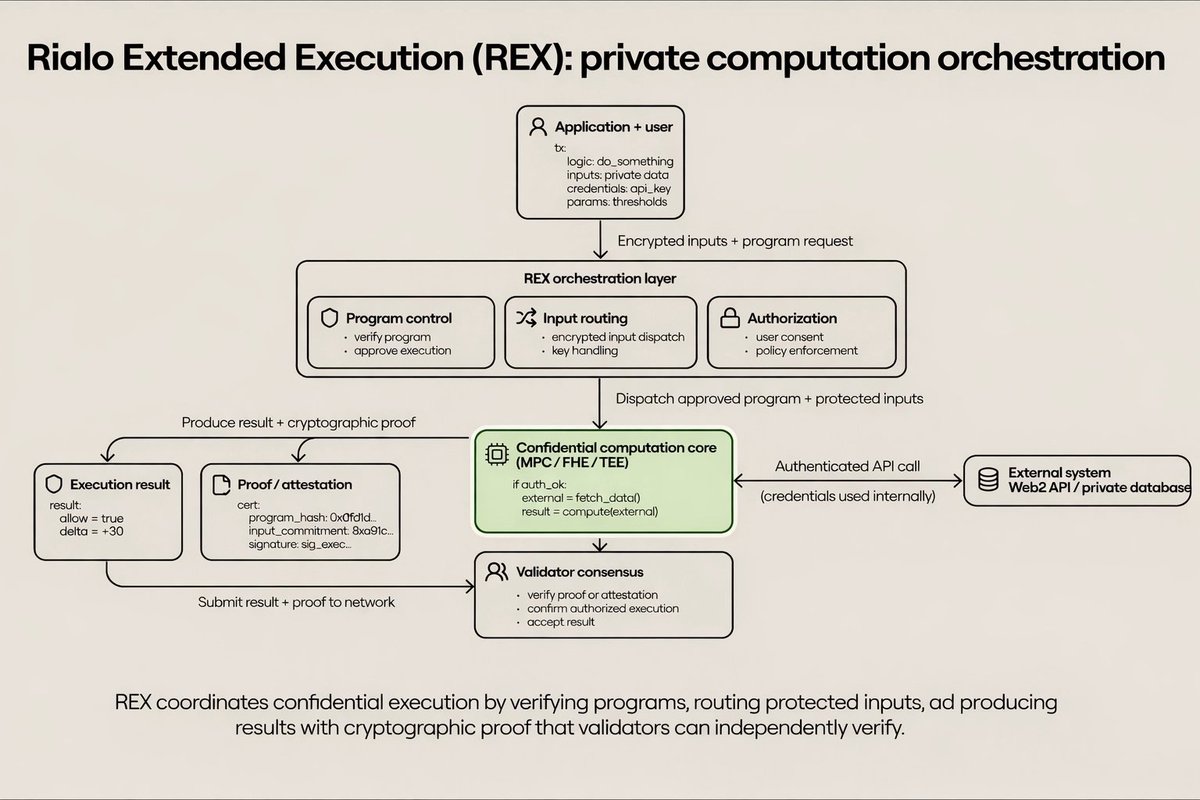
MPC. FHE. TEEs. All powerful on their own, but none solve the coordination problem. The hard part isn’t just encrypting computation; it’s the orchestration required to make it functional and secure. That’s what Rialo Extended Execution (REX) does. REX is a protocol-level orchestration system for confidential computation that manages the entire lifecycle of a secure request: Program Governance – Programs to be executed are verified and approved for specific execution runs before they ever touch the core. Encrypted Routing – Encrypted inputs are routed cryptographically to a computation core only after the appropriate program logic is loaded. Explicit Consent – Computation is performed only after explicit authorization from both the application and the user, enforced by strict policy. Confidential Compute Core – Secure execution using MPC, FHE, or TEEs, including protected Web2 API calls within an isolated environment. Verifiable Outputs – The system generates and verifies cryptographic attestations that prove a specific computation was correctly executed before routing the result to its destination. REX transforms Rialo into infrastructure for real-world secure computation: Private AI agents that process personal data without seeing it. Sensitive enterprise workflows that maintain competitive secrecy. Authenticated API automation for secure, off-chain interactions. Verifiable off-chain compute with immutable on-chain guarantees. This is native privacy at the protocol layer. Get Real. Get Rialo.
Rialo tweet media
English
140
93
444
35.1K
tunct .grvt🍏
tunct .grvt🍏@tunct101·
++ What Gauss is really about Core problem: Upgrading distributed systems (especially blockchains) is painful. > Changing validators → risky > Updating consensus rules → can break the system > Most upgrades require downtime or complex coordination In short: Running the system is easy. Upgrading it is the hard part. ++ The key insight Not everything ordered by consensus needs to be executed. >Traditionally: Consensus log = Execution log → everything must be executed >Gauss flips this: Only execute what actually affects state. ++ The big idea (1) Split the log into two layers Inner log (dirty) → everything (tx + coordination messages) Outer log (clean) → only executable transactions > Execution only sees the outer log. Consensus can be messy. Execution stays clean. (2) A controlled lie The title says it all: It’s not a lie if you don’t get caught Meaning: > Some entries exist in consensus > But are intentionally hidden from execution And it’s still safe. Why this matters: Systems don’t need perfect transparency between layers, they need deterministic consistency. (3) Upgrades without stopping the system > Instead of: pause → upgrade → restart > Gauss does: old config keeps running old config keeps runningparallel switch at a defined boundary No global halt. (4) Some transactions get dropped During transition: > transactions after the boundary (from old config) -> may be ignored → must be resubmitted in the new config Trade-off: > continuous operation > vs strict everything must execute ++ What Gauss is actually doing Turning upgrades from a high-risk event into a normal runtime process ++ Why this matters Blockchains constantly need to: > rotate validators > tweak parameters > upgrade consensus But: > upgrades are the most fragile moments Gauss enables: > seamless upgrades > no downtime > modular evolution of the protocol @RialoHQ
tunct .grvt🍏 tweet media
Rialo@RialoHQ

x.com/i/article/2036…

English
0
0
4
73
Adam (❖,❖)
Adam (❖,❖)@th787252·
Love seeing stuff like this from the Ritual community Built by @junn_17425737, a simple but meaningful site where you can create your own Ritual Role Card, revisit your first day, and get a few reminders for what’s ahead. This is the kind of energy that makes @ritualnet special. Try it here: ritual.gjunn.xyz
Adam (❖,❖) tweet media
Junn (❖,❖)@junn_17425737

I just finished a little something for the @ritualnet community A website where you can create your own Ritual Role Card There you'll relive your first day in Ritual and receive some "reminders" for the next level on this journey It's nothing too complicated, just a way for everyone to look back on their journey and see how far they've come I made it because I really enjoy being part of this community where everyone learns, builds, and shares together. Try creating your own Ritual card here: ritual.gjunn.xyz And honestly, I really cherish this community ❤️ @joshsimenhoff / @Jez_Cryptoz / @0xMadScientist / @ericgudboy

English
11
0
15
238
tunct .grvt🍏
tunct .grvt🍏@tunct101·
How Concrete Vaults Actually Work? You deposit into a vault You receive shares Your balance grows over time Sounds simple - but what’s really happening under the hood? Let’s break it down 1⃣ From the user’s view You deposit into a Concrete vault Suddenly you see: ▪️Vault shares ▪️eRate ▪️NAV And you wonder: “What do these mean?” 2⃣ Vault shares & eRate Think of a vault like a pie: ▪️The vault = the whole pie ▪️Shares = your slices When you deposit, you don’t just hold tokens → you own a piece of the vault eRate = the value of each slice As the vault performs better → each share becomes more valuable 3⃣ What is NAV? NAV = total value of the vault Think of it as the size of the pie ▪️More yield → bigger pie ▪️Same number of shares → higher value per share So: NAV = total pool Shares = your ownership When NAV grows → your wealth grows 4⃣ Why time matters Concrete vaults aren’t built for quick flips They’re more like planting a tree: ▪️Strategies take time to generate yield ▪️There are costs (gas, fees) ▪️Capital is actively adjusted over time Short term → noise Long term → compounding Time is what unlocks real growth 5⃣ Active management This isn’t a passive pool Vaults are actively managed: ▪️Allocating capital across strategies ▪️Rebalancing positions ▪️Adapting to market conditions Think of it like a skilled operator → constantly optimizing returns 6⃣ Putting it all together Here’s the key: ▪️Yield is generated ▪️Profits are reinvested (auto-compounding) ▪️Strategies evolve over time Result? Your shares keep increasing in value Not just from yield But from how that yield is managed 7⃣ Simple mental model Keep this in mind: ✅ Vault = pooled capital ✅ Shares = your ownership ✅ eRate = value per share ✅ NAV = total vault value ✅ Time = growth driver ✅ Management = optimization layer > Concrete vaults = managed DeFi + auto-compounding + on-chain capital deployment If you’re aiming for sustainable yield, this is the model to understand Explore Concrete at: app.concrete.xyz @ConcreteXYZ
tunct .grvt🍏 tweet media
English
3
0
6
75
tunct .grvt🍏
tunct .grvt🍏@tunct101·
You don't trade anymore. You deploy an agent. Most people still think the edge in crypto = finding better signals. But the real shift is happening somewhere else. Trading used to look like this: > Sit in front of charts > Wait for signals > Click buy/sell > Manage positions manually Now? You just define the goal. And an agent does the rest. Here's what actually happens under the hood: ++ You set intent Find me high-prob setups ++ System scans 24/7 Price, volume, whale moves, listings… ++ Signal triggers But doesn't execute yet ++ AI reviews the setup Filters noise, confirms entry 👉 Signal ≠ Decision anymore Then comes the real upgrade: ++ Agent selects strategy Long / Short / Arb / DCA → dynamically, not fixed ++ Executes on-chain Swap / limit / optimized slippage ++ Manages the position Auto TP/SL Risk handled for you ++ Notifies you Telegram / in-app No need to watch charts And the most important part: ++ It compounds. You set it once The agent executes The system learns And repeats This isn't just “auto trading” This is: > Less time on charts > Fewer emotional mistakes > Better execution > Real scalability The biggest cost in trading isn't fees. It's time. It's attention. It's human error. Agents remove all three. So the question isn't: Which coin should I buy? It's: What do I want my agent to do for me? @DonutAI @InternDonut
tunct .grvt🍏 tweet media
English
1
0
2
26
JohnNguyen 🔆
JohnNguyen 🔆@ThuyTrang108·
PrismaXAI: Where System Performance Meets Motion Intelligence In the era of physical AI, intelligence lies not only in the ability to think, but also in the speed of reaction. At PrismaXAI, robotics is not a single algorithm, but a full-stack system, where hardware and software merge to conquer the limits of kinematics. A breakthrough on the basketball court or a high-speed ball handling requires more than just code. It's about optimization from joint design and torque control to real-time data processing capabilities. First-Principles Design To enable robots to compete and collaborate in dynamic environments, PrismaXAI focuses on solving core engineering challenges: Mastering inertia and reaction force: Each dribbling maneuver is a delicate balance between propulsion and gravity. Our AI learns to control actuators to achieve near-human agility. Reality-based Training: Instead of just existing in simulations (Sim-to-Real), PrismaXAI's system collects data from the most complex physical interactions, turning every "collision" on the field into a valuable training signal. Sharing Intelligent Ecosystem: Data on how to maintain balance on the court or how to predict ball trajectories is updated into a shared network, helping all robots in the PrismaXAI ecosystem evolve in terms of motor skills. Realizing the Vision of Holistic Robotics PrismaXAI doesn't just build machines that work; we build systems that compete and win. From basketball courts to complex production lines, we're proving that with the right combination of data infrastructure and system design, no movement is unconquerable. PrismaXAI is bringing AI off the computer screen and into the pulse of real movement. Faster. More accurate. More powerful. PrismaXAI – Where intelligence leads the way in physics. @PrismaXai
JohnNguyen 🔆 tweet media
English
5
0
13
1.1K
tunct .grvt🍏
tunct .grvt🍏@tunct101·
gm everyone, As you've probably noticed, in recent years, AI has only existed on screens: text, images, code. But 2026 will feel different. AI is starting to enter the real world. Not just thinking → but acting: > robots picking items > machines adapting on the fly > systems interacting with physical environments This is what people call Physical AI and it’s finally becoming real, not just demos. But here’s the catch: > The bottleneck isn’t models. It’s data. Unlike internet-scale data for LLMs, robotics data is scarce, messy, and expensive. No data → no real-world intelligence. ++ So where does Prisma fit? ++ @PrismaXai isn’t building “just robots.” They’re building the infrastructure layer for Physical AI. Their core idea is simple but powerful: Human → Robot → Data → Model → Repeat > Humans teleoperate robots > Actions get recorded as real-world data > Models learn from that > Robots become more autonomous over time A true data flywheel. ++ Why this matters ++ Most teams are chasing better models. Prisma is solving the harder problem: > How do you scale real-world intelligence? If Physical AI takes off, the biggest value won’t just be in robots but in the systems that train and coordinate them. >> 2026 might not be the year robots replace humans. But it could be the year AI finally steps into reality. And @PrismaXai is betting on the layer that makes that possible.
tunct .grvt🍏 tweet media
tunct .grvt🍏@tunct101

Put two generations of robots in the same room and let them move. You don't need benchmarks or specs. The difference shows up on its own. At Stanford University recently, MIT Mini Cheetah and Unitree Go2 were operating in the same space. No direct comparison needed, just observation. What stands out isn't better vs worse, but how the approach has evolved: > movement patterns feel different over time > control systems interact with the environment differently > the overall behavior is becoming more integrated And more importantly, the focus is shifting beyond just the robot itself. Projects like @PrismaXai point toward a broader direction: → robotics + AI systems → real-world deployment as a baseline → building full-stack intelligence, not just machines When two generations run side by side like that, it becomes clear: robotics isn't changing in leaps; it's compounding, quietly.

English
9
0
11
112
Duno 🍌(❖,❖)
Duno 🍌(❖,❖)@DngDZ16·
Over the past decade, robotics has advanced at an incredible pace. Hardware is more powerful, sensors are more precise, and AI models have become significantly more sophisticated. Tasks that once required highly specialized machines can now be handled by increasingly versatile robots. But here’s the key insight: - Robots don’t become truly intelligent just because the technology improves. - They learn by interacting with the real world. They experiment, fail, adjust and repeat. Humans guide the process, and in doing so, generate the data that helps improve the system. It’s messy and imperfect, but that’s exactly how physical intelligence is built. At its core, everything revolves around a simple loop: Robot → Data → Intelligence The challenge is that this loop only works well when it’s properly structured. How robots are deployed, how tasks are designed, and how humans interact all of these directly impact data quality and learning speed. This is where @PrismaXai comes in. Instead of improving isolated components, @PrismaXai focuses on building a service layer that: Standardizes robot deployment Optimizes data generation and collection Aligns human interaction with system workflows When these pieces are coordinated, the loop accelerates: -> Robots generate better data -> Models improve faster -> Systems become more capable over time @PrismaXai isn’t just making robots better it’s enabling an entire ecosystem to function as a unified, continuously learning system.
Duno 🍌(❖,❖)@DngDZ16

PrismaX has officially joined the NVIDIA Inception Program a small milestone, but one that carries significant meaning when viewed in the bigger picture of AI for robotics. What I find interesting isn’t just the fact that they’ve joined a prestigious program, but the timing of it. We’re entering a phase where physical AI is moving out of the lab and into the real world. And at that point, the question is no longer “how smart is the model?” but rather “how do robots operate, interact, and learn in real environments?” From my perspective, what @PrismaXai is working on touches the hardest yet most critical part of this problem: real world data. Over the past year, they’ve been running large scale human in the loop robotics systems to generate real world interaction data. And one insight that really stood out to me is: 👉 The value of robotics data doesn’t lie in its quantity, but in how the system is deployed. More specifically: - Robot embodiment determines the types of interactions it can perform effectively - Sensor configuration (camera placement, depth, etc.) directly impacts how models perceive and understand the world - Task design decides whether the data is actually learnable or just noise - And human interaction within the loop is also a key variable In other words, collecting more data doesn’t automatically make AI better. If the setup is wrong, you’re just generating a large but useless dataset. What’s compelling is that over time, these patterns begin to form practical standards: - How robots should be configured - How environments should be set up - How tasks should be designed - Where humans should be involved in the loop And @PrismaXai is positioning itself to define these standards. To me, joining the NVIDIA Inception Program isn’t just about access to resources (tools, infrastructure, training…), but also about plugging into a broader ecosystem one that brings together builders, researchers, and investors to accelerate the path of physical AI into the real world. Personally, I think this is a space worth watching closely. If software based AI has already reshaped the world, then AI embedded in the physical world (robotics, automation) could drive even bigger transformations over the next 5 - 10 years. Bullish On @PrismaXai 🚀🚀🚀

English
6
0
11
446
Cao Thần Quang
Cao Thần Quang@caothanquang369·
AI isn’t stuck because of intelligence it’s stuck because of reality. Here’s what PrismaX gets right about the future of robotics 👇 1⃣ The real bottleneck: Data, not models Most AI breakthroughs today come from better models. But robotics is different. → Robots don’t just need data → They need real-world interaction data PrismaX focuses on collecting high-quality, real-world data through teleoperation and decentralized systems solving the hardest part first. 2⃣ From “demo AI” → “working AI” We’ve seen impressive demos. But very few robots actually work reliably in real environments. Why? → Edge cases → Unpredictable human behavior → Lack of continuous learning loops PrismaX emphasizes learning loops + feedback systems, turning one-time demos into evolving intelligence. 3⃣ Teleoperation is the bridge (not the end state) Instead of waiting for full autonomy: → Humans remotely operate robots → Data is captured → Models improve over time This creates a scalable path to autonomy, not a leap of faith. 4⃣ Decentralization = scalable data engine Traditional robotics struggles with data silos. PrismaX introduces: → Community-driven data collection (DataDAOs) → Incentivized participation → Open ecosystem growth Result: faster, broader, and more diverse training data. 5⃣ Reputation systems for machines One underrated idea: → Robots & AI agents build on-chain reputation This means: • Track performance over time • Reward reliability • Enable trust between machines A step toward machine accountability, not just automation. 6⃣ Robotics needs infrastructure, not hype PrismaX isn’t just building robots. They’re building: → Data layer → Coordination layer → Evaluation layer A full-stack approach to make robotics actually usable in the real world. 7⃣ The bigger picture AI transformed the digital world. Robotics will transform the physical one. But only if we solve: → Data → Coordination → Real-world deployment That’s exactly where PrismaX is focusing. @PrismaXai
Cao Thần Quang tweet media
Cao Thần Quang@caothanquang369

For decades, robotics has relied on one core idea: predict the future, then act accordingly. In classical control systems like Model Predictive Control (MPC), a robot uses a simplified model of physics to simulate how it will move over the next few seconds. It then solves an optimization problem to choose the best sequence of actions executing only the first step before repeating the process. This approach is powerful, but it comes with limits: - It depends on simplified (often linear) models of reality - It requires heavy computation to run in real time - It struggles with the complexity and unpredictability of the real world Today, we are seeing a fundamental shift. Instead of separating modeling and control, modern systems learn them together. A single model can now take: past observations + desired outcomes → and directly generate actions This changes everything. Rather than explicitly solving equations, the robot learns from data-simulations, real-world interactions, and even human demonstrations. It doesn’t just react; it anticipates. It doesn’t just follow rules; it adapts. But scaling this approach introduces a new challenge: data. Training robots in the real world is expensive and slow. Collecting millions of interactions-especially for complex tasks like cooking or assembly-is often impractical. The breakthrough comes from learning in latent space. Instead of predicting raw video frames, modern models predict compact representations of actions-capturing concepts like grasp, move, or pick up, while ignoring unnecessary visual detail. These representations are: - Faster to compute - Easier to generalize - Transferable across robots and even from humans to robots This is the foundation behind NVIDIA’s GR00T architecture: 1⃣ A vision-language model interprets the scene 2⃣ A diffusion model predicts future latent actions 3⃣ A lightweight decoder converts those into motor commands The result is a system that can reason about what should happen next - and act on it efficiently. We are moving from: physics-driven control → data-driven intelligence From carefully engineered pipelines → to learned, end-to-end behavior. And this shift is what will take robotics beyond controlled environments-into kitchens, factories, and everyday life. Not just robots that can walk. But robots that can understand, adapt, and truly assist. @PrismaXai

English
4
0
17
431
HuyTran
HuyTran@huytran1108hd·
Best scam @SmashersNFT > This was a truly elaborate scam, executed with meticulous artistry. > Create a website -> complete a task -> receive a World Life (WL) reward. > The lauch NFTs -> creates fear of missing out (FOMO) -> reduces the number of NFTs created -> but you can still create as many as you like. > SmashersNFT scammed approximately $20,000 from NFT creation. > After pulling the biggest scam of the week, SmashersNFT deletes x acct. > You did a great job, nobody could do it like you. Damn! alway DYOR 🙏
HuyTran tweet media
English
3
0
3
116