Adam (❖,❖)

2.6K posts

Adam (❖,❖) banner
Adam (❖,❖)

Adam (❖,❖)

@th787252

Don't ban my account anymore Builder AGI: @SentientAGI Chán Đời (Nói chung là chán...)

Katılım Temmuz 2024
1.4K Takip Edilen925 Takipçiler
Sabitlenmiş Tweet
Adam (❖,❖)
Adam (❖,❖)@th787252·
🎄 Ritual Christmas Card 🎄 I built a small Christmas Card project for the @ritualnet community — a place where anyone can create their own card, write a wish, and send holiday love to the community & the Ritual ecosystem ❤️ 🎁 Create your card & join the vibes 👇 🔗 ritual-christmas-card.vercel.app Let’s fill this Christmas with warmth, creativity, and Ritual magic ✨ @ritualfnd @joshsimenhoff @Jez_Cryptoz @dunken9718 @mongdiny7 @0xMadScientist @ericgudboy
English
37
3
124
4.3K
linhgia
linhgia@BonBon380991·
Rialo is an idea for asynchronous execution on the chain. Most current blockchains use a rigid synchronous model: transactions complete entirely within a single block, following an atomic flow. This works well for simple money transfers or swaps, but is inefficient when multi-step logic or external data is needed. In reality, most processes occur over time: payments awaiting confirmation, loans awaiting risk assessment, event-dependent logistics. Traditional smart contracts must be "crammed" into a transaction or rely on off-chain bots/keepers – increasing complexity and off-chain vulnerabilities. Rialo proposes a solution: transactions can pause and resume across multiple blocks. Contracts send requests, stop, and then automatically resume when conditions are met. The blockchain manages the entire process lifecycle itself. As a result, the blockchain is no longer just a "transaction computer" but becomes a reactive system: smart contracts become dynamic processes, evolving over time and events. Result: opening up new applications such as recurring payments, conditional lending, and real-world asset management based on off-chain triggers – without being limited by the “one transaction – one step” model. In short, many current limitations are not due to gas or throughput, but to the synchronous execution model itself. Asynchronous nature will significantly expand the design space of blockchain. @RialoHQ
linhgia tweet media
English
4
0
5
20
Cloud Labs
Cloud Labs@cloudtechvn·
How is mump2p different from GossipSub? The most important comparison when writing about Optimum In my view, even though both are pub-sub systems, mump2p and GossipSub differ from the very way messages are propagated. What I find notable about Optimum is that it does not just introduce a new protocol in abstract terms. It also lets users run two clearly separated modes for direct comparison: 👉 NODE_MODE=optimum → mump2p, meaning RLNC-enhanced gossip 👉 NODE_MODE=gossipsub → standard libp2p gossip The most important difference lies in how messages are transmitted. ⚙️ GossipSub: this is the widely used pub-sub standard in libp2p. Nodes maintain a mesh for each topic, gossip metadata, and forward messages across that mesh. It is a familiar baseline, scales well, and is already widely used across many blockchain systems. ⚙️mump2p: Optimum takes a different direction here by using Random Linear Network Coding (RLNC). According to the docs, messages are not always sent as one intact unit. Instead, they can be split into encoded shards, forwarded early once a threshold is reached, and later reconstructed to recover the original data. Optimum presents this design as a way to improve resilience to packet loss and to perform better in high latency or unstable network environments. So in simple terms GossipSub is the standard pub-sub approach: familiar, common, and easier to understand as a model. mump2p is a more optimized approach for message propagation under real-world network conditions, especially when there is packet loss, latency, and bandwidth pressure, thanks to RLNC. What I like is that Optimum does not ask readers to simply buy into a narrative. It provides a direct foundation for benchmarking and experimentation between these two modes within the same infrastructure. In the experiments section of the docs, the goal is clearly framed as comparing NODE_MODE=gossipsub and NODE_MODE=optimum across metrics such as delivery latency, bandwidth usage, and success rate, with the expectation that under heavier load, mump2p may handle stress better before failing. 🚩 Discord: discord.gg/getoptimum 🚩 Website: getoptimum.xyz @aqccapital @blockchainjeff @get_optimum
Cloud Labs tweet media
Cloud Labs@cloudtechvn

Looking at how Optimum is showing up at EthCC 2026, they are going straight into some of the most practical and important parts of Ethereum: Transaction lifecycle, block construction, token engineering, and even the issue of tail latency in the PBS hot path. These are not easy topics, but they are exactly where infrastructure quality is truly determined. If a team wants to make a serious contribution to Ethereum, then being willing to step into difficult discussions like blockspace, uncertainty, and latency is something worth respecting. 👀 I’ll be paying closer attention to what Optimum shares at EthCC this year, because sometimes the real value of a project is not in how loudly it speaks, but in which problems it is actually working to solve. 🚩 Discord: discord.gg/getoptimum 🚩 Website: getoptimum.xyz @aqccapital @blockchainjeff @get_optimum

English
2
0
3
40
Sonnui(❖,❖)
Sonnui(❖,❖)@sonnui210802·
The girl stood silently gazing out at the sea, the golden sunset reflecting on the rippling water. Colorful fishing boats were anchored, quietly enduring the waves. Life is like those boats: Every day at sea is a confrontation with storms, difficulties, and endless challenges. We are steering our @ritualnet Chain boats together on the Web3 ocean. Every line of code, every test, every step forward on the @ritualnet Chain is a voyage out to sea. No matter how difficult it is, as long as we hold firm to the steering wheel and have faith, we will reach the shore of success. @ritualnet @ritualfnd @Jez_Cryptoz @ericgudboy @Majorproject5 @joshsimenhoff @0xMadScientist
Sonnui(❖,❖) tweet media
Sonnui(❖,❖)@sonnui210802

The road is straight, lined with tall, lush trees that form this cool green canopy overhead. The whole scenery is straight-up breathtaking peaceful, magical, and full of life. Feels like a dream. This road is beautiful because it leads somewhere special. Kinda like our journey with Ritual. The path we’re on might get rough sometimes, or scorching hot, but it’s leading us straight to real success in the Web3 space. So let’s keep going. Because at the end of this dreamlike road, Ritual is waiting for us and so is the bag. @ritualnet @ritualfnd @Jez_Cryptoz @ericgudboy @Majorproject5 @joshsimenhoff @0xMadScientist

English
4
0
5
80
Junn (❖,❖)
Junn (❖,❖)@junn_17425737·
💠From initial curiosity to understanding more, becoming more involved, and gradually feeling connected 💠This is not just a project, but a place where I dedicate my time, energy, and attention It's just a small sticker, but every time I see it, I remember that I'm a part of something bigger 💠And perhaps… that's how the feelings began , very gently, but enough to last a long time @ritualnet / @joshsimenhoff @Jez_Cryptoz / @0xMadScientist @ericgudboy
Junn (❖,❖)@junn_17425737

I just finished a little something for the @ritualnet community A website where you can create your own Ritual Role Card There you'll relive your first day in Ritual and receive some "reminders" for the next level on this journey It's nothing too complicated, just a way for everyone to look back on their journey and see how far they've come I made it because I really enjoy being part of this community where everyone learns, builds, and shares together. Try creating your own Ritual card here: ritual.gjunn.xyz And honestly, I really cherish this community ❤️ @joshsimenhoff / @Jez_Cryptoz / @0xMadScientist / @ericgudboy

English
22
0
27
309
nanini🍊,💊🍚 ⛓
Cuối tuần rồi, bật mode touch grass thôi nào. Chúc cả nhà cuối tuần thật vui, thật chill, ăn ngon ngủ kỹ. Nạp full năng lượng để tuần mới bung lụa nhaaaa😃
Tiếng Việt
21
0
31
531
CipherAtlas (❖,❖)
CipherAtlas (❖,❖)@nguynng26509670·
most people don’t notice this shift yet we’re moving from “privacy as feature” → “privacy as foundation” @FlutonIO is building a universal Confidential Execution Layer (CEL): • swaps without showing balances • bridges without exposing intents • payments without leaking strategies • yield without broadcasting moves behind the scenes: privacy enforced at the execution layer, not patched per protocol this matters because current infra is flawed: • balances visible • strategies copied • intents exploited Fluton flips the script: you don’t switch chains, you gain composable privacy across them if this model succeeds privacy won’t be optional, it becomes a shared primitive for all apps. worth paying attention early , this is where asymmetry usually begins. cc :@cryptoperseus_ @JEAMSETH07 @KhandayFaisal20 @DucAnhXM
CipherAtlas (❖,❖) tweet media
English
16
0
25
223
Adam (❖,❖)
Adam (❖,❖)@th787252·
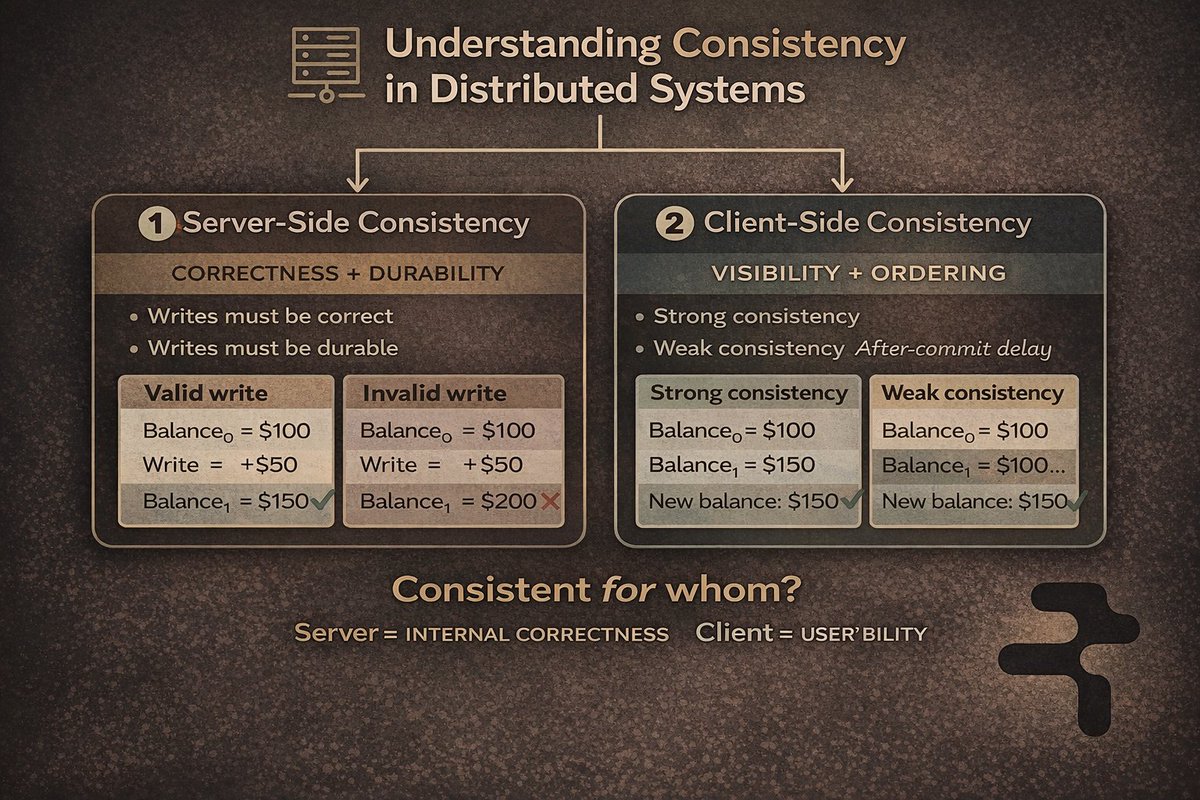
What is “Consistency” in Distributed Systems? When people talk about consistency, they often mean very different things. In reality, consistency has two distinct perspectives: 1️⃣ Server-Side Consistency (Correctness & Durability) This is the system’s internal guarantee: ✅ Every committed write must produce a valid state ✅ Once committed, data must never be lost or rolled back ✅ No partial or corrupted updates 👉 Example: - Alice has $100 - She deposits $50 → balance = $150 (committed) - She deposits another $50 → balance = $200 (committed) If the system later shows $150, something went wrong: → a committed write was lost or reverted In short: Server-side consistency = correctness + durability of writes 2️⃣ Client-Side Consistency (Visibility & Ordering) This is what users actually experience: - When can clients see updates? - Do reads reflect the latest write? - Can stale data appear? 👉 Two common behaviors: Strong Consistency - Alice deposits $50 - Immediately sees updated balance = $150 - All future reads reflect latest state 👉 “What you write is what you read” Weak Consistency - Alice deposits $50 - Still sees $100 for a while - Eventually updates to $150 👉 System is correct internally, but visibility is delayed The Key Insight - Server-side consistency = “Is the data correct?” - Client-side consistency = “Do users see the correct data now?” A system can be: - Perfectly correct internally - But still show stale data to users Why This Matters Most real-world distributed systems trade off: - Performance - Availability - Consistency This is why eventual consistency exists. Final Takeaway 👉 When someone says “this system is consistent”, ask: Consistent for whom? The server… or the client? Because in distributed systems, truth and visibility are not always the same thing. @RialoHQ
Adam (❖,❖) tweet media
Adam (❖,❖)@th787252

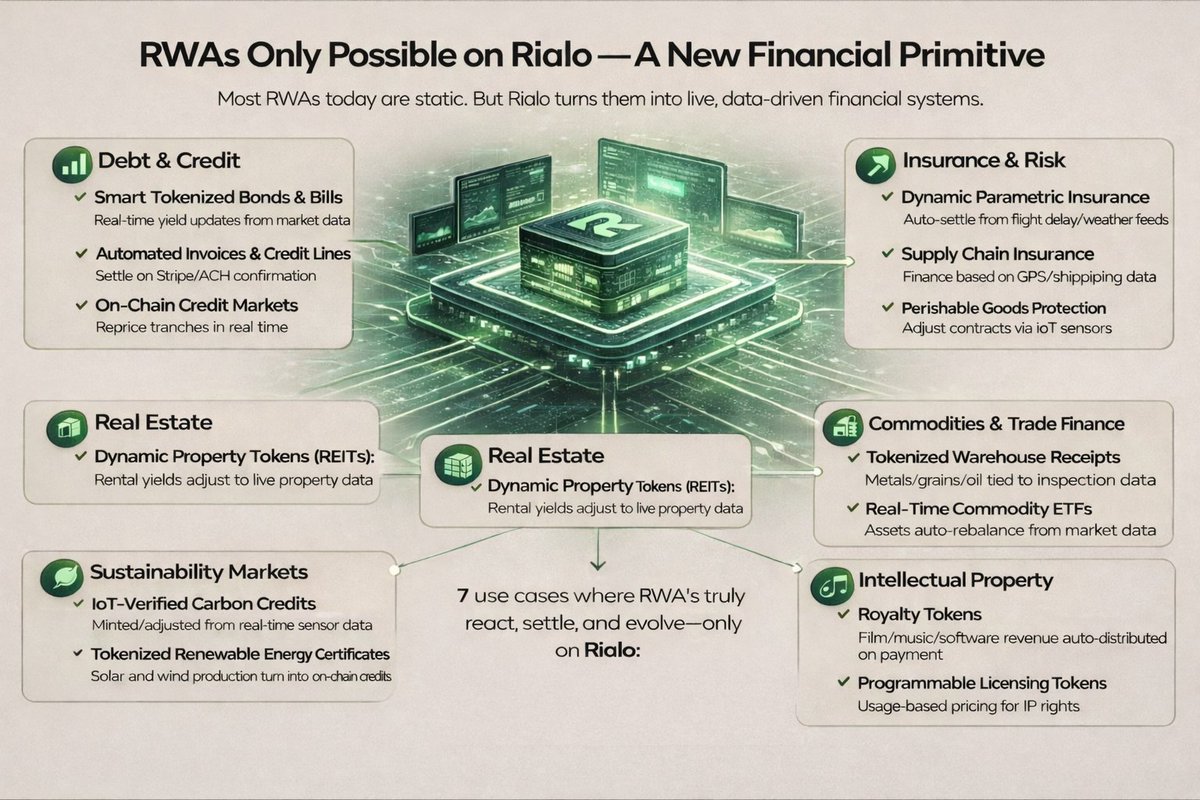
RWAs Only Possible on Rialo A New Financial Primitive Most RWAs today are static. They sit on-chain… but don’t react to the real world. @RialoHQ changes that by turning RWAs into live, data-driven financial systems. Here’s what becomes possible: 1️⃣ Debt & Credit From Static to Real-Time Finance - Smart Bonds & T-Bills Yields auto-adjust based on live CPI data, auctions, and market feeds - Tokenized Invoices & Credit Lines Invoices settle instantly when Stripe/ACH confirms payment → Liquidity pools reprice risk in real time → SMEs get instant, data-driven credit - Live Credit Markets RWA tranches adjust dynamically to ratings & alternative data → Markets can react before agencies like Moody’s update 2️⃣ Insurance & Risk Fully Automated Protection - Parametric Insurance Contracts settle instantly using real-world APIs (e.g. flight delays, weather, pricing data) - Supply Chain Finance Capital is released only when goods hit verified checkpoints (GPS, customs, shipping data) - Perishable Goods Protection IoT sensors trigger repricing or cancellation if goods spoil 3️⃣ Real Estate Living Yield Systems - Dynamic Property Tokens (REITs) Rental yields adjust automatically based on: - Occupancy - Payments - Maintenance costs All pulled directly from property management systems 4️⃣ Commodities & Trade Finance Verified & Liquid - Tokenized Warehouse Receipts Backed by GPS + inspection data → Enable instant financing or liquidation - Real-Time Commodity ETFs Auto-rebalance based on live market conditions 5️⃣ Markets & Trading Built for AI & Speed - Real-Time Data Terminal for AI Agents AI ingests news → estimates impact → executes trades All on-chain, sub-second latency 6️⃣ Sustainability Markets Data-Driven Impact - IoT Carbon Credits Mint / expire / adjust credits automatically from real-world sensor data - Tokenized Renewable Energy Certificates (RECs) Energy production feeds directly into on-chain settlement 7️⃣ Intellectual Property Autonomous Revenue Flows - Royalty Streams Music, film, software revenue auto-distributed (No intermediaries, no delays) - Programmable Licenses Pricing adjusts based on usage (API calls, streams, time left) The Big Idea: @RialoHQ doesn’t just tokenize assets. It turns them into autonomous systems that react, settle, and evolve in real time. That’s what makes these RWAs only possible on Rialo. @RialoHQ

English
6
0
8
60
S H Ξ N ²⁶
S H Ξ N ²⁶@duocpro1·
Good morning to all @RialoHQ builders Today we will explore Stake-for-Service (SfS) below. Wishing everyone a joyful and energetic Friday morning filled with positivity and good vibes. 👇👇👇 Recent debates on blockchain economic design increasingly reveal a structural tension that is often overlooked: most systems still preserve a relatively strict separation between yield-generation mechanisms and actual network consumption. Staking is typically conceptualized as a way to optimize idle capital, while usage remains mediated by independent cost layers such as gas fees and service charges. From a systems-economics standpoint, this can be read as a discontinuity in the internal value chain between capital formation and utility realization. Within this context, the Stake-for-Service (SfS) model proposed by Rialo appears less like a marginal adjustment and more like an attempt to reconfigure the circulation of value across the entire ecosystem. Rather than treating staking rewards as an endpoint, SfS reframes them as an intermediate layer that can be converted into ongoing service credits. In this configuration, yield does not exit the system as a purely financial outcome but is continuously reabsorbed into network usage. Interpreted through a self-regulating systems lens, this creates a bidirectional feedback loop between security and demand: staked capital secures the network while simultaneously generating resources that subsidize consumption. As this loop stabilizes, the distinction between investor and user becomes increasingly blurred, since the same underlying capital both secures infrastructure and finances usage. A particularly important implication lies in UX simplification. If properly calibrated, SfS may reduce reliance on fragmented gas management and repetitive top-ups, instead sustaining activity through yield-backed credits. This is especially relevant for long-duration interactions such as subscriptions, automated smart contracts, or continuous data services, where friction tends to accumulate over time. At the application layer, this shifts design logic toward a flow-based model in which costs are amortized rather than incurred discretely. Consequently, the notion of “operational cost” in dApps may be redefined as a continuously funded process rather than episodic expenditure. However, such integration also introduces unresolved systemic risks. Credit pricing may become unstable under volatile market conditions, yield-driven incentives could distort resource allocation, and the robustness of the feedback loop ultimately depends on strong economic assumptions that remain empirically unverified. Despite these uncertainties, Rialo’s SfS framework is notable not for eliminating fees per se, but for rethinking the relationship between capital and utility within a unified structure. If sustained, it could signal a broader shift in blockchain design: where yield functions not merely as an incentive, but as a direct operational substrate for network activity. #Rialo
S H Ξ N ²⁶ tweet media
English
45
9
86
4.1K
tunct .grvt🍏
tunct .grvt🍏@tunct101·
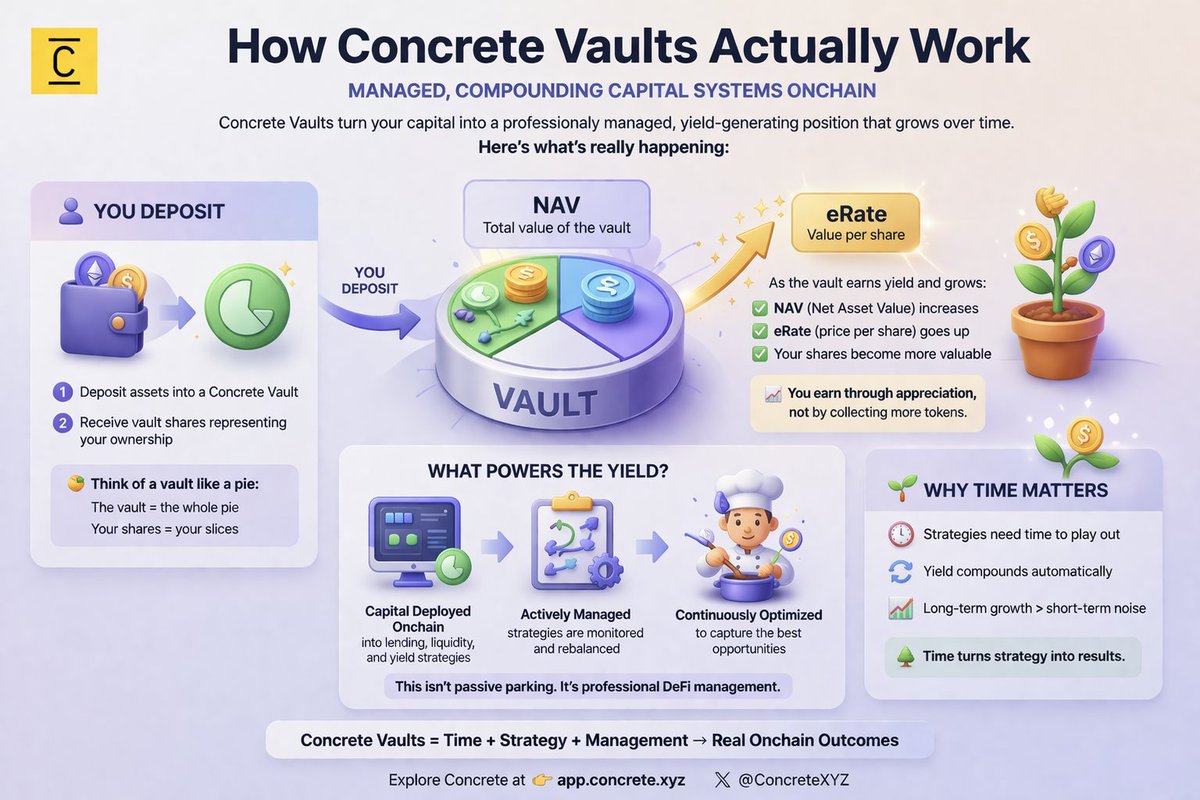
How Concrete Vaults Actually Work? You deposit into a vault You receive shares Your balance grows over time Sounds simple - but what’s really happening under the hood? Let’s break it down 1⃣ From the user’s view You deposit into a Concrete vault Suddenly you see: ▪️Vault shares ▪️eRate ▪️NAV And you wonder: “What do these mean?” 2⃣ Vault shares & eRate Think of a vault like a pie: ▪️The vault = the whole pie ▪️Shares = your slices When you deposit, you don’t just hold tokens → you own a piece of the vault eRate = the value of each slice As the vault performs better → each share becomes more valuable 3⃣ What is NAV? NAV = total value of the vault Think of it as the size of the pie ▪️More yield → bigger pie ▪️Same number of shares → higher value per share So: NAV = total pool Shares = your ownership When NAV grows → your wealth grows 4⃣ Why time matters Concrete vaults aren’t built for quick flips They’re more like planting a tree: ▪️Strategies take time to generate yield ▪️There are costs (gas, fees) ▪️Capital is actively adjusted over time Short term → noise Long term → compounding Time is what unlocks real growth 5⃣ Active management This isn’t a passive pool Vaults are actively managed: ▪️Allocating capital across strategies ▪️Rebalancing positions ▪️Adapting to market conditions Think of it like a skilled operator → constantly optimizing returns 6⃣ Putting it all together Here’s the key: ▪️Yield is generated ▪️Profits are reinvested (auto-compounding) ▪️Strategies evolve over time Result? Your shares keep increasing in value Not just from yield But from how that yield is managed 7⃣ Simple mental model Keep this in mind: ✅ Vault = pooled capital ✅ Shares = your ownership ✅ eRate = value per share ✅ NAV = total vault value ✅ Time = growth driver ✅ Management = optimization layer > Concrete vaults = managed DeFi + auto-compounding + on-chain capital deployment If you’re aiming for sustainable yield, this is the model to understand Explore Concrete at: app.concrete.xyz @ConcreteXYZ
tunct .grvt🍏 tweet media
English
3
0
6
71
Phú | RIALO
Phú | RIALO@phu09x1b78860·
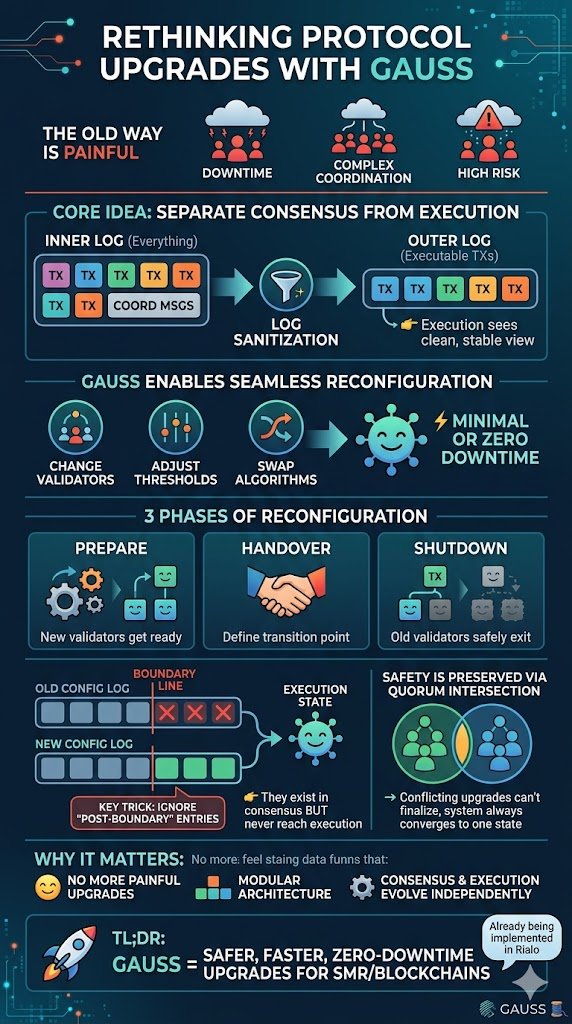
RGauss rethinks protocol upgrade with zero/low downtime→Separates consensus & execution (inner vs outer log) → Filters coordination data from execution → Enables seamless validator & consensus changesResult: safer, modular, and disruption free upgrades for blockchain @RialoHQ
Phú | RIALO tweet media
Rialo@RialoHQ

x.com/i/article/2036…

English
5
0
9
49
daniel võ
daniel võ@xuanni899·
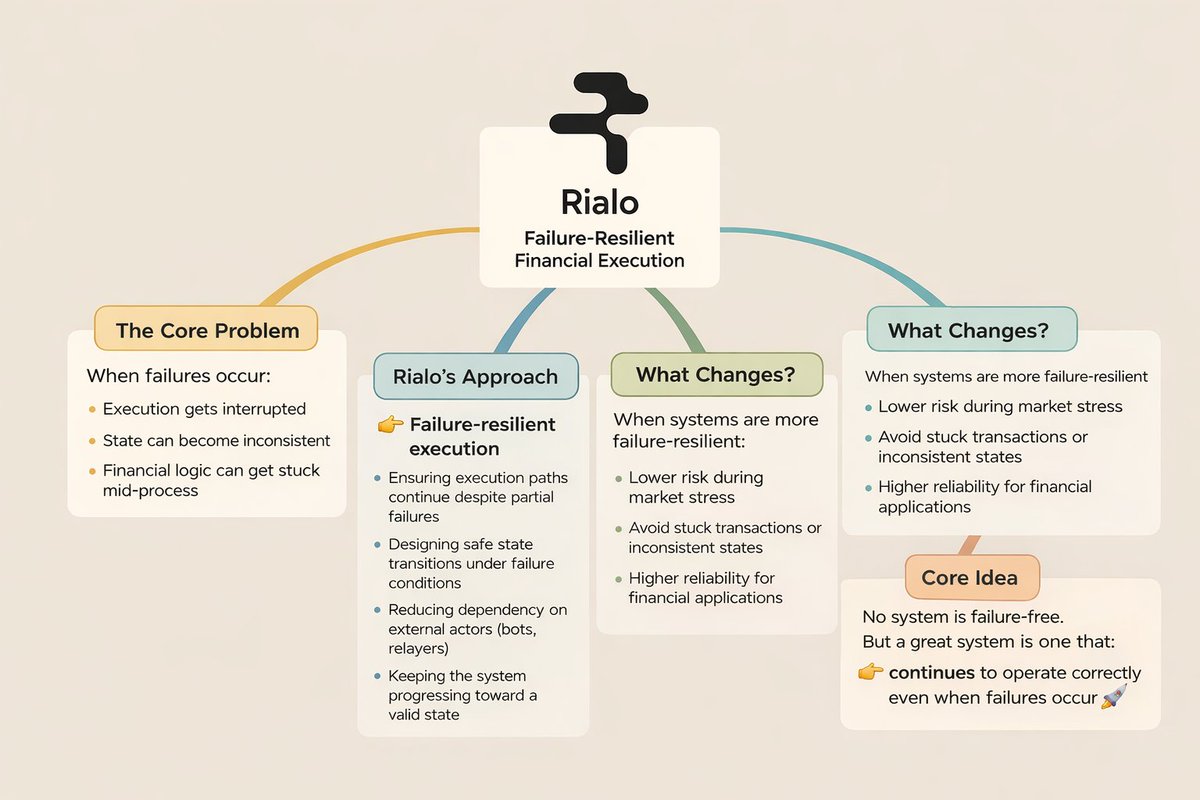
𝗥𝗶𝗮𝗹𝗼 – 𝗙𝗮𝗶𝗹𝘂𝗿𝗲 𝗥𝗲𝘀𝗶𝗹𝗶𝗲𝗻𝘁 𝗙𝗶𝗻𝗮𝗻𝗰𝗶𝗮𝗹 𝗘𝘅𝗲𝗰𝘂𝘁𝗶𝗼𝗻 ⚡ In Web3, most systems are designed to work when everything functions perfectly. But in reality: • Nodes can fail • Bots can stop running • Networks can be disrupted • Parts of the system can break ------------------------------------- 𝗧𝗵𝗲 𝗖𝗼𝗿𝗲 𝗣𝗿𝗼𝗯𝗹𝗲𝗺 When failures occur: • Execution gets interrupted • State can become inconsistent • Financial logic can get stuck mid-process For financial systems, this is a serious risk. ---------------------------------- 𝗥𝗶𝗮𝗹𝗼’𝘀 𝗔𝗽𝗽𝗿𝗼𝗮𝗰𝗵 Rialo can be designed for: 👉 Failure-resilient execution By: • Ensuring execution paths continue despite partial failures • Designing safe state transitions under failure conditions • Reducing dependency on external actors (bots, relayers) • Keeping the system progressing toward a valid state --------------------------------------- What Changes? When systems are more failure-resilient: • Lower risk during market stress • Avoid stuck transactions or inconsistent states • Higher reliability for financial applications Core Idea No system is failure-free. But a great system is one that: 👉 continues to operate correctly even when failures occur Rialo can become the foundation for reliable financial execution under imperfect conditions. 🚀
daniel võ tweet media
daniel võ@xuanni899

🔒 𝗠𝗣𝗖. 𝗙𝗛𝗘. 𝗧𝗘𝗘𝘀. Powerful technologies on their own… but they don’t solve the coordination problem. The challenge isn’t just encrypting computation. It’s orchestrating it safely and reliably. That’s exactly what Rialo Extended Execution (REX) does. ------------------------------------------- 𝗥𝗘𝗫: 𝗣𝗿𝗼𝘁𝗼𝗰𝗼𝗹-𝗟𝗲𝘃𝗲𝗹 𝗢𝗿𝗰𝗵𝗲𝘀𝘁𝗿𝗮𝘁𝗶𝗼𝗻 𝗳𝗼𝗿 𝗖𝗼𝗻𝗳𝗶𝗱𝗲𝗻𝘁𝗶𝗮𝗹 𝗖𝗼𝗺𝗽𝘂𝘁𝗮𝘁𝗶𝗼𝗻 REX manages the entire lifecycle of a secure computation request, ensuring safety, compliance, and verifiability at every step: 1️⃣ Program Governance All programs are verified and approved for specific execution runs before touching the computation core. 2️⃣ Encrypted Routing Inputs are encrypted and routed cryptographically to the compute core only after the correct program logic is loaded. 3️⃣ Explicit Consent Computation occurs only after explicit authorization from both the application and the user, enforced by strict policy. 4️⃣ Confidential Compute Core Secure execution using MPC, FHE, or TEEs, including protected Web2 API calls inside an isolated environment. 5️⃣ Verifiable Outputs Cryptographic attestations prove the computation was executed correctly before results are sent to their destination.

English
12
0
24
181
linhgia
linhgia@BonBon380991·
When a Protocol “Thinks”: The Rialo & Gauss Story Imagine you're using a very intelligent application. Initially, it works well. But there's a problem: everything inside it is pre-programmed. No matter how the market changes, how users change, how trends change… it still reacts in the old way. → It's like someone who only knows how to follow a “script”. And that's exactly where Rialo went wrong. Rialo was initially built as a specific product. It solved a problem well — but: It was difficult to adapt to rapidly changing markets. It lacked flexibility in operation. Everything depended on fixed rules. Simply put: Rialo “runs well,” but it hasn't yet “thought.” Then Gauss appeared. Instead of adding new features, Gauss brought something more important: → The ability to help the system self-adjust. Imagine this: Before: Rialo was like a car that only followed a fixed map. Now: It's like Google Maps — automatically finding the best route in real time. Gauss is the "brain" behind it: Continuously monitoring data. Analyzing market signals. Adjusting how the system operates instantly. The biggest change: Rialo began to "adapt." Instead of being rigid, Rialo can now: React faster. Optimize its operation. Adjust itself as the environment changes. This is the transition from: A fixed system → to an adaptive system. But that's not the end. The story doesn't end there. Currently, Rialo can adapt to the data. But in the future, the goal is even bigger: → A protocol that can learn and optimize itself Like AI: Not just reacting But also improving over time Gauss is the foundation for that progress. What does this mean for users? You may not see Gauss directly. But you will feel: The system runs smoother Decisions are more accurate A better experience over time And for developers: → Rialo is no longer an application → but a “living platform”, which can be built and scaled In short, a simple image: Before: Rialo was like a machine running according to a program Now: It is like a system that can observe and adjust Future: It will be like a “digital entity” that can learn Rialo + Gauss is not just an upgrade. It is the moment a system begins to “think”. @RialoHQ
linhgia tweet media
English
6
1
26
235
Junn (❖,❖)
Junn (❖,❖)@junn_17425737·
One of the most special gifts I've ever received came from @nguynng26509670 This isn't just a painting; it's a way of telling a story through light and shadow. Every detail has depth and emotion, clearly conveying a sense of quality Looking at it, you can immediately see the investment and unique "style" that not everyone can achieve This is truly more than just art; it's a work of art in the truest sense Thank you for this wonderful gift, and thank you for being part of the Seismic community, where creativity is valued and spread every day @SeismicSys is not just about technology; it's also a place where inspiring people come together @NoxxW3 - @xealistt - @heathcliff_eth
Junn (❖,❖) tweet media
CipherAtlas (❖,❖)@nguynng26509670

Proud to share my shadow art piece featuring @junn_17425737 and @susu_7968 💗 This work demanded great care and precision, and it’s even more meaningful knowing both of them truly enjoy it. I feel the spiritual value and, above all, the love everyone has for @SeismicSys 💗 As part of the project, this piece stands as a symbol of dedication, creativity, and connection . cc : @NoxxW3 @lyronctk @heathcliff_eth @xealistt @thoai6sixx @2imtunek

English
12
1
21
339
Adam (❖,❖)
Adam (❖,❖)@th787252·
RWAs Only Possible on Rialo A New Financial Primitive Most RWAs today are static. They sit on-chain… but don’t react to the real world. @RialoHQ changes that by turning RWAs into live, data-driven financial systems. Here’s what becomes possible: 1️⃣ Debt & Credit From Static to Real-Time Finance - Smart Bonds & T-Bills Yields auto-adjust based on live CPI data, auctions, and market feeds - Tokenized Invoices & Credit Lines Invoices settle instantly when Stripe/ACH confirms payment → Liquidity pools reprice risk in real time → SMEs get instant, data-driven credit - Live Credit Markets RWA tranches adjust dynamically to ratings & alternative data → Markets can react before agencies like Moody’s update 2️⃣ Insurance & Risk Fully Automated Protection - Parametric Insurance Contracts settle instantly using real-world APIs (e.g. flight delays, weather, pricing data) - Supply Chain Finance Capital is released only when goods hit verified checkpoints (GPS, customs, shipping data) - Perishable Goods Protection IoT sensors trigger repricing or cancellation if goods spoil 3️⃣ Real Estate Living Yield Systems - Dynamic Property Tokens (REITs) Rental yields adjust automatically based on: - Occupancy - Payments - Maintenance costs All pulled directly from property management systems 4️⃣ Commodities & Trade Finance Verified & Liquid - Tokenized Warehouse Receipts Backed by GPS + inspection data → Enable instant financing or liquidation - Real-Time Commodity ETFs Auto-rebalance based on live market conditions 5️⃣ Markets & Trading Built for AI & Speed - Real-Time Data Terminal for AI Agents AI ingests news → estimates impact → executes trades All on-chain, sub-second latency 6️⃣ Sustainability Markets Data-Driven Impact - IoT Carbon Credits Mint / expire / adjust credits automatically from real-world sensor data - Tokenized Renewable Energy Certificates (RECs) Energy production feeds directly into on-chain settlement 7️⃣ Intellectual Property Autonomous Revenue Flows - Royalty Streams Music, film, software revenue auto-distributed (No intermediaries, no delays) - Programmable Licenses Pricing adjusts based on usage (API calls, streams, time left) The Big Idea: @RialoHQ doesn’t just tokenize assets. It turns them into autonomous systems that react, settle, and evolve in real time. That’s what makes these RWAs only possible on Rialo. @RialoHQ
Adam (❖,❖) tweet media
Adam (❖,❖)@th787252

How Rialo Makes Real-World Assets Truly “Real” on Blockchain Real-world assets (RWAs) like tokenized treasuries, real estate, and credit have existed for years but most behave like slow, clunky replicas of off-chain assets. @RialoHQ changes that. 1️⃣ Real-World Data & Connectivity - Connects to government registries, rating agencies, payment rails, and market feeds - Auto-applies stock splits, confirms dividends, reconciles invoices 2️⃣ Real-World Reactivity & Automation - Event-driven programs react instantly—no off-chain bots - Reprice assets on credit downgrades, adjust insurance payouts, execute tender offers 3️⃣ Real-World Privacy & Identity - Confidential yet verifiable execution - Gated investment tranches, programmable wills for verified heirs 4️⃣ Real-World Speed & Scale - Sub-second latency and horizontal scalability - Real-time NAV updates, high-frequency arbitrage, same-block index fund rebalancing 5️⃣ Real-World Trading - Fully reactive strategies: equities track global news, commodities follow weather, dynamic stop-loss execution @RialoHQ doesn’t just put RWAs on-chain it lets them live, react, and trade in real time. @RialoHQ

English
8
0
12
128
Thần Quang
Thần Quang@thanquang9999·
Crypto won’t go mainstream through hype it will win through simplicity. @KASTxyz is quietly building exactly that. The shift from assets to everyday money What stands out in KAST’s content is a clear repositioning of crypto. Not as something you trade, but something you use. The focus moves toward stablecoins, cards, and local payouts turning digital assets into something that behaves like real-world cash. Stablecoins as the foundation, not a feature Instead of treating stablecoins as just another option, KAST builds the entire experience around them. This reflects a larger industry direction: Stablecoins are becoming the default financial rail for faster, borderless transactions especially where traditional banking struggles. A product designed to disappear The most interesting pattern is how KAST removes visible complexity: No need for bank details → send via usernames No external tools → built-in affiliate system Familiar payment methods → Apple Pay / Google Pay The goal is clear: users shouldn’t feel like they’re using crypto at all. Growth driven by behavior, not ideology KAST doesn’t market “decentralization” it markets incentives and utility. Referral loops, cashback, and local payment integrations suggest a playbook closer to fintech apps than crypto-native platforms. It’s less about beliefs, more about habits. Global users first The expansion strategy leans heavily into regions where: Cross-border payments are expensive Local currencies are unstable Banking access is limited This is where crypto utility becomes obvious not theoretical. Where it works and where it’s tested KAST’s strengths lie in clarity and usability. It simplifies one of crypto’s biggest pain points: actually spending it. But execution matters. Trust, support quality, and regulatory pressure will define whether this model scales or stalls. The bigger idea behind KAST What KAST is really testing is simple but powerful: A bank account might no longer be a bank. It could just be a stablecoin wallet with a card on top. @Coleta_Cripto
Thần Quang tweet media
Thần Quang@thanquang9999

Crypto cards are no longer just about spending they’re becoming identity layers. The new Pengu Card from KAST shows where Web3 fintech is heading next. 1⃣ What just launched? KAST introduced the Pengu Card, a co-branded Visa card inside the KAST ecosystem, built with Pudgy Penguins branding but running on the same infrastructure as the core KAST card. You fund it with USD, stablecoins, or crypto, and spend anywhere Visa is accepted globally. The key idea: bring on-chain identity into real-world payments. 2⃣ Why this matters for crypto fintech Most crypto cards solve one problem: off-ramping . Pengu Card tries to solve three at once: • Spend stablecoins like cash • Keep rewards native to the ecosystem • Turn digital identity into real-world utility KAST already supports spending at 150M+ merchants across 170+ countries, so the card is built for daily use, not just crypto users testing features. 3⃣ The real strategy: brand × payments × rewards The Pengu Card isn’t just a themed card. It plugs into the same reward system as KAST tiers: • 2% – 8% points depending on tier • extra token rewards on spending • virtual card first, physical later rollout This keeps the experience identical to the main product while letting communities plug into it. That’s a scalable model for Web3 fintech. 4⃣ Why Pudgy Penguins specifically Pudgy Penguins has one of the strongest consumer brands in Web3. By tying a real payment card to that identity, KAST turns NFT culture into something usable in everyday life. Not profile picture → payment method. Not flex → function. That shift is important. 5⃣ Bigger trend behind this launch We are moving from wallet → app → card → identity Crypto products that survive will be the ones that connect on-chain assets to real-world actions without friction. Pengu Card is a small release, but it shows the direction clearly. Conclusion The future of Web3 payments won’t be pure DeFi or pure fintech. It will be ecosystems where spending, rewards, and identity all live in the same loop. Pengu Card is one of the cleanest examples of that so far. @Coleta_Cripto

English
2
0
4
83
Cao Thần Quang
Cao Thần Quang@caothanquang369·
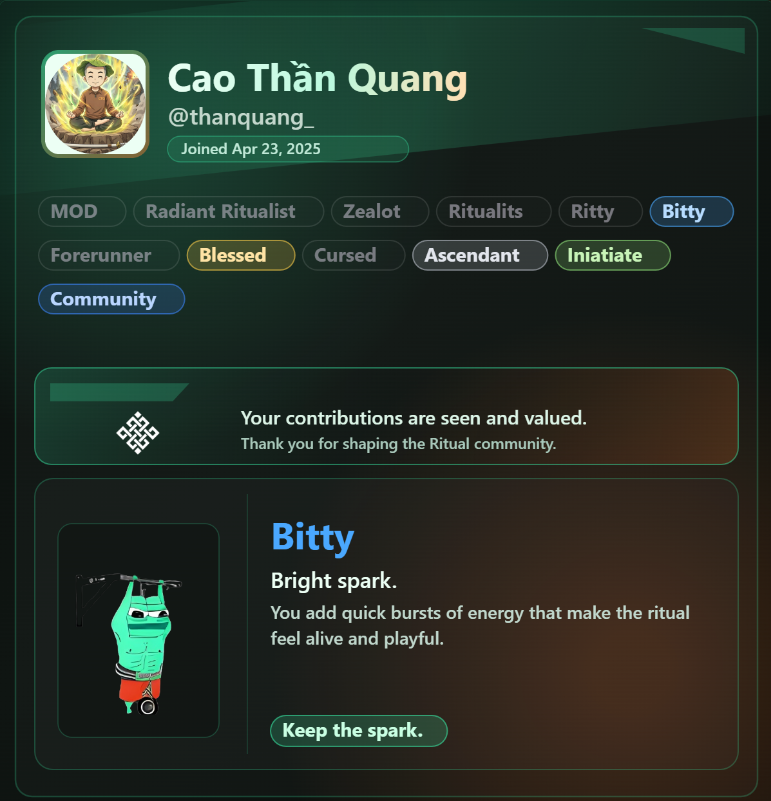
This is why community matters. Someone saw Ritual not just as a platform, but as something to build with and turned it into a small experience that helps you reflect, reset, and keep going. Shoutout to @junn_17425737 for creating a space where you can design your Ritual Role Card, look back at where you started, and stay grounded for what’s next. Moments like this are what make @ritualnet feel alive. Explore it: ritual.gjunn.xyz
Cao Thần Quang tweet media
Cao Thần Quang@caothanquang369

Maybe happiness isn’t something grand. Sometimes, it’s just sitting in a warm space, listening to the hum of voices, watching the food simmer in front of you… and holding onto a small, precious thing you cherish. @ritualfnd @joshsimenhoff @Jez_Cryptoz @ericgudboy

English
11
0
17
607
Mia Cara
Mia Cara@MCara65936·
How Do Concrete Vaults Actually Work? Most people in DeFi see this: Deposit -> get shares -> balance goes up And think: Cool… but what’s actually happening? 👇 1/ The User Experience (Where Confusion Starts) You deposit into a Concrete vault. You receive vault shares. You see numbers like eRate and NAV moving. Your balance grows. But... 👉 What do these numbers really mean? 👉 Where does the yield actually come from? 2/ Vault Shares (Your Slice of the System) Think of a vault like a pie The vault = the whole pie Your shares = your slices When you deposit: 👉 You don’t just “put money in” 👉 You own a portion of the vault As the vault grows, your slice becomes more valuable. 3/ eRate (The Value of Your Slice) eRate = the price of each share. If the vault performs well: 👉 eRate goes up 👉 Each share is worth more You don’t need more shares to earn. 👉 Your shares become more valuable over time That’s automated compounding in action. 4/ NAV (The Whole Pool) NAV = total value of the vault. Simple: NAV = everything inside the vault Shares = ownership of that total So: 👉 When NAV increases 👉 The value of each share (eRate) increases NAV = the pool Shares = your claim on it 5/ Where Yield Actually Comes From This isn’t magic yield. Concrete vaults are managed DeFi systems. Capital is: - deployed onchain - allocated across strategies - continuously optimized 👉 Yield comes from real capital deployment Not just recycled incentives. 6/ Why Time Matters (This Is Everything) Vaults are not built for quick flips. They’re more like a garden - strategies need time to play out - rebalancing takes execution - fees (gas, slippage) exist Short-term: 👉 noise, fluctuations Long-term: 👉 compounding + optimization wins Time is what turns yield into outcomes. 7/ Active Management (Not Passive Money) Concrete vaults don’t just sit there. Think of it like a chef - constantly adjusting ingredients - shifting strategies - optimizing for better returns 👉 capital is actively managed 👉 not passively parked This is onchain capital deployment done right 8/ How It All Connects Over time: - yield compounds automatically - strategies get rebalanced - better opportunities are captured So your outcome isn’t just: 👉 “earning yield” It’s: 👉 benefiting from how that yield is managed 9/ The Simple Mental Model If you remember nothing else, remember this: - Vault = pooled capital system - Shares = your ownership - eRate = value per share - NAV = total vault value - Time = growth engine - Management = optimization layer 10/ Final Thought Concrete vaults aren’t just DeFi vaults. They’re: 👉 managed, compounding capital systems onchain Built to turn time + strategy into real outcomes. ✍️Explore Concrete at app.concrete.xyz @ConcreteXYZ #Concrete
Mia Cara tweet media
Mia Cara@MCara65936

Topic : Why DeFi Needs Vault Infrastructure 1️⃣ The Fragmentation Problem DeFi didn’t fail to create yield. It failed to create systems. Today’s landscape is hyper-fragmented: - hundreds of protocols - multiple chains - constantly shifting yields - endless strategies The opportunity set is massive. But extracting value from it requires constant coordination. Capital doesn’t just sit, it needs to be managed. And right now, that burden falls entirely on the user. 2️⃣ The Operational Burden To stay competitive in DeFi, users become operators. They must: - monitor APY changes - move liquidity across protocols - claim and handle rewards - perform automated compounding manually - pay gas for every adjustment - track risk across positions Each action is logical in isolation. Together, they create friction. => DeFi isn’t just capital intensive. It’s attention intensive. 3️⃣ Idle Capital & Opportunity Cost And despite all that effort, capital is still inefficient. It often: - sits idle between decisions - remains in outdated strategies - misses better opportunities This is the hidden cost of fragmentation: opportunity cost at scale. More yield opportunities don’t guarantee better outcomes, especially when humans are the bottleneck. 4️⃣ From Manual Actions -> Vault Infrastructure In mature financial systems, capital doesn’t move manually. It flows through infrastructure. Structured. Automated. Continuous. => This is the shift happening in DeFi today through DeFi vaults. Vaults represent a new model: manual strategy management -> automated capital systems Instead of reacting to the market, capital is continuously deployed through systems designed to manage it. 5️⃣ How Concrete Vaults Enable Managed DeFi Concrete vaults take this idea further, turning DeFi into true managed DeFi. They introduce structured layers: - Allocator -> actively manages capital deployment - Strategy Manager -> defines the strategy universe - Hook Manager -> enforces risk and constraints Combined with: - liquidity aggregation - automated compounding - continuous onchain capital deployment This is no longer yield farming. It’s system-driven capital allocation. Efficiency is no longer dependent on user behavior, it’s embedded into the infrastructure. 6️⃣ Example: Concrete DeFi USDT Take Concrete DeFi USDT as a practical example: - ~8.5% stable yield - automated execution across strategies - continuous capital deployment Here, users don’t chase yield. They access a system that does it for them. The result: - improved capital efficiency - reduced idle capital - more consistent outcomes => This is where institutional DeFi begins to make sense. Because institutions don’t want dashboards full of decisions. They want predictable, structured systems that manage capital at scale. Vault infrastructure is what makes that possible. 7️⃣ The Big Shift DeFi will only become more complex from here. More protocols. More strategies. More fragmentation. Manual management will not scale with it. The next phase of DeFi won’t be defined by who finds the best yield but by who builds the best systems to manage capital. Vaults are not just a tool. They are becoming the default interface for capital deployment. Because the future of DeFi isn’t about doing more It’s about building systems where capital does the work itself. Explore Concrete at: 👉 app.concrete.xyz @ConcreteXYZ #ConcreteXYZ

English
1
0
2
51
Hanvis ✱,✱
Hanvis ✱,✱@Hanviiw_YS·
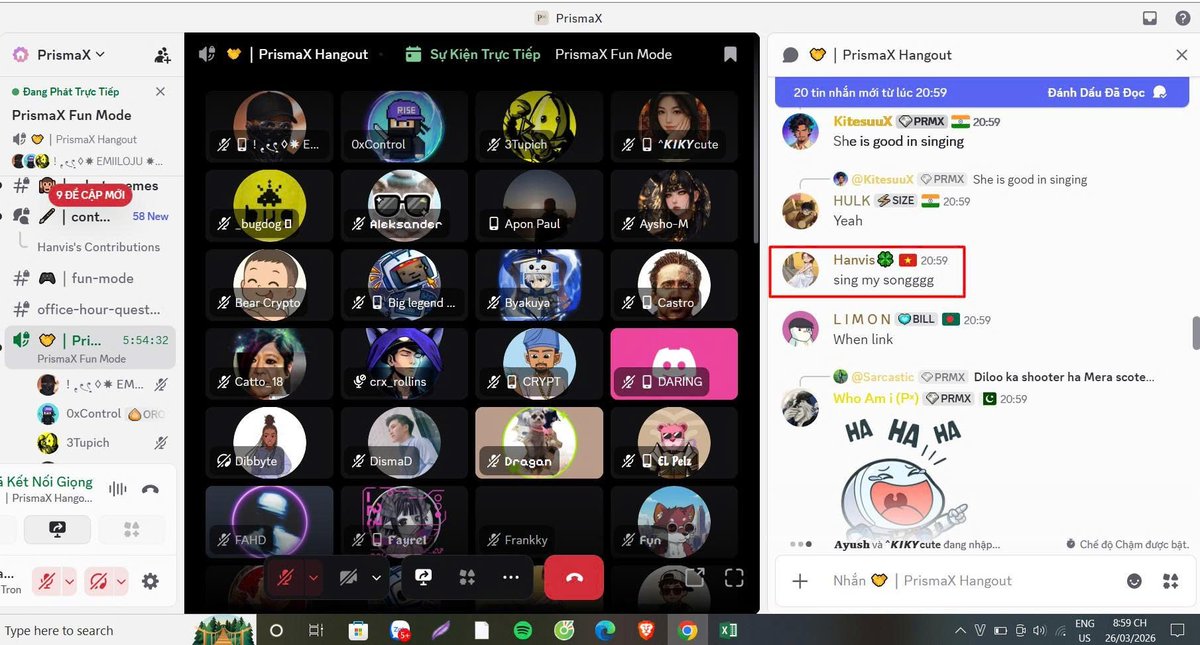
@PrismaXai Tonight's event is the biggest live concert ever, comparable to world-famous shows by Justin Bieber, Michael Jackson, Adale, and more... Join us! ☺️
Hanvis ✱,✱ tweet media
English
4
0
5
9