
Urbit

7.1K posts

Urbit banner
Urbit

Urbit

@urbit

Urbit is a computer built with networking, ownership, and durability as foundational design principles. A computer that you can trust to be yours, forever.

~zod 가입일 Eylül 2013
112 팔로잉33.5K 팔로워
고정된 트윗
Urbit
Urbit@urbit·
We often describe Urbit with big technological phrases like "self-sovereign, cryptographically-owned identity" or "deterministic operating function" or "solid state interpreter running on a distributed and end-to-end encrypted peer-to-peer network". Sorry. We'll do better. Your Urbit is Yours. Everything else is just implementation details. Lessons learned observing decades of incentives and outcomes in networked computing. The spam, the centralization, the data exploitation, the spying... It all happens because your computer isn't yours. And your computer isn't yours because it was never designed to be networked. It was never structured to be maintained by it's owner. Urbit is an endeavor to build a forever computer. A ground-up rewrite of the networked computing stack to fix the trendline towards endless complexity, unmanageable in a way that retains practical control by individuals of their computers. It is for these reasons that we use insane propositions like: - Nouns as a single foundational data type - Nock as a dead simple instruction set architecture - Hoon parlance disconnected from legacy vocabulary - Urbit OS (Arvo) as a pure function of its inputs - Urbit ID as a cryptographically owned hierarchical namespace - Kelvin versioning, where code eventually stops updating and becomes 'frozen' Again, these are implementation details. Necessary for building a world where our digital lives can last--where they can truly belong to us. Where computers can be passed down generation to generation, like a family home. But perhaps that is still to much to explan. So...What is urbit? A computer you can trust to be yours, forever.
Urbit@urbit

@medkemiacrosser @itsfolf Sorry for a $10 word when a $1 word would suffice: "yours."

English

3
8
62
7.9K
Urbit 리트윗함
Urbit
Urbit@urbit·
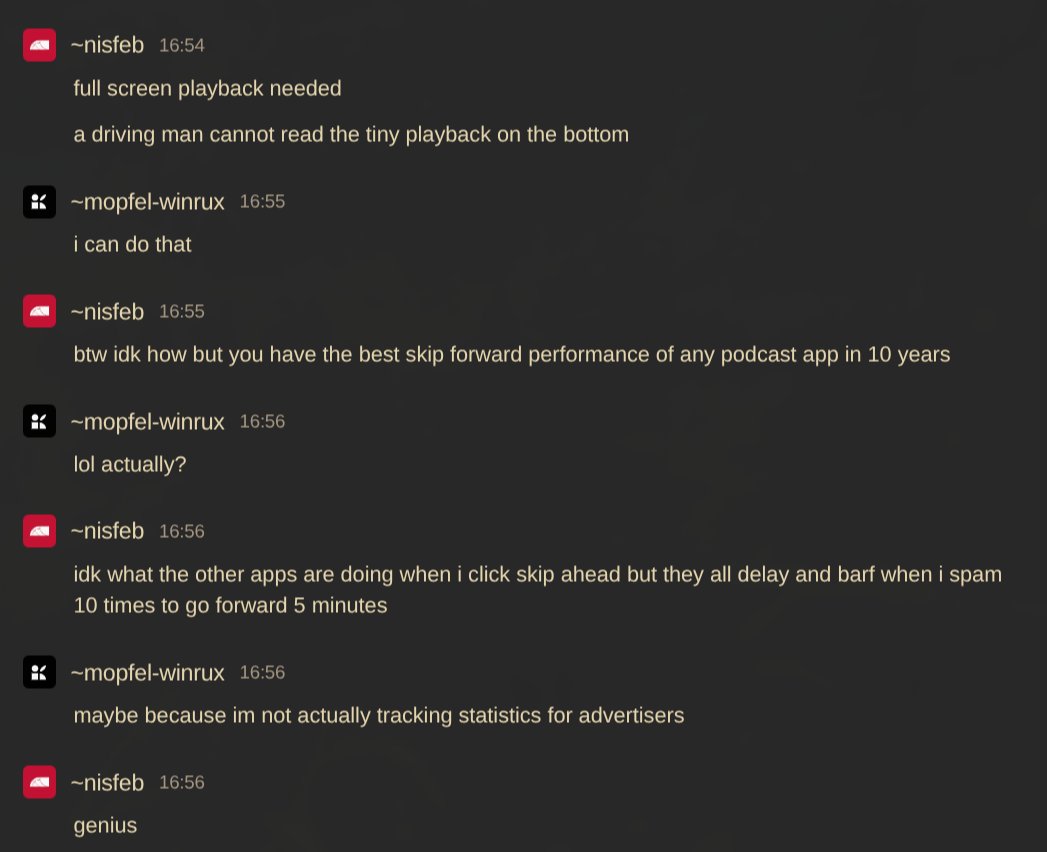
> "you have the best skip forward performance of any podcast app in 10 years" >> "maybe because im not actually tracking statistics for advertisers"
Urbit tweet media
English
3
6
45
5.8K
Urbit
Urbit@urbit·
This month we spoke with ~palfun-foslup, Urbit core dev and maker of beloved apps %pals and %rumors. Read the spotlight to learn his Urbit origin story, how he thinks about writing software for his friends, and striking a balance between archivist and digital hoarder. urbit.org/blog/contribut…
English
0
3
15
1.6K
Urbit
Urbit@urbit·
All software will eventually converge towards being Urbit. Not because we are going to make Nock the only legal form of computing. But because it is what people actually want. You just need to be brave enough to go all the way.
DHH@dhh

ONCE is back! It's now a full-fledged application server for running dockerized web apps, like Campfire/Writebook/Fizzy or your own vibe-coded adventures. Zero-downtime upgrades, scheduled backups, and a gorgeous TUI with hyperdrive graphics. Enjoy! github.com/basecamp/once

English
3
2
37
4.8K
Urbit 리트윗함
Urbit
Urbit@urbit·
We often describe Urbit with big technological phrases like "self-sovereign, cryptographically-owned identity" or "deterministic operating function" or "solid state interpreter running on a distributed and end-to-end encrypted peer-to-peer network". Sorry. We'll do better. Your Urbit is Yours. Everything else is just implementation details. Lessons learned observing decades of incentives and outcomes in networked computing. The spam, the centralization, the data exploitation, the spying... It all happens because your computer isn't yours. And your computer isn't yours because it was never designed to be networked. It was never structured to be maintained by it's owner. Urbit is an endeavor to build a forever computer. A ground-up rewrite of the networked computing stack to fix the trendline towards endless complexity, unmanageable in a way that retains practical control by individuals of their computers. It is for these reasons that we use insane propositions like: - Nouns as a single foundational data type - Nock as a dead simple instruction set architecture - Hoon parlance disconnected from legacy vocabulary - Urbit OS (Arvo) as a pure function of its inputs - Urbit ID as a cryptographically owned hierarchical namespace - Kelvin versioning, where code eventually stops updating and becomes 'frozen' Again, these are implementation details. Necessary for building a world where our digital lives can last--where they can truly belong to us. Where computers can be passed down generation to generation, like a family home. But perhaps that is still to much to explan. So...What is urbit? A computer you can trust to be yours, forever.
Urbit@urbit

@medkemiacrosser @itsfolf Sorry for a $10 word when a $1 word would suffice: "yours."

English
3
8
62
7.9K
Urbit
Urbit@urbit·
@_BILLDING_ @sol_plunder Just ask yourself, "do we need a networked computer that truly belongs to users?" If your answer to that question is yes, we consider you a friend whether your implementation is Nock & Arvo, or something else.
English
0
0
2
22
Urbit
Urbit@urbit·
Everyone wants a personal server, and they are just now realizing it. Docker self-hosting today is great for pushing forward that realization. Easily spin up a bitcoin node, or an AnythingLLM RAG instance, or any other number of services. But what they don't have is a great way to share your vibecoded apps with your friends (so they can run it themselves), nor do they easily solve the problem of networking. And of course, they don't have any solution to the spam problem that is getting exponentially worse. Big fans of what @dhh and @37signals are up to with both Once and @OmarchyLinux, though. Great mindset around software, hoping that one day they take it the final mile.
English
0
0
5
138
Urbit
Urbit@urbit·
|commit %base
Pasha Sviderski@psviderski

It's so liberating to go back to simple straightforward push deployments. Like old-school Ansible over SSH but feeling more like a modern container orchestrator. It took me a decade to come full circle. If you've been around long enough, you probably remember the evolution: configuration management tools, then the Docker boom, followed by the race of container orchestrators. K8s eventually won and we all agreed that the correct way to deploy software is: 1. Declare desired state (I want to run this service, don’t care how) 2. Let background controllers make it a reality continuously 3. Hope nothing silently fails 4. Set up a dozen different alerts so we actually know when it does 5. Every failure means tracing numerous resources, events, and logs to figure out the actual chain of actions and the root cause 6. And now adding more fuel into the fire - AI agents to help keep up with all this That’s the current norm. One solution that fits all. Sadly many engineers don't even know alternatives or question this because that’s what they all do. Reconciliation loops are brilliant engineering. At massive scale, you do need these autonomous controllers pulling and converging state and healing the dynamic system. It’s impractical to build a reliable synchronous workflow that would reliably manage services on thousands of machines over SSH. But the main tradeoff is poor visibility and troubleshooting. We can do better for smaller scale - which is most of the web apps tbf. But we need to go back and revisit the choices, not put more duct tape. We can keep the declarative definitions and reconciliation but run it synchronously on the client, not in a background loop you have no visibility into. You run the deploy, you see the result, you get a clear error if it fails. You instantly see what went wrong and what to troubleshoot or retry if needed. Your automated pipeline could do this too of course. And so this is how we designed Uncloud - push-based deployments with the lessons from the orchestrator era. Check out 👇

English
0
1
9
1K
Misha
Misha@mishadavinci·
By 2030, these technologies define the world: privacy encryption decentralization self-sovereign identity digital ownership peer-to-peer networks local-first open source censorship resistance personal AI protocols, not platforms sovereignty over convenience. Not Big AI, mass surveillance, or digital feudalism.
English
111
375
1.5K
38.3K
Lain on the Blockchain
Lain on the Blockchain@CryptoCyberia·
Ghuyz, I am getting @urbit pilled. My god, this is a crazy thing they've built on Ethereum, but it has a lot of great use cases and allows data sovereignty that is almost unheard of in internet structures that I am familiar with.
English
17
4
87
5K
unusual_whales
unusual_whales@unusual_whales·
Palantir Technologies and NVIDIA have unveiled a new Sovereign AI OS.
English
193
226
3.9K
465.7K
Urbit
Urbit@urbit·
@XMRVoid Where would you put us?
English
0
0
0
324
Mav
Mav@XMRVoid·
Privacy tier list
Mav tweet media
English
186
112
1.7K
107.3K