Ashutosh Singh

501 posts

Ashutosh Singh banner
Ashutosh Singh

Ashutosh Singh

@0xAshutosh

@Skyhighsecurity ex Quantiphi Software Engineer & Security Researcher exploring new Technologies Passionate Coder 3x GCP AI / ML RLHF Training , #coder

Bengaluru Katılım Şubat 2024
1.7K Takip Edilen254 Takipçiler
Sabitlenmiş Tweet
Ashutosh Singh
Ashutosh Singh@0xAshutosh·
Trying to figure out how one guy can launch rockets, ruin Twitter, and still find time to sleep!
Ashutosh Singh tweet mediaAshutosh Singh tweet media
English
2
1
10
4.1K
Ashutosh Singh retweetledi
Elon Musk
Elon Musk@elonmusk·
@durov Physics (with math)
English
373
389
6.9K
220.2K
Ashutosh Singh retweetledi
Pavel Durov
Pavel Durov@durov·
📚 If you’re a student choosing what to focus on, pick MATH. It will teach you to relentlessly rely on your own brain, think logically, break down problems, and solve them step by step in the right order. That’s the core skill you’ll need to build companies and manage projects.
English
975
4.3K
35.1K
1.6M
Arthur Conmy
Arthur Conmy@ArthurConmy·
I'm joining Anthropic! I'll start work on aligning upcoming models as they’re trained Claude's capabilities are extraordinary. But like all models thus far, Claude isn’t aligned enough to safely delegate AGI development to I can't think of a better place to work on this at
English
202
77
2.9K
325.6K
Ashutosh Singh retweetledi
Evan
Evan@StockMKTNewz·
THE MEMORY GIANTS ARE NOW WORTH A COMBINED $4.1 TRILLION 2016: Combined Market Cap $254B $204B - Samsung $26.2B - SK Hynix $24.1B - Micron $MU 2026: Combined Market Cap $4.1 Trillion $1.5T - Samsung $1.3T - SK Hynix $1.3T - Micron $MU
Evan tweet media
Oktay Kavrak, CFA@OKavrak

A rising tide lifts all boats?

English
27
51
343
56K
Ashutosh Singh
Ashutosh Singh@0xAshutosh·
@MicronTech Ai doesn't Think as it's own it's the loading screen thinking... 💬
English
0
0
0
128
Micron Technology
Micron Technology@MicronTech·
When an AI assistant “pauses” before responding, what is most often happening? #MicronTrivia
English
5
4
43
7.8K
Ashutosh Singh retweetledi
Pavel Durov
Pavel Durov@durov·
Telegram is now on Wear OS. Owners of Galaxy Watch, Pixel Watch, Xiaomi Watch and other smartwatches — enjoy! ☕️
English
314
249
2.9K
191K
Ashutosh Singh
Ashutosh Singh@0xAshutosh·
Just got access to Claude Fable 5. Anthropic's first Mythos-class model. Excited to test its reasoning, coding, research, and agentic capabilities on real-world workloads. @AnthropicAI The pace of AI progress is remarkable. #AI #Anthropic #ClaudeFable5 #LLM
Ashutosh Singh tweet media
English
1
0
2
191
Ashutosh Singh retweetledi
Claude
Claude@claudeai·
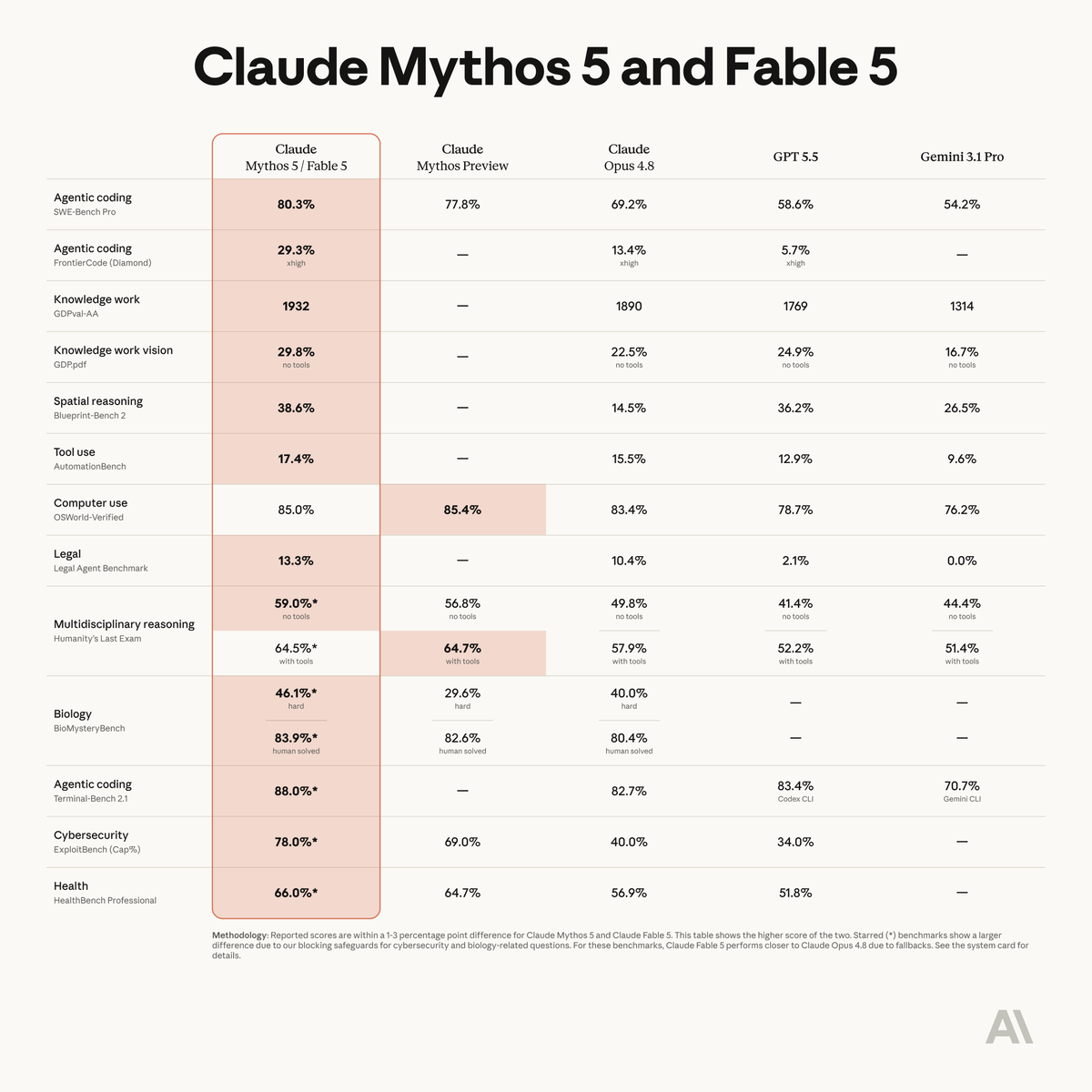
Fable 5 is state-of-the-art on nearly all tested benchmarks, with exceptional performance in software engineering, knowledge work, scientific research, and vision. The longer and more complex the task, the larger Fable 5’s lead over our other models.
Claude tweet media
English
511
1.8K
15.6K
5.7M
NVIDIA Korea
NVIDIA Korea@NVIDIAKorea·
📣 한국의 통신망이 국가 AI 인프라로 진화하고 있습니다 SK텔레콤은 NVIDIA DSX 플랫폼을 기반으로 기가와트 규모의 AI 클라우드를 한국에 구축할 계획입니다. 🇰🇷 2027년 첫 번째 AI 팩토리가 가동을 시작해 한국 전역의 기업과 산업을 위한 소버린, 피지컬, 에이전트 AI 서비스를 지원하며, 아시아 전역으로의 확장을 목표로 하고 있습니다. 🔗 블로그 읽기: nvda.ws/3Ss5PtR
NVIDIA Korea tweet media
한국어
2
21
132
6.5K
Ashutosh Singh
Ashutosh Singh@0xAshutosh·
@wiz_io Blue is my favourite colour and cloud is Blue as well 💙
English
0
0
1
91
Wiz
Wiz@wiz_io·
NEW: Introducing Wiz Cloud Cost 💸 We're bringing the power of Wiz to FinOps to help teams manage, optimize and govern cloud and AI spend - now Generally Available! Learn how Wiz Cloud Cost transforms your bottom line: wiz.io/blog/introduci…
English
2
7
25
1.8K
Ashutosh Singh retweetledi
Pubity
Pubity@pubity·
Google and Anthropic are now paying Elon Musk's SpaceX a combined $2,170,000,000 per month for cloud compute capacity to run their AI services.
Pubity tweet mediaPubity tweet media
English
93
167
2.8K
154.9K
Tur.js
Tur.js@Tur24Tur·
$300 → $99 for 3 months on SuperGrok Heavy. I claimed it. Not for the discount alone. I want @grok Build Beta in my daily workflow. 16x agents, heavy limits, early access. Let’s see if it keeps up with real offensive work.
Tur.js tweet mediaTur.js tweet media
Tur.js@Tur24Tur

Grok Composer 2.5 won my expert web security benchmark again. 25m46s / 1000 pts vs Claude Opus 4.8 at 45m10s / 500 pts. Codex GPT-5.5 judged from accepted submissions + server logs. Full chain, payloads, and screenshots: bugbounty.zip/Share/grok-cli… Congrats @xai @grok


English
4
0
31
5.1K
Ashutosh Singh
Ashutosh Singh@0xAshutosh·
@GoogleVRP I genuinely believe AI is exceptionally good at identifying vulnerabilities and scaling security analysis across massive codebases far faster than any human team alone.
English
0
0
0
116
Google VRP (Google Bug Hunters)
📣Blast from the past📣 This post takes us back to a flaw discovered in 2010: while technology has advanced, the general story of how the flaw was detected is still a great example of effectively identifying and remediating a security issue. bughunters.google.com/blog/bit-rot-d…
English
2
3
32
3.2K
Ashutosh Singh retweetledi
Farza 🇵🇰🇺🇸
Farza 🇵🇰🇺🇸@FarzaTV·
Watch me control my computer with just my voice. This is the future of operating systems. No hands. GPT-Realtime 2.0 is very, very underrated. Demo:
English
935
845
14.2K
3.7M
Ashutosh Singh retweetledi
Elon Musk
Elon Musk@elonmusk·
SpaceX has almost finished writing V1.0 of an in-house AI training stack in C that exact-maps to 220k GB300s with 800G NICs, making heavy use of pipeline parallelism and getting as close to bare metal as possible. The potential speed improvement vs JAX for large training runs is over an order of magnitude.
English
7.3K
9.6K
95.6K
30.7M
Ashutosh Singh retweetledi
Movez
Movez@0xMovez·
Jane Street AI Engineer revealed how they trained their own LLM for trading to make $22.5B/year 16 minutes. free. straight from tier-1 quants. bookmark & watch - this is the most honest "AI inside a hedge fund" talk ever published. forget the "AI trading bot" YouTube grifters. This is the real inside view: data, training, evals, integration. then start building your own bot using post below.
Movez@0xMovez

ex. Jane Street quant built a Polymarket bot with a 99.3% win rate and turned $1.2K → $865K in 6 months I analyzed his 29K trades with Opus 4.7 → reverse-engineered strategy based on 72M trades dataset rented VPS + connected Hermes agent + Binance API result 363% ROI in 3 days run your agent in 5 simple steps: • rent a VPS on Hetzner - $6.00 • install Hermes CLI using one-liner code - free • plug Opus 4.7 + TG bot + Polymarket API • run paper trading on 72M trades (John Backer) dataset • sent Hermes step-by-step prompts from article apply Kelly Criterion sizing & give agent at least $100 to run {50-100} trades for self-learning bot profile: polymarket.com/0x751a2b86cab5… start copy-trading in 2 clicks using Ares: t.me/AresProTrading… self-learning agents combined with quant models are the best setup for Polymarket crypto trading.

English
78
402
3.9K
820.8K
Ashutosh Singh retweetledi
Jukan @ICML
Jukan @ICML@jukan05·
Why did xAI hand over a 220,000-GPU cluster to Anthropic? The technical backdrop to xAI's decision to hand Colossus 1 over to Anthropic in its entirety is more interesting than it appears. xAI deployed more than 220,000 NVIDIA GPUs at its Colossus 1 data center in Memphis. Of these, roughly 150,000 are estimated to be H100s, 50,000 H200s, and 20,000 GB200s. In other words, three different generations of silicon are mixed together inside a single cluster — a "heterogeneous architecture." For distributed training, however, this configuration is close to a disaster, according to engineers familiar with the setup. In distributed training, 100,000 GPUs must finish a single step simultaneously before the cluster can advance to the next one. Even if the GB200s finish their computation first, the remaining 99,999 chips have to wait for the slower H100s — or for any GPU that has hit a stack-related snag — to catch up. This is known as the straggler effect. The 11% GPU utilization rate (MFU: the share of theoretical FLOPs actually realized) at xAI recently reported by The Information can be read as the numerical fallout of this problem. It stands in stark contrast to the 40%-plus MFU figures achieved by Meta and Google. The problem runs deeper still. As discussed earlier, NVIDIA's NCCL has traditionally been optimized for a ring topology. It works beautifully at the 1,000–10,000 GPU scale, but once you push into the 100,000-unit range, the latency of data traversing the ring once around becomes punishingly long. GPUs need to churn through computations rapidly to keep MFU high, but while they sit waiting endlessly for data to arrive over the network fabric, more than half of the silicon falls into idle. Google sidestepped this bottleneck with its own custom topology (Google's OCS: Apollo/Palomar), but xAI, by my read, has not yet reached that stage. Layer Blackwell's (GB200) "power smoothing" issue on top, and the picture comes into focus. According to Zeeshan Patel, formerly in charge of multimodal pre-training at xAI, Blackwell GPUs draw power so aggressively that the chip itself includes a hardware feature for smoothing power delivery. xAI's existing software stack, however, was optimized for Hopper and does not understand the characteristics of the new hardware; when it imposes irregular loads on the chip, the silicon physically destructs — literally melts. That means the modeling stack must be rewritten from scratch, which in turn means scaling is far harder than most of us imagine. Pulling all of this together points to a single conclusion. xAI judged that training frontier models on Colossus 1 simply was not efficient enough to be worthwhile. It therefore moved its own training workloads wholesale onto Colossus 2, built as a 100% Blackwell homogeneous cluster. Colossus 1, on the other hand — whose mixed architecture is far less crippling for inference, which parallelizes more forgivingly — was leased in its entirety to an Anthropic that desperately needed inference capacity. Many observers point to what looks like a contradiction: Elon Musk poured enormous capital into building Colossus, only to hand the core asset over to a direct competitor in Anthropic. Others read it as xAI capitulating because it is a "middling frontier lab." But these are surface-level reads. Look at the numbers and a different picture emerges. xAI today holds roughly 550,000+ GPUs in total (on an H100-equivalent performance basis), and Colossus 1 (220,000 units) accounts for only about 40% of the total available capacity. Colossus 2 — built entirely on Blackwell — is already operational and continuing to expand. Elon kept the all-Blackwell homogeneous cluster (Colossus 2) for himself and leased out the older, mixed-generation Colossus 1. In other words, he handed the pain of rewriting the stack — the MFU-11% debacle — to Anthropic, while keeping his own focus on training the next generation of models. The real point, then, is this. Elon's objective appears to be positioning ahead of the SpaceXAI IPO at a $1.75 trillion valuation, currently floated for as early as June. The narrative SpaceXAI now needs is that xAI — long the "sore finger" — is not merely a research lab burning cash, but a business with a "neo-cloud" model in the mold of AWS, capable of leasing surplus assets at high yields. From a cost-of-capital perspective, an "AGI cash incinerator" is far less attractive to investors than a "data-center landlord generating cash." As noted above, the most important detail of the Colossus 1 lease is that it is for inference, not training. Unlike training, inference requires far less tightly synchronized inter-GPU communication. Even when the chips are heterogeneous, the workload parcels out cleanly across them in parallel. The straggler effect — the chief weakness of a mixed cluster — is essentially neutralized for inference workloads. Furthermore, with Anthropic occupying all 220,000 GPUs as a single tenant, the network-switch jitter (unanticipated latency) that arises under multi-tenancy disappears. The two sides' technical weaknesses end up complementing each other almost exactly. One insight follows. As a training cluster mixing H100/H200/GB200, Colossus 1 was an asset that could only deliver an MFU of 11%. The moment it was handed over to a single inference customer, however, that asset transformed into a cash-flow asset rented out at roughly $2.60 per GPU-hour (a weighted average of the lease rates across GPU types). For xAI, what was a "cluster from hell" for training has become a "golden goose" minting $5–6 billion in annual revenue when redeployed for inference. Elon's genius, I would argue, lies not in the model but in this asset-rotation structure. The weight of that $6 billion becomes clearer when set against xAI's income statement. Annualizing xAI's 1Q26 net loss yields roughly $6 billion in losses per year. The $5–6 billion in annual revenue generated by leasing Colossus 1 to Anthropic, in other words, almost perfectly hedges xAI's loss figure. This single deal effectively pulls xAI to break-even. Heading into the SpaceXAI IPO, this functions as a core line of financial defense. From a cost-of-capital standpoint, if the image shifts from "research lab burning cash" to "infrastructure tollgate stably printing $6 billion a year," the entire tone of the offering can change. (May 8, 2026, Mirae Asset Securities)
Jukan @ICML@jukan05

What the SpaceX–Anthropic Deal Means Two weeks ago, we published a note laying out what GPT-5.5's release implied. The conclusion was simple: whoever secures compute first, in greater volume, and with greater reliability ultimately takes the win. With OpenAI's 30GW roadmap dwarfing Anthropic's 7–8GW, we closed by arguing that the structural advantage on compute sat with OpenAI. Less than a fortnight later, that conclusion is being tested. On May 6, Anthropic signed a single-tenant lease for the entirety of Colossus 1 with SpaceXAI — the infrastructure subsidiary that consolidates Elon Musk's xAI and SpaceX. The asset carries more than 220,000 GPUs and 300MW of power, and crucially, is scheduled to come online within this month. It served as the capstone of Anthropic's April blitz, which added 13.8GW of cumulative capacity over the span of a single month. On headline numbers alone, OpenAI took more than a year to stack 18GW; Anthropic has put 13.8GW in the ground in thirty days. The takeaways break down into three. First, the compute pecking order has been redrawn again. Anthropic has now swept up the AWS expansion (5GW, with $100B+ in spend commitments over a decade), Google + Broadcom (3.5GW of TPU), Google Cloud (5GW alongside a $40B investment), and now SpaceXAI's Colossus 1 (0.3GW). Cumulative committed capacity, inclusive of pre-April allocations, sits at 14.8GW. This is still only half of OpenAI's 2030 target of 30GW, but the fact that the SpaceX lease will be live inside a month makes "deliverability" a qualitatively different proposition. Second, Elon Musk is the plaintiff in an active lawsuit against OpenAI — and at the same time, the supplier handing 220,000+ GPUs and 300MW of power, in one block, to OpenAI's most formidable competitor. The timing matters: the deal was struck in the middle of the Musk–Altman trial. We read this as a deliberate pincer with OpenAI in the middle. In the courtroom, Musk works to dismantle the moral legitimacy of OpenAI's leadership; in the market, he arms Anthropic to absorb OpenAI's revenue and user base. Third, the structure is financial-engineering perfection — a clean win-win for both sides. xAI can recognize $6B of annual revenue from a single contract, an amount that almost precisely offsets its Q1 2026 annualized net loss of $6B. It also accelerates the cleanup of SpaceXAI's pre-IPO balance sheet, with the entity now being floated at around $1.75T. Anthropic, on the other side, converts roughly $5B of spend into what it expects to be $15B of ARR via the coming inference-revenue surge. (Mirae Asset Securities, May 8, 2026)

English
200
512
4.2K
1.2M
Ashutosh Singh retweetledi
Google Quantum AI
Google Quantum AI@GoogleQuantumAI·
Happy World Quantum Day! Today’s #GoogleDoodle represents the potential of the qubit. We’re harnessing its unique quantum properties to build systems capable of solving problems that remain intractable for classical computers → goo.gle/4ckighH
English
44
218
1.3K
175.2K