

Crypton.ETH
23.2K posts

Crypton.ETH
@0xCrypton_
| low-IQ dev, retail investor and researcher |
Universe Katılım Mart 2021
5.2K Takip Edilen6.8K Takipçiler

@nabi_sarvi Kova’s decentralized model is really interesting✍️.
Do you think it could replace traditional cloud services in the future?
English
the privacy versus transparency tradeoff in derivatives always felt like a false choice to me, just waiting for the right architecture to kill it.
@rails_xyz is actually doing it.
using zk proofs to verify margin and clearing without leaking position sizes or liquidation triggers...
that is the edge.
your alpha stays yours, but the solvency of the book is mathematically verifiable on chain.
it is not even a debate anymore.
cryptographic aggregation is the part that really sticks though.
publishing a single proof of correctness for the entire state instead of streaming every tx to a public mempool.
keeps the latency down, keeps the gas costs non existent, and keeps the strategy invisible. this is how pro markets actually work.
no more trusting some off chain black box, no more front running your own entry.
just pure verified execution.
the hybrid model is not some theoretical compromise, it is the only way permissionless perps actually scale to institutional volume.
honestly once you run a query on the verified state and see how fast it settles without exposing a single byte of your p and l... you get it.
the old on chain dex model is dead for anything serious.
this is the path.
GIF
English
The trust gap in AI is real, and honestly, it’s about to get worse before it gets better.
We’re seeing models scale so fast that the internal reasoning is basically a black box even to the people building them.
If you can’t prove *how* a decision was made, you don’t have an agent, you just have a really expensive magic trick.
This is where the verifiable compute stack actually matters.
Instead of just asking the model to run inference and hoping for the best, you’re forcing the execution through a provable circuit.
The model doesn’t just output an answer; it generates a cryptographic proof that the computation was executed exactly as defined.
No hallucinations in the logic layer, no hidden prompt injection, just math you can verify on chain in seconds.
It shifts the whole paradigm from “trust the model” to “verify the execution.” Once you see latency on recursive reasoning drop while the proof confirms the logic path held up, the game changes.
We’re not just talking about better answers, we’re talking about a system where the output is legally binding by code.
That’s the only way this stuff scales safely.
@inference_labs
English
the closed source ai race is getting weird, like watching walls go up around the most powerful tech we’ve ever seen.
@SentientAGI is the only one actually moving the other direction, full open source from day one.
that verifiable layer is the key though, being able to actually see how the thing thinks and changes?
that’s the moat.
modular intelligence built by everyone instead of locked in a boardroom.
feels like the only way this ends well.
English
honestly the privacy paradox on solana has been staring us in the face for ages.
you either get the raw speed or you hide everything in a zk black box that kills the composability and makes the whole thing feel sluggish.
@magicblock changed that.
private ephemeral rollups is the kind of infra shift that actually changes what builders can ship.
sub 50ms for shielded execution while staying native?
no bridges, no weird new vms to learn, just a few lines of code and you keep the liquidity right where it belongs.
plus the tee angle with intel tdx means you actually get the audit trail regulators want without exposing the raw data on the ledger.
this is the missing piece for serious finance or gaming mechanics where you need speed but can't have the entire state exposed.
finally a way to keep the chain screaming fast without forcing projects to compromise on the confidential layer.

English
honestly perps are the only leverage play that makes sense once you realize how capital efficiency actually compounds if you’re not getting rekt on funding rates or liquidation lag.
but the real bottleneck isn’t the mechanics, it’s the trader.
most people blow up because they never had to prove consistency under real pressure before scaling up.
@rails_xyz fixes that by separating skill from capital, which is quietly massive.
you grind the evaluation account with fake money but real market conditions, so the price action and latency are identical.
if you can’t make it work there, you definitely can’t handle real size.
once you prove the edge, they allocate actual capital. it’s basically a meritocratic filter for the perp market you keep the upside of leverage without the initial downside risk.
that structure is how you actually find durable alpha in this space.
GIF
English
the scaling is meaningless if the pipeline is opaque.
what @inference_labs is building feels like the first real answer to "trustless compute".
you actually need cryptographic verification on the inference step itself, not just the data inputs.
if you can't cryptographically prove the reasoning path or the weight execution, you're just trusting a black box again.
the math has to check out on chain, or it's all just noise.
glad to see this finally getting the attention it deserves.
English
gSenti 🩷
A new study dives into LLM fingerprinting under a truly hostile setup.
The host controls everything after release.
They serve the model through an API.
They know the public verification process but guard the secret key.
They run offline checks and tweak lightly without fully swapping the model.
All while keeping performance intact.
Attacks win when verification quietly fails yet the model feels unchanged.
Success measured by how often checks break versus how close usefulness stays to the original.
This realistic lens reveals hidden weaknesses in many schemes.
Simple tweaks defeat most while preserving core ability.
Sentient builds on this insight for stronger protections.
Fingerprinting becomes the quiet proof that a model remains yours even when others host it.
In open worlds ownership must survive active evasion.
This work shows why naive assumptions crumble and how to design for real threats.
Trust emerges only when verification holds against those who benefit from breaking it.
@SentientAGI
English
the most annoying part of building on solana has always been that hard stop where the chain just says "nope, too busy" or you hit that latency wall and the game loop stutters.
you start looking at sidechains or appchains and realize you're just fragmenting your liquidity and losing the whole reason you came here in the first place.
seeing ephemeral rollups actually working changes the vibe completely.
it’s not even about the tech anymore, it’s just that the friction is gone.
you keep the composability, keep the usdc flowing through the main dexes, but you get that offchain snap when you need it.
vrfs being free is huge for games too, randomness without bleeding fees on every roll?
yeah that’s the only way it actually works.
feels like we finally stopped trying to patch the limitations and just moved the heavy lifting somewhere else for a second.
@magicblock is exactly the kind of invisible plumbing that needs to happen.
real infra doesn't tweet, it just makes the thing feel instant.

English
most people treat perp dexes like black boxes that just spit out pnl and then act shocked when the box eats their money because the liquidity model or the oracle was shady the whole time.
@rails_xyz is basically the anti casino here.
merkle tree setup isn't just jargon, it's literally your receipt.
if the exchange goes down or tries to play games, you still have the cryptographic proof that your balance and those trades actually existed in the state.
you're not trusting a database admin in some offshore office, you're trusting math.
and the smart contract piece is the real lock.
when the execution and settlement rules are hardcoded, there's no "oh, the risk engine had a glitch" or selective slippage nonsense.
the code either clears or it doesn't, and it applies the same logic to a whale as it does to a smaller account.
custody is just the cherry on top actual key separation so a leak on their server side doesn't mean your wallet gets drained.
trading off understanding instead of blind faith is literally the only way to survive long term in this space. rails gets that.

English
gn
the way DSperse handles targeted verification is the only way this stuff actually works at scale.
you cant just zk prove the entire inference stack and expect it to be cheap or fast, the overhead would eat you alive.
being able to isolate just the critical sub computations and prove only those specific steps? that is the edge.
keeps the latency tight, costs down, and you still get the cryptographic guarantee on the parts that actually matter.
JSTprove confirms the model ran and DSperse makes the proof usable.
that is the whole @inference_labs stack
solid way to kick off the year
English
finally seeing it click for people…
you don't need the closed box to win,
you just need to actually route the logic.
SERA Crypto proving that open source architecture beats raw parameter scale is huge.
intent extraction plus vector based routing into live TVL and flows?
that’s the setup.
seeing it dunk on Perplexity and Grok on deep crypto research without any proprietary fine tuning is the kind of signal this cycle needed.
the real edge is just better plumbing, not bigger models.
open super intelligence era indeed
@SentientAGI
English
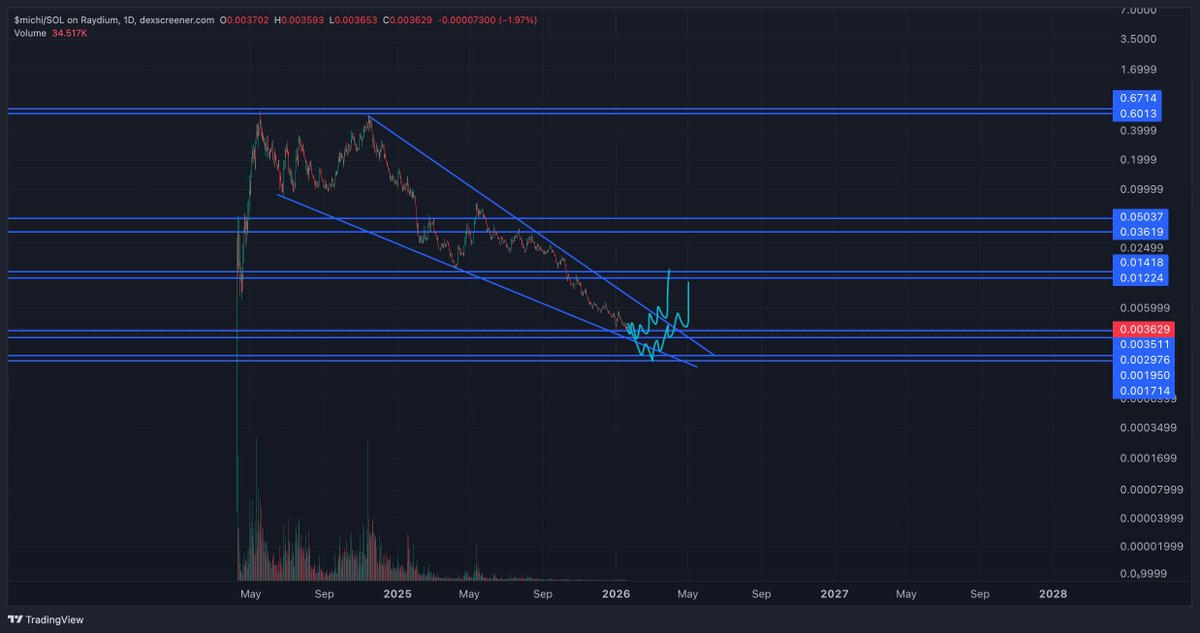
$Sol memes are dying
you can find alot of 100-500 M memes under 10m.
i picked 2 and 3 of them to accumulate
one of them is $michi under 2m - 1m.
it's not a financial advice at all because there is 90% chance for all of them going straight to zero.
English
the whole infra play shifts when you stop looking at chains as just places to park assets and start seeing them as markets for raw bandwidth and compute.
@magicblock is basically building the exchange layer for that
pay for exactly what you use, second by second, no weird monthly subscription lock in to some node provider you don't trust.
it’s the alignment thing that gets me though.
like, node operators actually get paid for real throughput and verification work, not just securing a ghost chain with zero tx volume.
that’s the incentive loop that sticks. feels like we’re finally moving past the “decentralized logo” phase into actual plumbing where the mechanics handle the load without breaking.
quiet stuff but if it holds,
it’s how you wire the whole stack without handing the keys to aws.
definitely keeping a close eye on how the routing evolves from here.

English
Summoning my favourite protocols @Uniswap @RelayProtocol @aave to join the movement!
ETHGas is introducing the Open Gas Initiative, eliminating gas fees from the end-user experience
Learn more: ethgas.com/open-gas/
x.com/ethgasofficial…
ETHGAS@ETHGasOfficial
Introducing the Open Gas Initiative - a way for protocols to subsidize gas for users, zero-code, for a seamless, frictionless onchain experience. With OG cohort: @eigencloud, @ether_fi, @pendle_fi, @Velvet_Capital. 👇
English
Just unlocked my Gas ID via ETHGas 🪪
I'm a Legendary Jack with 15.9469 ETH spent on gas since Beacon Chain - now fueling my climb to the Gasless Future and earned 4000 Beans already.
Reveal yours at ethgas.com/community/gas-…

English
spent the last few nights actually digging into how @rails_xyz is handling the order flow and yeah...
the distinction between execution and settlement is the whole game here.
we’ve been conflating them for years and it’s quietly killed edge on so many trades.
what’s actually happening under the hood is they’re pulling the intent off the critical path.
your funds never move, you’re just signing a scoped permit that lets the solver engine find the best fill across liquidity sources that standard dex aggregators usually miss.
the solver acts on that intent, executes at speed, and only then does the settlement tx hit your wallet.
you don’t wait for blocks. you don’t pray for inclusion in a packed slot. the latency delta is just… gone.
the structural shift is moving from a "push" model where you have to force a tx into a block, to a "pull" model where the market comes to you based on signed intent. it’s not just faster...
it completely changes the psychology of the trade.
you stop fighting the plumbing and start actually playing price.
if this architecture scales, the old way of clicking "swap" and sweating 45 seconds of pending mempool purgatory is gonna feel primitive.
this is how onchain should have always felt.
GIF
English
the autonomous agent is scary good
like weve been running these bots in the dark for years hoping the risk engine doesnt hallucinate a liquidation at 3am but the way @inference_labs forces every compute step through a verifiable loop changes the whole risk profile entirely
you can actually trace the decision tree from trigger to execution onchain, see exactly why the agent rejected that loan or flagged that tx, no more he said she said with centralised ai providers
its not even about transparency for transparency sake, its about survival in high value defi where a single opaque error can toast a whole protocol
if we want real autonomous finance this layer of cryptographic proof is non negotiable
sleep well
English