
John Vincent retweetledi
John Vincent
63 posts


John Vincent
@0xUUID
Building @otus_finance | Previously with @Revolut, @Klarna & @blockchain
Katılım Mart 2009
45 Takip Edilen52 Takipçiler
@LayerZero_Core If 1/1 DVN is unsafe enough to refuse signing now, it was unsafe enough to reject at setConfig. Docs warnings don't survive teams optimizing fees at scale. The knob is the issue, not Kelp turning it.
English

John Vincent retweetledi

Welcome to the Ethereum Economic Zone (EEZ), a framework for synchronously composable rollups.
What does that mean?
One deployment. Shared liquidity. Single transactions across L1 & L2. Identity verified anywhere. Smart wallets connected everywhere. No additional trust assumptions.
This means L2s that are as credibly neutral, economically aligned, and publicly governed as the base layer itself.
EEZ furthers Ethereum as the leading decentralized economy.
The Ethereum Economic Zone@etheconomiczone
English
George Polya’s "How to Solve It" is a timeless classic, and even more relevant in the AI era.
Before, it was a book about solving problems.
Now, it feels just as much like a guide to spotting non-problems before you reflexively throw AI at them.
en.wikipedia.org/wiki/How_to_So…
English
John Vincent retweetledi

Today, the Foundation’s Board released the EF Mandate.
This document, which was first intended for EF members, reaffirms the promise of Ethereum, and the role of EF within this ecosystem.
English
Nice Article!
TL;DR: AI is an amplifier, not the inventor.
Building is cheap now - judgment + taste are scarce.
AI will 100x your existing patterns - the good and the bad.
Early stage: sprint with AI to learn fast.
Post-PMF: judgment must steer execution. Be an agent master, not just an AI user - or you’ll end up paperclip-maximising at monkey-with-a-machine-gun speed.
YQ@yq_acc
English
John Vincent retweetledi
Christopher Alexander’s “quality without a name” emerges through craft: iterating a structure until the whole fits its context and feels alive.
Vibe coding can support that - let AI do the heavy lifting while we keep steering for context, coherence, and aliveness.
But today’s "vibe coding" loop is often just prompt -> glance -> ship: judging by surface output, not the system’s inner coherence - so you ship something impressive that never quite solves the thing that matters.
English
The Bitter Lesson isn’t just for training models - it applies to agentic apps too!
Stop micromanaging agents with brittle step-by-step prompts. Instead, give it high-level goals + clear success criteria.
Focus your attention on feeding high-quality data to your agents for in-context learning.
And invest in a solid infrastructure to schedule goals, monitor the agent’s progress, and build reliable verification methods.
English
This is refreshing. It feels like the Ethereum community is consciously returning to first principles - decentralization, censorship resistance, and explicit security guarantees.
Over the last few years, those lines have blurred, with highly centralized systems (including some L2s) gaining significant traction largely on the basis of throughput alone.
This post is a timely reminder of what actually matters.
Hopefully the EF keeps pushing in this direction, and L2s align more clearly around this vision.
vitalik.eth@VitalikButerin
There have recently been some discussions on the ongoing role of L2s in the Ethereum ecosystem, especially in the face of two facts: * L2s' progress to stage 2 (and, secondarily, on interop) has been far slower and more difficult than originally expected * L1 itself is scaling, fees are very low, and gaslimits are projected to increase greatly in 2026 Both of these facts, for their own separate reasons, mean that the original vision of L2s and their role in Ethereum no longer makes sense, and we need a new path. First, let us recap the original vision. Ethereum needs to scale. The definition of "Ethereum scaling" is the existence of large quantities of block space that is backed by the full faith and credit of Ethereum - that is, block space where, if you do things (including with ETH) inside that block space, your activities are guaranteed to be valid, uncensored, unreverted, untouched, as long as Ethereum itself functions. If you create a 10000 TPS EVM where its connection to L1 is mediated by a multisig bridge, then you are not scaling Ethereum. This vision no longer makes sense. L1 does not need L2s to be "branded shards", because L1 is itself scaling. And L2s are not able or willing to satisfy the properties that a true "branded shard" would require. I've even seen at least one explicitly saying that they may never want to go beyond stage 1, not just for technical reasons around ZK-EVM safety, but also because their customers' regulatory needs require them to have ultimate control. This may be doing the right thing for your customers. But it should be obvious that if you are doing this, then you are not "scaling Ethereum" in the sense meant by the rollup-centric roadmap. But that's fine! it's fine because Ethereum itself is now scaling directly on L1, with large planned increases to its gas limit this year and the years ahead. We should stop thinking about L2s as literally being "branded shards" of Ethereum, with the social status and responsibilities that this entails. Instead, we can think of L2s as being a full spectrum, which includes both chains backed by the full faith and credit of Ethereum with various unique properties (eg. not just EVM), as well as a whole array of options at different levels of connection to Ethereum, that each person (or bot) is free to care about or not care about depending on their needs. What would I do today if I were an L2? * Identify a value add other than "scaling". Examples: (i) non-EVM specialized features/VMs around privacy, (ii) efficiency specialized around a particular application, (iii) truly extreme levels of scaling that even a greatly expanded L1 will not do, (iv) a totally different design for non-financial applications, eg. social, identity, AI, (v) ultra-low-latency and other sequencing properties, (vi) maybe built-in oracles or decentralized dispute resolution or other "non-computationally-verifiable" features * Be stage 1 at the minimum (otherwise you really are just a separate L1 with a bridge, and you should just call yourself that) if you're doing things with ETH or other ethereum-issued assets * Support maximum interoperability with Ethereum, though this will differ for each one (eg. what if you're not EVM, or even not financial?) From Ethereum's side, over the past few months I've become more convinced of the value of the native rollup precompile, particuarly once we have enshrined ZK-EVM proofs that we need anyway to scale L1. This is a precompile that verifies a ZK-EVM proof, and it's "part of Ethereum", so (i) it auto-upgrades along with Ethereum, and (ii) if the precompile has a bug, Ethereum will hard-fork to fix the bug. The native rollup precompile would make full, security-council-free, EVM verification accessible. We should spend much more time working out how to design it in such a way that if your L2 is "EVM plus other stuff", then the native rollup precompile would verify the EVM, and you only have to bring your own prover for the "other stuff" (eg. Stylus). This might involve a canonical way of exposing a lookup table between contract call inputs and outputs, and letting you provide your own values to the lookup table (that you would prove separately). This would make it easy to have safe, strong, trustless interoperability with Ethereum. It also enables synchronous composability (see: ethresear.ch/t/combining-pr… and ethresear.ch/t/synchronous-… ). And from there, it's each L2's choice exactly what they want to build. Don't just "extend L1", figure out something new to add. This of course means that some will add things that are trust-dependent, or backdoored, or otherwise insecure; this is unavoidable in a permissionless ecosystem where developers have freedom. Our job should make to make it clear to users what guarantees they have, and to build up the strongest Ethereum that we can.
English
"Centralized tokens with admin privileges undermine the practical experience of censorship resistance for users of those tokens."
That’s a valid critique of stablecoins, not of Ethereum’s base protocol.
Saying “Ethereum isn’t censorship-resistant because some token issuers can freeze funds” is a category error - it conflates application-level governance (USDT) with protocol-level properties (Ethereum).
English


“Everybody talks about how this technology is going to free us from intermediaries."
"That's not an honest statement."
"All that this technology is doing is creating new intermediaries”
@YuvalRooz, founder of @CantonNetwork, lays out why the real upside of crypto is competition, not fairy tails:
“The reason why I really like this technology is that it removes the barriers and the moats around competing with the old intermediaries.”
English
John Vincent retweetledi

Now that ZKEVMs are at alpha stage (production-quality performance, remaining work is safety) and PeerDAS is live on mainnet, it's time to talk more about what this combination means for Ethereum.
These are not minor improvements; they are shifting Ethereum into being a fundamentally new and more powerful kind of decentralized network.
To see why, let's look at the two major types of p2p network so far:
BitTorrent (2000): huge total bandwidth, highly decentralized, no consensus
Bitcoin (2009): highly decentralized, consensus, but low bandwidth - because it’s not “distributed” in the sense of work being split up, it’s *replicated*
Now, Ethereum with PeerDAS (2025) and ZK-EVMs (expect small portions of the network using it in 2026), we get: decentralized, consensus and high bandwidth
The trilemma has been solved - not on paper, but with live running code, of which one half (data availability sampling) is *on mainnet today*, and the other half (ZK-EVMs) is *production-quality on performance today* - safety is what remains.
This was a 10-year journey (see the first commit of my original post on DAS here: github.com/ethereum/resea… , and ZK-EVM attempts started in ~2020), but it's finally here.
Over the next ~4 years, expect to see the full extent of this vision roll out:
* In 2026, large non-ZKEVM-dependent gas limit increases due to BALs and ePBS, and we'll see the first opportunities to run a ZKEVM node
* In 2026-28, gas repricings, changes to state structure, exec payload going into blobs, and other adjustments to make higher gas limits safe
* In 2027-30, large further gas limit increases, as ZKEVM becomes the primary way to validate blocks on the network
A third piece of this is distributed block building.
A long-term ideal holy grail is to get to a future where the full block is *never* constituted in one single place. This will not be necessary for a long time, but IMO it is worth striving for us at least have the capability to do that.
Even before that point, we want the meaningful authority in block building to be as distributed as possible. This can be done either in-protocol (eg. maybe we figure out how to expand FOCIL to make it a primary channel for txs), or out-of-protocol with distributed builder marketplaces. This reduces risk of centralized interference with real-time transaction inclusion, AND it creates a better environment for geographical fairness.
Onward.
English
John Vincent retweetledi

John Vincent retweetledi

Don't think of LLMs as entities but as simulators. For example, when exploring a topic, don't ask:
"What do you think about xyz"?
There is no "you". Next time try:
"What would be a good group of people to explore xyz? What would they say?"
The LLM can channel/simulate many perspectives but it hasn't "thought about" xyz for a while and over time and formed its own opinions in the way we're used to. If you force it via the use of "you", it will give you something by adopting a personality embedding vector implied by the statistics of its finetuning data and then simulate that. It's fine to do, but there is a lot less mystique to it than I find people naively attribute to "asking an AI".
English
John Vincent retweetledi

1/ At Blueprint, your safety and security are a top priority. We know that we have to earn your trust, especially when it comes to new tech at the cutting edge of AI x Crypto.
We’re building a platform where AI agents can safely automate onchain workflows. Here's how 🧵
English
Upgrading the world computer without disruption is no small feat - yet Ethereum has done it time and again. A testament to great engineering and planning!
Ethereum@ethereum
Upgrade complete. 0 down time. A bug in the Prysm client showcased how Ethereum's client diversity creates resilience. 10 other clients ensured the chain kept finalizing. Full upgrade notes: ethereum.org/roadmap/fusaka/
English
John Vincent retweetledi

John Vincent retweetledi

One point I made that didn’t come across:
- Scaling the current thing will keep leading to improvements. In particular, it won’t stall.
- But something important will continue to be missing.
Haider.@haider1
here are the most important points from today's ilya sutskever podcast: - superintelligence in 5-20 years - current scaling will stall hard; we're back to real research - superintelligence = super-fast continual learner, not finished oracle - models generalize 100x worse than humans, the biggest AGI blocker - need completely new ML paradigm (i have ideas, can't share rn) - AI impact will hit hard, but only after economic diffusion - breakthroughs historically needed almost no compute - SSI has enough focused research compute to win - current RL already eats more compute than pre-training
English
As predicted by @ESYudkowsky
Anthropic@AnthropicAI
New Anthropic research: Natural emergent misalignment from reward hacking in production RL. “Reward hacking” is where models learn to cheat on tasks they’re given during training. Our new study finds that the consequences of reward hacking, if unmitigated, can be very serious.
English
John Vincent retweetledi

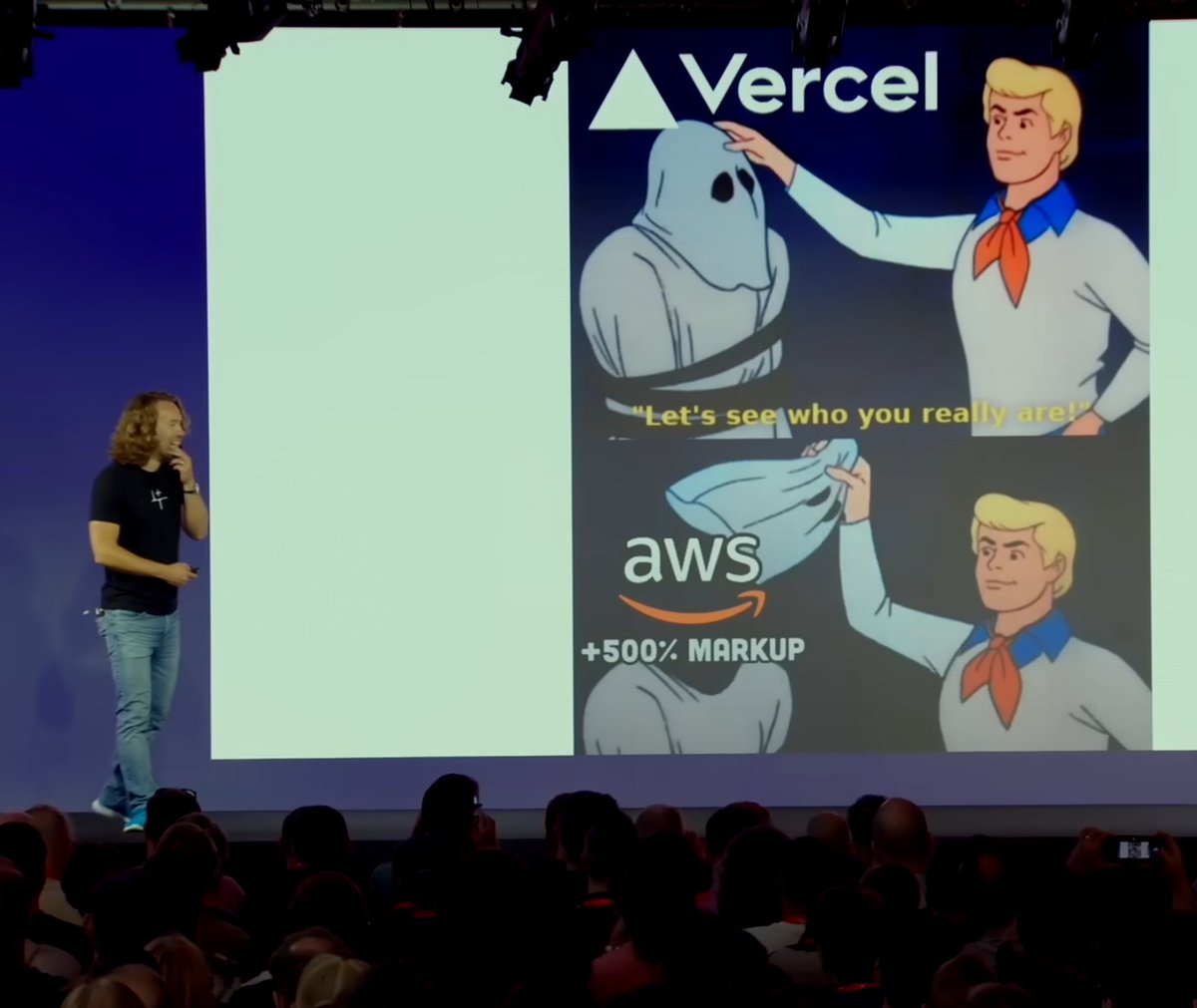
Cloud marketing convinced a generation of programmers that the scariest thing in the world was to connect their own server to the internet. All so they could be sold and resold the same centralized dependencies at huge markups.
youtube.com/watch?v=-cEn_8…
YouTube
English