nΞxt alphaa 🛡️

28.8K posts

nΞxt alphaa 🛡️ banner
nΞxt alphaa 🛡️

nΞxt alphaa 🛡️

@nextalphaa

⟠ | decentralized crypto rails matter | ETH is the ultimate freedom and productive SoV asset – securing the global economy onchain | member of dopest dao |

Ethereum Katılım Şubat 2021
2.2K Takip Edilen2K Takipçiler
Sabitlenmiş Tweet
nΞxt alphaa 🛡️
nΞxt alphaa 🛡️@nextalphaa·
I’m doubling down on ETH (and there’s nothing FUD bros can do about it)
English
44
29
469
18.9K
nΞxt alphaa 🛡️ retweetledi
⟠
@ryanberckmans·
Full deleted thread by Brian Chesky. imo a massive Ethereum bullpost
⟠ tweet media⟠ tweet media⟠ tweet media
English
11
17
230
19K
nΞxt alphaa 🛡️
nΞxt alphaa 🛡️@nextalphaa·
massive friction reduction makes Ethereum the best business decision > In the coming quarters and years, the world will enter Phase 3 of early adoption and hit the ramp of the global adoption S-curve. The entire world will realize that not only do they need to be onchain, but they need to be onchain on Ethereum L1+L2, where the friction/risk are lowest, protocols are strongest, and liquidity is deepest.
English
0
0
3
30
nΞxt alphaa 🛡️
nΞxt alphaa 🛡️@nextalphaa·
CROPS + massive friction reduction with the L1+L2 model enable the best business decision 👌 we're participating in the evolution of a new tech social and economic infrastructure that will enable freedom and innovation in expected and unexpected ways i love to be on the Ethereum and ETH journey and your perspective is always much appreciated ♥️🧠
English
1
0
7
104
⟠
@ryanberckmans·
This post is from the heart, motivated by Brian Chesky's bullpost last night. We're so close now. It's been 3 years since I wrote the below essay explaining precisely how Ethereum reduces friction to enable bringing the global economy onchain and enhance productivity. It got 540 likes which is pretty good for an account my size. It was my pinned post for years. Last night, Brian Chesky (Airbnb Founder & CEO) became the most famous, successful, and high status trad tech CEO to finally say the quietest part out loud: The most special thing about public chains is friction reduction. In doing so, Brian effectively endorsed Robinhood L2 and Eth's whole L1+2 model. I have been a big fan of the podcast EconTalk for my whole adult life and of its most frequent guest Mike Munger. This gave me early exposure to the theory of friction which economists refer to as "transaction costs"... not to be confused with gas fees. It helped me see the global friction reduction benefits of eth, which I have been writing about since 2019. That being said- During these early years, the world's onchain adoption has had and will have 3 distinct phases. Phase 1: Admitting the tech is pretty great. We saw this gradually ramp up from 2017-2024 in the form of early failed private blockchains, early institutional discussions and uptake of programmability, etc. Phase 1 is about institutions, corps, governments, central banks, and silicon valley recognizing that our onchain tech (almost always EVM) is a 1000x improvement to their offchain systems. Phase 2: Admitting that public chains are special networks. This started approximately with Facebook's Libra and has exploded after GENIUS, with the launch of many new corpo L1s. Phase 2 is characterized by trad folks all agreeing with each other and aping into the fact that public chains embody "come for the tech, stay for the market". The growth of international tbill demand from stablecoins played a key role in this. Brian's post has taken us to the bottom of the 8th inning here today in Phase 2. What happens next is Phase 3. That's where we win. Phase 3: admitting that the additional friction reduction-- above and beyond EVM tech and just any public chain-- from the Ethereum L1's decentralization and the L1 being the hub for defi/L2s is extremely valuable at global scale, and not available anywhere else. Phase 3 is where the world collectively realizes that the Ethereum L1 has a monopoly on being maximally decentralized and on being the global defi/L2 hub with the deepest liquidity, and also realizes that the world desperately needs this, or else the global economy literally can't come onchain. It's too risky and inconvenient to bring trillions in assets/activity onchain without Eth L1+L2. Skipping going onchain is not an option, specifically because the world wants to capture all of the magical apps/UX/markets uniquely enabled by Ethereum. Ethereum is inevitable. Friends... fellow Ethereum and ETH lovers and holders... it has been a long and frankly brutal road. As of today, we have never been closer and more certain to the realization of the incredible outcomes that used to merely exist in our dreams. We are near the end of the beginning. In the coming quarters and years, the world will enter Phase 3 of early adoption and hit the ramp of the global adoption S-curve. The entire world will realize that not only do they need to be onchain, but they need to be onchain on Ethereum L1+L2, where the friction/risk are lowest, protocols are strongest, and liquidity is deepest. Ethereum will achieve its potential to provide a level economic playing field for all of humanity. ETH will achieve its potential as a global treasury-grade SoV. Both will dominate for decades, maybe centuries. From the heart- love all of you that have been on this journey together for so long. And a huge welcome to everyone joining us now. The best is truly yet to come. So close now.❤️🚀
@ryanberckmans

For any person in the world, the goods & services accessible by them are determined by the extent of their trade network. A larger trade network increases capacity for specialization, resulting in new goods & services and making existing goods & services better and cheaper. The size of a person's trade network depends on the total friction of their individual circumstances. Economists refer to this friction as "aggregate transaction costs". They use a much wider definition of "transaction cost" than, for example, a gas fee. Any kind of added friction cost whatsoever reduces the size of a person's trade network, and that reduces the quality, affordability, and variety of their available goods & services. Costs of all kinds play a role in determining the extent of a person's trade network: Does the person live in a city or on a farm? Is their city separated from neighboring cities by a mountain range or a flat highway? What regulations or taxes exist to restrict or enable commerce? Are there any wars, famine, natural disasters, or other circumstances? Does their country have good physical infrastructure? All types of costs and friction play a role. How does a person's trade network move information? Do they rely on wagon loads of clay tablets hauled by oxen to move information, as was done in some ancient civilizations? Do they use morse code telegraph lines? Or, do they have digital information transfer, ie. the internet? Is the same information transfer technology available everywhere in their trade network? How does their trade network move goods? Do they haul wagons of wheat on dirt-packed roads? Or, do they have a modern network of vehicles and highways, of ships and shipping lanes? What loss of goods occurs during transit? To disasters? To theft? Perishable? What technologies and systems work to prevent these losses? Political systems? Security cameras and national ID databases? Is the level of risk similar throughout the trade network, or are some parts safer than others? How does a person's trade network move money? Do they pass around IOUs by messengers on horseback? Do they pass around digital IOUs in a rigid banking federation based on privilege and relationships (web2 finance)? Or, do they have a global internet financial system that's an open access level playing field and lets you "hand cash" to anyone in the world (web3)? Jason asks, "How does web3 improve economic output?" The answer is that economic output depends on the quality, affordability, and variety of goods & services available to each person, and this depends on that person's unique vantage point into the global trade network, and that depends on each person's trade network's aggregate transaction costs, and these transactions costs are greatly reduced by web3. Web3 - reduces information transfer transaction costs (secure open data for prices, markets, etc) - reduces money transfer transaction costs (bearer ownership, instant settlement, etc) - decentralization reduces risk which further reduces transaction costs. Example: erc20 transfer on BSC vs Eth L1, both are the same token transfer, but the one on Eth has much lower risk because BSC is centralized. That lower risk is a type of transaction cost reduction. - public chains are global and open-access, so these beneficial reductions in transaction costs can apply to everyone in the world's unique vantage point into the global trade network. Web3 helps everyone, not just people in wealthy countries. Every major benefit of web3 tends to reduce transaction costs: ERC standards, public composability, trustless bridging among L2s, censorship resistance, strong property rights, open innovation, etc. In short, web3 increases economic output by reducing friction costs that limit the extent of the global trade network and therefore growing the quality, affordability, and variety of goods & services available to everyone in the world.

English
9
22
127
12.5K
nΞxt alphaa 🛡️
nΞxt alphaa 🛡️@nextalphaa·
DCF/REV maxis have a set of beliefs that are incoherent: – btc is a special snowflake outside DCF/REV – all blockspace on sc chains are equal hence they don’t understand CROPS or the value prop of it and they don’t get the CROPS L1+L2 CUSTOMIZATION nuance – low fees are bad for ETH (no value accrual) – high fees are bad for ETH (no one uses Ethereum) the truth is that ETH will have a new valuation model and it’s going to 100k+
English
0
0
1
47
pinedegen ᵐᶠᵉʳ
pinedegen ᵐᶠᵉʳ@pinedegen·
All the discounted cash flow, and REV maxis are currently witnessing what Ethereum has been building for all along and what the value ETH really is.
English
2
0
13
379
David Hoffman
David Hoffman@TrustlessState·
The unbundling of the EF continues… Congrats to @eth_systems on the launch! Privacy is such an important frontier, glad someone is taking ownership over it!
EthSystems@eth_systems

Today we're launching EthSystems. We build confidential systems for institutional Ethereum. Institutions want to use Ethereum, but one of the biggest problems is the lack of built-in, modular privacy tools. We were the Ethereum Foundation's Institutional Privacy Task Force (IPTF) for the past year. We had hundreds of conversations with central banks, regulators, tier-one banks, and asset managers, shipping open source work the whole time. Wall Street has found crypto as an asset class, but not yet as commercial infrastructure. Institutions want to run real flows on Ethereum: stablecoins, tokenized assets, settlement. These are businesses with billions of dollars on the line, and no bank will operate in full public view. On a public ledger, confidentiality is the hard part: each party to a transaction should see what it has a right to see, and nothing more. We have a year of proof of work: private bonds, confidential stablecoin transfers, private settlement across chains, the Ethereum Privacy Map, and more. All with protocol specs and security properties, at our website. We've spent a decade working on privacy in crypto. We know there's no silver bullet. Different use cases need different systems, each designed, specified, and hardened properly, and someone has to do that work. That's why EthSystems exists. We're an independent, for-profit company, backed by long-term Ethereum-aligned investors. This is a decade-long transition, and we aren't going anywhere. If you're an institution that wants to build on Ethereum, talk to us. We're hiring: BD in New York, protocol engineers, ops: join@ethsystems.org

English
22
6
233
22.1K
ΞlCoco.eth🌪
ΞlCoco.eth🌪@cocothecorncob·
@MikeSylphDapps I’m sorry to hear that, but glad it’s nothing scary. Welcome back. Nothing much changed other than Hoffman now holds no Eth and Robinhood chain is blasting off.
English
2
0
2
47
mike.sylphdapps.eth 🌎💻
mike.sylphdapps.eth 🌎💻@MikeSylphDapps·
Hi. It's been a bit. A few months ago my wife had an accident. Nothing scary, but it sidelined her until recently. Doing everything for two kids and playing nurse meant something had to go, so I logged off. I finally feel like I have some bandwidth again. Let's buidl.
English
6
0
14
671
nΞxt alphaa 🛡️
nΞxt alphaa 🛡️@nextalphaa·
to build a solid ETH treasury will be a big thing for both businesses and normies in the coming decade you better start building now when the price is 100x less than it will be
larzon.eth@heysnberg

Hey @vladtenev 🪶 Robinhood Chain now uses ETH for gas and settlement. Why not build a strategic ETH treasury and stake it? - Earn native staking yield - Align your balance sheet with your L2 - Help secure Ethereum network Easy win-win for Robinhood and Ethereum. 🤝

English
1
0
28
632
nΞxt alphaa 🛡️
nΞxt alphaa 🛡️@nextalphaa·
it’s all about the money ETH is competing to be appreciated as the best money in the world – yes ETH is competing for the price to be known as the most secure and productive SoV asset (Ethereum L1+L2 model is the vehicle for it) ETH is always sound money and sometimes ultrasound depending on economic activity on the network Ethereum has the most solid monetary policy in the world (not just crypto)
nΞxt alphaa 🛡️ tweet media
English
0
0
5
78
Jon De Lorraine
Jon De Lorraine@jon_delorraine·
🔴🇪🇺 FLASH - Ursula Von der Leyen confirme bien qu'il y aura une application européenne pour l'authentification sur les réseaux sociaux. L'union européenne va donc avoir accès aux cartes d'identités de tous les européens qui vont devoir les présenter pour se connecter sur les réseaux sociaux. Von der Leyen indique que pour cette application, "c'est facile à utiliser" et que "cela protège la vie privée'. Elle indique qu'il faut comme un permis pour les enfants pour se connecter aux réseaux sociaux. Une loi sera proposée après les vacances d'été.
Français
2.3K
2.9K
5.7K
1.3M
Paul Walsh
Paul Walsh@Paul__Walsh·
Ursula von der Leyen has confirmed that everyone in the EU will need to use the EU's app for identity authentication before being able to access or post on social media websites. 🇪🇺 As an expert in online child safety, I am here to expose the misinformation and misdirection in von der Leyen's statements. Today von der Leyen said: "This is not about whether children can access social media, it is about whether social media can access our children". 💡The first part is true. This isn't about children. It's about surveillance and combating political dissent. A state that can't control its own citizens is more dangerous than a state rife with criminals. The second part is a PR soundbite that politicians are using like a campaign slogan straight out of 1984. 🇪🇺"The question is no longer if children face risks online, but what can we do to give children a safer start online". 💡No. You can't give children a "safer start" online any more than you can offline. In the offline world, the government doesn't enforce curfews or ban children from entering liquor stores, bars or restaurants. That's a parent's responsibility. The digital world should be no different. 🇪🇺"The age verification app is one of the tools to get it done". 💡This is a contradiction because she also said "It won't be foolproof". 🇪🇺"It's easy to use, it is privacy preserving and it is open source". 💡The app was compromised as soon as it was released. "Privacy-preserving" age verification is an oxymoron. You can't verify a person's age without verifying their identity. Where or how that age is shared afterwards is irrelevant. 🇪🇺"This is basically about putting back the power into the hands of parents". 💡More from 1984. The EU is doing the opposite. Parents are having their authority stripped by politicians who think they know better. Many parents are capable and unaffected by peer pressure, and they know how to use parental controls to block any app classified as 13+. Some teens are safe, their parents trust them, and the state has no business overruling that trust. 🇪🇺"We don't give our children keys to the car before they have their licence" 💡Comparing an app to a car is a false equivalence used to justify mass surveillance. Governments don't decide when a young person is ready for car keys, guardians do. 💡Forcing every adult and child into a biometric checkpoint just to use an app or website is not licensing drivers. It's the state seizing everyone's keys, locking the garage, and forcing every driver to ask a private company for permission to take a drive. 💡 This is a gross, unethical overreach that strips authority from parents while imposing state sanctioned identity verification on every adult who doesn't even have a child. 💡Additionally, people who pass a test, obtain a licence and drive a car aren't forced to use an app to constantly authenticate their suitability to drive. 🇪🇺"We do not let them buy alcohol until they are legally allowed" 💡False equivalence. We don't force every person to show ID at a shopping mall entrance just because a few people might buy alcohol with a meal at a restaurant. Some parents are okay with their 12 year-old going to the mall with friends while others aren't. Either way, it's their choice. Whatever irresponsible decisions some parents might make, every adult in the country shouldn't be forced to pay the price. 🇪🇺"It won't be foolproof" 💡This is all the proof we need to show that the EU and every government know that banning social media for teens won't protect them. When pressed by journalists about VPNs being used to circumvent a ban, politicians always state the ban isn't a silver bullet and will take time. The Mayor of London, Sadiq Khan went as far as to say "we know it's not the solution". 💡Either age verification works, or it doesn't. As a technical expert in this space, I can tell you there are no additional steps to take and no progress to be made. Either the approach does what it is supposed to do, or it's not fit for purpose. If they claim a bulletproof solution is coming, it can only mean one thing. They intend to ban or restrict VPNs to people who verify their identity. 🇪🇺"It will take time to invite the cultural change that is already taking shape in our society, just as it took time to outlaw drink driving, just as it took time to use seatbelts in the cars. Great change never happens overnight, but when it comes to our safety it is always worth it". 💡Comparing a social media ban and age verification to seatbelts is a completely broken analogy. Seatbelts are a safety feature that protects children while allowing them to travel in a car. A ban doesn't give kids a seatbelt. It kicks them out of the car entirely. 💡Instead of supporting parents who want to guide their own children through the digital world, this heavy-handed law strips away parental authority by banning the apps and websites that many parents are perfectly fine with and actively monitor. 💡Furthermore, enforcing these bans requires biometric age verification, which means forcing millions of adult citizens to scan their IDs, faces or credit cards just to browse the internet. That isn't a common-sense traffic law. 💡It's a digital checkpoint on every street. True safety means teaching kids how to navigate the digital world safely with real guardrails and parental guidance, not burning down digital spaces for everyone under the guise of protection. 🇪🇺☠️ The EU wants to ban teens from social media so every person is forced to verify their identity before they can read, share or post anything online. In their words, this is to protect children from dangerous content. 🇪🇺☠️ The EU wants to enforce "Chat Control" so every app has to monitor everything people say privately inside it, including apps with end-to-end encryption. In their words, this is to protect children from dangerous criminals. 💡Where this ends 🇪🇺 "If you want a picture of the future, imagine a boot stamping on a human face - forever". George Orwell, 1984.
English
505
3.1K
7.2K
765.8K
nΞxt alphaa 🛡️
nΞxt alphaa 🛡️@nextalphaa·
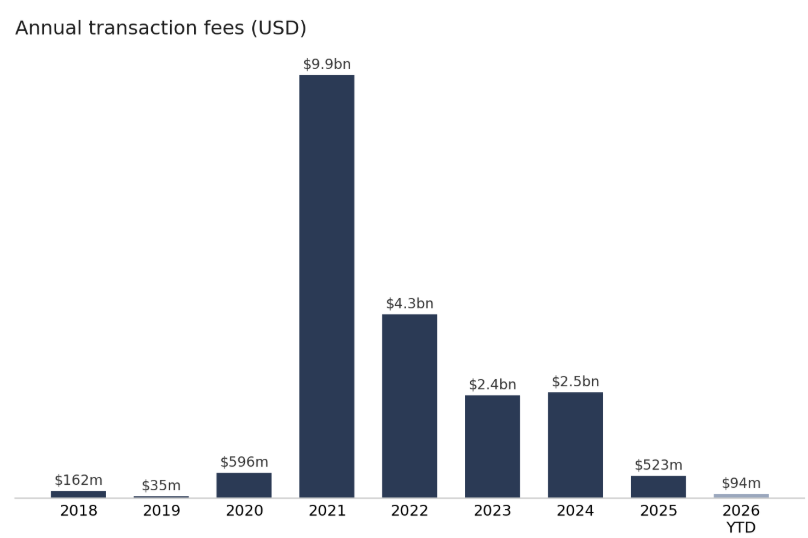
there is no subsidization going on – there is not ’we’ll take more rent later’ when we own the market like a rent seeking company Ethereum will offer the lowest fees possible as long as we can secure the CROPS network fees will stay low and Ethereum will keep scaling to win the world as the default settlement layer this makes Ethereum the best business choice and thus schelling point onchain for any REV maximalist out there, transactions on the network will 10,000x by humans and machines, hence make ETH deflationary at times – but the monetary premium will formost come from the fact that ETH is the CROPS quantum secure productive SoV with a sustainable monetary policy that protects you from fiat debasement while it simultaneously secures the global economy onchain via the secure Ethereum CROPS L1 + L2 CUSTOMIZATION model CROPS is the value prop (not fees):
nΞxt alphaa 🛡️ tweet media
English
1
0
1
35
Kath L
Kath L@KathEthereum·
yes actually, that chart is controlled by a few variables in software and is intentionally subsidized currently. It is an introductory rate on rent for a building (schelling point) that is incredibly hard to build. Ethereum commands the most pricing power for block space out of any protocol as none have touched its high water mark for fees when it wasn't even ubiquitous.
English
1
0
0
30
Richard Galvin
Richard Galvin@richwgalvin·
ETH is unfortunately trending the way of a public good - incredible technology, but becoming the internet of crypto, where the Amazons and Googles capture the value. From an investment perspective, agree with the below, money-ness is one path out. The second - and probably the more likely longer-term - is the sheer weight of TVL dragging ETH higher which has to scale (eventually) with the value it secures. The mechanism that makes this happen isnt entirely clear to me though...
Lorenzo Valente@LorenzoARK

The Robinhood Chain is the cleanest case study of what happened to ETH's economics over time. Since inception, @RobinhoodApp Chain has grossed ~$816K in revenue. @Arbitrum, the middleware provider, takes 10%: ~$80K. Arbitrum then pays Ethereum for settlement: $1,538. The margin profile roughly: Robinhood: 89% Arbitrum: 10% Ethereum: 0.15% If your thesis is "ETH is money," Robinhood building here is ultra bullish. More activity, more ETH collateral, more lindyness. If your thesis is "ETH is a revenue generating asset," this is the ultra-bear case. And here's the uncomfortable truth: Robinhood was never going to build on Solana, Sui or any monolithic L1. They want the stack customization. They want to be landlords, not renters. Ethereum won this deal on merit. It's just not pricing it right. A healthy split to me looks more like: Robinhood: 75% Arbitrum: 10% Ethereum: 15% Ethereum sells the most valuable settlement layer in crypto at marginal cost. Things need to change. @ethlabs_org


English
19
2
28
9.8K
nΞxt alphaa 🛡️
nΞxt alphaa 🛡️@nextalphaa·
instead of reading the article you reiterate REV as the model to use (but it is what makes you mentally stuck in the valuation of ETH – it’s the tradfi thinking and altL1 thinking) fees are going to ’zero’ on all blockchains eventually as onchain becomes the default for the global economy including the financial system – and transactions and TVL through the roof now apply your thinking to btc and don’t say ’it’s a special snowflake’ since it’s intellectually incoherent
English
0
0
0
35
pray.gwei
pray.gwei@pray_eth·
@ethereumJoseph 100%. I don't understand the need to boost L1 revenues through higher fees when we are at the very beginning of institutional adoption. I fear too many people are thinking in terms of ETH price and cycles, when our true end game is global ubiquity.
English
1
0
9
239
Joseph Lubin
Joseph Lubin@ethereumJoseph·
In my opinion, Ethereum L1 revenue fees should stay low to foster growth. Tens of thousands of companies will set up shop over the next 2-3 years on some mix of Ethereum L1, L2s, and private permissioned EVMs like Besu chains which will be fully interoperable with L2s and L1s. Monetary premium will grow very large, "fee revenue" to L1 from so much activity will grow significant, staking and other locking away of ETH will reduce supply, and net burning of ETH under ultrasound conditions will further grow the value of ETH.
Lorenzo Valente@LorenzoARK

The Robinhood Chain is the cleanest case study of what happened to ETH's economics over time. Since inception, @RobinhoodApp Chain has grossed ~$816K in revenue. @Arbitrum, the middleware provider, takes 10%: ~$80K. Arbitrum then pays Ethereum for settlement: $1,538. The margin profile roughly: Robinhood: 89% Arbitrum: 10% Ethereum: 0.15% If your thesis is "ETH is money," Robinhood building here is ultra bullish. More activity, more ETH collateral, more lindyness. If your thesis is "ETH is a revenue generating asset," this is the ultra-bear case. And here's the uncomfortable truth: Robinhood was never going to build on Solana, Sui or any monolithic L1. They want the stack customization. They want to be landlords, not renters. Ethereum won this deal on merit. It's just not pricing it right. A healthy split to me looks more like: Robinhood: 75% Arbitrum: 10% Ethereum: 15% Ethereum sells the most valuable settlement layer in crypto at marginal cost. Things need to change. @ethlabs_org

English
98
157
1.3K
126.1K
Watcher.Guru
Watcher.Guru@WatcherGuru·
JUST IN: 🇺🇸🇨🇳 President Trump says China wants to take "complete and total control" of crypto and AI.
English
568
647
6.9K
814.4K