

basil
2.8K posts
basil
@0xbasil
growth (stealth) // incentives @skycastletokens
nyc Katılım Şubat 2021
801 Takip Edilen2.2K Takipçiler

Creators and founders on @base deserve BETR… So we built it.
Introducing @betrmint v3.
♾️ Infinite rounds
♾️ Infinite rewards
♾️ Infinite upside
No more scheduled drops with limited tickets… Just head to betrmint.fun to discover new creators and spin the Neon Flywheel anytime, from any browser, using any wallet.
Win big prizes just for supporting onchain builders, with spin odds now fully onchain and provably fair via @chainlink VRF.
Every v3 spin programmatically buys back $BETR for maximum flywheel motion.
Stake to earn daily revenue share and own your slice of the Infinite Flywheel.
Stack BETR Karma with:
🔥 Daily spin streaks
⚡ Super Spin multipliers
🥩 Staking boosts
🫡 BETR Believer bonuses
Next community airdrop: April 29.
Winning together is now BETR than ever, so come through and see for yourself!
[Full v3 vision in the X article linked in next tweet]
English
basil retweetledi

Someone with a newsletter randomly came across what we're building and gave it some very kind validation.

English
this is the most beautiful thing i have ever seen
storm@notnotstorm
new from paradigm: we are building a tool for exploring prediction market data try it out today. I bet you'll find new markets you never knew existed
English
basil retweetledi

We are very excited about the Farcaster ecosystem coming together under Neynar.
Skycastle came together on Farcaster with a simple belief: lasting value in this space is created by developers and the applications they build. This transition feels like a meaningful step in that direction, and one that aligns closely with how we’ve viewed the ecosystem from the start.
With Neynar taking stewardship of the protocol, the client, and Clanker, there is a renewed focus on builders and the communities forming around their work. Farcaster has always been defined by the people building within it, and Neynar has been supporting that work quietly and consistently from the beginning.
Today, $SKY includes many of the most active $CLANKER projects, with Skycastle Partners across both Clanker and Neynar. That puts our partners and clients in a strong position as the ecosystem evolves, as we have been building in alignment all along.
We’re excited to work more closely with Rish, Maman and the Neynar team as this next chapter begins, and we want to sincerely thank DWR and V for what they built and for the environment they created. Farcaster has meant a great deal to many of us, and that foundation would not exist without them.
This is an important moment for Farcaster, for builders, and for the applications that will shape what comes next.
It's now time to build Castles in the Sky. Together.
rish@rish_neynar
Excited to share that @neynarxyz is acquiring @farcaster_xyz. This means we will now maintain the Farcaster protocol, run the Farcaster client and operate Clanker. Our vision is to enable builders to go from idea to recurring revenue, supported by a builder-first network. See more of our thinking in the link in reply
English
you mean to tell me not a single human being on this planet wants to be treated like a memecoin??

Nikita Bier@nikitabier
We are revising our developer API policies: We will no longer allow apps that reward users for posting on X (aka “infofi”). This has led to a tremendous amount of AI slop & reply spam on the platform. We have revoked API access from these apps, so your X experience should start improving soon (once the bots realize they’re not getting paid anymore). If your developer account was terminated, please reach out and we will assist in transitioning your business to Threads and Bluesky.
English

Jesse Pollak just announced Base is pivoting away from social. Dan Romero said the same about Farcaster last month. I pulled the data on what went wrong.
open.substack.com/pub/nickysap/p…

English
@redphone > Most founders are just doing what the last successful project did.
this is usually the problem; we are not designing for an environment, we are trying to control outcomes
touched a bit on it here
basil@0xbasil
i spent the weekend revisiting the books and ideas that actually changed how i think then i tried to reapply them to consumer crypto and network design, distilling a philosophical framework that may challenge a few comfortable assumptions... the throughline is emergence over prescription: complexity, sociobiology, evolutionary psychology, systems thinking, and, somewhat heretically, a critique of strict first-principles thinking itself imagine that (it's all the same thing and a bit more intellectual than my normal prose) @0xbasil.eth/designing-emergence-in-consumer-crypto?referrer=0xd76fF76AC8019C99237BDE08d7c39DAb5481Bed2" target="_blank" rel="nofollow noopener">paragraph.com/@0xbasil.eth/d…
English

“The ‘VCs are evil’ and ‘founders are grifters’ narratives are super lazy. Most founders are just doing what the last successful project did. VCs are optimizing for their LPs. Retail is trying to get an edge. Everyone's playing the game they were handed. The problem is the game itself.”
rosie@therosieum
English
i spent the weekend revisiting the books and ideas that actually changed how i think
then i tried to reapply them to consumer crypto and network design, distilling a philosophical framework that may challenge a few comfortable assumptions...
the throughline is emergence over prescription: complexity, sociobiology, evolutionary psychology, systems thinking, and, somewhat heretically, a critique of strict first-principles thinking itself
imagine that
(it's all the same thing and a bit more intellectual than my normal prose)
@0xbasil.eth/designing-emergence-in-consumer-crypto?referrer=0xd76fF76AC8019C99237BDE08d7c39DAb5481Bed2" target="_blank" rel="nofollow noopener">paragraph.com/@0xbasil.eth/d…
English
my favorite all-time scapegoat, beyond the day one idiom, is: “we don’t know what the users want”
i’m sorry. are we not venture-backed businesses with years of direct learnings? with nearly a decade of consumer crypto behind us, layered on top of twenty years of social and forty years of networking?
what do *you* mean *you* don’t know what *your* users want? what have we been doing then?
and then comes the escalation: “the user doesn’t even know what they want”
so now it’s not just that we lack insight. it’s that insight itself is unknowable. the users are confused, the future is opaque, and therefore anything we do is justified. a perfect abdication of responsibility.
this is how we got here…
this mindset is the downstream effect of trying to force behavior instead of observing it; of mistaking authority for insight; of believing that vision alone is sufficient to override revealed preference.
and when that fails, we retreat to an even lazier framing: “attention is the only thing that matters.” mimetic value is the only value. if people are talking, we’re winning.
but attention without utilty is just measurement without meaning: numbers on a screen that never materialize. you can manufacture eyeballs but you cannot manufacture retention. the tokens of last cycle are not the ones still here. the projects that optimized for virality over value didn’t graduate into infrastructure, but into case studies we aptly ignore.
mimetic energy can spark adoption but it cannot sustain it. at some point, the user asks: what does this actually do for me? and if the answer is “others are watching,” that’s not a product; that’s a performance and all performances must come to an end.
we’ve seen this before; many times, actually. we have more lessons to pull from than we know what to do with, but we choose to play God.
we tried to normalize always-on cameras in public before society had arrived at norms for them. we tried to invent premium short-form video while stripping away sharing, the very behavior that made short-form work in the first place. we tried to replace lightweight, asynchronous communication with heavy, immersive presence, assuming that “more real” would beat “more convenient.” hell, this is crypto, we’ve been trying to force behaviors for a decade now.
none of these failed because the technology didn’t work; they failed because the behavior never emerged.
contrast that with how durable systems actually form:
the most efficient paths on campuses aren’t drawn first. they appear as dirt under repeated footsteps. rivers don’t follow blueprints; they follow energy minimization. languages don’t wait for committees; grammar crystallizes after misuse, not before it. open-source software doesn’t ship perfect architectures; it hardens only what survives real use.
in every case, structure follows behavior.
yet in consumer tech, and especially in crypto, we keep attempting the inverse. we declare primitives. we prescribe flows. we demand that users onboard into complexity before they’ve received value. we design systems that require belief before benefit.
then, when adoption stalls, we claim the “users weren’t ready” or “it was just an experiment”
an experiment that caused those very users to lose money and churn out. alas.
ready for what?
ready to abandon patterns they’ve spent decades reinforcing? ready to shoulder cognitive load, financial risk, and social friction for a product that hasn’t yet earned trust? that doesn’t make sense to them? that doesn’t add value to their lives?
this is not how systems scale. it’s how they fracture.
emergent systems don’t require users to change who they are. they meet users where they already are and quietly remove friction until new behavior feels inevitable rather than imposed.
the uncomfortable truth is most failures blamed on “users” are actually failures of observation; they are failures of those who ignored their users: those who want to play God.
we didn’t watch closely enough. we didn’t listen long enough. we didn’t let reality invalidate our egos and theories. we doubled down.
because forcing a primitive is easy and riding some flashy abstracted attention thesis makes us sound smart.
but admitting you’re wrong, and letting the system teach you, is hard.
but the path is already there…
it’s always been there, lying in the grass…
you just have to look down and accept it.


English
amazing! always loved this team. i have to go find the first iteration of the card somewhere. seems like it will be a collectible someday! congrats, guys!
Rain@raincards
Onchain rails have proven their value. Rain is making them usable by everyone, and keeping them invisible in the process. Today, we’re announcing our $250M Series C at a $1.95B valuation to keep building. 🧵
English

the real trench strategy is to constantly change the meta such that our platform overloads are always pivoting and never truly competing
this is the only way they don’t build into you egregiously out on a whim and destroy your user base — it’s the same strategy the government uses to keep you enraged
to tokenize everything is to tokenize nothing
to be an everything app is to be a nothing app
English
$SKY <> $GIFTR*
Skycastle is pleased to welcome Giftr as the sixth project in our network incubator.
Giftr is building a Farcaster-native gifting rail that turns USDC into real-world gifts, abstracting identity, privacy, and logistics into a seamless onchain experience.
We’ll be partnering on token design, incentive modeling, and long-term ecosystem strategy as Giftr scales merchant-aligned gifting, community drops, and onchain commerce.
Permanent. Onchain. Aligned.
*The $GIFTR token is not yet live.
Full Announcement: news.skycastle.network/giftr

English
basil retweetledi

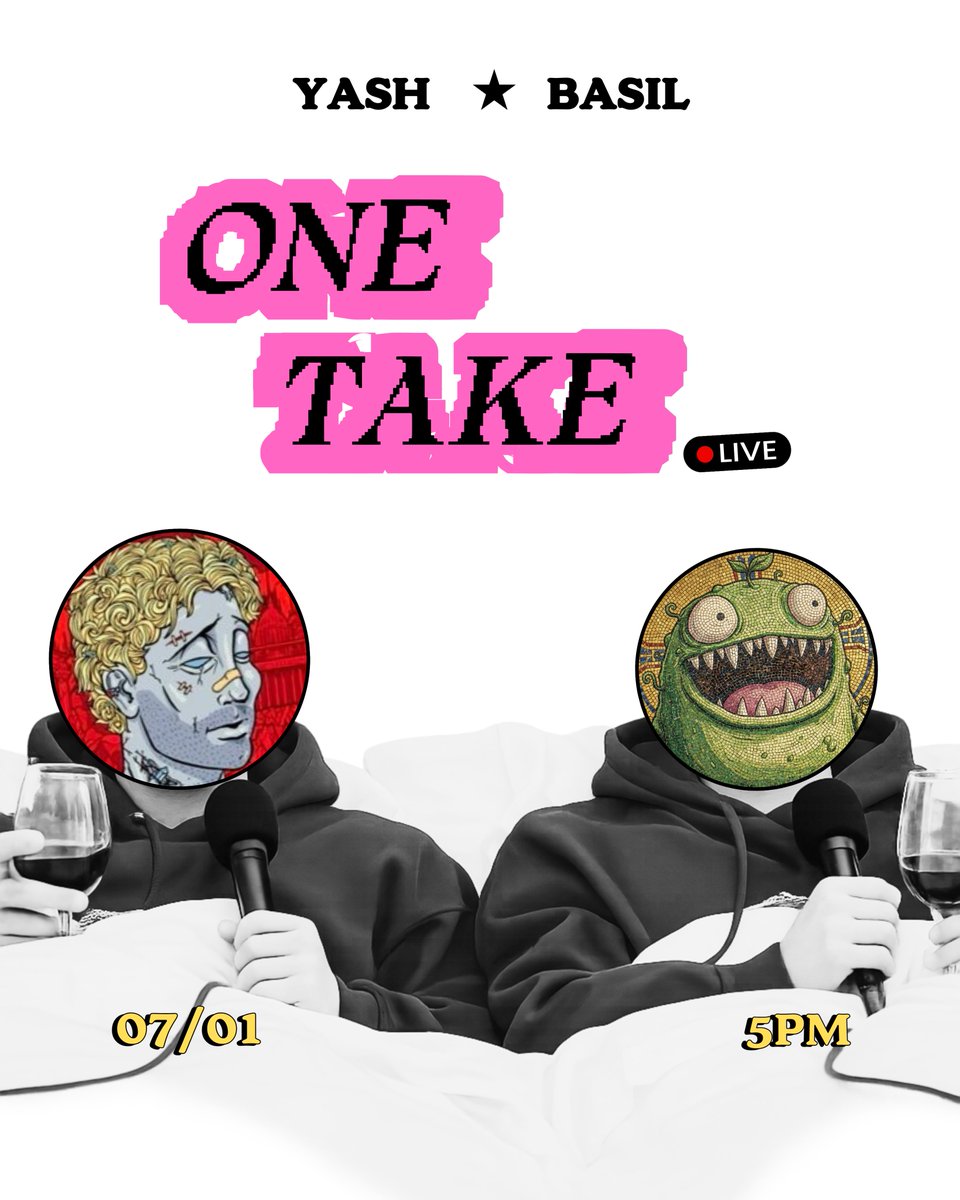
☆ WE'RE BACK ☆
Tomorrow, @pratapyps sits down with @0xbasil to understand what's it like to be in the business of creating productive assets.
EP.05 live at 5pm UTC on DEN
English