thiigth | blockfit retweetledi

thiigth | blockfit
6.1K posts

@0xcryptopanda
building blockfit 关注 Crypto / 探索新技术 / 坚持运动锻炼 所有观点不提供任何投资意见和建议

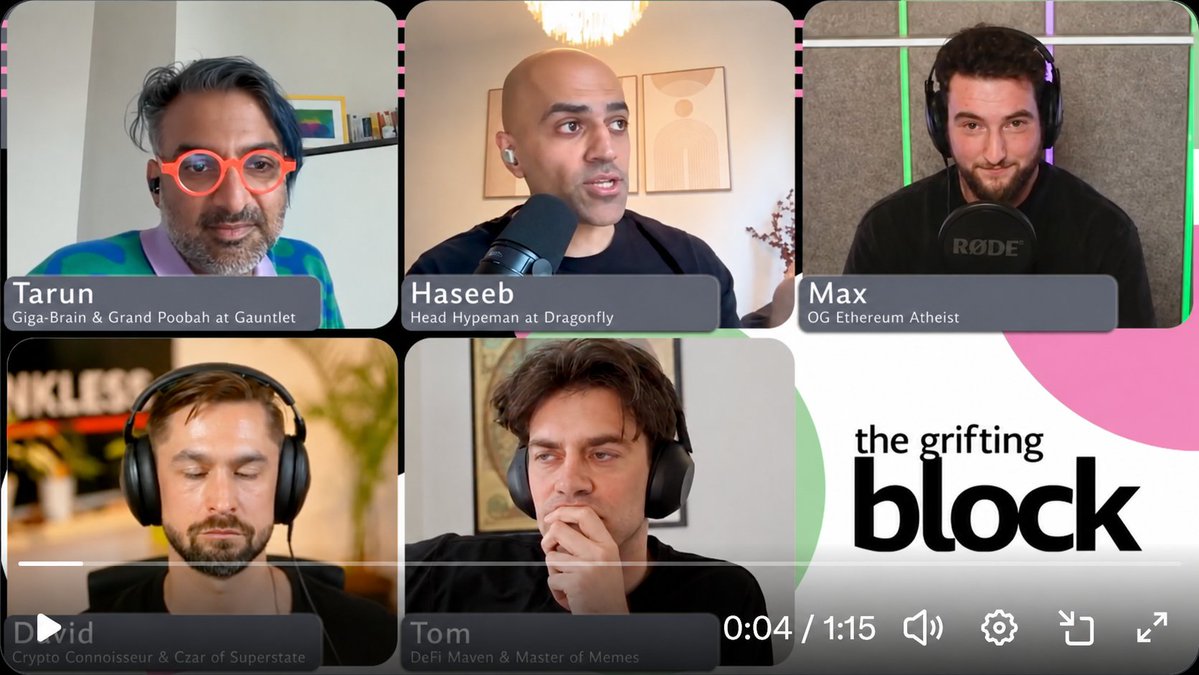






Ethereum gas prices 5 years ago 🤯


Arthur Hayes:多数代币的下跌源于项目方私吞协议收入 2026 年 5 月 23 日,BitMEX 联合创始人 Arthur Hayes @CryptoHayes 在 What Bitcoin Did 播客中表示,多数加密项目未能将协议层创造的经济价值回馈给代币持有者。他认为,早期风投为了实现利润最大化及履行受托责任必然向市场抛售,这导致了代币价格的持续下行。他以 Hyperliquid 的收入回购机制为例,表示当前的加密投资者已经成熟,不再为单纯的白皮书或豪华早期投资阵容买单,而是更加看重代币持有者所能获取的实际现金流。 来源:What Bitcoin Did

Wrong anchor. Manuel is a legend in smart contract security, so when he issues a PSA to exit DeFi because AI agents make it fundamentally unsafe, people listen. But his conclusion anchors on the wrong premise. Credit card fraud was once considered an existential threat to digital commerce. The industry didn’t solve it by eliminating fraud - that was never possible. They won by engineering the per-incident blast radius down to what the system could absorb: $0 cardholder liability, tokenization, real-time detection, and issuer insurance. Trillions flow through card networks daily on top of a permanent attack surface because they anchored on containment, not elimination. History repeats this pattern across aviation, the early internet, and traditional banking. Each was once labeled doomed or fundamentally unsafe. Each won, not by becoming error-free, but by iterating until the system could absorb the failures it couldn't prevent. Yes, AI has lowered the cost of attack. That's real. But as many have noted, AI is just as available to defenders. Auditors, security researchers, whitehats, and protocol teams are using the same tools. And as @StaniKulechov pointed out, DeFi has made generational progress on the defense side: better risk engines and lending market structures, formal verification, oracle improvements, cap management, circuit breakers, automated monitoring, SOC2-grade opsec. None of this existed at scale a few cycles ago. The ecosystem has been building the right infrastructure to guard against attacks, similar to what credit card industry has gone through. AI is not our enemy; hackers are. The anchor isn't "bug-free". It's "no single bug drains the protocol." If you design every system with the assumption that a vulnerability will exist, you stop trying to build an unbreachable wall and start engineering the blast radius down to what the network can safely absorb. The real PSA isn't to exit DeFi. It's to build it right. DeFi will win.




"Ethereum is a Giver, not a Taker" is a brilliant thought. I just think it leads to the opposite conclusion. Crypto has become so used to extraction - high fees, high margins, rent-seeking, "value capture", number go up - that when something gives more than it takes we instinctively read it as weakness. But maybe that’s exactly what makes Ethereum special. Look at tokenized art as a tiny fractal of the Ethereum economy. Ethereum gives artists and collectors the whole stack: issuance, provenance, settlement, custody, identity, global liquidity, composability etc. And it charges almost nothing for it. It already beats the IRL art market on almost every primitive: cost, speed, provenance, settlement, reach, custody and collector experience. So what happens? Artists price in ETH. Collectors think in ETH. Cultural value gets denominated in ETH. Communities form around ETH-native objects. Art alone won’t reprice ETH. Of course not. But art is a fractal. The same thing can happen across creators, DeFi, social, gaming, AI agents, stablecoins, RWAs and whatever else gets built here. Ethereum gives first. Value comes back later. Value comes back slowly - through people pricing things in ETH, using it as collateral, staking it, building on it and treating it as the base asset of the ecosystem. The best monetary networks aren’t the ones that tax everything the hardest. They’re the ones everything chooses to coordinate around because they give without extracting too much - and over time that compounds into trust, culture and value. "Giver, not Taker" isn’t the bear case for ETH. It is the reason Ethereum keeps becoming the place value returns to. That is the longest game in crypto - and as a collector, the game I’m most interested in.