broke boy
265 posts

Sabitlenmiş Tweet

THIS DEVELOPER JUST UNLOCKED A SECRET CLAUDE PLUG-IN TO AUTOMATICALLY STRIP EVERY VIRAL SOCIAL MEDIA SECRET FOR FREE
People are completely missing how powerful LLMs have gotten at reversing viral content pipelines. There is a slick new workflow making the rounds where creators are turning Claude into an automated social media parsing engine
All you really do is type a simple /analyze command straight into the prompt window and paste in a video link. In about a minute, the system spits out a complete, highly detailed structural breakdown of the clip
It gives you the full transcript, the exact formatting style, target topics, and the actual storytelling framework used to hook viewers. Plus, it dissects the visual layout frames. It is very useful if you are trying to understand why a piece of video content blew up on TikTok or Instagram reels. Because let's be honest, trying to manually reverse engineer viral structures by hand is a massive waste of time
But the real value comes when you scale the loop into batches. As you scroll your feeds, you just grab the URLs of ten or twenty top performing clips and dump them all into the terminal at once. Claude parses the whole batch in one shot, uncovering hidden macro trends and structural commonalities that you would completely miss on your own
The technical architecture under the hood relies on an open source Model Context Protocol plugin from a tool called Sandcastles .ai. Setting it up gives Claude access to 14 dedicated social media engineering skills. It simplifies the entire research process, acting like a direct intelligence upgrade for your workspace
Bookmark this so you don't lose it
ami@ami10iv
English

Google just published a free 1-hour course on building agents from scratch.
00:00 - Your first AI agent
08:24 - Memory that survives sessions
28:34 - Agentic loops and long-running tasks
40:04 - MCP vs API for tool use
1:00:22 - Multi-agent systems
Most $500 courses teach less than the first 20 minutes.
Bookmark this now, you won't want to hunt for it later 👇
spect@spectnfa
English

@0xfuckpoverty the hidden context assembly layer is what most people never think about
English

You think you're talking directly to ChatGPT or Claude.
But you aren't.
In reality, there is a hidden layer of context assembly happening right between your prompt and the AI's response.
And 99% of users have absolutely no idea it exists.
If you are building with LLMs, you have to understand how agent memory systems actually work.
Procedural. Semantic. Episodic.
Mastering these three is everything.
It is the difference between building a smart, lightning-fast agent...
...and burning thousands of dollars on useless tokens.
Incredible breakdown of what is actually happening under the hood here 👇
broke boy@0xfuckpoverty
English

@0xfuckpoverty Without procedural, semantic, and episodic memory layers, an agent is just a stateless, expensive calculator
English

NVIDIA engineer:
"My job is two things. I build agents, and I babysit agents"
He names three moments that changed his work completely:
→ ChatGPT - even his parents got what he does for a living
→ reasoning models - the first time one caught its own mistake mid-answer
→ January '26 - agents started running for hours with zero babysitting
That last one is the whole game. An agent that works unattended for hours saves you a full workday, every time you ship one.
This 1-hour talk shows the exact setup NVIDIA engineers use to get there.
Watch it, then save the playbook below 👇
unicode@unicodef1wn
English

1 YOUTUBE VIDEO → 100 TIKTOKS IN ABOUT AN HOUR?
The workflow uses Opus Pro and Repurpose. io to turn one long YouTube video into dozens of short clips.
Instead of editing every Short manually, it generates clips with captions and even scores each one by its viral potential.
The workflow:
copy a YouTube link
paste it into Opus Pro
generate 10 AI Shorts
sort them by virality score
send everything to Repurpose. io
publish across TikTok and other platforms
One screen shows the process starting from a single YouTube URL.
A few minutes later, Opus Pro returns 10 captioned Shorts, each with its own virality score.
Repeat the workflow a few times and the creator claims you can produce around 100 TikToks in an hour.
The interesting part isn’t AI editing.
It’s using one long-form video as the source, then repeating the same pipeline until one recording becomes dozens of pieces of content.
Misato@misat0x
English

"- You basically just said this technology is too powerful to be in the hands of a few private companies, and it's too powerful to be in the hands of a government.
- That is, unfortunately, the situation we're in."
The CEO of Anthropic just dropped the ultimate AI paradox.
We are building a technology that no single entity on Earth can safely control - and neither the Pentagon nor Silicon Valley knows how to solve it.
The race for AI dominance has reached a terrifying breaking point.
Full breakdown of this interview below. Make sure to bookmark this! 👇
English

THIS BUILDER JUST DROPPED 256GB OF RAM INTO A MONSTER THREADRIPPER WORKSTATION TO RUN UNFILTERED LOCAL AI
Imagine trying to fit a computer setup into a chassis that is basically the size of a mini fridge. That is the Corsair 1000D tower. The builder crammed an ASUS Pro WS WRX80E-SAGE motherboard inside and slapped a 64-core AMD Threadripper PRO 5995WX right into the socket
Why go this heavy? Simple. To make sure local open weights models don't instantly choke standard desktop hardware during heavy reasoning tasks
Then things get downright ridiculous with the memory configuration. He unboxes eight separate Kingston DDR4 modules, pinning a massive 256 gigabytes of system RAM directly to the board. Having that kind of local memory headroom is an absolute necessity if a team wants to handle massive datasets or run dense training loops without constantly swapping data to the storage drives
Speaking of storage, the system relies on two lightning fast 2TB Samsung 990 PRO NVMe drives
For the graphics pipeline, he drops in a top-tier ASUS ROG RTX 4090 boasting 24 gigabytes of VRAM. That is pretty much the gold standard right now if you want to run quick local inference cycles and completely stop paying corporate cloud token fees to OpenAI or Anthropic
Powering this whole grid requires a monstrous ASUS ROG 1600W Thor Gen 2 power supply. And to prevent the entire workstation from turning into a space heater under full load, the builder went all out with a 360mm AIO liquid cooling setup and an insane cluster of sixteen Lian Li SL-Infinity RGB fans
It looks incredibly flashy, probably sounds like a jet engine when the cores push maximum load
What to buy for local AI? => my guide below
Bookmark this so you don't lose it
beamnxw ./@beamnxw
English

CLAUDE CODE + GOOGLE STITCH = A $10,000 WEBSITE. FOR FREE?
Stitch generates the UI.
Claude Code reads files like design.md and turns the mockup into a working project.
The workflow:
> describe the site in Stitch
> generate the design
> open it in Claude Code
> build the full site
> edit it with plain English
Need another section, different copy, new colors or animations? Describe the change and Claude updates the code.
Stitch handles the interface. Claude handles the implementation.
One prompt creates the design. The next turns it into something you can actually ship.
Adea@Adea0x
English

@Kozh_Crypto Structuring prompts with six blocks forces the AI into precise, non-generic execution.
English

6 blocks that turn any weak prompt Into a working one 👀
AI doesn't read minds.
> It either gets a clear task or guesses and usually guesses poorly.
> There's a 6-block formula that solves 95% of this problem:
Task → Context → Requirements → Constraints → Format → Example
Without Constraints and Context, the answer is almost always generic and boring - these are the two blocks people skip most often, and they're the ones that make the biggest difference.
Below is an analysis of each block plus a ready-made template that you can insert into any prompt today 👇
Kozh ./@Kozh_Crypto
English

A BRAND NEW YOUTUBE AUTOMATION CHANNEL. DAY 1 STARTS WITH $0.
The creator is documenting a faceless YouTube channel built from scratch with almost no budget.
He skipped finance, AI and motivation.
Instead, he picked curiosity: Shorts built around simple questions people immediately want answered.
Examples:
Why do we get butterflies when we’re nervous?
Why do we yawn?
Why does this happen?
The workflow:
research YouTube, TikTok and ChatGPT
pick one question
use ChatGPT for the script
add stock footage or AI visuals
publish as YouTube Shorts
repost to TikTok and Facebook
He also chose Shorts over long-form.
Long videos usually pay more per view, but Shorts are faster to produce alone and can be reused across three platforms.
The interesting part isn’t the niche.
It’s taking one question, turning it into a template, and repeating it over and over.
Ostap@0xOstap
English

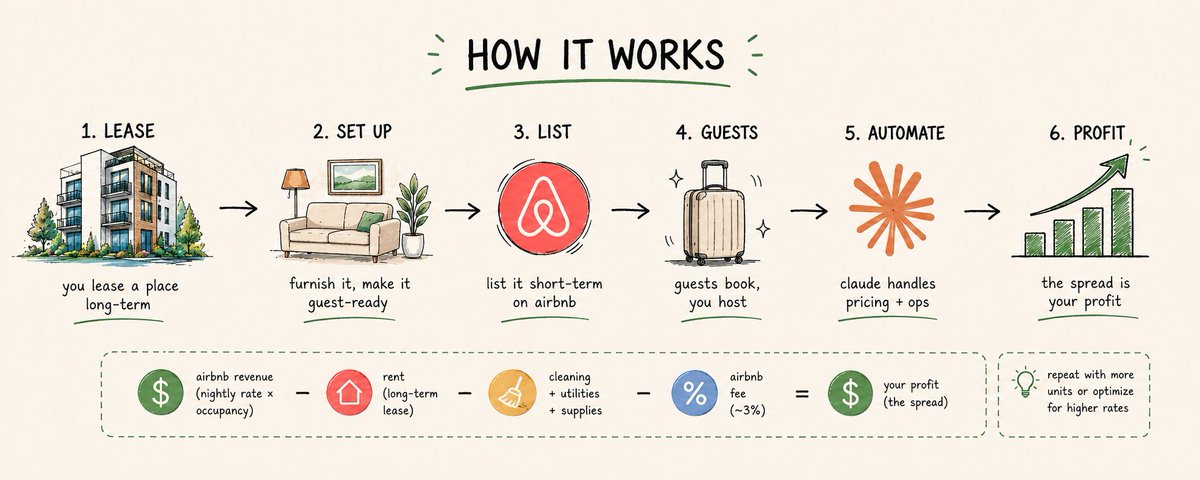
EVERYONE WANTS THE 15K/MONTH AIRBNB SCREENSHOT. NOBODY WANTS THE FOUR-HOUR RESEARCH THAT USED TO COME BEFORE IT. BUT NOW CLAUDE DOES IT FOR YOU!!!
> Rental arbitrage, in plain terms: you lease long-term, you list short-term, you keep the spread. It's been the same play for a decade
What actually changed is who does the research. It used to be you, zillow, airdna, and a spreadsheet for four to six hours per unit. Now it's a single prompt to claude, verdict in twenty minutes
Per unit math, rough: $145/night, 74% occupancy, that's about $3,200 gross. subtract rent, cleaning, utilities, the 3% platform fee. net comes out near $1,000. The 15k figure is a handful of units, not one lucky apartment
The part that still can't be automated: read the lease, confirm subletting is legal, check if the city requires a short-term rental license. sign after you know, not before
Seasonality will eat a market that looks great in july and dies in january. pull a full year of data or you're guessing
The strategy was never the hard part
The research was. That part's dead now
Save the cheat sheet and the article so you don't lose them👇

RetroChainer@RetroChainer
English

FORGET THE MYSTIQUE: THIS MINI PC BRINGS MONSTER DEEP LEARNING COMPUTE STRAIGHT TO YOUR DESK FOR UNDER $5,000. HOW GIGABYTE'S NEW BOX ACTUALLY COMPARES TO ENTERPRISE AI HARDWARE
This guy is holding a $4,500 personal supercomputer called the Gigabyte AI Top Atom. Sounds like an absolute fortune until you see what it actually handles under the hood
This little grey box is essentially a direct competitor to NVIDIA's incredibly fancy DGX Spark systems. But instead of renting time on a massive remote server rack, you just plug this thing straight into your desk setup. It is purpose built to train and run massive open weights models natively. But when you actually boot it up, the experience is surprisingly grounded
You get standard storage blocks, a solid CPU layout, and a completely ridiculous 128 gigabytes of unified RAM. That massive memory pool is the real magic here because it gives you the exact headroom needed to load complex neural networks entirely on-device without running out of space.
It is basically like taking the form factor of a standard Mac Mini and completely supercharging the raw graphics performance. It completely simplifies the development pipeline by giving teams an off-grid processing hub that keeps data locked to the local environment
Why keep paying recurring token costs to external cloud platforms when you can just host the whole loop on your own desk
Bookmark this so you don't lose it👇
beamnxw ./@beamnxw
English

The biggest AI bottleneck just got fixed:
"Instead of just making up facts off the top of its head, your agent can now independently pull real data and live trends from the outside world before it even starts a task."
We call it "The Hallucination Trap."
Most developers build AI agents that are completely cut off from reality. They ask them to write, plan, or analyze, and then wonder why the output is generic, outdated, or completely fabricated.
The secret to a production-ready agent isn't better prompting. It's giving your AI eyes and hands using MCP (Model Context Protocol).
Here is exactly how to wire your agent to an external server so it stops guessing and starts fetching real-time data.
Full step-by-step breakdown below. Make sure to bookmark this! 👇
broke boy@0xfuckpoverty
English

A 428B-parameter model just ran on 3 Mac Minis.
No cloud. No API bill.
The project behind it - Gradient - is building something bigger than a demo. Here's what it actually is:
Parallax: splits a model too big for one machine into layer-slices, spreads them across your laptop, a GPU, a teammate's desktop - routes each request over the fastest available path
> Supports 40+ open models, from 0.6B up to trillion-parameter MoE, on Mac, Windows, and Linux
> 3 modes: run solo on your own machine, pool with a LAN cluster, or join a wide-area network worldwide
> Echo, their second piece, does the same trick for training - splitting reinforcement learning across many machines instead of one data center
The pitch: intelligence that's hosted, served, and owned by the people running it - not rented from a hyperscaler API.
Reality check: this is still early.
Throughput over a real WAN, with real network variability, is a much harder problem than a demo on 3 Macs sitting on the same desk.
Worth watching, not worth assuming it already beats a cloud API on cost-per-token at scale.
If local AI clusters end up being a real category, this is one of the teams actually shipping toward it, not just talking about it.
Gradient@Gradient_HQ
A self-evolving agent + a 428B model + 3 Macs = ? Your own AI lab. We ran @MiniMax_AI M3 locally with @tryParallax, right on our desk. Then @GA_agent_ai took over to create a 5-stock portfolio and write it to disk. No cloud. No API bills. Nothing left the machine. Wild to see a ~3K-line agent drive all this with a 400B+ model on local hardware. Thanks to the GenericAgent and MiniMax teams for making local AI feel real.
English

Google CEO Sundar Pichai:
"If you don't learn how to orchestrate agents now, you'll spend 2027 catching up to people who started today"
30 minutes on why the best engineers stopped writing code line by line and started running agents instead
Most people think building an agent needs an engineering degree
It doesn't
It needs one guide and one afternoon
Bookmark and watch the interview
Then read the article below
One guide, one afternoon, that's all it takes
rari@0xwhrrari
English