

Kenias Horonga
781 posts
Kenias Horonga
@1kenias
All things Oil. All things Bitumen. DIESEL. Once an Accountant Always an Accountant.
Harare, Zimbabwe Katılım Temmuz 2015
926 Takip Edilen349 Takipçiler

@AlfredMurumbi It will be out of Champions League in two weeks time.
English
Kenias Horonga retweetledi

This is how an intelligent farmer produces Chicks from eggs without a hen.
English
Kenias Horonga retweetledi

That time Wimbledon security didn’t let in THE Roger Federer 😅
SK@Djoko_UTD
What's the best Tennis Interview clip ever ?
English
Kenias Horonga retweetledi

Kenias Horonga retweetledi
Businesses in America have moved quickly and are now demanding refunds for the tariffs they paid after the pronouncement by the United States Supreme Court that Donald Trump’s tariffs were illegal.
So this is how the tariffs worked. If you imported goods from South Africa and there was an illegal 30 percent tariff on them, the company importing the goods from South Africa would have had to pay that 30 percent tariff to the American government and then pass that cost on to the consumer.
For instance, if an American company ordered a bottle of wine from South Africa and there was a 30 percent tariff on it, which the Supreme Court has now pronounced illegal, and that bottle cost US$1 to import, once it reached America the importer would have to add the 30 percent tariff, taking the cost to US$1.30.
The importing company would then add its own margin, say another US$0.30 as profit. Ordinarily, without the tariff, that bottle might have retailed at around US$1.30, but because of the additional 30 percent tariff, it would end up costing the consumer about US$1.60.
In effect, the 30 percent tariff was passed directly on to the consumer through higher retail prices.
What American businesses are now saying is that they want that 30 percent tariff refunded. So the company that imported the bottle of wine from South Africa and sold it for US$1.60, comprising 30 percent tariff and 30 percent profit, now wants the tariff component returned to them.
How consumers themselves will be reimbursed, if at all, remains unclear, and that is likely to become the next area of legal and commercial contestation.
Meanwhile, American media is reporting that Donald Trump has gone into meltdown after the Supreme Court delivered this important ruling, which many had already predicted because it was clear to numerous legal experts that the tariffs were unlawful. Only his most loyal supporters insisted that the court would uphold them.
The decision has triggered not only political shockwaves in Washington but also significant financial and legal consequences, as businesses begin positioning themselves to recover the money improperly collected by Trump’s government.
English
Kenias Horonga retweetledi

🌐🎯 REBUTTAL TO PROF. JONATHAN MOYO'S PRESENTATION ON THE CONSTITUTION OF ZIMBABWE (AMENDMENT NO. 3) BILL, 2026
*Twitter/X Space | 19 February 2026*
A Constitutional Response — Grounded in Text, Structure, History, and Democratic Principle
💦PREFATORY STATEMENT
Prof. Jonathan Moyo's presentation at the Twitter/X Space on 19 February 2026 is polished, structurally confident, and draws on genuine constitutional scholarship. It deserves a serious response — not dismissal. Several of his technical propositions are textually defensible. The distinction between term-length provisions and term-limit provisions is a legitimate analytical category. The Tenth Parliament's authority to amend the Constitution is not in dispute. The referendum requirements under section 328(6) are accurately stated.
But the presentation is, at its core, an act of constitutional misdirection — conceding what is defensible, elevating it into decisive conclusions, and using that edifice to foreclose the questions that are not settled and that go directly to the constitutional integrity of this Bill.
This rebuttal addresses each argument on its merits and identifies, with precision, where the reasoning fails.
🤝PART I: THE STRAW MAN OF PUBLIC PARTICIPATION
Prof. Moyo opens by insisting that constitutional issues are for everyone, not only lawyers, and that dismissing non-lawyers is "childish." This is correct as a democratic principle. It is also entirely beside the point.
No serious opponent of Amendment No. 3 has argued that constitutional debate is the exclusive preserve of legal practitioners. The objections are constitutional law arguments advanced by practising lawyers, academics, civil society organisations, war veterans, and opposition senators. Prof. Lovemore Madhuku, who filed the Constitutional Court application challenging the Bill on 16 February 2026 — three days before this presentation — holds a doctorate in constitutional law and has spent decades in practice. Senator David Coltart is an advocate of the High Court with thirty years of constitutional litigation experience. These are not people who need to be reminded that constitutional issues belong to everyone.
The opening gambit functions as a pre-emptive delegitimisation of professional objections by rebranding them as intellectual snobbery — the very rhetorical move Prof. Moyo accuses others of making. The audience is thereby primed to receive his legal arguments as commonsense democratic participation rather than as contestable propositions advanced by someone publicly identified as centrally involved in the Bill's conceptual design.
The question before us is not who may debate. It is whether Parliament may lawfully do what is proposed, and whether the Bill's effects are constitutionally permissible. Popular enthusiasm does not dissolve constitutional constraints. It operates within them.
🤝PART II: LEGISLATIVE AUTONOMY IS NOT CONSTITUTIONAL SUPREMACY
Prof. Moyo invokes the anti-entrenchment principle — that one legislature cannot bind its successors — and supports it with *Fletcher v. Peck* (1810), where the United States Supreme Court held that one legislature cannot abridge the powers of a succeeding legislature.
This is a valid statement of the principle in ordinary legislation. It does not apply in the way Prof. Moyo deploys it.
♟️*First*, *Fletcher v. Peck* concerns contractual obligations under statute — not constitutional amendment procedure. It was not decided under a constitution with an express amendment mechanism equivalent to section 328. Importing it as authority for the proposition that the Tenth Parliament faces no substantive constraint is a category error.
♟️*Second*, the anti-entrenchment principle operates in ordinary law. Constitutions are, by design, the exception. A constitution amendable without procedural constraint would not be a constitution — it would be a glorified statute, changeable by any temporary majority. The entire purpose of section 328 is to be an entrenched constraint on parliamentary power. It cannot be circumvented by invoking the very doctrine that entrenchment is designed to limit.
♟️*Third*, nobody disputes that the Tenth Parliament may amend the Constitution. The dispute concerns two specific questions: (a) whether the prescribed procedure has been followed; and (b) whether section 328(7) bars the incumbent from benefiting from the amendment's effects. Prof. Moyo addresses (a) at length. He never properly addresses (b).
Invoking anti-entrenchment doctrine to bypass entrenched safeguards is not a legal argument. It is a conceptual inversion.
🤝PART III: THE DEFINITIONAL SLEIGHT OF HAND — SECTION 328(7) AND THE INCUMBENCY BAR
This is the central issue in the entire debate. It is also the argument Prof. Moyo most studiously avoids engaging with in full.
3.1 What Section 328(7) Actually Says
Section 328(7) provides:
📌 *"Notwithstanding any other provision of this section, an amendment to a term-limit provision, the effect of which is to extend the length of time that a person may hold or occupy any public office, does not apply in relation to any person who held or occupied that office, or an equivalent office, at any time before the amendment."*
Prof. Moyo's argument is that section 328(7) cannot be triggered because sections 95(2)(b) and 143(1) are not "term-limit provisions" within section 328(1). Since the provisions being amended are duration clauses, not term-limit clauses, section 328(7) does not activate, and President Mnangagwa may benefit from the extended term without constitutional difficulty.
This argument has two fatal flaws.
3.2 The First Flaw: The Effects-Based Language of Section 328(7)
Section 328(7) does not merely prohibit amendments to provisions formally classified as "term-limit provisions." It prohibits any amendment — to any provision — *the effect of which is to extend the length of time that a person may hold or occupy any public office* from applying to an incumbent.
The operative phrase is *"the effect of which is to extend."* The provision is effects-based, not label-based.
Even accepting entirely that sections 95(2)(b) and 143(1) are duration clauses, the question section 328(7) asks is not: *what type of provision is being amended?* It asks: *what is the effect of the amendment on the incumbent's tenure?*
The effect of extending the presidential term from five to seven years — applied to a president in his second five-year term — is to keep him in office until 2030 instead of 2028: an extension of twenty-four months. Whatever label is attached to the provision being amended, that effects-based prohibition operates directly. No classification exercise can dissolve this conclusion. It is embedded in the text.
3.3 The Second Flaw: The *Mupungu* Judgment Is Being Misused
Prof. Moyo relies heavily on *Mupungu v Minister of Justice, Legal and Parliamentary Affairs & 6 Others* CCZ 7/2021, citing the Court's distinction between a "term" (fixed, known beginning and end) and a "period" (subject to contingencies) as establishing that duration provisions are categorically different from term-limit provisions.
Three points must be made about this reliance.
♟️*First*, *Mupungu* concerned the retirement age extension of the Chief Justice — not a presidential term extension. Judicial tenure provisions operate under a distinct constitutional regime. Transposing the Court's reasoning to the presidential context requires an argument Prof. Moyo does not make.
♟️*Second*, the *Mupungu* Court itself stated:
📌 *"The prescribed term limits cannot be extended so as to apply to sitting incumbents."*
This observation — which Prof. Moyo does not cite — confirms that the Court understood section 328(7) as a substantive constraint against incumbents benefiting from tenure extensions. That understanding is directly inconsistent with the argument that section 328(7) is rendered inoperative by definitional classification.
♟️*Third*, the *Mupungu* decision has itself been questioned on legitimacy grounds. The judges who decided it had a direct personal interest in the outcome — their own retirement ages were affected by the same amendment. The *nemo judex in causa sua* principle was raised but not accepted. The decision therefore carries a legitimacy burden that limits its authority as clean precedent for the far more significant question of presidential tenure extension. This does not strip the judgment of all persuasive value, but it cautions against treating it as determinative in a materially different constitutional context.
3.4 The Conflict of Interest — Section 196(2)
Prof. Moyo's presentation makes no mention of a live constitutional issue before the courts since 16 February 2026: that President Mnangagwa personally chaired the Cabinet meeting on 10 February 2026 that approved the Bill whose primary effect is to extend his own tenure.
Section 90(2)(b) requires the President to respect, uphold, and defend the Constitution. Section 196(2) requires all senior public officers to act in the public interest and avoid conflicts between personal interests and public duties. The war veterans' application directly alleges that the President's personal participation in approving a Bill that benefits him violates both provisions.
This is a justiciable constitutional claim that the Constitutional Court is required to consider. A presentation purporting to offer a comprehensive constitutional defence of the Bill, while making no reference to this challenge, is not a complete account of the constitutional landscape.
🤝PART IV: THE "MISCHIEF" NARRATIVE AND THE ERASURE OF POLITICAL HISTORY
Prof. Moyo identifies two "mischiefs" the Bill addresses: the conflict generated by direct presidential elections introduced in 1987, and the dysfunction of short five-year electoral cycles.
Both diagnoses are presented as politically neutral observations about institutional design. Neither is.
4.1 On the "Conflict Mode" of Direct Presidential Elections
The claim that Zimbabwe's instability flows from the method of electing the President is a diagnosis that abstracts entirely from the political agent that has governed Zimbabwe continuously since 1980.
Zimbabwe has not experienced political instability because its citizens vote directly for their president. It has experienced instability because of:
♟️*Gukurahundi* (1983–1987): the state-directed massacre of an estimated 20,000 civilians in Matabeleland and Midlands, carried out under the authority of a president never subjected to a single competitive election;
♟️*The land seizures of 2000–2008*: conducted in deliberate violation of constitutional property rights, with judicial orders ignored by the executive;
♟️*The 2008 election*: in which 200 people were killed, thousands tortured, and the internationally recognised first-round winner was forced into a Government of National Unity under duress;
♟️*The militarisation of civilian governance*: documented extensively by the Zimbabwean Human Rights Commission and independent international observers;
♟️*The capture of the Electoral Commission, the judiciary, and the security services*: which has made competitive elections structurally impossible regardless of the method of presidential election.
None of these pathologies was caused by five-year electoral cycles. All were caused by unchecked executive power without institutional restraint, judicial independence, or democratic accountability. The argument that removing direct presidential elections will cure them is a selective abstraction from political history — the substitution of institutional formalism for political accountability.
4.2 On "Perpetual Election Mode" and the Seven-Year Cycle
The argument that shorter electoral cycles incentivise divisive politics has genuine empirical support in comparative literature. Prof. Moyo is not wrong that constitutional systems operate on longer cycles. He is wrong to present this as a neutral improvement in Zimbabwe's specific context.
In Zimbabwe in 2026, extending electoral cycles from five to seven years operates under conditions where:
♟️A single party holds a two-thirds supermajority in Parliament — the threshold required to pass constitutional amendments;
♟️The same party controls the Electoral Commission, the security services, the public broadcaster, and the state apparatus;
♟️Independent civil society, opposition parties, and the private media operate under sustained legal and extralegal pressure.
In this environment, extending the electoral cycle does not reduce divisive politics. It extends the interval during which those without power must wait — without recourse — for the next opportunity to seek accountability. The "Sabbath solution," as Prof. Moyo describes it, is only restful for those already in power.
🤝PART V: THE REMOVAL OF DIRECT PRESIDENTIAL ELECTIONS — WHAT IS NOT BEING SAID
The Bill abolishes direct popular election of the President in favour of election by a joint sitting of the National Assembly and Senate. Prof. Moyo defends this as aligning Zimbabwe with SADC and Commonwealth best practices and correcting tension between section 3(2)(a)'s multi-party democratic principle and the ethnically mobilising effects of direct presidential campaigns.
Several critical observations must be made.
5.1 Section 3(2)(a) Does Not Prescribe an Electoral Method
Section 3(2)(a) requires that Zimbabwe be governed by a multi-party democratic political system. It says nothing about how the President must be chosen. Both direct election and parliamentary election are compatible with multi-party democracy. The claim that direct presidential election is "in direct conflict" with section 3(2)(a) is not supported by the text. It is a political theory inference, not a constitutional one.
5.2 Parliamentary Election Under Present Conditions Is Not Democratic Deepening
Parliamentary presidential election has democratic merit in genuinely competitive systems. Parliamentary systems in Germany, India, and the United Kingdom operate with democratic legitimacy precisely because their Parliaments are genuinely competitive, their judiciaries independent, and their electoral systems prevent permanent single-party control.
In Zimbabwe in 2026, ZANU-PF holds a two-thirds supermajority in both chambers. The Bill simultaneously grants the President power to appoint ten additional senators, expanding the Senate from 80 to 90 seats. The combination — parliamentary presidential election, a supermajority, and expanded Senate appointments — does not create a more democratic system. It creates one in which the selection of the President is formally insulated from voters and placed in the exclusive control of a legislature one party dominates absolutely.
This is not constitutional progress. It is the formalisation of one-party dominance within an architecture designed to prevent it.
5.3 The 2013 Constitution Was Itself the Product of Direct Public Participation
The Constitution of Zimbabwe (2013) was produced through COPAC — extensive public consultation, cross-party negotiation, and a national referendum. Its provisions, including direct presidential elections, were the product of an express popular mandate. The Bill proposes to abolish a core feature of that mandate through a parliamentary vote alone.
Prof. Moyo is correct that section 328(6) does not require a referendum for provisions outside Chapters 4, 16, and section 328. But democratic legitimacy is not exhausted by formal legality. A change of this magnitude — removing the direct popular election of the Head of State — may be formally lawful without being democratically legitimate. Zimbabwe's constitution-making tradition has consistently insisted that fundamental changes require popular validation. That tradition is being abandoned here.
🤝PART VI: PATRIOTISM, STABILITY, AND THE LANGUAGE OF INEVITABILITY
Prof. Moyo describes the Bill as "historic," "patriotic," "forward-looking," and a "Sabbath solution." President Mnangagwa and his Cabinet are said to "deserve unqualified national commendation."
These are not constitutional arguments. They are the rhetorical instruments of political consolidation — manufactured consensus presenting a contested power arrangement as the natural, inevitable, and morally necessary evolution of national destiny.
Constitutions are amended by compliance with procedures and substantive limits — not aspiration, tone, or moral posture. A Bill whose primary effect is to extend an incumbent's tenure, remove direct democratic accountability, and concentrate presidential selection in a party-dominated legislature is not "historic progress." It is the use of constitutional form to achieve what constitutional substance was designed to prevent.
The language of patriotism has historically been deployed in Zimbabwe to silence dissent. Gukurahundi was defended as national unity. Land seizures were liberation history. Operation Murambatsvina was urban renewal. Invoking it in support of Amendment No. 3 does not make the Bill constitutional. It places it in a recognisable tradition.
🤝PART VII: THE COMPARATIVE ARGUMENT — CONTEXT MATTERS
Prof. Moyo cites Guinea's adoption of a new constitution on 21 September 2025, extending the presidential term to seven years, and data from 16 African Commonwealth countries to support longer electoral cycles.
Comparative constitutionalism is a legitimate tool. But it requires contextual fidelity, not selective citation.
♟️*Guinea in September 2025* adopted its constitution under a military government — the National Committee for Rally and Development — which seized power in a coup in September 2021 and has repeatedly postponed its return to civilian rule. This is not a validating comparator. It is a revealing one.
♟️*The Commonwealth and SADC* comparators are selectively deployed. Zambia, Malawi, South Africa, and Botswana have robust judicial independence, genuine electoral competition, and functioning separation of powers. Longer terms in those contexts serve different institutional functions than they would in a state where those safeguards are structurally compromised.
Comparative constitutional method requires asking: what conditions make a particular arrangement work where it is used? The answer — institutional independence, genuine competition, judicial oversight — is precisely what is absent in Zimbabwe, and precisely what this Bill does nothing to create.
🤝PART VIII: THE PENDING CONSTITUTIONAL COURT CHALLENGE
Prof. Moyo presents the constitutional questions surrounding Amendment No. 3 as settled. They are not.
On 16 February 2026 — three days before this presentation — a Constitutional Court application was filed by war veterans, represented by Professor Lovemore Madhuku, on the following grounds:
1. That sections 95(2)(b) and 143(1), as amended, have the *effect* of extending the incumbent President's tenure, triggering section 328(7);
2. That the President's personal chairing of the Cabinet meeting approving the Bill constitutes a breach of sections 90(2)(b) and 196(2);
3. That the Bill, as applied to the incumbent, is constitutionally void.
A further application from the Ibhetshu LikaZulu group was anticipated. These applications are pending. The section 328(7) question is therefore a live matter of ongoing litigation — not a resolved academic debate.
A presentation delivered after these applications were filed, without a word about their existence or arguments, is not a complete account of the constitutional landscape. It is a one-sided advocacy document dressed in academic language.
🤝PART IX: SYNTHESIS — WHAT THIS BILL ACTUALLY DOES
Setting aside classification debates, what does Amendment No. 3 actually do?
1. *It extends President Mnangagwa's current term from 2028 to 2030* — seven years in his second term rather than five.
2. *It removes direct popular election of the President*, replacing it with selection by a Parliament his party holds with a two-thirds supermajority.
3. *It expands his power to appoint senators*, further entrenching ZANU-PF's grip on the upper chamber.
4. *It was approved by a Cabinet he personally chairs*, creating a direct conflict between personal interest and constitutional duty.
5. *It is publicly defended by someone centrally involved in its drafting*, without disclosure of that relationship.
6. *It was passed in the teeth of a live Constitutional Court challenge* directly contesting its applicability to the incumbent.
None of these facts are answered by classifying sections 95(2)(b) and 143(1) as duration clauses. Legal classification does not exhaust constitutional method. Where the structure, history, and evident purpose of section 328(7) is to prevent incumbents from benefiting from tenure extensions, that purpose cannot be defeated by amending a duration clause and calling the result an "institutional cycle adjustment."
🤝💦CONCLUSION
Zimbabwe's constitutional history is not a history of insufficient clever design. It is a history of power without accountability — of constitutional frameworks that were architecturally sophisticated and operationally compromised by the political will of those who held power within them.
Amendment No. 3 does not resolve that history. It continues it — with greater constitutional formalism and greater academic scaffolding, but with the same fundamental logic: the arrangements of power must be made to serve those who currently hold it, and the constitutional instrument must be interpreted in whatever way makes that possible.
Prof. Moyo's presentation is sophisticated. But sophistication in service of incumbency extension is not constitutional scholarship. It is constitutional advocacy. The distinction matters, because the Constitution of Zimbabwe was not written to be interpreted by those it most benefits.
The questions this Bill raises — about the incumbency bar in section 328(7), about the conflict of interest under section 196(2), about the democratic legitimacy of abolishing direct presidential elections — are before the courts and before the Zimbabwean people. They deserve honest answers, not methodologically sophisticated avoidance.
The measure of constitutional reform is not whether it can survive a textual argument. It is whether it makes power more accountable or less. By every constitutionally relevant measure, Amendment No. 3 diminishes it.
💦🤝FOOTNOTES
[^1]: Constitution of Zimbabwe (2013), s 328(7).
[^2]: *Mupungu v Minister of Justice, Legal and Parliamentary Affairs & 6 Others* CCZ 7/2021, per Makarau JCC and Patel JCC.
[^3]: Constitution of Zimbabwe (2013), ss 90(2)(b), 196(2).
[^4]: Constitution of Zimbabwe (2013), s 328(1) (definition of "term-limit provision").
[^5]: Constitution of Zimbabwe (2013), s 3(2)(a) (multi-party democratic system as a founding principle of good governance).
[^6]: COPAC, *Final Draft Constitution Report* (2012), Chapter 5 Explanatory Memorandum (confirming s 91(2) as the sole vehicle for presidential term limits under the 2013 Constitution).
[^7]: *Fletcher v. Peck*, 10 US (6 Cranch) 87 (1810) — correctly limited to ordinary legislative succession; not authority for constitutional amendment without substantive constraint.
[^8]: David Landau, "Abusive Constitutionalism" (2013) 47 *UC Davis Law Review* 189 (on the use of formally legal constitutional mechanisms to undermine democratic governance).
[^9]: Tom Ginsburg & Rosalind Dixon (eds), *Comparative Constitutional Law* (Edward Elgar, 2011) 273–275 (on contextual fidelity in comparative constitutional method).
[^10]: Richard Albert, *Constitutional Amendments: Making, Breaking, and Changing Constitutions* (Oxford University Press, 2019) 145–148 (on the structural distinction between personal term limits and institutional duration provisions).
[^11]: Helen Xanthaki, *Drafting Legislation: Art and Technology of Rules for Regulation* (Hart Publishing, 2014) 112–115 (on the drafting distinction between term-length and term-limit provisions and the constitutional consequences of conflation).
[^12]: Constitution of Zimbabwe (2013), s 91(2) (the sole presidential term-limit provision — unaffected by Amendment No. 3).
*This rebuttal is submitted in the public interest and for the integrity of Zimbabwe's constitutional order. It is grounded in the text of the Constitution, available judicial authority, and verified comparative sources. The author remains available to engage these arguments publicly, on the basis of law, text, history, and democratic principle.*
🚪Apostle Joel I Servant LeadersWorld (SLW) Ministries
x.com/ApostleJoelSLW…
English
Kenias Horonga retweetledi

🚨 MASSIVE STATEMENT BY SIKANDAR RAJA ON WIN AGAINST SRILANKA 🚨
Sikandar Raja Said 🗣️
"Beating a big team like Srilanka and top of the group truly feels great. It’s a very big achievement for us. From now on, no one will take us lightly or see us as underdogs anymore. Hopefully, we’ll play very well in the Super Eight. In our group, there are big teams like South Africa, West Indies, and India. But we won’t spare anyone we’ll fight hard. We’ll give it our all and try to qualify for the semifinals with our own strength."
#SlvsZIM #Zimbabwe #ISN29

English

Prayer for miracles, blessings and
breakthroughs
English
Kenias Horonga retweetledi
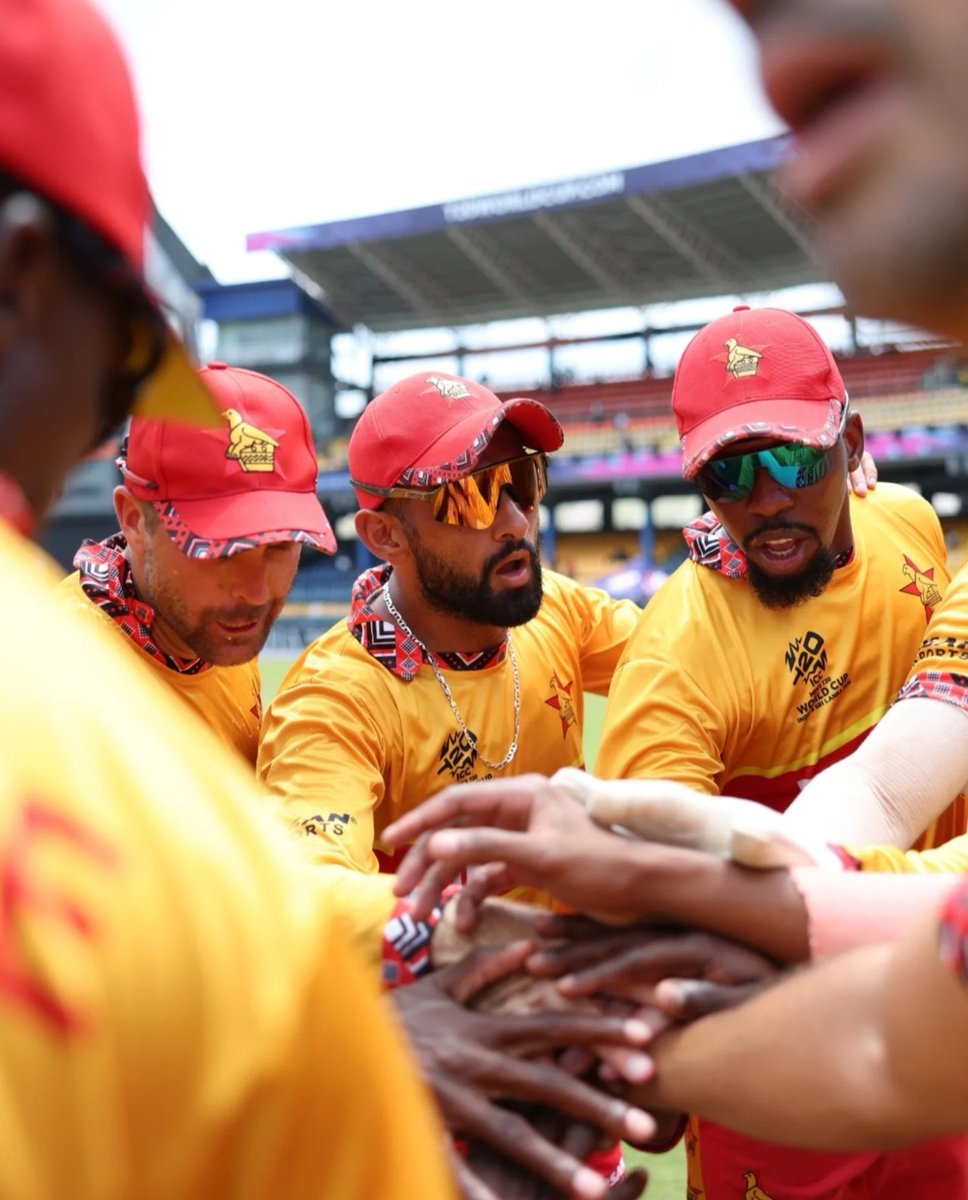
🚨 MASSIVE STATEMENT BY RICKY PONTING ON ZIMBABWE INCREDIBLE PERFORMANCE 🚨
Ricky Ponting Said 🗣️
“First they knocked Australia out of the tournament by beating them, and now they have defeated Sri Lanka. I had already said that the Zimbabwe team would surprise everyone this time. If they reach the semifinals or even the final of this World Cup, it won’t be surprising; because their players’ confidence is now at its peak.”

English
Kenias Horonga retweetledi
I have listened to the debate on Constitutional Amendment Bill No. 3 between legal scholar Dr Justice Mavedzenge and political scientist Prof Jonathan Moyo today on Twitter.
Without any doubt, Dr Justice Mavedzenge explained, clarified, and made ordinary people understand the issues, and more importantly, in my humble view, he won the debate on whether there is need for Constitutional Amendment Bill No. 3 to be subjected to a referendum or not.
Anything done for the people, as Prof Jonathan Moyo says these monumental amendments are, should be subjected to the people.
The Constitution is not ambiguous on this. It is clear that term limits should be subjected to a referendum for any change to be done legally.
Under Section 328 of the Constitution of Zimbabwe, any amendment that seeks to extend the length of time a President may hold office, or to remove or alter term limits in a way that benefits an incumbent, cannot apply to the sitting President and must be subjected to constitutional safeguards.
You cannot claim to be doing something for the people and yet deny those same people the right to have a say. Prof Jonathan Moyo has a right to his views, but those views must be subjected to the law for the amendments to be implemented legally, and based on what I have read in our Constitution, his views are not aligned with the law.
And I am not making this up. It is in the Constitution. Even veteran Zimbabwean lawyer and former ZANUPF legal secretary, Patrick Chinamasa, has said so. In this video, he explains in front of President Mnangagwa that what they are attempting to do today, which Prof Jonathan Moyo argues does not require a referendum, would in fact require two referendums.
One to remove or alter presidential term limits from five to seven years, and another to extend the sitting president’s tenure to 2030.
This position was declared, and not contradicted, at a ZANUPF conference in Bulawayo. What the broader legal fraternity in Zimbabwe is saying, save for a few lawyers who have since revised their positions and now echo the same view, is that the Constitution is explicit on these prescripts. Anything else is political propaganda to win hearts and minds.
The problem with propaganda is that it cannot be anchored in constitutional provisions. It rests on opinion. In this instance, however, we are not expressing opinions. We are stating what is contained in the Constitution and what ZANUPF itself has previously acknowledged.
You can decide today that you want a 20-year presidential term. That is your right to hold that view, but you must subject that proposition to the law. If you believe in it, take it to the citizens in the manner prescribed by the Constitution.
You cannot decide, through opinion or political argument, whether a referendum is required or not. That question is not settled by what anyone thinks. It is settled by what the law says. If the Constitution requires a referendum, then you must subject yourself to it. That is how constitutional democracy works.
We know that the judiciary in Zimbabwe is captured. We know how they are going to rule, but the whole world knows the truth, that if they rule in favour of these amendments going ahead without a referendum, they are simply a captured judiciary without the respect that is required for anyone holding such an important office, and history will remember them as such.
English
Kenias Horonga retweetledi

CHAMPIONS! T20 Cricket World Cup chaos! Go ZIMBABWE! Proteas at 15h30 on Sunday! ❤️❤️❤️🇿🇦🇿🇦🇿🇦 #T20WorldCup
English
Kenias Horonga retweetledi

HUGE CONGRATULATIONS to the Zimbabwe national cricket team The Chevrons 🇿🇼
What a superb performance topping the table with a brilliant six-wicket win over the Sri Lanka national cricket team. Your fearless batting, disciplined bowling, and unshakeable belief have rewritten expectations and shown the world that the Chevrons are truly a force to be reckoned with.
This spectacular achievement is a testament to your hard work, resilience, and team spirit. Zimbabwe is incredibly proud, and rightly so!
Here’s to many more victories ahead! God bless Zimbabwe!
Zimbabwe Cricket@ZimCricketv
Clinical performance! We finish the group stages unbeaten! 🥳 Match Details 👉 t.ly/9Jhlx #SLvZIM #T20WorldCup
English
Kenias Horonga retweetledi


Kenias Horonga retweetledi

Zimbabwe march into the Super 8s with a brilliant win over Sri Lanka 🇿🇼👏

English
Kenias Horonga retweetledi

WOOOHOOO #ZIMBABWE YOU ABSOLUTE BEAUTIES .
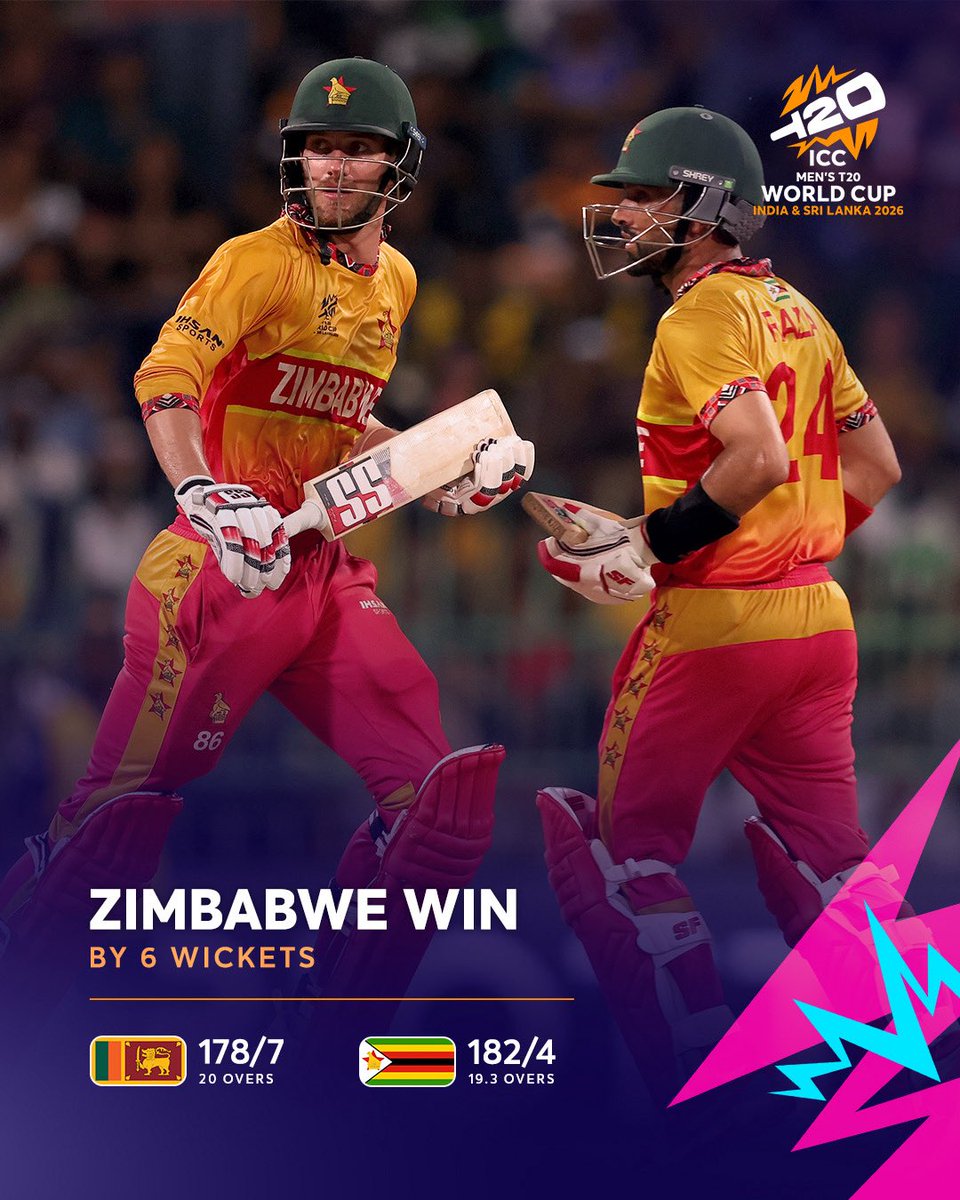
Zimbabwe cruise to victory against Sri Lanka. Brilliant play by Bennett (63 not out off 48 balls), Marumani (35 off 26), Burl (1 for 16 and 23 off 12) , Raza (45 off 26), Munyonga (brilliant 6 in the last over), Muzarabani (2 for 38) , Evans (2 for 35) , Cremer (2 for 27) - in fact the whole team.
What a tremendous team effort. Well done @SRazaB24 and the entire team and coaching staff.
The whole of #Zimbabwe is smiling!!!
English
Kenias Horonga retweetledi

Zimbabwe remain unbeaten in the 2026 #T20WorldCup group stages with a brilliant victory over Sri Lanka 👏
📝: icc-cricket.com/tournaments/me…
English
Kenias Horonga retweetledi

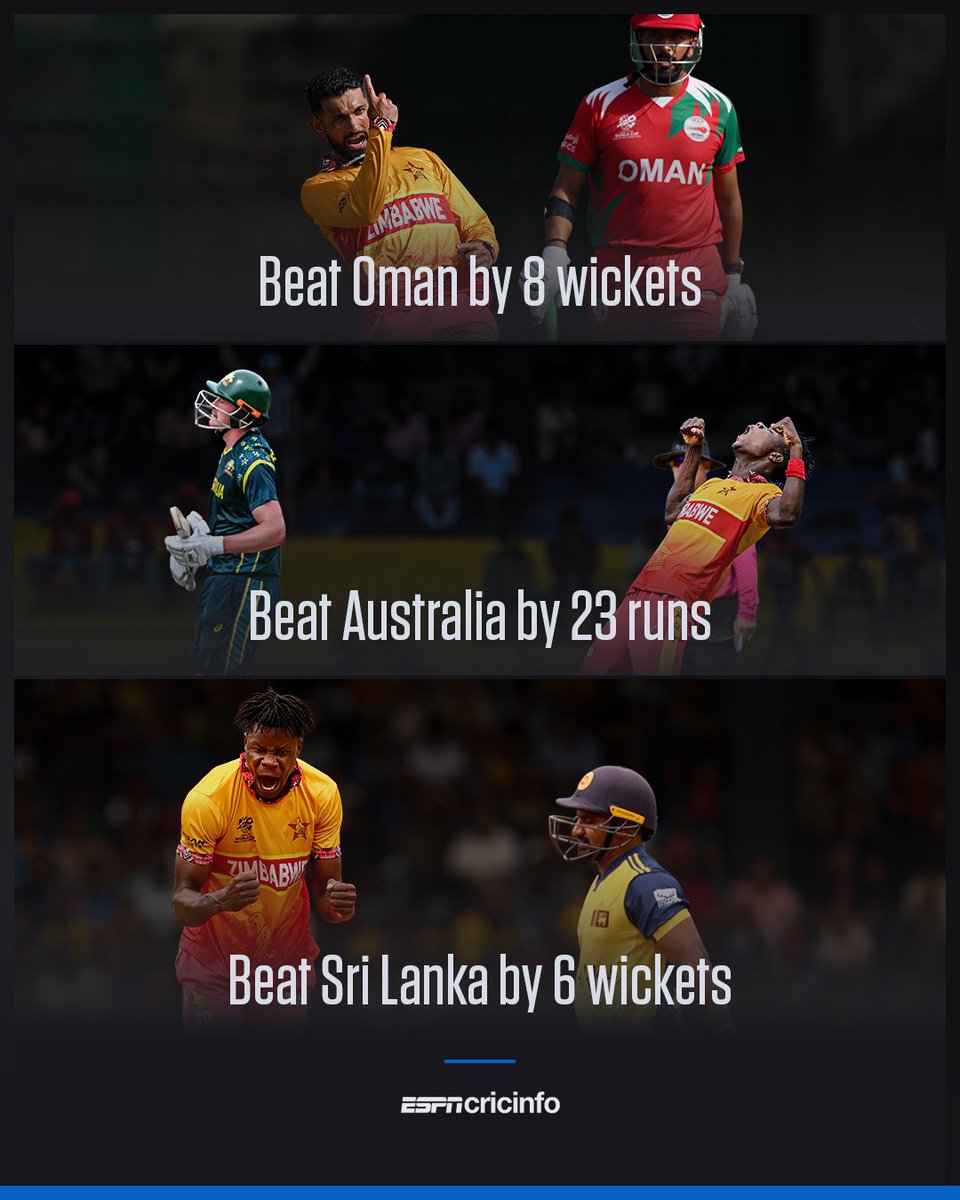
UNDEFEATED 🔥
Zimbabwe have won three games in the group stage for the first time at the men's T20 World Cup!
English