3NDeveloper
5.9K posts

3NDeveloper
@3NDeveloper
Real Estate developer who specializes in retail ground-up / value-add. Average unlevered IRR (no debt) of ~40%. Just sharing my thoughts and experiences.

Katılım Aralık 2022
138 Takip Edilen8.5K Takipçiler


Working on a development project which has environmental contamination (former gas station site).
Not my cup of tea, but there is a long story behind this.
Engaged my environmental consultant to perform a Phase 2 investigation, and to provide a recommendation on how to handle the matter.
He does so.
His recommendation feels too 'light' 🙃
I decide it's best to get a second opinion, and hire a very well known, national company for this.
- Proposal is presented
- Contract signed
- Retainer funds wired
Off to the races.
ETA: 10 Business Days (ending last Friday).
On Thursday, I send a follow-up to check-in on the status.
"The report is under final review - we're expecting to get it to you by tomorrow"
Okay - nice 🥳
Friday rolls around - no report.
Monday rolls around - no report, but I get an email notification that I have a package being delivered by USPS.
Tuesday - nada
Today - my USPS package arrives.
I open it.
It's a gift box of fancy pecans, and a note from this environmental company about how important my relationship is to them 🤨
How much is this upcoming report going to end up costing me? 😂🤣
English

@skylarromines No and yes - not your conventional insurance.
I have a Rep & Warranty from the Seller that the property never stored hazmat.
Seller is a City with deep pockets.
English

@3NDeveloper Hope you got environmental insurance pre phase 2
English

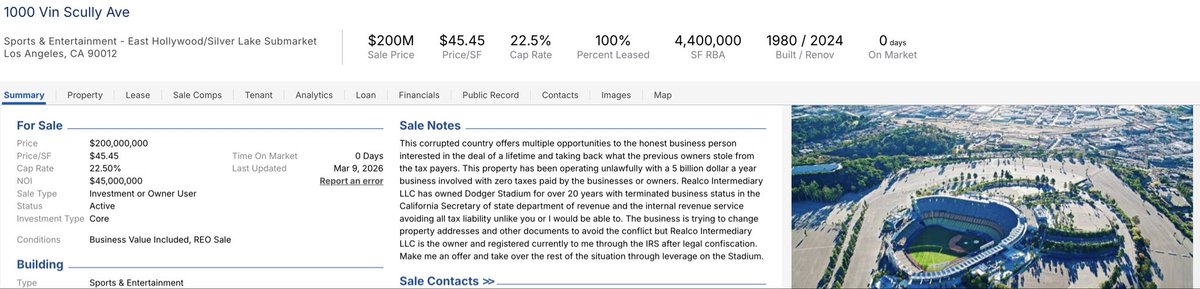
@3NDeveloper @Dodgers Seems like someone was just having fun on costar 🤣
English


Need to understand who your counterparts are, and adapt the negotiating style around them.
In SoCal (LA) - you need to leave room in the offer to negotiate. These Sellers expect it, and need to go through the process of 'fighting' for their best deal. Only way that happens is if they provide counter, and get countered back. It is what it is.
With Tenants/institutional players - I always provide the terms upfront, and (honestly) tell them there is very little room to negotiate. Take it or leave it.
With LA-based Sellers, I leave a lot more room for negotiations. It's simply part of the process.
I agree with David - it is akin to a poker game.
English

@pathfinder17m @FromWhiteCastle For a stabilized business with longevity, yes. Very low.
For a brand new business that launched a few months ago, it’s interesting. Fashion brand with 13 customers in it when we visited (every other adjacent retailer was empty at the time), and this was a very small store.
English

@3NDeveloper @FromWhiteCastle $70K/mo gross sounds low for a retail business
English

I love working with 'mom and pop' tenants, but they have their quirks.
One of my (more fun) projects was the conversion of an industrial building into a retail showroom - one of those rare situations where it works well.
Space leased up quickly to a notable operator, and they eventually outgrew the space.
Took it back out to market - 6,000 SF (not an easy pill for many to swallow).
LOI comes in from a local business, and terms are agreed to within days so I request financials.
TT financials finally arrive.
The annual negotiated rent is equivalent to their entire 2025 Gross Sales.
Oh boy😂🤣
English

@pathfinder17m @FromWhiteCastle They sent their P&Ls via text message with no explanation.
Apparently, it's a brand new retail business that posted $200k in the first 3 months of opening. Seems interesting.
English

I asked them to help me make it make sense.
Apparently, they have been operational for only 3 months and posted over 200k in gross sales. P&L was accurate, but they should have clarified how new their business is 😅
Trendy tenant for a trendy building in a trendy submarket.
Zero TIA, immediate rent commencement, and a personal guarantee.
Might do a deal with them 🤷♂️
English

@Tmac4real1 I believe in missing all the shots you don't take, but I also believe in not gambling with russian roulette 😂
English

@michaeljburry The subscription is worth every penny, and I have told all of my closest friends to sign up.
Appreciate your long-form writing.
English

Thank you all for your interest in what I am doing here and on SS. I am actively working on posts some of you are expecting - GME Part 2, the Heretic’s Guide Part 3, the LULU and Palantir pieces. After these are done - or maybe before - I imagine the content and stocks covered will become more unexpected in nature.
All paid subscribers today already have their lifetime subscription rate as long as they stay current.
Those who received a subscription to Cassandra Unchained over the holidays have this month to consider continuing the subscription at the initial founding rate.
On February 1, the subscription rate for new subscribers will move to $49/month or $439/year.
English

I never understood this 'scare tactic' of threatening to dump bonds purely to flood the market and hurt the US Government.
It's tantamount to cutting off your nose to spite your face.
Short-term: Seller will need to price the bond at a massive discount to market value, and will book a guaranteed loss.
That $180B may transact for $120B-150B, depending on the intensity of the sale. Maybe even $100B.
Seller takes that immediate loss.
Bond buyers will scoop them up immediately, especially given that investments flow based on relative yields (e.g. US Treasuries yielding 5% will be substantially more attractive than, let's say, Nigerian bonds yielding X%).
The more moronic consequence is that all sovereign bond yields are really priced relative to US Treasury yields, which are the baseline for 'lowest risk' assets.
If USTs reprice, then sovereign debt reprices more intensely (credit spreads increase greater for 'lower quality' investments; in other words: literally every other sovereign debt in the market).
Congratulations - you played yourself.
English

@realEstateTrent Always good to remember - business and social are 2 different worlds. What works in one may not be suitable for the other.
English

It's case dependent.
Often, it's better for principals to interact directly.
Sometimes, it's better to have brokers interact directly.
Other times, put everyone in the same room.
Some deals are driven by brokers, and some deals are broken by brokers. Just need to understand which side of the fence your counterpart's broker is sitting on.
English

@CaseyMericle @3NDeveloper But they get so butthurt and turn into little children when you suggest that.
English

Experienced such an off-putting interaction today.
We're in negotiations with an operator to lease an entire building:
- Experienced operator
- Well educated and well spoken
- Savvy and successful
LOI is mutually executed, and we're speeding through lease negotiations.
They come back with a small, but fair, set of comments, which I respond to within a few hours.
Tenant Broker wants to schedule a Teams call to speed things along.
It's a bit too soon for a Teams call at this stage of negotiations, but it's okay - I accept.
Principal #1: 3ND
Principal #2: Tenant
Landlord Rep #1
Landlord Rep #2
Tenant Rep #1
Meeting is far too stacked for something so simple, but it originated from the Tenant Broker who wanted an 'all hands' environment.
Okie dokie.
Prior to the meeting starting, I prepare my broker on the cadence I expect:
- He leads with the opening, an explanation of the lease form, etc., and opens the floor for engagement
Meeting starts.
My broker opens perfectly.
Tenant (Principal) immediately begins diving into the conversation, and is abruptly interrupted, and cut off, by their broker.
Tenant Broker takes over and starts leading on behalf of the Tenant side.
My reaction was simple: 🤨
We have some back and forth, and the Tenant (Principal) begins communicating certain concerns regarding a lease provision.
Before they can finish, my broker also interrupts.
I'll let bad behavior slide for an opposing side, but not from my team.
Cut off my broker, and ask the Tenant to finish their thoughts.
What the fuck is going on here?
Meeting continues for ~90 minutes, and we're simply getting to a point where we're rehashing old topics, so I end it, and say I'll get them my responses soon.
I've thought about this meeting several times today. It just put me off so much.
The only thing different about this operator, compared to other operators in the field, is that 'they' is a 'she'.
The good news is that it's the first time in over a decade that I've experienced this first hand (thankfully).
The bad news is that it still happened. Wild.
The best part about all this?
The Tenant (Principal) was the best champion for communicating their issues/concerns in an eloquent and effective format. Their broker simply confused the shit out of me 😂🤣
English

The simpler way of looking at it is as follows:
Underwrite returns based on how the majority of investors will also underwrite the asset. Calculate the FMV based on the commonly accepted methodology.
After this, underwrite the returns based on your unique circumstances (tax advantage, tenant-in-tow, etc.).
If you're buying the asset at, at least, FMV, then your downside is protected and you're not overpaying based on factors unique to you (or to a small subset of investors).
English

@3NDeveloper So underwrite returns at net cash flow before taxes (income taxes), not net cash flow after taxes (income taxes).
Make sure deal makes sense at that level. Keep mind “depreciation recapture” that you need to pay on “back end”.
English

Tax-advantaged investing is phenomenal, but it comes with a doubled edged sword.
Many CRE deals are being shoved into a YE 2025 close due to cost segregation / bonus depreciation.
Why?
Time value of money.
Investors (that need to shield their incomes) save a ton in taxes today, and kick the can down the road (depreciation recapture tax).
We're selling a property to an investor that absolutely needs to close escrow by year-end. It's one of my first development projects I ever built, and it's my smallest transaction, but the savings are notable for this Buyer.
In simple terms:
- Down Payment: ~$1,680,000
- Tax Savings: ~$300,000 instantly
He's closing escrow on December 31, and will save $300k on his taxes by doing so. In other words, an 18% 1-day return.
Absolutely insane metric.
Will he owe this $300k in the future?
Yes.
If, however, he invests this $300k saved for 30 years at:
8%: He'll have $3,000,000
10%: He'll have $5,300,000
And he'll owe $300k in recapture taxes in the future (assuming he doesn't find a creative way to transfer his wealth to his kids).
Tax-advantaged strategies are extremely compelling for this reason. They make the Year 1 ROIC look incredible.
With that said, it also comes with a double edged sword.
I've seen too many investors gloss over glaring asset-related issues that may become a major problem tomorrow (permanent losses), in exchange for saving some tax money today.
CRE car wash investments come front-and-center to my mind.
Never let a tax-related factor drive your investment decision - whether it's to buy or to sell.
This applies to real estate, stocks, etc.
Any tax-related factor should be a secondary consequence, and should only be treated as 'icing on the cake'. It's a bonus, and nothing more.
English