

Ashwath Shankar
490 posts

Ashwath Shankar
@3ulldoze
opinions are just opinions, not results. Consensus is great to begin with. #blockchain #architecture #ai #ai-agent #microservicesexpert
Australia Katılım Şubat 2010
395 Takip Edilen54 Takipçiler

@theliverdoc @theliverdoc man you are so shrewd and your comments have an amazing sense of humor. Do you take alcohol Golis in the morning? Because those Golis are a joke 🤣
English

You're still troll worthy and you have achieved nothing in life. Homeopathy is healthcare fraud which also defines its practitioners. The many who come for treatment are because you lie to them. Like you lie to yourself every single day of your life that you are a doctor. You're not.

English
Ashwath Shankar retweetledi

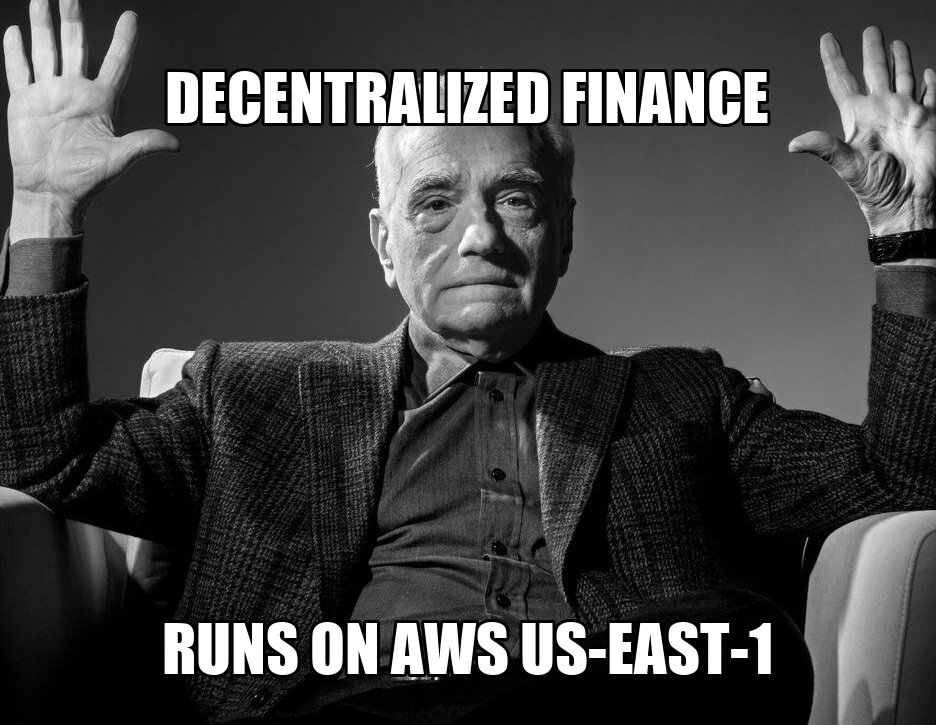
@brian_armstrong wild that "we experienced an outage" from the coinbase ceo is followed by "room overheating in aws". the decentralized future runs on one data center in virginia lol
English
@theliverdoc @theliverdoc thank you doing this but when I looked up the benefit of Rosehip, even Google AI talks about benefits to RA and joint inflammation. How can a ordinary person verify the medication?
English
Name that Orthopedician. Supposed "doctors" like them should be dragged out into the light so that they dont do this sort of dangerously expensive nonsense ever again.
If this is what Orthopedics department at AIIMS Delhi is upto these days, then it is better to consult a more academically oriented doctor at a private hospital.
Right at the bottom of this herbal and dietary supplement it is clearly written - not for medicinal use.
Zero evidence that this combination works for anything in Orthopedic practice, but ample evidence that Curcuma longa in it, in the high dose present, can cause liver injury.
michiganmedicine.org/health-lab/15-…
Very triggering to see academic institutions spiral into INTEGRATED unscientific treatments. Is prescribing herbal supplements your doctors new modus operandi @aiims_newdelhi ? Did your Orthopedician discuss with the patient regarding possibility of liver injury with this product before prescribing?
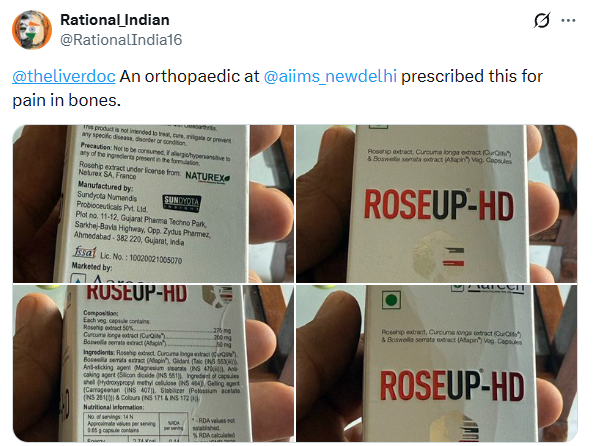
Rational_Indian@RationalIndia16
@theliverdoc An orthopaedic at @aiims_newdelhi prescribed this for pain in bones.
English
Ashwath Shankar retweetledi

Hello. How are you? Thank you. I love you. Please.
Some of the most frequently translated phrases of the past 20 years!
Google Translate began twenty years ago with a mission to help people understand one another, regardless of the language they speak. What started as a small experiment has become a global tool that helps over 1 billion users every month.
In that time Translate has evolved from simple pattern matching to true understanding. In 2006, it relied on statistical machine learning to look for patterns in small word clusters. By 2016, we pioneered a shift to neural networks to move beyond literal word-for-word translations, and today we’re using our powerful Gemini models to make Translate even more helpful.
We are moving from text to fluid, real-time conversations. With our latest models, you can even use your headphones as a personal interpreter that preserves your original tone and cadence - it’s an amazing experience!
One of the interesting things about AI is that as we make progress, we begin to take it for granted. If you met a person who could translate across a hundred languages faster than any human can, you would be so impressed. Today, one product does that for nearly 250 languages, and we kind of just shrug.
Being able to say thank you in 250 languages is not something I take for granted. So to the 1 billion who use Google Translate - merci, dhanyavaad, arigatō, gracias, and thank you! Let’s see what the next 20 years will bring.
GIF
English
Ashwath Shankar retweetledi

₹8,181 crore. 22 years. And India became only the second country after Russia to pull this off.
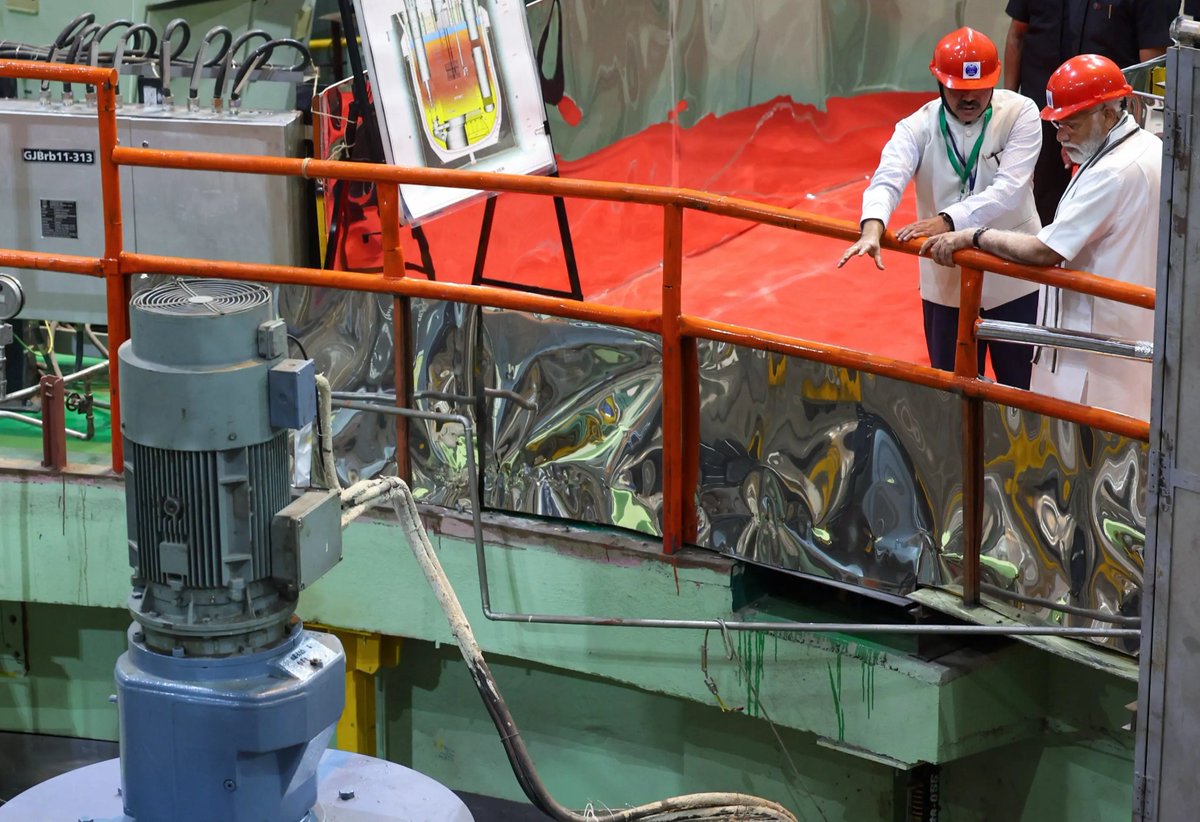
India's Fast Breeder Reactor went critical 3 days ago.
You've read the headline.
But almost nobody understands What made this reactor SO INSANELY HARD TO BUILD.
Here are 3 Engineering challenges that needed to be solved AND the 3 listed small-cap companies that solved them.
3 ENGINEEERING CHALLENGES:
1. Extremely high temperature,
2. Fuel structure development
3. Mastering sodium technology.
But first, why sodium? Why not just use heavy water like India's PHWR - Pressurised Heavy Water Reactors.
Because heavy water would kill the reactor's entire purpose. Heavy water is a moderator. It slows neutrons down.
A fast breeder needs fast neutrons to convert uranium-238 into plutonium-239.
Slow the neutrons and you kill the breeding. No breeding, no point.
Sodium let's the neutrons stay fast. That's the non-negotiable reason.
But sodium also happens to be a freakishly good coolant + Thermal conductor.
Thermal conductivity? 100x better than water.
Boiling point: 883°C, so at 550°C it stays liquid at atmospheric pressure.
No need for the 150+ atmospheres of pressurisation that water reactors require.
That means thinner vessel walls, no risk of pressure-rupture accidents, and a more compact core.
The trade-off? Sodium catches fire in air, explodes in water, and becomes radioactive inside the reactor.
You can't see through it. You can't inspect anything visually.
Every component must be perfect before it goes in, because YOU CANNOT open it up afterwards.
Now we got the basics, here are the 3 Engineering challenges + 3 Companies that solved them.
🔹 Challenge 1:
High Temperature → Kirloskar Brothers (KBL)
A conventional PHWR operates at around 300°C. The PFBR runs liquid sodium at 550°C. That 250-degree gap changes everything.
At 550°C, metals creep. They slowly deform under sustained stress. Welds weaken over time. Seals degrade.
Thermal expansion is massive, so every component must be designed with expansion tolerances that still maintain a perfect seal against sodium.
KBL built all the Primary and Secondary Sodium Pumps for the PFBR at their Kirloskarvadi plant.
Three primary pumps, 135 tonnes each, with an 11-metre long shaft submerged in liquid sodium.
That shaft expands and contracts with every temperature cycle.
The secondary pumps use hydrodynamic bearings running in sodium itself, no conventional lubrication possible.
Both pump types must be essentially maintenance-free.
You cannot open up equipment sitting inside a pool of liquid sodium at 550°C. Once installed, these pumps must run for years without human hands touching them.
Dr. Prabhat Kumar, former CMD of BHAVINI (the man who ran the entire PFBR project), wrote that "it took knowledge, skills and courage by the KBL team to accept the order for these pumps."
When the project head says it took courage to even accept the contract, you understand the engineering risk involved.
Market cap ~₹12,000 crore. KBL is the only Indian company that has built sodium pumps for a nuclear reactor. No second vendor exists.
🔹 Challenge 2:
Fuel Structure → MTAR Technologies
Fast neutrons inside a breeder reactor bombard the fuel cladding and wrapper materials at intensities far beyond what a PHWR experiences.
This causes "void swelling," where the metal literally puffs up at an atomic level.
Over time, fuel pins swell unevenly. Fuel sub-assemblies bow and distort.
Extracting a swollen, bowed fuel assembly (think rod) from a reactor core filled with opaque liquid sodium is one of the hardest precision engineering problems in nuclear technology.
MTAR manufactured the Inclined Fuel Transfer Machine (IFTM) and reactor top control plug for the PFBR.
The former BHAVINI CMD confirmed this directly.
And this is exactly where the PFBR's worst commissioning failure occurred.
The IFTM's transfer pot couldn't be lowered fully into the reactor during trials. Because sodium is completely opaque, engineers couldn't see what was wrong.
They had to develop ultrasonic imaging tools just to diagnose the problem.
This single issue delayed core loading by roughly two years.
IGCAR and BHAVINI eventually designed an alternate fuel handling scheme and fabricated new components in a 4-5 month sprint.
But the lesson is clear: fuel handling in a sodium environment demands micron-level precision in conditions where you're operating completely blind.
MTAR's market cap is ~₹8,500 crore. Nuclear was only 14% of FY25 revenue. But their order book hit ₹2,395 crore by December 2025, with the Kaiga order alone at ₹500 crore+.
The FBR-600 reactors will each need fuel transfer machines and control plugs. MTAR built the only ones India has ever made.
🔹 Challenge 3:
Mastering Sodium → Walchandnagar Industries (WIL)
Sodium is the best and worst coolant for a fast reactor at the same time.
Best: it doesn't slow down neutrons (essential for breeding), transfers heat brilliantly, and operates at atmospheric pressure (so vessel walls can be thinner and you eliminate high-pressure rupture risk).
Worst: it's opaque (no visual inspection possible), catches fire on contact with air, explodes on contact with water, and becomes radioactive (Na-24, 15-hour half-life) inside the primary circuit.
The PFBR holds 1,950 metric tonnes of this stuff.
The former BHAVINI CMD confirmed that WIL manufactured the large sodium-to-sodium and sodium-to-air heat exchangers.
These are the components where sodium mastery matters most.
The sodium-to-sodium heat exchangers (called Intermediate Heat Exchangers) sit between the radioactive primary circuit and the clean secondary circuit.
One leak and you contaminate the entire secondary loop with radioactive sodium.
The sodium-to-air heat exchangers are the decay heat removal system: the reactor's absolute last line of safety when everything else fails.
WIL also handled the sodium piping scope. Every weld, every joint, every bend in a sodium pipe must be perfectly leak-proof.
Not "industrial standard" leak-proof. Nuclear-grade, zero-tolerance leak-proof. Because a micro-crack in a sodium pipe gives you a fire, not a drip.
BHAVINI noted that the project handled 1,950 tonnes of sodium "without spilling a single drop."
WIL's fabrication quality is a big part of why that record held.
Market cap under ₹1,700 crore. Four decades of working with the Department of Atomic Energy. Class-I nuclear qualification from NPCIL, BARC, and BHAVINI.
For a company this small, the FBR-600 programme (six reactors, each needing heat exchangers and sodium piping larger than the PFBR prototype) could be transformative.
⚠️ Risks you can't ignore
📌 FBR-600 hasn't received financial sanction yet. DAE says it comes after one year of successful PFBR operation. That's 2027 at the earliest. Until then, this is optionality, not revenue.
📌 Sodium reactor technology has a brutal global track record.
Japan's Monju had a sodium leak in 1995 and never recovered. France's Superphénix was shut permanently. Russia's BN-800 is the only commercial fast breeder operating today.
India is betting it can be the second. If the PFBR hits serious problems during power ramp-up, the commercial FBR programme could stall for years.
📌 Valuations already reflect optimism. MTAR trades at roughly 180x FY25 earnings.
WIL has yet to run up on the nuclear narrative.
KBL is more reasonably priced but nuclear is still a tiny fraction of total pump revenue.
📌 BHAVINI is the sole buyer for FBR components. One budget cut, one priority shift at DAE, and these order pipelines disappear.
So that was it folks.
Three technical challenges. Three companies that solved them. Three qualification moats that took decades to build and can't be replicated quickly.
The real question isn't whether these companies are capable. They've already proved that.
The question is whether the PFBR works at full power over the next 12 months, because that's the trigger for everything that comes after.
Share with friends if you found this useful.
English

This is either brilliant or scary:
Anthropic accidentally leaked the TS source code of Claude Code (which is closed source). Repos sharing the source are taken down with DMCA.
BUT this repo rewrote the code using Python, and so it violates no copyright & cannot be taken down!

English
Ashwath Shankar retweetledi

My dear front-end developers (and anyone who’s interested in the future of interfaces):
I have crawled through depths of hell to bring you, for the foreseeable years, one of the more important foundational pieces of UI engineering (if not in implementation then certainly at least in concept):
Fast, accurate and comprehensive userland text measurement algorithm in pure TypeScript, usable for laying out entire web pages without CSS, bypassing DOM measurements and reflow
English
@Mavericks100xs @bryan_johnson And humans will do the same to the next planet. Stop trying to escape, time to become conscious
English

The problem with the world, my friend, is that human beings fail to understand we're all in it together: we're on a ball of rock floating through space.
And we don't know how much time we have left.
Time is ticking, and humanity may disappear forever if we don't try to reach for the stars now.
We must leave this planet and expand into the cosmos.
NOW.
GIF
English

First, fuck off.
Ok, now we’re locked in, I sincerely wish you all the best. The world is brutal. Uncaring, wanting its own at your expense and indifferent to your losses. Leaving no safe haven for reprieve and rejuvenation. Yet the want to interdigitate and be fiercely loyal to each other persists beneath the wreckage. It’s how we are built and what we are built for. Society has strip-mined our togetherness by chopping up our bonds with endless insult.
We do best with shared purpose and a common enemy. We are the stewards of intelligent life. Our moral duty is to tend its continuation. Not as martyrs, but as stalwarts. Our enemy is that which makes you smaller.
Count me as your ally.
English
@karpathy SRE still applies, Oauth is not on AI infrastructure it is a regular service on existing software systems.
English

My autoresearch labs got wiped out in the oauth outage. Have to think through failovers. Intelligence brownouts will be interesting - the planet losing IQ points when frontier AI stutters.
English
Ashwath Shankar retweetledi

NDIS EXPOSED: Massive 52 minute investigation with @PeteZogoulas into Australia's immense disability fraud crisis.
This is Minnesota on a national scale. The NDIS budget - now approaching $50 billion a year - is closing in on Australia's entire military budget, and there is so much fraud in the system that the official government regulator told the Australian Senate there are not enough judges in Australia to try all known cases of fraud. The entire Australian legal system would collapse if they tried.
Up to 99% of alleged NDIS fraud goes unprosecuted. Out of over 7,000 tip-offs alleging fraud in the March quarter of 2025, just 16 cases (0.22%) were prosecuted.
So alleged scammers don't even bother to hide abuse.
To give you just one example: we visited a West Sydney NDIS provider operating out of the exact same address as a previous NDIS business the Australian government shut down for fraud four months ago. They were using the same accountant and THE EXACT SAME PHONE NUMBERS!
When we confronted them on camera, the owners physically assaulted us, smashed $800 worth of @PeteZogoulas's equipment, and staff screamed "RETARD" at us.
These people work in disability care.
Very legitimate and professional disability service business.
Watch the whole thing now. This is just the tip of the iceberg.
English

“My husband just finished this paint job and he made me promise to share it because the people he showed it to ignored him or brushed it off.
Here's why this matters. Seven years of severe depression where I watched the man I married disappear completely. Couldn't get out of bed most days, lost his job, stopped talking to our kids. Last year his therapist said find something to work with your hands, so he bought this beat up 1967 Beetle with money his dad left him and I thought he'd wasted it on junk.
But he started working on it every single day in our garage. Some days all he did was sand one panel, but he kept showing up. And slowly he started coming back to us. Started smiling again. This paint job took three months. He learned from tutorials and some car groups who actually encouraged him, bought his custom paint from a maker in a shop who spent an hour teaching him technique over the phone.
When he showed his friends and family, they left him on read. Just didn't respond at all. So he asked me to post it here because maybe strangers would understand what this actually means better than people who've known him forever.
This car saved my husband's life. It's proof that broken things can be beautiful again if you just keep working. And the man I married is finally back.”
Credit: Nice Pets/fb

English

Patterns for Building AI Agents Book for FREE!
- Comment AI Agents to get your FREE copy.

English
@EABlair2021 @calcsam Don't know the sequence of books but the last book was "Principles of Building AI Agents"
English


icymi we wrote a new agents book: patterns for building ai agents
it has everything you need to take your agents from prototype to production, like agent design patterns, the basics of security, etc
reply to this tweet with BOOK and we'll dm you so you can get a copy

English
@calcsam Book. I recently ordered Principles of Building AI Agents
English
@GergelyOrosz Blind is a place to vent? Nothing in there can be trusted then
English
Blind (and much of mainstream media!): the AWS outage is the result of “mass layoffs, outsourced talent.”
Me: talks to the AWS engineers handling the incident. Turns out the creators of the systems impacted were in the call (not laid off!), no outsourcing etc
Will share more
Blind@JoinBlind
A massive AWS outage broke the internet this morning — taking down everything from Fortnite and Snapchat to Starbucks mobile orders and Ring cameras. On Blind, engineers say the crash was a long time coming — the result of mass layoffs, outsourced talent, and poor leadership. “If you constantly fire people who make mistakes, you’re just left with people who haven’t learned anything and are waiting for their turn to screw up.” — Verified Amazon Employee “Constant layoffs have consequences.” — Verified Zapier Employee Was this just bad timing — or the inevitable result of years of cost-cutting and leadership decay? Share your thoughts below. Read the full story on Blind
English
My pleasure to come on Dwarkesh last week, I thought the questions and conversation were really good.
I re-watched the pod just now too. First of all, yes I know, and I'm sorry that I speak so fast :). It's to my detriment because sometimes my speaking thread out-executes my thinking thread, so I think I botched a few explanations due to that, and sometimes I was also nervous that I'm going too much on a tangent or too deep into something relatively spurious. Anyway, a few notes/pointers:
AGI timelines. My comments on AGI timelines looks to be the most trending part of the early response. This is the "decade of agents" is a reference to this earlier tweet x.com/karpathy/statu… Basically my AI timelines are about 5-10X pessimistic w.r.t. what you'll find in your neighborhood SF AI house party or on your twitter timeline, but still quite optimistic w.r.t. a rising tide of AI deniers and skeptics. The apparent conflict is not: imo we simultaneously 1) saw a huge amount of progress in recent years with LLMs while 2) there is still a lot of work remaining (grunt work, integration work, sensors and actuators to the physical world, societal work, safety and security work (jailbreaks, poisoning, etc.)) and also research to get done before we have an entity that you'd prefer to hire over a person for an arbitrary job in the world. I think that overall, 10 years should otherwise be a very bullish timeline for AGI, it's only in contrast to present hype that it doesn't feel that way.
Animals vs Ghosts. My earlier writeup on Sutton's podcast x.com/karpathy/statu… . I am suspicious that there is a single simple algorithm you can let loose on the world and it learns everything from scratch. If someone builds such a thing, I will be wrong and it will be the most incredible breakthrough in AI. In my mind, animals are not an example of this at all - they are prepackaged with a ton of intelligence by evolution and the learning they do is quite minimal overall (example: Zebra at birth). Putting our engineering hats on, we're not going to redo evolution. But with LLMs we have stumbled by an alternative approach to "prepackage" a ton of intelligence in a neural network - not by evolution, but by predicting the next token over the internet. This approach leads to a different kind of entity in the intelligence space. Distinct from animals, more like ghosts or spirits. But we can (and should) make them more animal like over time and in some ways that's what a lot of frontier work is about.
On RL. I've critiqued RL a few times already, e.g. x.com/karpathy/statu… . First, you're "sucking supervision through a straw", so I think the signal/flop is very bad. RL is also very noisy because a completion might have lots of errors that might get encourages (if you happen to stumble to the right answer), and conversely brilliant insight tokens that might get discouraged (if you happen to screw up later). Process supervision and LLM judges have issues too. I think we'll see alternative learning paradigms. I am long "agentic interaction" but short "reinforcement learning" x.com/karpathy/statu…. I've seen a number of papers pop up recently that are imo barking up the right tree along the lines of what I called "system prompt learning" x.com/karpathy/statu… , but I think there is also a gap between ideas on arxiv and actual, at scale implementation at an LLM frontier lab that works in a general way. I am overall quite optimistic that we'll see good progress on this dimension of remaining work quite soon, and e.g. I'd even say ChatGPT memory and so on are primordial deployed examples of new learning paradigms.
Cognitive core. My earlier post on "cognitive core": x.com/karpathy/statu… , the idea of stripping down LLMs, of making it harder for them to memorize, or actively stripping away their memory, to make them better at generalization. Otherwise they lean too hard on what they've memorized. Humans can't memorize so easily, which now looks more like a feature than a bug by contrast. Maybe the inability to memorize is a kind of regularization. Also my post from a while back on how the trend in model size is "backwards" and why "the models have to first get larger before they can get smaller" x.com/karpathy/statu…
Time travel to Yann LeCun 1989. This is the post that I did a very hasty/bad job of describing on the pod: x.com/karpathy/statu… . Basically - how much could you improve Yann LeCun's results with the knowledge of 33 years of algorithmic progress? How constrained were the results by each of algorithms, data, and compute? Case study there of.
nanochat. My end-to-end implementation of the ChatGPT training/inference pipeline (the bare essentials) x.com/karpathy/statu…
On LLM agents. My critique of the industry is more in overshooting the tooling w.r.t. present capability. I live in what I view as an intermediate world where I want to collaborate with LLMs and where our pros/cons are matched up. The industry lives in a future where fully autonomous entities collaborate in parallel to write all the code and humans are useless. For example, I don't want an Agent that goes off for 20 minutes and comes back with 1,000 lines of code. I certainly don't feel ready to supervise a team of 10 of them. I'd like to go in chunks that I can keep in my head, where an LLM explains the code that it is writing. I'd like it to prove to me that what it did is correct, I want it to pull the API docs and show me that it used things correctly. I want it to make fewer assumptions and ask/collaborate with me when not sure about something. I want to learn along the way and become better as a programmer, not just get served mountains of code that I'm told works. I just think the tools should be more realistic w.r.t. their capability and how they fit into the industry today, and I fear that if this isn't done well we might end up with mountains of slop accumulating across software, and an increase in vulnerabilities, security breaches and etc. x.com/karpathy/statu…
Job automation. How the radiologists are doing great x.com/karpathy/statu… and what jobs are more susceptible to automation and why.
Physics. Children should learn physics in early education not because they go on to do physics, but because it is the subject that best boots up a brain. Physicists are the intellectual embryonic stem cell x.com/karpathy/statu… I have a longer post that has been half-written in my drafts for ~year, which I hope to finish soon.
Thanks again Dwarkesh for having me over!
Dwarkesh Patel@dwarkesh_sp
The @karpathy interview 0:00:00 – AGI is still a decade away 0:30:33 – LLM cognitive deficits 0:40:53 – RL is terrible 0:50:26 – How do humans learn? 1:07:13 – AGI will blend into 2% GDP growth 1:18:24 – ASI 1:33:38 – Evolution of intelligence & culture 1:43:43 - Why self driving took so long 1:57:08 - Future of education Look up Dwarkesh Podcast on YouTube, Apple Podcasts, Spotify, etc. Enjoy!
English

i just trained an AI on every alex hormozi book, playbook, blackbook, and podcast episode...
he charges $5000 for his AI assistant and people pay it, i'm giving you the same thing for free
this isn't some shitty GPT with 3 pages of info that hallucinates answers, NotebookLM is the best AI for consuming and recalling information right now, i fed it EVERYTHING:
- $100M offers, leads, money models
- the black books (given to people who donated 200 books)
- all the playbooks and lost chapters
- his best podcast breakdowns and frameworks
the information inside is worth thousands it can answer ANY business problem using hormozi's exact frameworks
it pulls from the exact books and gives you page-specific answers... no generic advice, no made-up bullshit
i should NEVER be sharing this for free, that's why i'll delete this in 24hrs
reply 'HORMOZI' + RT and i'll give you access for free (must follow me so i can dm)
English
@elonmusk Don't question deeply, pay attention and meditate intensely
English

@karpathy I am copy pasting always... It's got verbose and gives you too many options making option 1 as recommended and 5 more additional options
English
I'm noticing that due to (I think?) a lot of benchmarkmaxxing on long horizon tasks, LLMs are becoming a little too agentic by default, a little beyond my average use case.
For example in coding, the models now tend to reason for a fairly long time, they have an inclination to start listing and grepping files all across the entire repo, they do repeated web searchers, they over-analyze and over-think little rare edge cases even in code that is knowingly incomplete and under active development, and often come back ~minutes later even for simple queries.
This might make sense for long-running tasks but it's less of a good fit for more "in the loop" iterated development that I still do a lot of, or if I'm just looking for a quick spot check before running a script, just in case I got some indexing wrong or made some dumb error. So I find myself quite often stopping the LLMs with variations of "Stop, you're way overthinking this. Look at only this single file. Do not use any tools. Do not over-engineer", etc.
Basically as the default starts to slowly creep into the "ultrathink" super agentic mode, I feel a need for the reverse, and more generally good ways to indicate or communicate intent / stakes, from "just have a quick look" all the way to "go off for 30 minutes, come back when absolutely certain".
English