Antonio Rodriguez

141 posts

Antonio Rodriguez banner
Antonio Rodriguez

Antonio Rodriguez

@4ntonioR

associate professor of economics @UCIrvine | international trade, labor markets, and some macro | 🇲🇽

Irvine, CA Katılım Kasım 2018
171 Takip Edilen700 Takipçiler
Sabitlenmiş Tweet
Antonio Rodriguez
Antonio Rodriguez@4ntonioR·
What do diff-in-diff event-study designs really tell us about the employment effects of min wages? My new paper with @NeumarkEcon tackles this using the stacked design of Cengiz-@arindube-@attilalindner-@benzipperer and the related LP-DiD design in Dube-Lindner’s HLE chapter. 🧵
Antonio Rodriguez tweet media
English
11
123
501
237.3K
Antonio Rodriguez
Antonio Rodriguez@4ntonioR·
“Hoy estamos en el sitio 14 con una trayectoria en ascenso brutal.” Este neposeñor sería un gran comediante, si la realidad no fuera tan trágica.
José Ramón López Beltrán@_JRLB_

El banco de inversión @GoldmanSachs proyecta que para 2075 México será la DÉCIMA potencia económica mundial, superando a Reino Unido, Japón, Francia, Canadá e Italia. Hoy estamos en el sitio 14 con una trayectoria en ascenso brutal. ¿Qué cambió? La política económica. La economía moral de la Cuarta Transformación sigue demostrando que combatiendo la corrupción, aumentando el salario mínimo, fortaleciendo el mercado interno y poniendo en primer lugar a la gente humilde y a la gente pobre no frena el crecimiento: lo impulsa. Lo que inició Andrés Manuel López Obrador hoy lo consolida la presidenta Claudia Sheinbaum: Récord de inversión extranjera, un SuperHiperMegaPeso fuerte, el desempleo en mínimos históricos y millones de mexicanos saliendo de la pobreza. El futuro de México no se decreta desde Nueva York, pero desde ahí ya lo reconocen. 🇲🇽📈🚀🌎🌍🌏😎. #Economía #México #4T @lopezobrador_ @Claudiashein.

Español
1
0
2
447
Fabio Ghironi
Fabio Ghironi@FabioGhironi·
Round 16! 💪❤️😁
Fabio Ghironi tweet media
English
19
0
108
4.2K
Antonio Rodriguez
Antonio Rodriguez@4ntonioR·
Muy buena reflexión. De lo mejor que he leído acerca de las recientes controversias en el mundial.
José Antonio Meade🇲🇽@JoseAMeadeK

Dos jugadas de este Mundial me dejaron pensando en algo que trasciende el resultado: cuánto tensiona el reglamento del fútbol principios que, fuera de la cancha, damos por intocables. La primera fue la anulación de un gol de Egipto ante Argentina. El VAR se retrotrajo a una falta cometida en el origen de la jugada, varios segundos y muchos metros antes de la definición, para borrar el tanto. En este caso la decisión pudo ser correcta: el contacto existió. Pero el principio que la habilita inquieta. Si un gol, el hecho más definitivo del juego, el que hace estallar un estadio y un país, puede deshacerse retrocediendo a una fase previa cuya frontera es interpretativa, entonces ningún gol es del todo firme hasta que alguien, desde una cabina, decide hasta dónde mirar hacia atrás. La certeza, ese bien que en el derecho protegemos como sagrado, queda supeditada a una apreciación elástica sobre dónde empieza una jugada. Hay un viejo aforismo jurídico que parece darle la razón al videoarbitraje: causa causae est causa causati, la causa de la causa es causa de lo causado. Si la falta originó la jugada, y la jugada terminó en gol, ¿no es la falta, al final, causa del gol? Suena impecable, pero tiene trampa. El propio derecho que acuñó la máxima aprendió pronto a ponerle freno: sin límites, todo termina siendo causa de todo, y habría que sentar en el banquillo también a quien fabricó el arma, y al que le vendió el acero. Por eso la doctrina se queda en la causa próxima y no persigue la cadena hacia atrás hasta el infinito; el aforismo se agota en una o dos iteraciones, no en varias jugadas y muchos metros de distancia. El VAR, en este caso, sí la persiguió. Retrocedió pases y metros como si el hilo causal no tuviera que cortarse nunca. Toma el aforismo, pero se olvida de su límite. La segunda es más antigua, pero igual de incómoda: la sanción que trasciende al infractor. Una expulsión que no solo se paga en el partido donde se comete la falta, sino en el siguiente. Y como el fútbol es una empresa colectiva, el castigo, formalmente individual, lo termina cumpliendo todo un equipo, una afición, casi un país. En 1998, Zidane fue expulsado en la fase de grupos y su ausencia dejó a Francia al borde de la eliminación ante Paraguay, salvada apenas por un gol de oro. La falta fue de uno; el precio estuvo a punto de pagarlo una nación entera. Conviene recordar que esta norma no es de derecho divino. Las tarjetas nacieron apenas en 1970, y la propia FIFA acaba de reformar en 2026 el castigo por acumulación, precisamente para que los seleccionados no se pierdan partidos decisivos. Es decir: la institución ya admitió que el diseño podía ser injusto. Solo que la reforma se quedó a medias, porque atacó la acumulación de amarillas pero dejó intacta la raíz: que una pena recaiga sobre quienes no cometieron la falta. Naturalmente no pido un fútbol sin reglas ni sin tecnología. Pido, apenas, que reparemos en la paradoja. En el torneo que más se acerca a lo que Shankly llamaba, con ironía, algo más importante que la vida y la muerte, dos de sus normas: la falta de certeza del gol por actos futbolísticamente lejanos y la pena que trasciende al infractor, chocan de frente con nociones de justicia que en cualquier otro ámbito nos parecerían inaceptables. El fútbol se toma licencias que el derecho no se tomaría. Vale la pena, al menos, pensarlas.

Español
0
0
2
437
Antonio Rodriguez
Antonio Rodriguez@4ntonioR·
differences due to updates in the QCEW total employment series. CIs are wider in the bottom plots, as ensuring non-overlapping events with 40-quarter windows reduces the number of events to 54 (from 138), hence losing precision.
English
0
0
5
781
Antonio Rodriguez
Antonio Rodriguez@4ntonioR·
An important omission on my part, @jondr44. The attached figure shows in panel (d) the log emp path with the extended pre-period without overlapping events. In the end, I think this is the one to focus on. The top plots correspond to yours, with small... x.com/jondr44/status…
Antonio Rodriguez tweet media
Jonathan Roth@jondr44

We can learn a little more by adding additional preperiods, as below. (Note that this changes the sample a little since the stacked event-study is balanced.) Here the pre-trend in population becomes much more apparent. 10/

English
1
1
26
9K
Antonio Rodriguez
Antonio Rodriguez@4ntonioR·
The pre-trend Jon shows in his thread when extending the pre-period is due to the overlap in CDLZ’s events. Once you avoid this problem, the clear pre-trend disappears. Jon’s figure is panel (b), but the reliable one is panel (d).
Antonio Rodriguez tweet media
Jonathan Roth@jondr44

A few thoughts on this interesting new minimum wage paper by @NeumarkEcon and @4ntonioR renalyzing the QJE paper by @arindube-@attilalindner-@benzipperer, which relates to one of my favorite topics: event-studies and parallel trends! 1/

English
3
4
72
14.3K
Antonio Rodriguez retweetledi
Jack Salmon
Jack Salmon@_JackSalmon_·
Minimum wage research has shifted from “do wage floors reduce jobs?” to “which empirical choices make the answer disappear?” The recent literature increasingly says: the null results are much more fragile than advertised. 🧵
English
9
42
330
72.3K
Antonio Rodriguez
Antonio Rodriguez@4ntonioR·
Of course, Arin. I look forward to reading your response.
Arin Dube@arindube

@4ntonioR Antonio, let's return to the substance. Words are getting heated, and I take responsibility for my share. We will put out a response and share with you. I think it will hopefully shed light of the points you made, and others can decide.

English
0
0
21
5.7K
Rudi Bachmann
Rudi Bachmann@BachmannRudi·
@PatrickNuess I liked @jondr44 ‘s discussion a lot. And, yes, he problematizes the general practice… and says (like I do) it’s more complicated.
English
1
0
4
621
Rudi Bachmann
Rudi Bachmann@BachmannRudi·
Schlechte Nachrichten für die Berliner Linksbubble. Die SPD-nahen Thinktanks, die “die Wissenschaft zeigt, dass Mindestlöhne keinen Beschäftigungseffekt haben” posaunt haben. Es ist eben, wie immer, komplexer.
Jack Salmon@_JackSalmon_

Minimum wage research has shifted from “do wage floors reduce jobs?” to “which empirical choices make the answer disappear?” The recent literature increasingly says: the null results are much more fragile than advertised. 🧵

Deutsch
7
10
91
17.8K
Antonio Rodriguez
Antonio Rodriguez@4ntonioR·
@jondr44 Got me. We’ve used population on the RHS several times in our other MW papers, but that was before this last paper where we discovered how deep the pop-mw relationship is.
English
2
0
7
2.1K
Jonathan Roth
Jonathan Roth@jondr44·
@4ntonioR I'm not sure I follow your argument. If you think population responds to the MW then isn't it a bad control if you put it on the RHS? Why's that better than putting it on the LHS?
English
1
5
51
7K
Jonathan Roth
Jonathan Roth@jondr44·
A few thoughts on this interesting new minimum wage paper by @NeumarkEcon and @4ntonioR renalyzing the QJE paper by @arindube-@attilalindner-@benzipperer, which relates to one of my favorite topics: event-studies and parallel trends! 1/
Antonio Rodriguez@4ntonioR

What do diff-in-diff event-study designs really tell us about the employment effects of min wages? My new paper with @NeumarkEcon tackles this using the stacked design of Cengiz-@arindube-@attilalindner-@benzipperer and the related LP-DiD design in Dube-Lindner’s HLE chapter. 🧵

English
7
89
440
186.5K
Antonio Rodriguez
Antonio Rodriguez@4ntonioR·
@jondr44 Fair point, Jon. The issue is how much of the LT effect a linear extrapolation of the PT explains. With overlapping events, the pre-slope accounts for most of it. Without, I'd say it explains roughly a third (though of course I'd want a formal HonestDiD test to pin it down 😉)
English
1
0
2
828
Jonathan Roth
Jonathan Roth@jondr44·
@4ntonioR Thanks Antonio! Very interesting. I would still say it's hard to tell from this graph whether there's a break from trend in pop tho, right? As in, you can't reject zero pretrends but you also can't reject it's a straight line.
English
3
0
25
1.8K
Antonio Rodriguez
Antonio Rodriguez@4ntonioR·
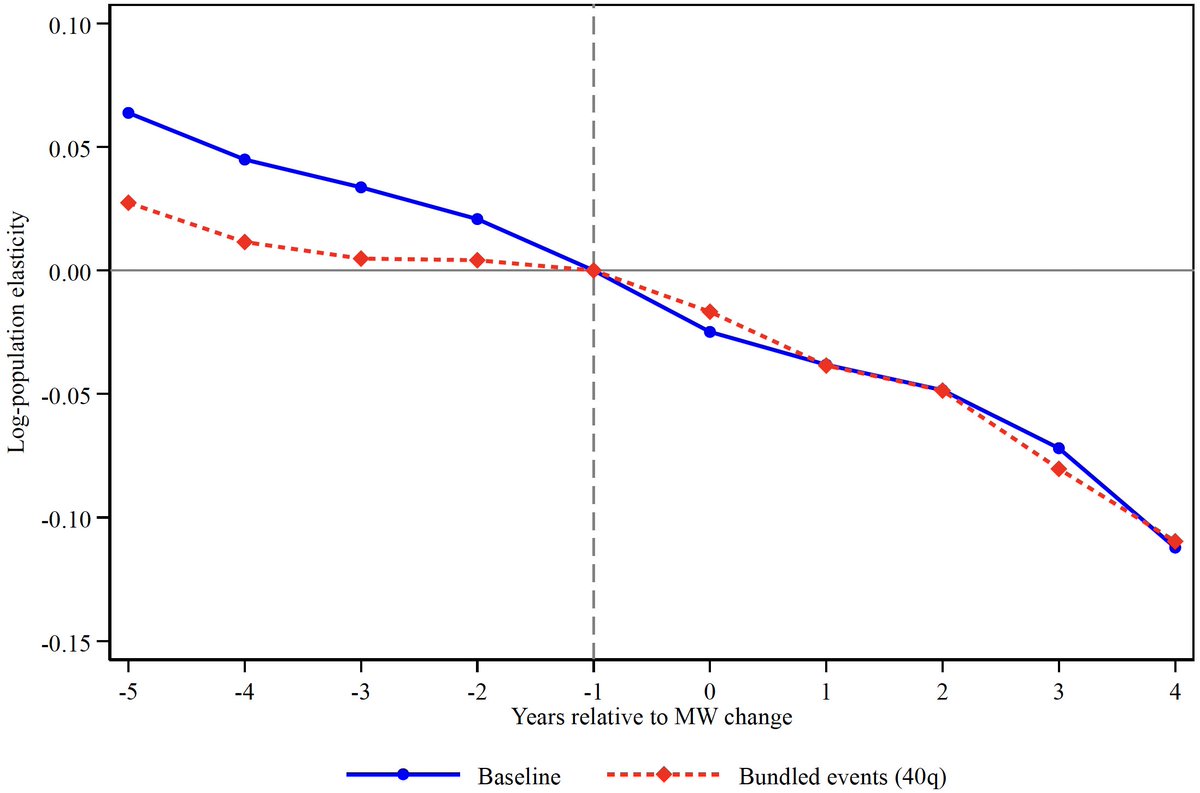
To make this clearer, this figure shows only the “All events” lines from panels (b) and (d). These are the point estimates: t Baseline Bundled −5 +0.063 +0.028 −4 +0.045 +0.012 −3 +0.034 +0.005 −2 +0.021 +0.004 −1 0 0
Antonio Rodriguez tweet media
English
1
1
6
1.1K