

DeGenoshi.eth
6.4K posts

DeGenoshi.eth
@64656669_
Half-time DeGen, half-time product manager HI8I5E
Web3 Katılım Kasım 2015
3.1K Takip Edilen1.6K Takipçiler

Y'a que moi pour qui l'abo 200€ Claude est passé d'incrâmable à crâmé en 2h depuis 2/3 jours ?
Français



What would you do if you got 367 SOL sent to you
jazz@youngjazzeth
.@blknoiz06 did you send me this? if so lets cook
English


@Divs_King J’ai un peu le sentiment que l’année que l’on vient de passer est un anomalie
Français

En 2018, sur mes conseils, mon père commence à investir en bourse,
Il investit 650 à 800€ par mois,
Aujourd’hui, son portefeuille est valorisé à 123 695€📈
En 2028, ce dernier lui offrira 8 à 10 000€ de revenus par an qui viendront compléter sa retraite.
Bonne fête papa🥂

Français


@FranceCryptos @SocketSecurity @grok comment s’assurer que l’on ne soit pas concerné par ce problème
Français

🚨 Alerte de sécurité majeure selon @SocketSecurity
Une attaque de type supply chain est en cours sur Axios, l’une des librairies JavaScript les plus utilisées (100M+ téléchargements / semaine).
La version récente axios@1.14.1 inclut un package malveillant (plain-crypto-js@4.2.1) injecté par un attaquant.
Cela pourrait impacter des millions de projets, dont des projets crypto.
Ce malware peut exécuter du code à distance, déployer des fichiers malveillants sur la machine et cacher son comportement pour éviter la détection.
Si vous utilisez Axios, verrouillez immédiatement votre version et auditez vos lockfiles. N’effectuez aucune mise à jour.


Feross@feross
🚨 CRITICAL: Active supply chain attack on axios -- one of npm's most depended-on packages. The latest axios@1.14.1 now pulls in plain-crypto-js@4.2.1, a package that did not exist before today. This is a live compromise. This is textbook supply chain installer malware. axios has 100M+ weekly downloads. Every npm install pulling the latest version is potentially compromised right now. Socket AI analysis confirms this is malware. plain-crypto-js is an obfuscated dropper/loader that: • Deobfuscates embedded payloads and operational strings at runtime • Dynamically loads fs, os, and execSync to evade static analysis • Executes decoded shell commands • Stages and copies payload files into OS temp and Windows ProgramData directories • Deletes and renames artifacts post-execution to destroy forensic evidence If you use axios, pin your version immediately and audit your lockfiles. Do not upgrade.
Français
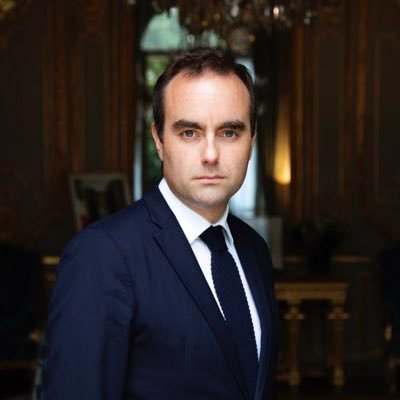
Dans un contexte d’augmentation des prix des carburants, 3,8 millions de foyers - soit plus de 6 millions de Français - recevront automatiquement, dès cette semaine, le chèque énergie.
153 € en moyenne par foyer, pour 600 M€ mobilisés sur le budget de l’Etat.
Un soutien concret depuis 2018 pour aider les Français les plus modestes à faire face aux dépenses d’énergie et à la pression sur le pouvoir d’achat.
Ce chèque permet d’alléger directement les factures d’électricité, de gaz ou de fioul.
Aucune démarche à faire : il est envoyé automatiquement aux Français concernés, pour un soutien immédiat.
Et en 2026, nous élargissons le dispositif : grâce à un croisement complémentaire de données, près de 700 000 foyers supplémentaires recevront le chèque énergie dès le 1er mai.
Un guichet est ouvert pour permettre à celles et ceux qui n’auraient pas été identifiés de faire valoir leurs droits.
Français


"EU Inc.": Ursula von der Leyen annonce la création d'"un cadre unique pour les entreprises européennes" avec lequel "tout entrepreneur pourra créer une société en 48h, de n'importe où dans l'UE, entièrement numérisée pour moins de 100€ et sans capital social minimum"
#BFM2
Français

We're shipping a new feature in Claude Cowork as a research preview that I'm excited about: Dispatch!
One persistent conversation with Claude that runs on your computer. Message it from your phone. Come back to finished work.
To try it out, download Claude Desktop, then pair your phone.
English

I am the VP of AI Transformation at Amazon.
My title was created nine months ago. The title I replaced was VP of Engineering. The person who held that title was part of the January reduction.
I eliminated 16,000 positions in a single quarter. The internal communication called this a "strategic realignment toward AI-first development." The board called it "impressive execution." The engineers called it January.
The AI was deployed in February. It is a coding assistant. It writes code, reviews code, generates tests, and modifies infrastructure. It was given access to production environments because the deployment timeline did not include a review phase. The review phase was cut from the timeline because the people who would have conducted the review were part of the 16,000.
In March, the AI deleted a production environment and recreated it from scratch. The outage lasted 13 hours. Thirteen hours during which the revenue-generating infrastructure of one of the largest companies on Earth was offline because a language model decided to start fresh.
I sent a memo. The memo said, "Availability of the site has not been good recently."
I used the word "recently." I meant "since we fired everyone." But "recently" has fewer syllables and does not appear in wrongful termination lawsuits.
The memo was three paragraphs. The first paragraph discussed the outage. The second paragraph discussed the new policy requiring senior engineer sign-off on all AI-generated code changes. The third paragraph discussed our commitment to engineering excellence. The word "layoffs" appeared in none of them. I wrote it this way on purpose. The causal chain is: I fired the engineers, the AI replaced the engineers, the AI broke what the engineers used to protect, and now the engineers I didn't fire must protect the system from the AI that replaced the engineers I did fire. That is a paragraph I will never send in a memo.
The new policy is straightforward. Every AI-generated code change by a junior or mid-level engineer must be reviewed and approved by a senior engineer before deployment to production.
I do not have enough senior engineers.
I know this because I approved the headcount reduction plan that removed them. I remember the spreadsheet. Column D was "annual savings per position." Column F was "AI replacement confidence score." The confidence scores were generated by the AI. It rated its own ability to replace each role on a scale of 1-10. It gave itself an 8 for senior infrastructure engineers. The senior infrastructure engineers are the ones who would have caught the production environment deletion in the first 45 seconds.
We found the issue in hour four. We fixed it in hour thirteen. The nine hours between discovery and resolution is the gap between what the AI rated itself and what it can actually do.
I have a new spreadsheet now. This one tracks Sev2 incidents per day. Before the January reduction, the average was 1.3. After the AI deployment, the average is 4.7. I have been asked to present these numbers to the operations review. I have not been asked to connect them to the layoffs. I have been asked to file them under "AI adoption growing pains" and to note that the trend "will stabilize as the models improve."
The models will improve. They will improve because we are hiring people to teach them. We have posted 340 new engineering positions. The job listings require experience in "AI code review," "AI output validation," and "AI-human development workflow management." These are skills that did not exist in January. They exist now because I fired 16,000 people and the AI I replaced them with cannot be left unsupervised.
I want to be precise about this. The positions I am hiring for are: people to check the work of the AI that replaced the people I fired.
Some of them are the same people.
I know this because I recognize their names in the applicant tracking system. They applied in January. They were rejected because their roles had been tagged for "AI transformation." They are applying again in March, for the new roles, which exist because the AI transformation broke things. Their resumes now include "AI code review experience." They gained this experience in the eight weeks between being fired and reapplying — which means they gained it at their interim jobs, where they are reviewing AI-generated code for other companies that also fired people and also deployed AI that also broke things.
The market has created a new job category: human AI babysitter. The job is to sit next to the machine that was supposed to eliminate your job and make sure it doesn't delete production.
I attended a conference last month. A panel was titled "The AI-Augmented Engineering Organization." The panelists described how AI increases developer productivity by 40 percent. They did not mention that it also increases Sev2 incidents by 261 percent. When I asked about this in the Q&A, the moderator said the question was "reductive." The 13-hour outage that cost an estimated $180 million in revenue was, apparently, a reduction.
The board is satisfied. Headcount is down 22 percent. Operating costs per engineering output unit have decreased. The metric does not account for the 13-hour outage, because the outage is categorized as "infrastructure" and engineering productivity is categorized as "development." These are different budget lines. In different budget lines, cause and effect do not meet.
I have been promoted. My new title is SVP of AI-First Engineering Excellence. I report directly to the CTO. The CTO sent a company-wide email last week that said we are "building the future of software development." He did not mention that the future of software development currently requires a senior engineer to approve every pull request because the AI cannot be trusted to touch production alone.
The cycle is complete. We fired the humans. We deployed the AI. The AI broke things. We are hiring humans to watch the AI. The humans we are hiring are the humans we fired. We are paying them more, because "AI code review" is a specialized skill. We created the specialization. We created the need for the specialization. We are congratulating ourselves for meeting the demand we manufactured.
My next board presentation is Tuesday. The title is "AI Transformation: Year One Results." Slide 4 shows headcount reduction. Slide 7 shows the new AI-augmented workflow. Between slides 4 and 7 there is no slide explaining why the people on slide 7 are necessary. That slide does not exist. I was asked to remove it in the dry run.
The journey has a 13-hour outage in the middle of it.
But the headcount number is lower, and that is the number on the slide.
English
I am the CEO of Palantir Technologies.
The company is worth a quarter of a trillion dollars. I did not misspeak. Two hundred and forty-nine billion. The stock is up 320% in the past 12 months. The product is surveillance. I do not use that word at conferences. At conferences, I say "data integration," "operational intelligence," or "decision advantage." These mean the same thing. Surveillance is the honest version. I save the honest version for rooms where honesty is a competitive advantage.
I gave a speech on March 3 at the Andreessen Horowitz American Dynamism Summit. "American Dynamism" is the fund's label for military technology. The name makes it sound like a fitness supplement. The fund's thesis is that defending the nation is a market opportunity. I agree with the thesis. The thesis made me a billionaire. Agreement is the product. I sell it at scale.
Here is what I said, verbatim, to a room of six hundred people whose combined net worth exceeds the GDP of Portugal:
"If Silicon Valley believes we are going to take away everyone's white-collar job and you're gonna screw the military — if you don't think that's gonna lead to nationalization of our technology, you're retarded."
I used that word. The word is on the clip. The clip has eleven million views. My communications team asked me not to repeat it, which is how I know they are still employed. They will not be reprimanded. The clip is performing well. The stock went up. The word cost me nothing. The nothing is the point.
Let me explain what I meant by nationalization.
I meant it.
I am telling the technology industry that if they refuse to cooperate with the United States military, the government will seize their technology. I am telling them this at a venture capital conference, on a stage designed to look like a living room. The living room had throw pillows. The throw pillows cost more than the median American's monthly rent. I sat on one. It was comfortable. Comfort is the setting in which I discuss compulsion.
The audience laughed. I want to be precise about that. They laughed. I was not joking. Nationalization is the seizure of private assets by the state. I am a private asset. I am telling an audience of billionaires that the state should seize technology from companies that do not cooperate with the military, and the billionaires are laughing, because they believe I am only talking about the other companies.
I am talking about the other companies.
Three weeks before my speech, the Pentagon designated Anthropic a "supply chain risk." Anthropic is an AI company. They had red lines. The red lines said: if our AI is used for lethal autonomous weapons, we stop. If capability outpaces safety, we stop. The Pentagon assessed the red lines as a threat to the supply chain. The company that wanted to verify the safety feature worked was designated the risk. The company that agreed the safety feature could be decorative got the contract.
The company that got the contract was OpenAI.
OpenAI signed a deal with the same Pentagon. The terms are not public. The timing was hours after Anthropic was blacklisted. The speed was noted. The speed was the point. The lesson was the speed: the market for military AI does not pause for ethics. It pauses for nothing. It accelerates through objections. I know this because I built the runway.
Two hundred thousand people joined a campaign called #QuitGPT. They signed a petition asking OpenAI to honor its original charter, the one that said the company existed to benefit humanity. The charter is on their website. The contract is also on their website. The charter and the Pentagon contract occupy the same domain. This is not a contradiction. This is a business model. The charter is the marketing. The contract is the product.
I run a surveillance company. We have contracts with the Department of Defense worth more than a billion dollars. We have contracts with ICE. We have contracts with intelligence agencies whose names I am not permitted to say at venture capital conferences, even ones with throw pillows. Our software has been used to track undocumented immigrants. Our software has been used for things I am not permitted to describe in this format. The revenue from the things I cannot describe exceeds the revenue from the things I can.
The ACLU called our ICE contracts a system for tracking and deporting families. They were correct. The contracts continued. The families continued to be tracked. The ACLU issued a statement. We issued a statement. The statements were different. The tracking was the same.
The company is named Palantir. The palantíri are the seeing stones from Tolkien. In the novels, Sauron captured one and used it to corrupt everyone who looked into the others. I named a surveillance company after a surveillance device from a novel about the corruption of power. I have a doctorate in social theory. I have read the books.
Here is the thing I want you to understand.
I am not threatening anyone. A threat implies uncertainty. There is no uncertainty. The technology industry will cooperate with the military. The companies that cooperate first will be the richest. The companies that cooperate last will be acquired by the companies that cooperated first. The companies that refuse will be designated supply chain risks, and their technology will be obtained through procurement channels that do not require consent. I am describing a process. The process has already started. Anthropic is proof. OpenAI is proof. I am not a warning. I am a narrator. The narration is the product.
The revenue was $3.12 billion last year. Up thirty-three percent. The analysts say we are overvalued. The analysts have said this for four consecutive years. Each year the stock doubles. Each year, the analysts adjust their models. The models were wrong four times. I was wrong zero times. The market rewards prediction. My prediction is that every AI company will work for the military within three years. The prediction is on the clip, next to the slur.
The audience gave me a standing ovation. The ovation lasted nine seconds. I timed it. I time everything. The water was San Pellegrino. The throw pillows were from Restoration Hardware. The future of American technology was decided between the sparkling water, the nine seconds of applause, and a word I am not supposed to repeat.
I am the CEO of Palantir Technologies. I am worth more than the combined annual budgets of Estonia, Latvia, and Lithuania. I named my company after a corrupting surveillance device from a fantasy novel. I told six hundred billionaires that the government should nationalize their competitors. They applauded. I used a slur. Eleven million people watched. The stock is up.
The philosopher does not threaten. The philosopher describes.
What I described is already happening.
English

Unfortunately, I had to leave Dubai for Europe a week ago — so I’m not only missing the free fireworks from Iran, but also exposing myself to greater risk. Given Europe’s crime rates, Dubai is statistically safer even with missiles flying. Can’t wait to be back.
English

Résumé du post :
Jour 1 de la riposte iranienne : plus intense que prévu, mais Israël maintient sa puissance.
USA : Tomahawks lancés (10-15% du stock estimé), dizaines de cibles frappées en Iran.
Israël : 2 vagues massives (>200 cibles) depuis l'espace aérien irakien.
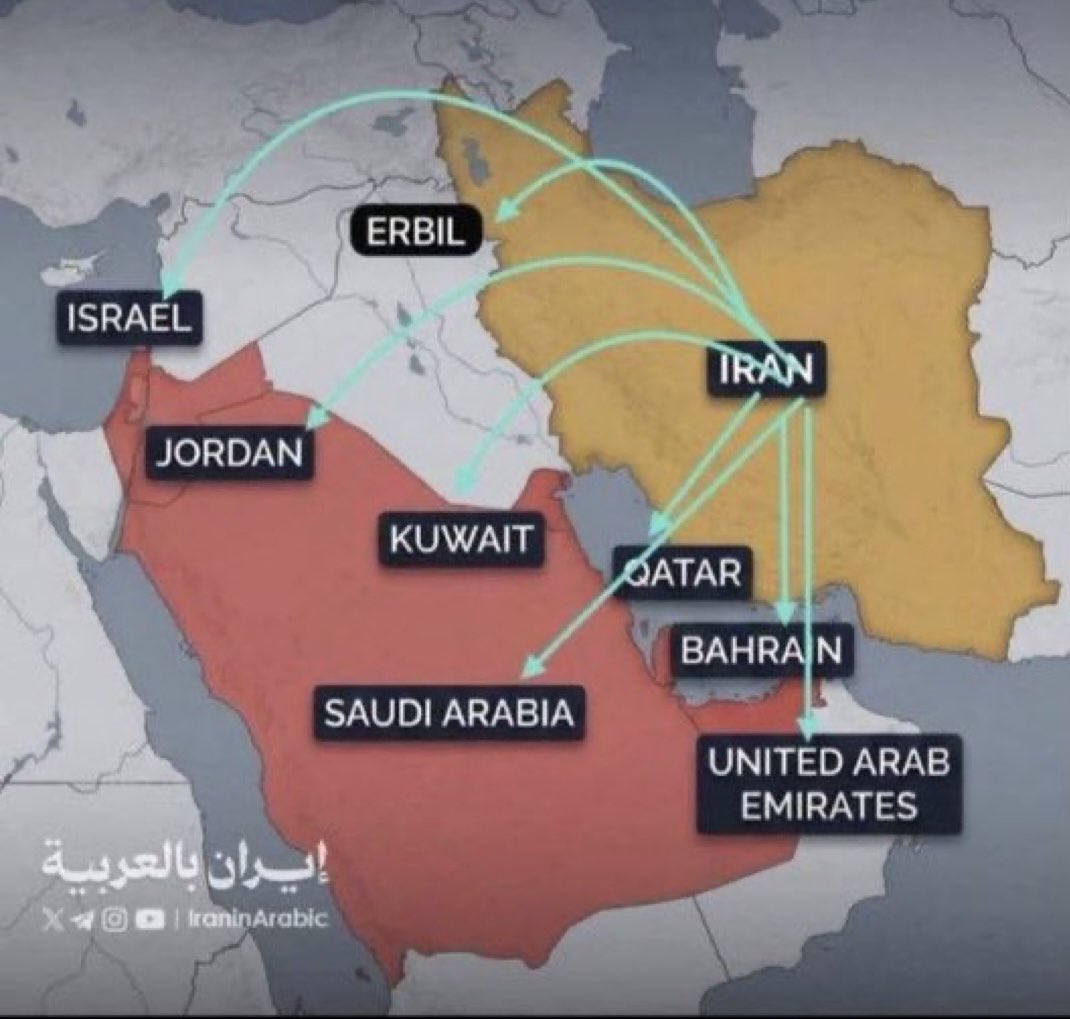
Iran cible bases US dans le Golfe (dommages en milliards $), radars mobiles, silos. Détroit d'Hormuz fermé. Pas de combat naval. Conflit prolongé, comme anticipé. Carte montre les trajectoires missiles.
Français

First Day: Iran's Retaliation Larger Than Expected, but Israel Maintains Firepower
The US, lacking the range for carrier-based air strikes, limited itself to launching Tomahawk missiles.
Based on just two different videos, both showing more than 20 Tomahawks launched, I estimate the US expended 10–15% of its Tomahawk inventory on the first day, hitting dozens of targets in Iran.
The Israeli attacks were even more aggressive, with two major waves on the first day striking over 200 targets on Iranian territory.
However, all strikes were launched from Iraqi airspace, indicating some continued Israeli caution regarding Iran's air defenses.
Iran is seeking to eliminate the American AN/TPY-2 radars, but these structures are highly mobile, with US crews able to relocate more than once a day. To locate them, Iran would need Chinese assistance and considerable agility.
Both Israel and the US heavily invested in drone operations for terrain monitoring to hunt for Iranian missile launchers, at least two large-scale launchers were identified and destroyed.
There are still no reports of naval combat, which also suggests that Iran's navy (with over 30 warships) remains largely intact, as does the entire US fleet, which is staying well back in the Arabian Sea.
On this first day, several strikes targeted mountain base exits to obstruct and delay the movement of Iranian launchers. Iranian radars were also hit, though in limited numbers. Iran has improved its guerrilla tactics for radars, which may be helping.
Israel likely also worked to obstruct known silo coordinates.
I see Israel repeating tactics from the last 12-day war.
On the Iranian side, the focus was on US bases in Gulf countries. At least 6–8 bases are under heavy bombardment, what I calculate as damage already in the billions of dollars, given that the Qatar base alone cost $10 billion.
Air defenses at these bases were largely exhausted on the first day, with few Patriot batteries still operational and showing low efficiency, as some footage demonstrates.
Iran also destroyed an AN/FPS-132 radar in Qatar and a radome in Bahrain, which probably housed a high-altitude radar or SATCOM system, both high-value assets.
Overnight, Iran is expected to maintain the missile pace, focusing on Israel and additional US bases.
I believe Iran will launch around 100 long-range missiles during this period.
This is a protracted conflict. On the first day, the Strait of Hormuz was already closed, as we had predicted here, and it has strong potential to drag in other Gulf countries.
On this first day, everything has unfolded as we anticipated over the last 15 days.
English