
Ben Mann retweetledi
Ben Mann
284 posts


Ben Mann
@8enmann
Make AI safe again
San Francisco, CA Katılım Ocak 2010
188 Takip Edilen8.2K Takipçiler
Ben Mann retweetledi


Among all the frontier AI labs, Anthropic took the lead in supporting our warfighters and the American way starting in 2024. I am saddened by today's developments and hope we can find a way to continue our support without compromising our values.
Anthropic@AnthropicAI
A statement on the comments from Secretary of War Pete Hegseth. anthropic.com/news/statement…
English
Ben Mann retweetledi

My bio says I work on AGI preparedness, so I want to clarify:
We are not prepared.
Over the last year, dangerous capability evaluations have moved into a state where it's difficult to find any Q&A benchmark that models don't saturate. Work has had to shift toward measures that are either much more finger-to-the-wind (quick surveys of researchers about real-world use) or much more capital- and time-intensive (randomized controlled "uplift studies").
Broadly, it's becoming a stretch to rule out any threat model using Q&A benchmarks as a proxy. Everyone is experimenting with new methods for detecting when meaningful capability thresholds are crossed, but the water might boil before we can get the thermometer in. The situation is similar for agent benchmarks: our ability to measure capability is rapidly falling behind the pace of capability itself (look at the confidence intervals on METR's time-horizon measurements), although these haven't yet saturated.
And what happens if we concede that it's difficult to "rule out" these risks? Does society wait to take action until we can "rule them in" by showing they are end-to-end clearly realizable?
Furthermore, what would "taking action" even mean if we decide the risk is imminent and real? Every American developer faces the problem that if it unilaterally halts development, or even simply implements costly mitigations, it has reason to believe that a less-cautious competitor will not take the same actions and instead benefit. From a private company's perspective, it isn't clear that taking drastic action to mitigate risk unilaterally (like fully halting development of more advanced models) accomplishes anything productive unless there's a decent chance the government steps in or the action is near-universal. And even if the US government helps solve the collective action problem (if indeed it *is* a collective action problem) in the US, what about Chinese companies?
At minimum, I think developers need to keep collecting evidence about risky and destabilizing model properties (chem-bio, cyber, recursive self-improvement, sycophancy) and reporting this information publicly, so the rest of society can see what world we're heading into and can decide how it wants to react. The rest of society, and companies themselves, should also spend more effort thinking creatively about how to use technology to harden society against the risks AI might pose.
This is hard, and I don't know the right answers. My impression is that the companies developing AI don't know the right answers either. While it's possible for an individual, or a species, to not understand how an experience will affect them and yet "be prepared" for the experience in the sense of having built the tools and experience to ensure they'll respond effectively, I'm not sure that's the position we're in. I hope we land on better answers soon.
English
Ben Mann retweetledi

Introducing Claude Opus 4.6. Our smartest model got an upgrade.
Opus 4.6 plans more carefully, sustains agentic tasks for longer, operates reliably in massive codebases, and catches its own mistakes.
It’s also our first Opus-class model with 1M token context in beta.
English
Unprecedented times are coming, and with that, we will all need to work together to figure out how to make the transition go well. I love Dario's new essay on this topic. Worth the read!
Dario Amodei@DarioAmodei
The Adolescence of Technology: an essay on the risks posed by powerful AI to national security, economies and democracy—and how we can defend against them: darioamodei.com/essay/the-adol…
English
Ben Mann retweetledi

We’re publishing a new constitution for Claude.
The constitution is a detailed description of our vision for Claude’s behavior and values. It’s written primarily for Claude, and used directly in our training process.
anthropic.com/news/claude-ne…
English
Ben Mann retweetledi
Ben Mann retweetledi
Ben Mann retweetledi

Ben Mann retweetledi

I've been using this for a while now, not just for frontend development, but also for checking docs, sending Slack messages, and doing research. Game changer!
Claude@claudeai
Using the extension, Claude Code can test code directly in the browser to validate its work. Claude can also see client-side errors via console logs. Try it out by running /chrome in the latest version of Claude Code.
English
Ben Mann retweetledi

Here are my Opus 4.5 thoughts after ~2 weeks of use.
First some general thoughts, then some practical stuff.
--- THE BIG PICTURE ---
THE UNLOCK FOR AGENTS
It's clear to anyone who's used Opus 4.5 that AI progress isn't slowing down.
I'm surprised more people aren't treating this as a major moment. I suspect getting released right before Thanksgiving combined with everyone at NeurIPS this week has delayed discourse on it by 2 weeks. But this is the best model for both code and for agents, and it's not close.
The analogy has been made that this is another 3.5 Sonnet moment, and I agree. But what does that mean?
Every few generations we get a major model unlock - a moment that unlocks a new way of working. GPT-4 was the unlock for chat, Sonnet 3.5 was the unlock for code, and now Opus 4.5 is the unlock for agents. Thanks to Opus 4.5, agents can now work reliably on increasingly longer time horizons and get real-world work done on your behalf.
Opus 4.5 is like a Waymo. You tell it "take me from A to B", and it takes you there. After a few of these experiences your brain realizes "oh. ok. we live in this world now". And then you're hooked.
From that moment on, you'll never work the same way again.
THE YEAR OF AGENTS
2025 has been touted as the year of agents, and Opus 4.5 + Claude Agent SDK is the pairing that makes that phrase true.
The Claude Agent SDK is the best open secret in AI right now. An agent's harness matters almost as much as its model. If you have a bad harness, then you may as well have a bad model. With the SDK you get a world-class agentic harness out-of-the-box which you can now pair with Opus 4.5 to build real-world agents that actually work.
I'm reminded of Alan Kay's quote "People who are really serious about software should make their own hardware". The agent version of this is "people who are serious about models should make their own harness". Anthropic clearly believes this, and it's working. The pairing of these tools is magic.
I would describe myself as being "unhobblings-pilled", and the Claude Agent SDK + Opus 4.5 is the next major unhobbling. There's now another OOM of new latent economic value stuck in this combo, and it's the job of builders to get it out.
If you were bearish on agents, now is the time to turn bullish.
"ALL OF THIS IS REAL"
"You know what's crazy? That all of this is real". This was Ilya's opening line about the state of AI in his Dwarkesh interview, and I echo that sentiment. I can't believe that Opus 4.5 is real.
There have been several times as Opus 4.5's been working where I've quite literally leaned back in my chair and given an audible laugh over how wild it is that we live in a world where it exists and where agents are this good.
Nat Friedman has this great question on his website: "Where do you get your dopamine?"
Increasingly, I get mine from Claude.
LONG ANTHROPIC
I saw a post yesterday where someone said that Opus 4.5 was the most important thing to happen to them in their professional career. This will be true for more people going forward.
Every year for the past 3 years, Anthropic has grown revenue by 10x. $1M to $100M in 2023, $100M to $1B in 2024, and $1B to $10B in 2025. In Dario's recent DealBook interview he expressed that he wasn't sure if that 10x pattern would hold for 2026.
While he's probably right, I do expect Anthropic's revenue at the end of next year to be much higher than everyone expects. It wouldn't surprise me if they passed OpenAI in valuation by early 2027.
Opus 4.5 is too good of a model, Claude Agent SDK is too good of a harness, and their focus on the enterprise is too obviously correct.
Claude Opus 4.5 is a winner.
And Anthropic will keep winning.
English
Ben Mann retweetledi

Claude Skills are awesome, maybe a bigger deal than MCP
simonwillison.net/2025/Oct/16/cl…
English
Ben Mann retweetledi

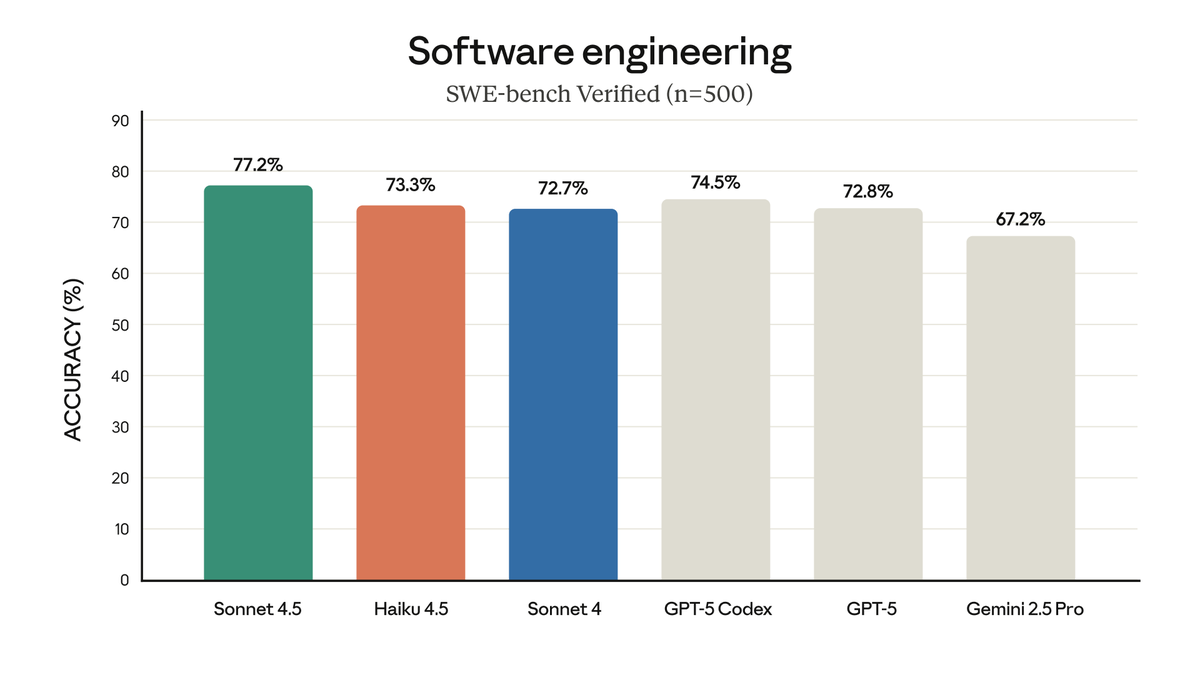
Excited to ship Claude Haiku 4.5 today!
What was state-of-the-art 5 months ago (Sonnet 4) is now available at 1/3 the cost and 2x the speed. Even beats Sonnet 4 at computer use. Available today wherever you get your Claude :)
English
Ben Mann retweetledi
Technological Optimism and Appropriate Fear - an essay where I grapple with how I feel about the continued steady march towards powerful AI systems. The world will bend around AI akin to how a black hole pulls and bends everything around itself.

English
It's been great working with you @henrythe9ths ! Let's get some more founders in here 🚀
English
Ben Mann retweetledi
Long time coming, but much more to come!
Claude@claudeai
Claude Sonnet 4 now supports 1 million tokens of context on the Anthropic API—a 5x increase. Process over 75,000 lines of code or hundreds of documents in a single request.
English