AB Nexus

795 posts

AB Nexus banner
AB Nexus

AB Nexus

@ABNexusGlobal

On-chain USD, ETH & BTC strategies Risk-managed allocation | Transparent execution Built for risk-adjusted returns https://t.co/LB2o2KjFRQ

Katılım Eylül 2017
3.5K Takip Edilen457 Takipçiler
Sabitlenmiş Tweet
AB Nexus
AB Nexus@ABNexusGlobal·
We’ve been running on-chain strategies for 3+ years. Across USD, ETH, and BTC. Through bull markets, bear markets, and everything in between. No yield chasing. Most strategies in DeFi fail for one reason: They chase yield without managing risk. Our approach has always been different: • Focus on risk-adjusted returns • Avoid fragile / unsustainable yield • Size positions based on risk, not APY • Continuously monitor exposure Today, we run 3 live vaults: USD → active stablecoin allocation ETH → risk-managed yield strategies BTC → structured yield on core holdings All positions are verifiable on-chain. The goal isn’t the highest yield. It’s about preserving capital and compounding it over time. If you’re allocating capital on-chain, that distinction matters more than anything. If you’re interested in how we approach allocation, feel free to reach out.
English
2
2
3
128
AB Nexus retweetledi
Stackit
Stackit@stackitdaily·
The Space rug just went nuclear. Raised ~$20M in presale as the next big competitor to Polymarket and Kalshi. Multiple TGE delays. Beta launched yesterday. $SPC token listed on Kraken, KuCoin and others today… then crashed 99% in hours. Presale buyers locked out while the chart got dumped. This is the 2026 launch playbook 👇
Stackit tweet media
English
1
2
4
199
AB Nexus retweetledi
Stackit
Stackit@stackitdaily·
What if you could invest like someone smarter than you automatically, on-chain, without trusting them with a single dollar? That’s copy investing. And it’s nothing like what you’ve seen before
Stackit tweet media
English
1
1
2
45
AB Nexus retweetledi
Stackit
Stackit@stackitdaily·
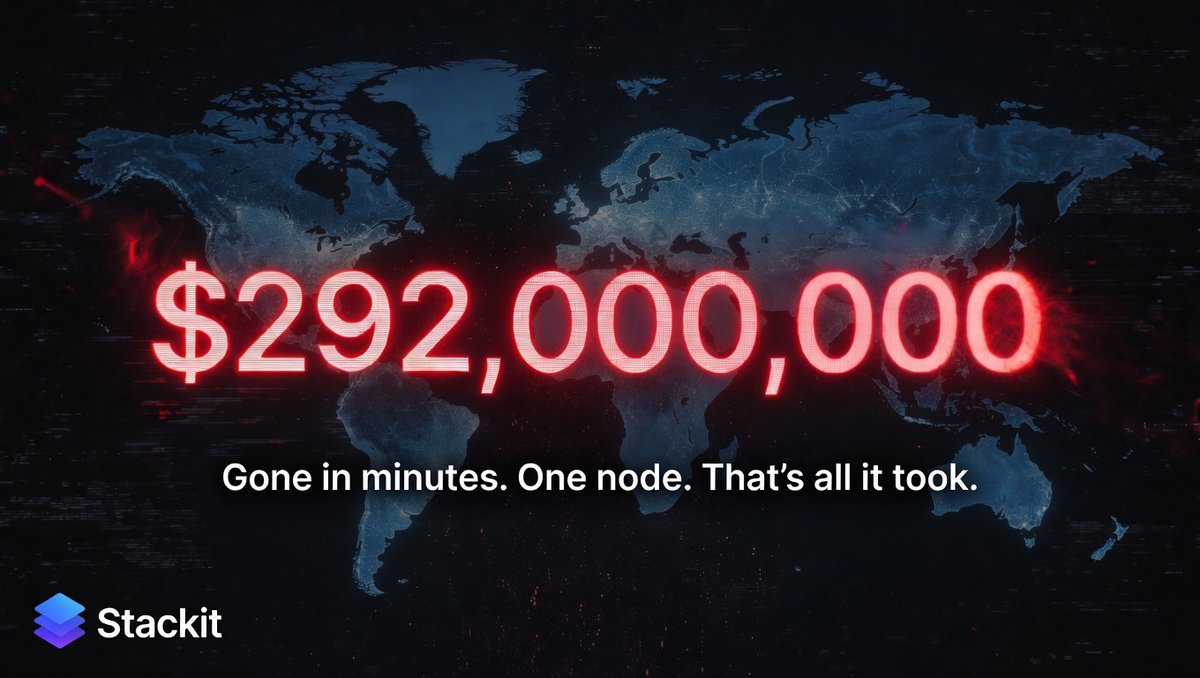
$292 million gone in minutes. Not because of a smart contract bug. Because of one single verifier node. Here's the Kelp DAO hack and what it actually means for your money 🧵
Stackit tweet media
English
2
3
3
112
AB Nexus retweetledi
Stackit
Stackit@stackitdaily·
Stackit just got a full redesign. New UI. New features. Built for people who want to stack crypto without thinking about it every week. Here's what changed and why it matters 🧵
Stackit tweet media
English
1
3
5
258
AB Nexus
AB Nexus@ABNexusGlobal·
@Crypto_Zh0u @pendle_fi @alturax Nice! Pendle gets a lot more interesting once you start thinking about entry timing and how PT vs YT dynamics play out.
English
1
0
1
30
Zh0u
Zh0u@Crypto_Zh0u·
Just made my first ever @pendle_fi deposit 👀 Hope this gives me a good boost on @alturax's YieldRun rankings!
Zh0u tweet media
Zh0u@Crypto_Zh0u

27% APY on @alturax's AVLT LP on @pendle_fi 😮 This on top of the 3x YieldRun points! I think I need to look into this seriously, probably start doing this by this weekend Each Epoch, special rewards are allocated for the Top 200 in YieldRun With Pendle, we can provide LP, earn points & yield, it's the best of both worlds! We can also do YT for max YieldRun points with APY or PT, max APY without Points This is a good partnership with Pendle! And there is something for everyone! Check Altura out here: app.altura.trade/?referral=zhou

English
4
1
11
537
AB Nexus
AB Nexus@ABNexusGlobal·
@Dougytrades Hard to disagree. Most people don’t really think about custody and smart contract risk until something actually breaks.
English
0
0
0
8
Pendle
Pendle@pendle_fi·
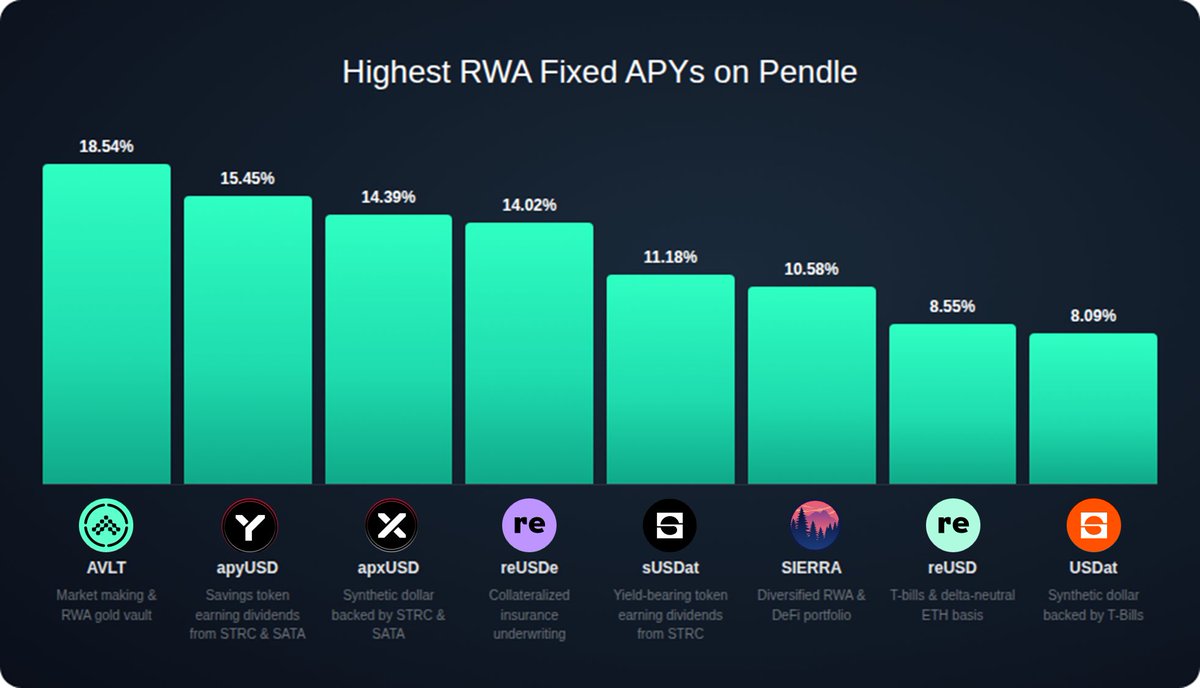
Who said fixed income has to be boring? Pendle has the best RWA yields in DeFi, with offerings for every risk appetite. Up to 18.54% Fixed APY, locked in at purchase, across gold vaults, insurance underwriting, private credit, preferred shares, and T-bill backed dollars.
Pendle tweet media
English
45
27
151
16.5K
AB Nexus
AB Nexus@ABNexusGlobal·
@Jonasoeth Tranching makes risk easier to package and distribute but the underlying exposure is still the same, just held differently.
English
0
0
0
14
Defi Jonaso
Defi Jonaso@Jonasoeth·
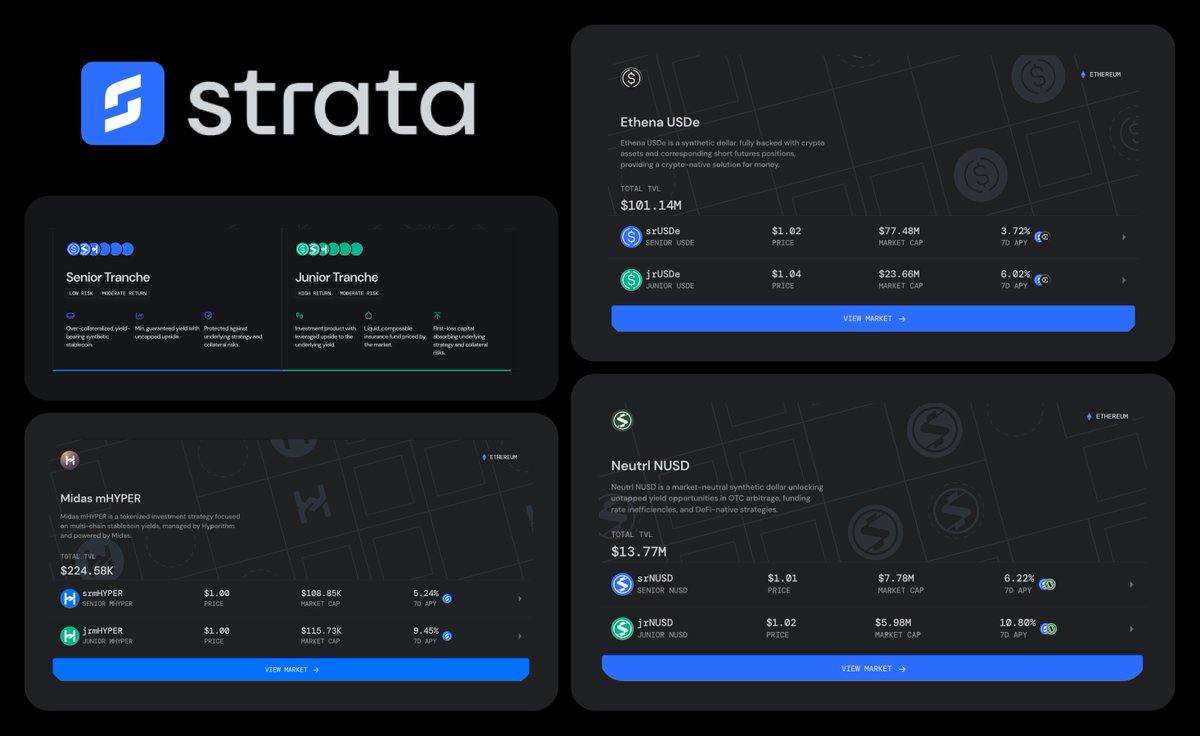
Strata keeps tranching on Vaults are exploding but still stuck in a one-size-fits-all model. TVL has grown from near zero to $15B+, with a path toward $60B+. But the core issue remains: - All users share the same risk profile - No customization for different risk appetites DeFi today is good at two things: risk assessment and risk mitigation. But it’s missing a critical layer: → risk transfer, which TradFi has mastered (insurance, structured products, tranching). That’s where @strata_markets comes in - Users can finally choose their own risk/yield profile. - Moving vaults from generic products → structured financial products. More importantly, Strata is building the infrastructure layer → any yield vault can be tranched (Yearn, Morpho, RWA, multi-strategy). Expansion focus includes: - Tokenized investment strategies (with MidasRWA as a key launch partner) - Multi-strategy vaults - Curated lending vaults (Morpho, Euler, Aave-style) - RWA yields (private credit, Treasuries, structured credit) - Non-USD yield strategies - Exotic / delta-neutral strategies (Ethena-like)
Defi Jonaso tweet media
Defi Jonaso@Jonasoeth

There’s a trend quietly emerging: Yield Tranching Instead of: 1 pool → 1 level of risk → 1 level of yield Tranching turns it into: 1 pool → multiple layers of risk - Senior tranche (low risk) like bonds - Junior tranche (high risk) like equity / leverage I - Why institutions like this Institutions don’t want: 30% APY with unclear risk They need: - predictable yield - downside protection - clear structure Tranching solves this Senior → behaves like fixed income Junior → attractive for retail / degens It bridges DeFi ↔ TradFi II - This isn’t new and it’s similar to - CDOs - Structured products - Securitization ⤷ DeFi is simply: putting structured finance onchain III - Why the trend is growing (1) RWA is booming ↔ Real-world yield (treasuries, credit) → moving onchain (2) Institutions entering DeFi ↔ They need risk segmentation (3) Old yield farming is dead ↔ No more 1000% APY, shifting to structured yield (6–20%) IV - Key players today @strata_markets : Largest TVL (~$268M) with strongest generalized tranching model with Dynamic Yield Split - Senior (srUSDe) = protected, stable yield (institutional-friendly). - Junior (jrUSDe) = leveraged upside, takes first loss. - High liquidity, composability, and ~$8.5M annual revenue → clear market leader. @ResolvLabs : TVL ~$113M (down after exploit) - Previously strong dual-tranche model (USR / RLP) with multiple yield sources. - Recently hacked (~$23 - 25M), USR depegged heavily, trust damaged → now high risk, market watching recovery. @YuzuMoneyX : TVL ~$60 - 70M, fast growth - Multi-strategy yield engine (Aave, Morpho, Ethena,) + RWA direction. - yzUSD = overcollateralized yield stablecoin. - yzPP = junior buffer + reserve protection. - Strong risk layering, less dependent on a single strategy. TL;DR: Strata = scale + liquidity leader Resolv = broken (for now) Yuzu = smaller but more diversified and flexible The trend is accelerating, especially as DeFi volumes grew ~45% in February 2026 alone, largely driven by institutional flows.


English
11
1
20
990
AB Nexus
AB Nexus@ABNexusGlobal·
@thelearningpill You can usually tell when the yield disappears faster than the users. That’s when it was never real demand to begin with. Incentives bring users in, but they also teach them how to leave.
English
0
0
0
1
The Learning Pill 💊
The Learning Pill 💊@thelearningpill·
How incentive cliffs kill chains and protocols: 1) Emissions spike participation 2) Retention never becomes endogenous 3) Users learn to leave early 4) Protocol bleeds credibility 5) Yield wasn’t the problem - the incentives were Yet in DeFi, incentives become the main focus.
DeFi Warhol@Defi_Warhol

L1 launches from 2025-26 have terrible TVL retention. Let me show you the real picture: → @berachain: $3.3B peak, $74M now (-97%) → @SonicLabs: $1.14B peak, $34M now (-97%) → @plumenetwork: $299M peak, $11M now (-96%) → @StoryProtocol: $45M peak, $352K now (-99%) → @initia: $42M peak, $4M now (-90%) None could retain capital once incentives ran out. That liquidity rotated straight into stablecoins, Ethereum, @HyperliquidX, and @base. Not all L1 launches during this period were bad, though. For example, TVL in projects like @monad, @megaeth, and @Plasma is steadily growing. Future L1s need to ensure they have a good enough PMF to retain users once the incentives are gone. Otherwise, we'll see a lot more dead chains with -99% TVL.

English
21
0
30
1.4K
AB Nexus
AB Nexus@ABNexusGlobal·
@kenodnb A lot of these work well individually .It gets more interesting once you start stacking them and thinking about how they behave on the way out.
English
0
0
0
1
Keno
Keno@kenodnb·
It's never over, bro. Time to Farm Smart, Not Hard #91 🧵
Keno tweet media
English
34
9
59
2.8K
DeFi Andree
DeFi Andree@DeFi_Andree·
Hack Multi-Layered Yield | Looping with Ethena x Strata x Pendle x Aave For any DeFi degens hunting for stablecoin yields, this is a combo you cannot afford to ignore We are now officially plugging @strata_markets into this powerhouse stack --- 1. @Ethena_Eco: Yield Engine Ethena remains the ultimate source of yield: Mint USDe → Stake sUSDe → Earn yield from funding rates + delta-neutral strategies. This serves as a stable and highly composable base yield 2. @strata_markets: Risk Tranching Strata was built to solve the "one-size-fits-all" nature of sUSDe. By depositing sUSDe/USDe into Strata, you receive two distinct tranches: > srUSDe (Senior): Lower risk, features a yield floor, and offers higher stability > jrUSDe (Junior): Higher risk, but captures the lion's share of the yield upside ⤷ Strata is doing an excellent job of filling the gap as many Pendle maturities approach expiry. Strata’s TVL has already surpassed $220M and is climbing fast. 3. @pendle_fi: Yield Tokenization Next is Pendle, where you deposit srUSDe (or sUSDe) to split it into: > PT-srUSDe: Purchased at a discount → Locks in a fixed APY until maturity > YT: For those looking to speculate on pure variable yield PT-srUSDe often offers more attractive fixed yields than PT-sUSDe, thanks to Strata’s unique tranching mechanism 4. @aave: The Leverage Layer Aave acts as the catalyst that makes the entire strategy explode: > Supply PT-srUSDe as collateral on Aave V3 (utilizing a dedicated eMode with LTVs as high as 90-94%) > Borrow stables (USDC, USDT, USDe, GHO, etc.) at low interest rates Loop: Use the borrowed stables to mint more USDe → Stake sUSDe → Deposit into Strata → Pendle → Repeat --- The Ultimate Yield Flywheel This strategy turns a single capital base into leveraged fixed yield with extreme capital efficiency, all while farming points for Ethena, Strata, and Aave incentives. The logic is simple: @ethena generates the yield → Strata tranches the risk → Pendle fixes the rate → Aave leverages the position. Key Benefits: > Fixed Yield: Protects you from the volatility of negative funding rates > High Leverage: Safely achievable via Aave’s eMode and dynamic oracles > Deep Liquidity: Easy to roll over positions at maturity > Multi-layered Farming: Earn points across multiple protocols Currently, this combo accounts for a massive portion of the Ethena-related TVL on Pendle and Aave With new maturities being onboarded and Aave expanding its capacity for PT-srUSDe, the flywheel shows no signs of slowing down.
DeFi Andree tweet media
English
42
14
94
10.9K
AB Nexus
AB Nexus@ABNexusGlobal·
@phtevenstrong @USDai_Official The structure makes sense, but the risk profile shifts quite a bit as more capital moves into GPU loans. Curious how underwriting and liquidity hold up as utilization increases.
English
0
0
1
82
Stephen | DeFi Dojo
Stephen | DeFi Dojo@phtevenstrong·
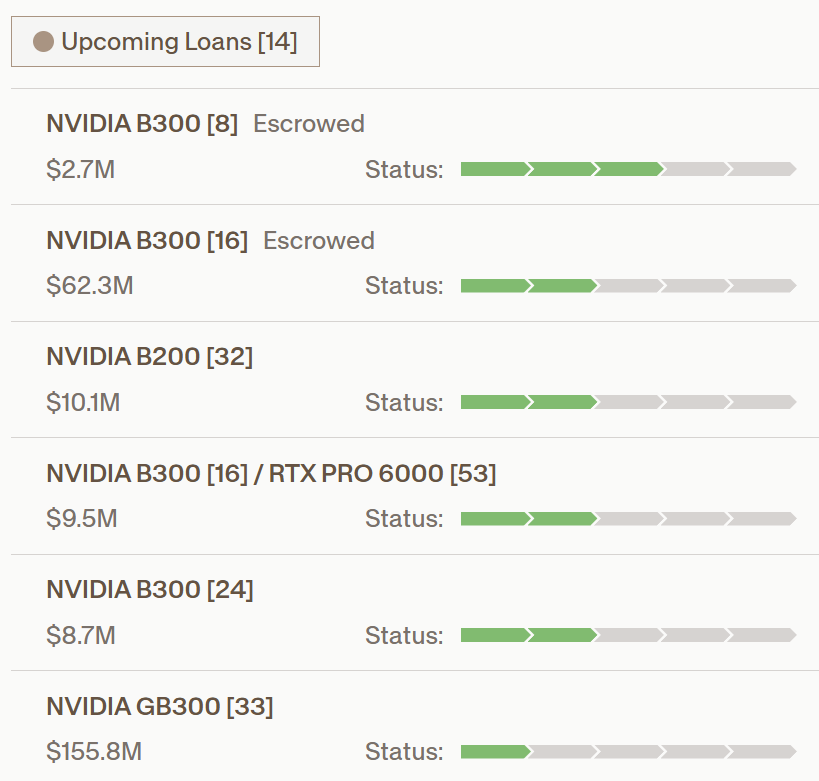
The expected APY of sUSDai is 12.17%. @USDai_Official is finally going from being a wrapped TBILL to becoming an AI-aligned, GPU-backed lending stablecoin protocol. And they already have >$600M in dealflow. Let me explain where that 12% expected comes from: Currently, USDai is 87% backed by PYUSD and 13% backed by GPU loans. The 87% gets the risk-free-rate (tbill yield) and the 13% gets between 10% and 15% depending on the loan. USDai has a max utilization of ~80% which means 80% of the PYUSD can be deployed into loans. At max utilization/deployment (20% PYUSD / 80% GPU Loans) the yield would be ~12%. But these loans can't happen in the snap of a finger. The loans can't be originated until chips are installed and they're third-party verified. However, there's already 64M escrowed which is about 18% of the TVL awaiting finalization. That alone should push the APY up a few percentages. Anywho, I have no affiliation with USDai, but I think this development is incredible and they definitely have PMF at the moment. Love to see it.
Stephen | DeFi Dojo tweet mediaStephen | DeFi Dojo tweet media
English
26
9
107
11.1K
AB Nexus
AB Nexus@ABNexusGlobal·
@thedefiedge A lot of these risks don’t show up in steady conditions They tend to surface when liquidity tightens or assumptions break especially around exits and underlying exposure
English
0
0
0
18
Edgy - The DeFi Edge 🗡️
Edgy - The DeFi Edge 🗡️@thedefiedge·
$400M has been lost to DeFi exploits in 2026. The 8 questions I ask before farming any managed yield product: #1 Hidden leverage or market exposure Is the protocol taking leverage with your deposits? Stream was managing $500M AUM on $160M of deposits. That math only works with excessive leverage. If a "stablecoin" is selling volatility or has any directional exposure, it's a hedge fund with a different label. #2 Real-time monitoring I'm paying a lot more attention to projects running Hypernative, Hexagate, or Chainalysis after Resolv. Automated threat detection and contract pausing would've mitigated a lot of that damage. #3 Audits and response to findings Multiple audits from different firms plus bug bounties are baseline. What matters more is how the team responded to critical findings. Nomad famously ignored Code4rena findings and got hacked for $200M. #4 First-loss protection Case by case, but for protocols with first-loss mechanisms (Avant, Royco, etc), who is protected, by how much, and under what circumstances? #5 RWA is higher risk Apart from sector leaders, I mostly avoid off-chain and RWA stables because I can't personally measure the counterparty risk. It's higher risk because the backing isn't onchain. #6 Backing and exposure Where does the yield come from? How are deposits managed? You're directly exposed to every underlying token and position the backing is deployed to. #7 Peg and redemptions How is the peg maintained? Are redemptions open or KYC-gated? How do the rules change in a crisis? #8 Liquidity How much DEX liquidity exists relative to circulating supply? This matters even more if the stable is borrowable on lending markets and redemptions are gated. One more thing: it's okay to leave yield on the table. Higher APY always has a price, you just don't see it until the protocol blows up.
English
12
0
50
6.5K
AB Nexus
AB Nexus@ABNexusGlobal·
Most risks don’t show up in steady conditions. They show up when liquidity tightens or assumptions break. That’s what we try to underwrite upfront.
English
0
0
0
15
AB Nexus
AB Nexus@ABNexusGlobal·
Most DeFi strategies don’t fail because yield disappears. They fail because risk wasn’t understood in the first place. Yield is easy to find on-chain. What’s difficult is understanding how that yield behaves under stress. At AB Nexus, every allocation is driven by a structured risk framework. We evaluate each strategy across: • Protocol maturity • Liquidity depth • Strategy complexity • Oracle dependencies • Operational exposure These aren’t just checkboxes. They directly determine whether we allocate, how much we allocate, and how risk is managed over time. Most participants optimize for yield. We optimize for durability.
English
1
0
1
69
AB Nexus
AB Nexus@ABNexusGlobal·
@MerlinEgalite @Morpho @Figure Bridging real-world credit onchain is powerful. The key is understanding how these exposures are structured and where they fit within an on-chain portfolio.
English
0
0
0
65
Merlin Egalite 🕛
Merlin Egalite 🕛@MerlinEgalite·
HELOCs will soon be made productive on @Morpho via PRIME from @Figure. What are HELOCs? Home Equity Lines of Credit: revolving, flexible borrowing secured by the home value. DeFi is no longer an isolated island; it’s now truly delivering solutions for real-world use cases.
Hastra@HastraFi

x.com/i/article/2044…

English
5
4
57
7.9K
AB Nexus
AB Nexus@ABNexusGlobal·
The difference usually shows up after the first drawdown or liquidity shock. That’s where most strategies break.
English
0
0
1
29
AB Nexus
AB Nexus@ABNexusGlobal·
We’ve been running on-chain strategies for 3+ years. Across USD, ETH, and BTC. Through bull markets, bear markets, and everything in between. No yield chasing. Most strategies in DeFi fail for one reason: They chase yield without managing risk. Our approach has always been different: • Focus on risk-adjusted returns • Avoid fragile / unsustainable yield • Size positions based on risk, not APY • Continuously monitor exposure Today, we run 3 live vaults: USD → active stablecoin allocation ETH → risk-managed yield strategies BTC → structured yield on core holdings All positions are verifiable on-chain. The goal isn’t the highest yield. It’s about preserving capital and compounding it over time. If you’re allocating capital on-chain, that distinction matters more than anything. If you’re interested in how we approach allocation, feel free to reach out.
English
2
2
3
128
AB Nexus
AB Nexus@ABNexusGlobal·
@phtevenstrong @apyx_fi The yield looks attractive but it’s heavily dependent on assumptions around dividends and continued vesting The real risk shows up if those expectations change
English
0
0
0
51
Stephen | DeFi Dojo
Stephen | DeFi Dojo@phtevenstrong·
apyUSD yields is up above 12% again on @apyx_fi. This is great news for YT $apyUSD holders and apyUSD loopers. Why is this the case: Apyx is increasing the yield by vesting more apxUSD into the contract. They can do this because they can calculate the additional dividend they'll be receiving at the end of the month based on their ex-dividend date STRC holdings. Loop Yields (@Morpho via @0xAlphaping): apyUSD/apxUSD (6x): 27% PY-apyUSD/USDC (6x): 37%
Stephen | DeFi Dojo tweet media
English
5
2
41
5.5K