Antidepressant Coalition for Education

289 posts

Antidepressant Coalition for Education

Antidepressant Coalition for Education

@ACE_CoalitionEd

Katılım Nisan 2025
110 Takip Edilen693 Takipçiler
Antidepressant Coalition for Education retweetledi
Taylor 🌞
Taylor 🌞@taperingtay·
This past week I had a chance to go to the @APApsychiatric conference here in San Francisco. I had planned to share a little bit about my experience today but after seeing the piece from @EllenBarryNYT this morning, I'd say she did a good job capturing the general sentiment toward deprescribing. So I'll just add a personal note. I left the conference feeling very hopeful about the future of support for antidepressant withdrawal and safer deprescribing practices. While I still believe there is more work to be done—for example, those of us who have experienced withdrawal know Stahl's guide misses the mark—there was a real openness to exploring antidepressant discontinuation and better support. I deeply appreciate these conversations. My hope is that as they continue, patients and psychiatrists find more chances to sit at the table together—as partners. I believe we all want the same thing: for patients to get the best mental health support possible. And no one understands that support better than the people living it. If you didn't get a chance to read Ellen's article yet, you can check it out here: nytimes.com/2026/05/24/sci…
Taylor 🌞 tweet media
San Francisco, CA 🇺🇸 English
1
6
18
636
Antidepressant Coalition for Education
For the millions of long-term antidepressant users in the US, hyperbolic tapering is currently the best strategy to reduce the risk of severe and protracted withdrawal. Linear tapers can work for short-term users, but many people who’ve been on antidepressants for >12 months find they need progressively smaller dose reductions at lower doses. Why? Antidepressants interact with serotonin transporters in a hyperbolic way, meaning tiny reductions become much more powerful near zero. Featuring ACE founder Morgan Stewart @morgan_stewar, Mark Horowitz @markhoro and Awais Aftab @awaisaftab, read more about hyperbolic tapering from WebMD below.
WebMD@WebMD

If you’ve ever tried to stop an antidepressant and felt like you were "falling to pieces," you aren't alone. For many long-term users, the standard medical advice to taper off over just a few weeks can lead to a "cliff" of severe withdrawal symptoms. Seek a doctor who understands hyperbolic tapering. Hyperbolic tapering offers a personalized, slower path that respects how your brain actually heals. Read the full deep-dive on the science of hyperbolic tapering: wb.md/3RyYRmr

English
11
18
66
5.8K
Antidepressant Coalition for Education retweetledi
Angie Peacock, MSW, CPC
Angie Peacock, MSW, CPC@angpeacock1111·
The average mental health patient has no power in any of the discourse happening. We have one side accusing another of being "fascist-adjacent," and another screaming "am not." Anyone who doesn't want to take meds or went through SSRI withdrawal is not "anti-psychiatry."
English
10
11
75
2.6K
Antidepressant Coalition for Education retweetledi
Laura Delano
Laura Delano@LauraDelano·
It’s only a matter of time before the distorting lens perceiving psychiatric medication withdrawal as relapse disintegrates and our culture is left, once and for all, to grapple with what’s happening here
Mark Horowitz @markhoro.bsky.social@markhoro

I think when doctors say they don’t see withdrawal it goes something like this. - The average GP/PCP has 2000 patients under their care, -200 on antidepressants (10% of pop), -studies show 6% of people stop their AD each year (eveleigh, 2018) in regular practice so 12 people stop -4 will have no major issues, -4 will have moderate issues, -4 severe issues. Of the 8 with problems 6 or 7 will be told or think it is relapse and go back on meds (of course textbooks and training say relapse is very common, withdrawal is a minor concern so it would be a pretty rare physician to see what they haven’t been taught to see). 1 or 2 will say this doesn’t make sense, research it, try to work out what is going on and make a point about it to doctor (30% of people on social media groups for withdrawal have graduate degrees). And so the doctor will say ‘I rarely if ever see this’ because drugs are rarely stopped and the correct diagnosis is rarely made. It takes a motivated, thoughtful patient to push the issue. There are currently about 200,000 such patients, and growing rapidly. Given that most studies of withdrawal from relatively long term treatment show 60%+ of patients experience withdrawal syndromes of at least 4 withdrawal symptoms (Rosenbaum 1998) it is simply not plausible that most people are not having pronounced withdrawal effects. And that's before we even talk about the plausibility of the concept of 'relapse'....

English
9
27
114
13K
Antidepressant Coalition for Education retweetledi
Taylor 🌞
Taylor 🌞@taperingtay·
Been on X for only 24hrs and got a d*ath threat for sharing my story about antidepressant withdrawal. A few years ago, I might’ve deleted this account. But if you saw the messages I get from people suffering through withdrawal—the desperation, the pain—you’d keep talking too. So I'll see you guys again tomorrow 🙂
English
15
15
116
5.7K
Antidepressant Coalition for Education retweetledi
Mark Horowitz @markhoro.bsky.social
It is heartening that the American Society of Clinical Psychopharmacology have taken a belated interest in deprescribing - they make some good points but they ignore a lot of core issues including withdrawal effects and methods of tapering. @cwestonclark and I here:
Mad In America@Mad_In_America

Rearranging Deck Chairs While the Titanic Goes Down—The American Society of Clinical Psychopharmacology Issues Deprescribing Recommendations By Carrie Clark & Mark Horowitz buff.ly/k0Um9Zo

English
2
20
62
3.8K
Antidepressant Coalition for Education retweetledi
Dr Joanna Moncrieff
Dr Joanna Moncrieff@joannamoncrieff·
'Psychiatry has normalised long-term psychotropic use while investing remarkably little effort into understanding its long-term consequences.' The ASCP statement on deprescribing does little to change this. By @markhoro and @cwestonclark madintheuk.com/2026/05/rearra…
English
13
57
163
6.5K
Antidepressant Coalition for Education retweetledi
Dr Joanna Moncrieff
Dr Joanna Moncrieff@joannamoncrieff·
If people were told that antidepressants would make them numb rather than correct an underlying mechanism AND that we don't know how they do this or understand the consequences, at least they could make a better informed decision.
fireworks and confetti@fworksconfetti

There's a thing on TikTok called "When I was on Lexapro" about how it makes you apathetic and numb. This one from last November got ~370k likes.

English
15
69
248
10K
Antidepressant Coalition for Education retweetledi
Mark Horowitz @markhoro.bsky.social
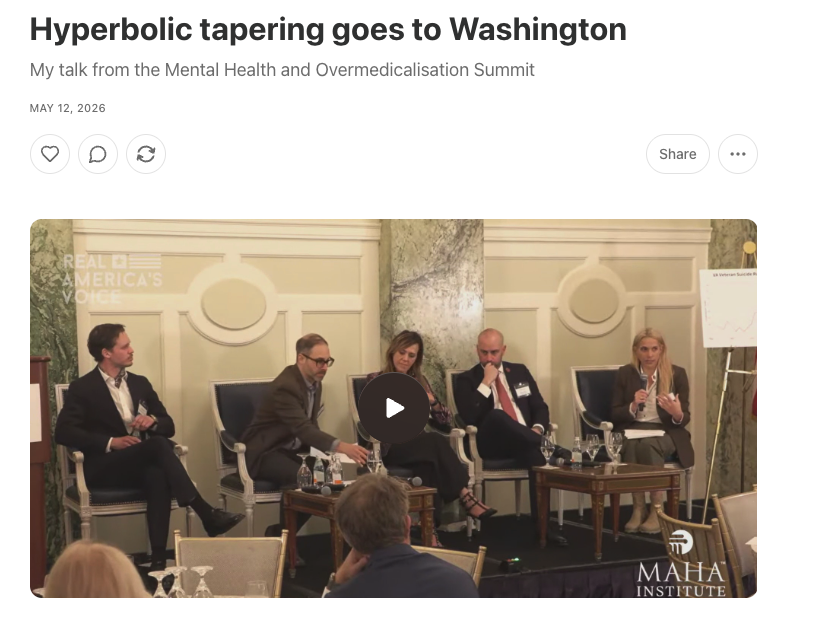
Hyperbolic tapering goes to Washington. A summary of the main ways to safely stop antidepressants and ways of implementing it in practice from the Washington conference. Link below
Mark Horowitz @markhoro.bsky.social tweet media
English
2
22
64
8.5K
Antidepressant Coalition for Education retweetledi
Adam Urato, MD
Adam Urato, MD@AdamUrato1·
FDA must warn the public. With this new study, there are now 13 -yes 13- consecutive MRI studies showing that SSRIs alter fetal brain development. (Listed below) There is scientific agreement. Common sense, basic science, & animal/human studies all show this. The Studies: #1 Wu, Y., Andescavage, N., Wisner, K. L., Kapse, K., Murnick, J., Ngwa, J. S., & Limperopoulos, C. (2026). Prenatal serotonin reuptake inhibitor exposure and maternal depression symptoms are associated with altered fetal brain and placental development. Neuropsychopharmacology. #MOESM1" target="_blank" rel="nofollow noopener">nature.com/articles/s4138… #2 Zanni, G, et al (2025). Perinatal SSRI exposure impacts innate fear circuit activation and behavior in mice and humans. Nature Communications, 16(1), 4002. doi.org/10.1038/s41467… #3 Koc, D., et al (2023). Prenatal antidepressant exposure and offspring brain morphologic trajectory. JAMA Psychiatry, 80(12), 1208–1217. doi.org/10.1001/jamaps… #4 Moreau, A. L., et al (2023). Biological Psychiatry: Global Open Science, 3(2), 243–254. doi.org/10.1016/j.bpsg… #5 Campbell, K. S. J., et al (2021a). Prenatal antidepressant exposure and sex differences in neonatal corpus callosum microstructure. Developmental Psychobiology, 63(6), e22125. doi.org/10.1002/dev.22… #6 Salzwedel, A., et al (2020). Functional dissection of prenatal drug effects on baby brain and behavioral development. Human Brain Mapping, 41(15), 4123–4135. doi.org/10.1002/hbm.25… #7 Rotem-Kohavi, N., et al (2019a). Hub distribution of the brain functional networks of newborns prenatally exposed to maternal depression and SSRI antidepressants. Depression and Anxiety, 36(8), 753–765. doi.org/10.1002/da.229… #8 Rotem-Kohavi, N., et al (2019b). Alterations in resting-state networks following in utero selective serotonin reuptake inhibitor exposure in the neonatal brain. Biological Psychiatry: Cognitive Neuroscience and Neuroimaging, 4(1), 39–49. doi.org/10.1016/j.bpsc… #9 Lugo-Candelas, C., et al (2018). Associations between brain structure and connectivity in infants and exposure to selective serotonin reuptake inhibitors during pregnancy. JAMA Pediatrics, 172(6), 525–533. doi.org/10.1001/jamape… #10 Podrebarac, S. K., et al (2017). Antenatal exposure to antidepressants is associated with altered brain development in very preterm-born neonates. Neuroscience, 342, 252–262. doi.org/10.1016/j.neur… #11 Jha, S. C., et al (2016). Antenatal depression, treatment with selective serotonin reuptake inhibitors, and neonatal brain structure: A propensity-matched cohort study. Psychiatry Research: Neuroimaging, 253, 43–53. doi.org/10.1016/j.pscy… #12 Salzwedel, A. P., et al (2016). Thalamocortical functional connectivity and behavioral disruptions in neonates with prenatal cocaine exposure. Neurotoxicology and Teratology, 56, 16–25. doi.org/10.1016/j.ntt.… #13 Knickmeyer, R. C., et al (2014). Rate of Chiari I malformation in children of mothers with depression with and without prenatal SSRI exposure. Neuropsychopharmacology, 39(11), 2611–2621. doi.org/10.1038/npp.20…
Adam Urato, MD tweet media
English
26
159
448
24.1K
Antidepressant Coalition for Education
In this detailed account of navigating the mental health industry, Carrie Clark writes about her journey of being diagnosed with mental illness as a teen, the futility of medication, and ultimately leaving psychiatry and deconstructing the diagnostic paradigm. We highly recommend this captivating Substack. Link in comments!
English
2
4
19
675
Antidepressant Coalition for Education retweetledi
Maryanne Demasi, PhD
Maryanne Demasi, PhD@MaryanneDemasi·
💥FOIA documents show FDA examined reports of persistent sexual dysfunction tied to antidepressants — but declined stronger warnings Critics say the FDA set too high an evidentiary bar before deciding against stronger warnings about persistent sexual dysfunction linked to antidepressants. Link 👇👇 @abcsoka @PSSDNetwork @MikhailaFuller @unhealthytruth @benzosarebad @woodymatters @jeffreytucker @Mangan150 @newstart_2024
English
12
74
186
114.7K
Antidepressant Coalition for Education retweetledi
Adam Urato, MD
Adam Urato, MD@AdamUrato1·
NEW Study: Fetuses with prenatal SSRI exposure have brain & placental alterations seen on in utero MRI. This is now the 13th consecutive MRI study showing that prenatal SSRIs are associated with altered fetal brain development. #MOESM1" target="_blank" rel="nofollow noopener">nature.com/articles/s4138… "Importantly, we observed decreased left & right hippocampal volumes, as well as reduced cortical gyrification index, curvedness, & surface area in fetuses exposed to SRIs compared to unexposed controls after adjusting for maternal depression scales." "SRIs cross the placenta & potentially influence fetal brain development by altering levels of critical neurotransmitters. Indeed, changes in serotonin levels during critical periods of brain development could alter the formation of neural circuits & potentially lead to brain structural alterations & subsequent neuropsychiatric outcomes."
Adam Urato, MD tweet media
English
35
177
611
222.5K
Antidepressant Coalition for Education
As most of our community is aware, after petitioning the FDA, requesting tapering guidelines, and launching a coordinated reporting drive one year ago this May, the U.S. government has finally acknowledged an issue that has upended many of our lives: severe antidepressant withdrawal. On Monday, May 4, the Secretary of Health and Human Services acknowledged this problem and announced the development of deprescribing guidelines for antidepressants. We praise our community because this monumental step would not have been possible without decades of collective effort. No single person or organization brought this issue to a head. This moment was built on the backs of legends and pushed forward by others pioneering this advocacy: those who created the first withdrawal forums, our sister organizations that fought for benzodiazepine label updates and tapering guidance, advocates who built relationships with key decision-makers, researchers and academics who believed patients and dedicated their careers to producing the data and evidence needed to document severe withdrawal, and countless others who refused to let these harms remain invisible. Most critical to this movement, however, are the sufferers themselves. The people who stayed vocal despite being dismissed, those who submitted MedWatch reports, the many who devoted their time to supporting fellow sufferers through messages, phone calls, and support forums, the coaches who turned their own suffering into a commitment to help others navigate withdrawal safely, and the moderators and admins who sustained our support communities when the necessary infrastructure was, and still remains, absent within our health care systems. Together, we built what the systems that harmed us failed to provide. And together, we continued raising awareness until what now appears to be a tipping point. For those enduring severe withdrawal, we know that staying alive can itself be an act of resistance and, in a sense, advocacy. Please continue to hold on and please continue to be advocates because there is still more work ahead, and your voice matters deeply as both this movement and your recovery move forward. We acknowledge the political disparity within our community. The issue of antidepressant withdrawal will always remain nonpartisan, and so will ACE. While many in our community may not align politically with the current HHS leadership, we can still recognize the significance of this development and the progress it represents. We thank everyone in this community for making this happen. There is an awakening on the horizon and we must not stop now.
Antidepressant Coalition for Education tweet mediaAntidepressant Coalition for Education tweet media
English
11
44
122
5.6K
Antidepressant Coalition for Education retweetledi
Javeed Sukhera MD PhD
Javeed Sukhera MD PhD@javeedsukhera·
Doctors tweeting about hot topics for clicks and clout does not generate trust. Some of us have been fighting to improve systems for our entire lives because we have lived experience of harm. Others are piling onto a nuanced issue with hot takes to amplify their brand. Patients notice the difference between opportunism and authenticity.
English
2
5
18
713