Aditya Chaturvedi

4.7K posts

Aditya Chaturvedi banner
Aditya Chaturvedi

Aditya Chaturvedi

@ACphenomen

Realist Contrarian. Pessimism of the Intellect, Optimism of the Will. Bylines: News18, Firstpost, Space News, Wire, Swarajya, New Indian, Eurasia Review

Katılım Şubat 2017
2.6K Takip Edilen632 Takipçiler
Sabitlenmiş Tweet
Aditya Chaturvedi
Aditya Chaturvedi@ACphenomen·
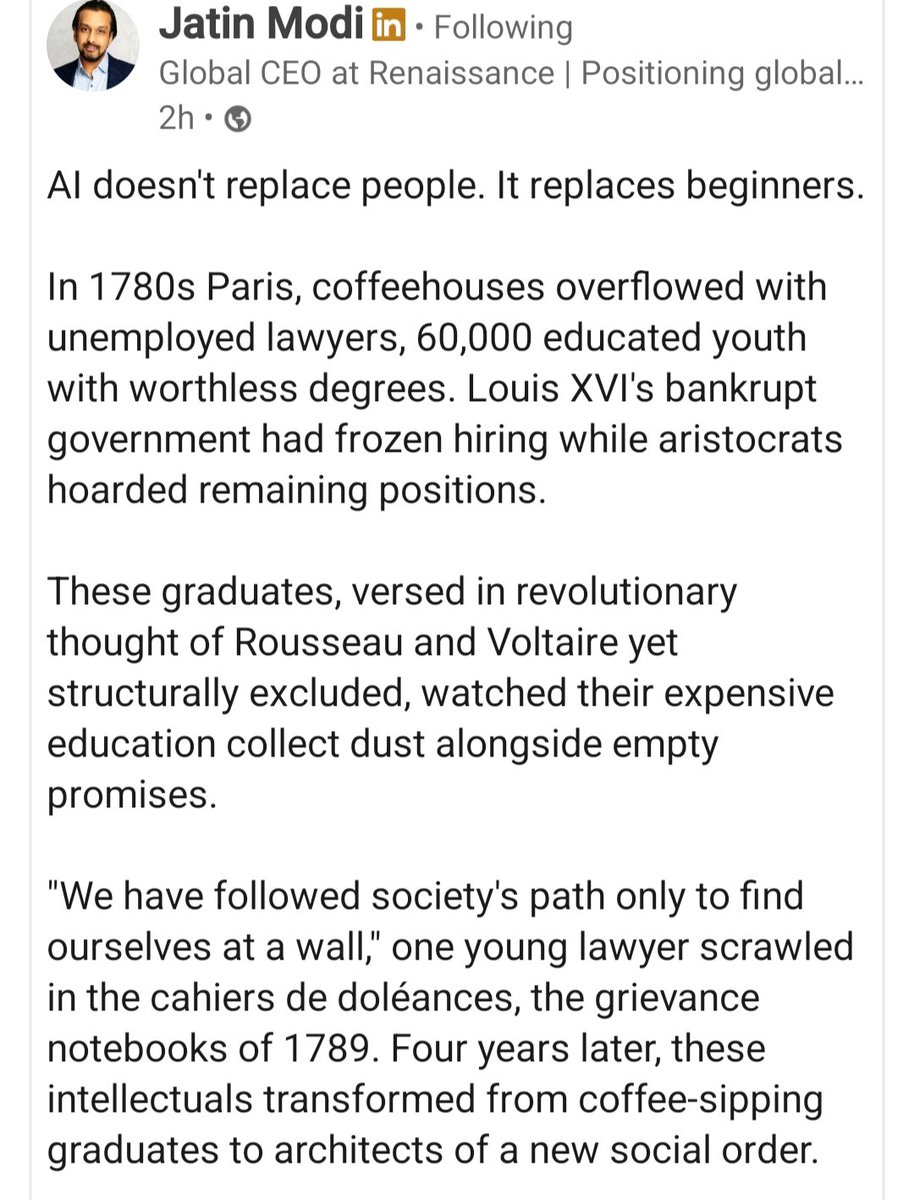
This redundancy is what leads to @Peter_Turchin's Elite Overproduction'. Too many people with vaunted higher education and superfluous diplomas that the market doesn't value, leading to bitter turf wars and zero-sum competition to grab limited spots available in high echelons.
Aditya Chaturvedi tweet media
English
1
17
37
5.7K
Aditya Chaturvedi
Aditya Chaturvedi@ACphenomen·
What @TVKVijayHQ has achieved in Tamil Nadu elections is nothing short of an epoch-defining paradigm-shift. A total smashing of the Overton window. The 50 year duopoly of Dravidian parties, fuelled heavily by local nexuses & massive doles and giveaways, has been trounced.
English
0
0
0
28
Aditya Chaturvedi
Aditya Chaturvedi@ACphenomen·
7) The election was majorly about aspiration and the desire to break free from the old and stifling system of institutionalized de-growth, glaring hypocrisies, and harking back to nostalgia of the old times as a cope.
English
0
0
1
14
Aditya Chaturvedi
Aditya Chaturvedi@ACphenomen·
5) Apparently, there was no en bloc voting by what's identified as the strongest constituency of TMC, the rural Mahilas. 6) Minorityism in Indian politics is on death-spiral. The coalition of women voters+ developmental state+led welfarism + regional issues have replaced it.
English
1
0
1
17
Aditya Chaturvedi
Aditya Chaturvedi@ACphenomen·
There are a few points that the mandate in #WestBengal has conclusively proven: 1) The Insider-Outsider narrative was a social media hit-job not the pulse of the ground. The rank & file Bengali associates squarely with Indian mainstream, rather than some 1970s retro vintage.
English
1
0
1
49
Aditya Chaturvedi retweetledi
Daniel Steinmetz-Jenkins
Daniel Steinmetz-Jenkins@daniel_dsj2110·
"Marcuse began in Germany in the twenties by being something of a serious Hegel scholar. He ended up here writing trashy culture criticism with a heavy sex interest." --Allan Bloom, Closing of the American Mind
English
2
8
55
6.2K
Aditya Chaturvedi retweetledi
Jesús Fernández-Villaverde
Jesús Fernández-Villaverde@JesusFerna7026·
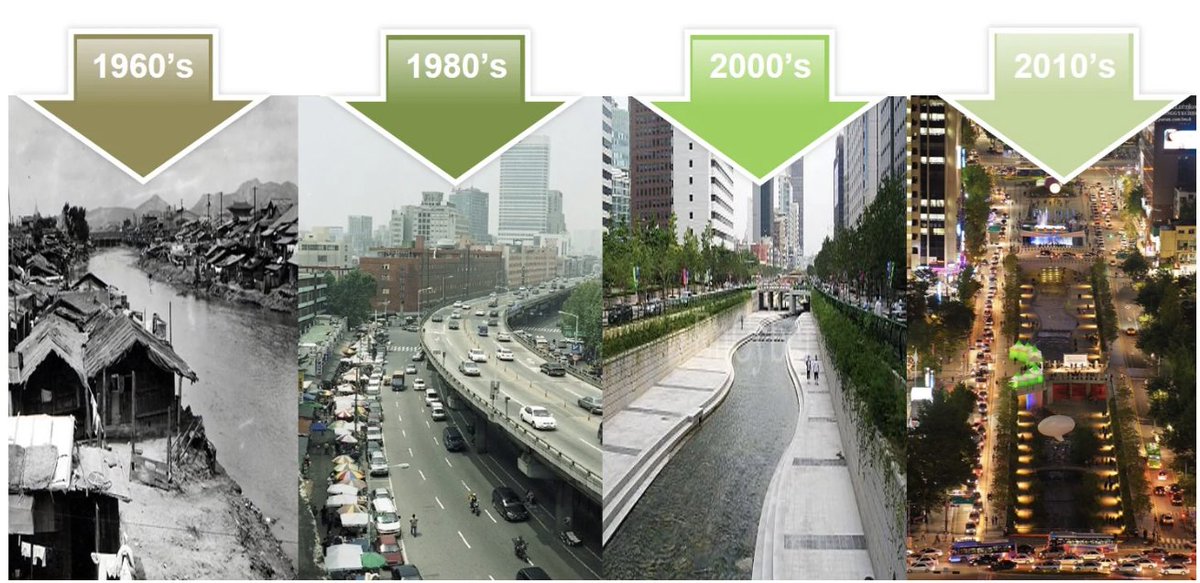
A fundamental lesson from my posts these last two weeks on modernization, industrial policy, and development is that development economics should be about understanding why South Korea got rich but Bolivia did not. The current field has largely given up on that question. Sharply identified RCTs on small micro programs are a fine way to publish in the AER and get tenure at a fancy university, but a profession that knows everything about microfinance impact evaluations and almost nothing about industrialization has misallocated its own intellectual capital on a pretty heroic scale. Four images of Seoul:
Jesús Fernández-Villaverde tweet media
English
73
300
1.7K
525.6K
Aditya Chaturvedi
Aditya Chaturvedi@ACphenomen·
@Aunindyo2023 Bengal owed it's growth and headstart in big conglomerates due to a peculiar milieu of Boxwaalahs, totally a creation of the British Empire that continued haltingly till the late 1960s.
English
0
0
1
89
Aunindyo Chakravarty
Aunindyo Chakravarty@Aunindyo2023·
The Truth about Bengal's De-industrialisation In 1947, Bengal was the most industrialised province in India, with one-fourth of all registered factories, and 24-27 percent of industrial output. But these figures hide some important truths: a) Bengal's key industries largely produced raw materials and inputs: jute, coal, iron & steel, and tea. b) They were overwhelmingly owned by non-Bengalis, and c) The condition of the working class was abysmal. The largest of the capitalist groups were British expatriates who operated through managing agencies - Andrew Yule, Bird & Co., Williamson Magor, McLeod & Co., Begg Dunlop, etc. As late as 1955, more than two-thirds of India's diversified business groups were British owned conglomerates with headquarters in Calcutta. The second big group was Marwari trading capital - Birlas, Goenkas, Bangurs, Khaitans, Kanorias, Jalans, Bajorias, etc. British control was finally dismantled after the Hazari Reports of 1964 and 1966, and the Monopolies Inquiry Commission of 1965. This accelerated the transfer of corporate control from the British to the Marwaris - something that had already started in the early 1950s. The buyouts were financed by private banks, share market manipulations, and even funds diverted from worker PFs. The focus was on arbitrage earnings, rather than expanding production. What broke Bengal's back, however, was the Freight Equalisation Act of 1956. Before 1956, it made sense to set up factories close to the source of coal, and iron ore. And that gave Bengal its unique advantage, since it was the hub of the mineral wealth of the eastern states. But the Freight Equalisation Act brought in by the Nehru government removed that advantage, by subsidising the flow of raw materials to other states. This meant that factories could be set up elsewhere and didn't need to be concentrated in Bengal. Within a few years, Maharashtra was receiving many more industrial licences than Bengal, and by 1964, well before the Left came to power, Bombay's factories were employing 13.5 lakh workers, compared to Bengal's 8.8 lakh. What about workers? Bengal's jute, steel and mining companies were notorious for exploiting workers. This became a cause of struggle under the national movement as long as their employers were British. But even after the transfer of ownership, the conditions of Bengal's working class continued to be terrible. Even in the early-70s, their wages were about a third less than what workers earned in Maharashtra, and surveys showed they suffered from chronic work-related ailments. That was the ground on which Bengal's militant labour movement arose and then intensified from the mid-1960s. The Left and socialist parties rode on the anger and frustration of industrial workers, miners, and of course, share-croppers. The 1967 United Front govt, brought SUCI's labour leader, Subodh Banerjee, to the labour minister's chair. He would come to be known as 'gherao minister.' Gheraos increased dramatically, and industrial stoppages rose from 179 in 1965 to 894 in 1969. The Left's political obligation was towards workers - not their employers. This accelerated the flight of capital that had already started two decades earlier. Equally important was the collapse of the global demand for jute, which was once the mainstay of Bengal's industry. Along with that the nationalisation of coal by Indira Gandhi also removed another important magnet for private capital in the region. The end of the licence-quota raj after the mid-1980s, caused a massive migration of capital from pro-worker states to pro-employer states. The Left Front's initial strategy was to implement land reforms, and generate capital formation in agriculture. While there is no doubt that Operation Barga was the most successful example of land reforms in India, the LF completely failed in its programme to create rural industries. This was despite the CPIM's trade union, CITU, becoming largely an industrial peace broker, shedding its old militant stance. By 1991, the number of stoppages had dropped to 192 (from 894 in 1969) out of which only 32 were because of workers' strikes. Most of the industrial stoppages were because of employers locking their factories and leaving. By 2003, mandays lost in West Bengal due to lockouts by owners was 16x that of what was lost due to workers' strikes. Of course, this was because other states were much more capitalist-friendly than West Bengal, and were much more open to implement anti-worker 'labour-reforms.' The biggest example of that was the suppression of the long textile workers' strike in Mumbai. The Left Front, under Buddhadeb Bhattacharjee tried its best to compete with other states to present a business-friendly image. It succeeded as well, in attracting capital into real estate, establishing SEZs across the state, and even getting the Tatas to invest in Singur. The rest, of course, is history. The question remains - why did the Bengalis not develop their own capitalist class? That is an entirely different story.
English
74
187
608
57.4K
Aditya Chaturvedi
Aditya Chaturvedi@ACphenomen·
@JesusFerna7026 Historian John Lukacs got it right. Nationalism, not Communism or Fascism, was the leitmotif of the late 19th century and the entire 20th century.
English
0
0
0
194
Jesús Fernández-Villaverde
Jesús Fernández-Villaverde@JesusFerna7026·
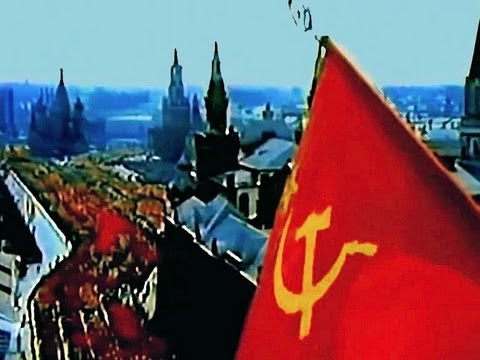
Since today is May Day, it would be fun to show how modernity and capitalism are related yet distinct by analyzing the video of the Soviet Anthem that was broadcast twice a day on Soviet State TV around 1984. I do this exercise with my students at UPenn when we cover the economic history of the Soviet Union (yes, I spent too much time covering it every semester), and they always enjoy it quite a bit. youtube.com/watch?v=rHomET… The video loops twice over the Anthem, once with subtitles in Russian and English and once with subtitles in Russian and Spanish. We open with a shot of the Kremlin in Moscow, and we are told that we have “An unbreakable union of free republics, The Great Rus’ has sealed forever.” There you have it: right off the bat, nationalism, a fundamental aspect of modernity. Yes, we are free republics, but the Russians are really in charge. If you are Georgian or Latvian, smile and accept your destiny. If the 20th century taught us anything, it is that Marx got it wrong: religion is not the opium of the masses; nationalism is the crack cocaine, much more powerful and addictive. Then we switch to the ultimate symbols of modernity: a rocket about to launch (yes, a bit of a phallic symbol right there), a gigantic steelworks (nothing a good communist loves more than steel) with a manly man working on it (gendered forms of labor), and oil drills (fossil capital and CO2 emissions all around; wasn’t capitalism supposed to be about fossil fuels? Well, never mind). We continue with more manly men, dirty from hard but very manly work, building pipelines, big dams that dominate nature, trains, and nuclear power plants. No tree-hugging here: socialism is about exploiting nature, and you should get the point! Now that we have established that this business of the Soviet Union is a creation of the Russians to quickly industrialize the land and dominate nature, we move on to show what we get out of it. First, a hospital that gives strength to the people (picking a child delivery is not casual either), a cosmonaut, and the rocket, finally firing off! We are achieving, people! A good moment to loop back into history: the October Revolution (shots from Eisenstein’s movie), our holy father, Lenin, and how he led to more factories, more dams, and our ultimate legitimizing instrument: victory over fascism in World War II. This seems a good moment to pivot to the modern Soviet armed forces: jets, a Victor-class nuclear submarine, paratroopers, and frontier guards (do not think about leaving without a permit! The home of the free is, more than anything, home). Well, it is time to go back to the farmers now. We start with a handsome Russian farmer, and then we have a couple of Central Asians (not many minorities so far in the video, so we need some diversity casting) with cotton and grain from the big plains of Asia (talking about ecological degradation, nothing beats what the Soviet Union did with cotton). Next, some miscellaneous accomplishments: a nuclear icebreaker (I believe it is from the Arktika class; yes, a true communist loves nuclear power; renewables are for petit bourgeois professors of English in California who believe in silly “degrowth” ideas), health and education services for minorities, and rail tracks. Time to return to manly men building manly things like trucks and ships, to introduce Andropov, addressing all of us under Lenin’s statue (a fantastic shot), and to the May Day parade (this is why I am showing this video today), with a final close-up of the Lenin banner. We wrap by returning to the very beginning: the Kremlin. As a piece of propaganda, this is magnificent work. The music by Alexander Vasilyevich Alexandrov is moving, classical but not stuffy; the lyrics (1977 version) get all the messages across, and the selection of visual themes has been curated with incredible care. I like to show propaganda videos of regimes (including those from other totalitarian regimes) because they document how the regime wanted to be seen. I am not the one selecting the message; the Soviet Union leadership is. And it is selecting a message of modernity: big factories, rockets, hospitals, nuclear power, and oil wells. If your analytic framework cannot distinguish between modernity and capitalism, as most social theory cannot today, you are at a deep loss when trying to understand the Soviet Union. You are even more at a loss to understand why socialism was so attractive in the 20th century. Socialism promised underdeveloped countries a faster route to modernity. If you were a young Honduran in 1960 or a young Egyptian in 1962, you fell in love with socialism because you thought it could deliver modernity faster and better. Socialism was the ultimate engine of modernity. “Degrowth” is only for sociology lecturers with bad hairdos. Nobody with half a brain takes it seriously. But most contemporary social theorists, which are activists, not scholars any longer, are only interested in criticizing capitalism, so they pile onto it a list of flaws, including nationalism, fossil fuel consumption, the use of nuclear power, the gendered division of labor, bureaucratic gigantism, inequality of income, wealth, and power, and many other phenomena that, at their very core, are about modernity, not about capitalism per se. Their own ideological narrowness leads to a lack of nuance and theoretical blind alleys that are driving most of social theory to absolute irrelevance. It is a pity, because we need social theory more than ever.
YouTube video
YouTube
English
17
79
323
61.9K
Aditya Chaturvedi
Aditya Chaturvedi@ACphenomen·
@sabeer Roti + Kapda + roof over head is very late 60s/ early 70s bollywood type trope rather than absolute reality. India has grown by leaps & bounds since then. As per Maslow's Hierarchy of Needs, people everywhere are more assertive, aspirational, and searching their actualization.
English
0
0
0
22
Sabeer Bhatia
Sabeer Bhatia@sabeer·
The Indian mind isn’t lacking innovation-it’s stuck in survival mode. When your subconscious is wired for “roti, kapda aur makaan,” imagination takes a back seat. Survival first. Innovation later.
English
91
118
639
10K
Aditya Chaturvedi
Aditya Chaturvedi@ACphenomen·
Demography is destiny. Yes. A mix of internal migration+ grassroots empowerment often fills the gaps. The obsession to control/ engineer birth rates is counterproductive and comes along with unforeseen second order effects. A recipe worst than the ailment.
Aditya Chaturvedi@ACphenomen

@marinebharat @MCA21India @PiyushGoyal LOL. You are sounding like an acolyte of Romanian commie dictator Nicolae Ceausescu. Read Freakonomics as 101 primer to understand the nuances of demographics and unintended consequences of state interventionism in population before ringing alarm bells.

English
0
0
0
48
Aditya Chaturvedi
Aditya Chaturvedi@ACphenomen·
@marinebharat @MCA21India @PiyushGoyal LOL. You are sounding like an acolyte of Romanian commie dictator Nicolae Ceausescu. Read Freakonomics as 101 primer to understand the nuances of demographics and unintended consequences of state interventionism in population before ringing alarm bells.
English
0
0
1
110
InfraStory
InfraStory@marinebharat·
60% of the Jobs in LARGE CORPORATES should be reserved for Married people with Kid/Kids Need to punish Double Income No Kid ideology couples DINK ideology is huge threat for Indian Economy whose consequences will be borne by Future Generations .@MCA21India .@PiyushGoyal 🙏
English
224
147
900
70.1K
Aditya Chaturvedi
Aditya Chaturvedi@ACphenomen·
@talk2anuradha False Equivalence. Overall fertility rate as well as children per household have drastically reduced over the past decades all across. The folks on doles with half dozen kids doesn't correspond with reality, especially among Hindus, both rural + semi urban.
English
0
0
1
41
Anuradha Tiwari
Anuradha Tiwari@talk2anuradha·
The real issue is not - DINK (Double Income & No Kids) The real issue is people living on subsidies & freebies are having 4-5 kids. This will create a massive imbalance in coming years!
English
169
1.1K
6.2K
69K
Aditya Chaturvedi
Aditya Chaturvedi@ACphenomen·
@ShreeHistory Ability is nothing without opportunity. And unsung genius/ unrecognised talent is almost proverbial. Holds true everywhere. That's why we need to widen the net of opportunity through knowledge sharing and investments to create a level-playing field.
English
0
0
1
33
History इतिहास 🇺🇲🛕 🚀
One of the best coder I have ever hired came from very disadvantaged class in Rajasthan and had below mediocre credentials from a third tier college in third tier city. Yet, he churned out most productive code. Vembuji also probably sees this in his company. India has very deep and wide talent pool. This talent pool is able to escape the draconian restriction of "reservation" because of the private institutions and private investment that creates jobs. Because this talent pool exists, the damage from the reservation is not still impacting private industry. If India has to become world beating, the merit must be promoted.
Sridhar Vembu@svembu

This topic of reservation comes up often in these threads. People don't seem to realise that American universities have had strong Affirmative Action and Asian American kids (including Indian American kids) need far higher grades and test scores to get into top Universities. This is absolutely true in California even now - even though the law prohibits it and the Universities will deny it! On the other side, Zoho has thrived in Tamil Nadu and both AIADMK (MGR initiated the massive increase in reservation quota in early 1980s in higher education) and DMK have long maintained the same reservation policy here. It is a political non-issue in Tamil Nadu. Zoho has benefited from and has in turn benefited all the communities in Tamil Nadu. When private sector investment is strong (as has been the case in Tamil Nadu) reservation policy in education can help to create a bigger talent pool. When private sector investment is low, society becomes a zero sum game. This is why we must work to boost private sector investment in a big way, rather than fight about reservation. I repeat: Universities in California have very strong Affirmative Action programs too. And California also has had strong private sector investment.

English
12
73
345
16.4K
Stephen R. C. Hicks
Stephen R. C. Hicks@SRCHicks·
Jean-Paul Sartre's consumption habits, according to Thomas Szasz's “The Theology of Medicine”: "What Jean-Paul Sartre regularly consumed over a 24-hour period while writing The Critique of Dialectical Reasoning ...: at least a quart of alcohol, often more, including wine, beer, vodka, whiskey, various liqueurs; 200 milligrams of amphetamines; 50 grams of aspirin; several grams of barbiturates, two packs of cigarettes (unfiltered Gauloises Caporal), several pipes stuffed with black tobacco, two pots of coffee, tea, and three rich meals, usually featuring tripe, and the specialities of his natural habitat, the Cafe de Flore, boiled eggs and Welsh rarebit slathered in Scottish ale and Worchester sauce." Nausea, indeed.
English
31
29
192
22.1K
Aditya Chaturvedi retweetledi
Ho-fung Hung
Ho-fung Hung@hofunghung·
good to see the renewed serious debate about $ hegemony (again). so many recent good books on this topic that i roughly classify into the $ hegemony is always secured b/c of TINA camp & $ hegemony is vulnerable b/c of US problems (institutional & fiscal) camp .. 1/2
Ho-fung Hung tweet mediaHo-fung Hung tweet mediaHo-fung Hung tweet mediaHo-fung Hung tweet media
English
2
46
279
12.9K