Alumni for Free Speech

768 posts

Alumni for Free Speech banner
Alumni for Free Speech

Alumni for Free Speech

@AFFSUK

Passionate about free speech in Universities? Follow us! We say "YES, DEBATE".

United Kingdom Katılım Eylül 2022
250 Takip Edilen1K Takipçiler
Alumni for Free Speech retweetledi
Committee for Academic Freedom
It is with great sadness that we announce the death of Lord Robert Skidelsky, historian, economist, and a founding member of CAF. Robert was a steadfast defender of free speech and academic freedom, and a shining exemplar of intellectual independence. He was also among the first to recognise the emerging dangers of “safetyism” on campus, an issue he addressed with characteristic clarity in a speech delivered in the House of Lords on 26 November 2015. We reproduce it below in full: I shall draw your Lordships’ attention to two threats to free speech on the campus. In four minutes I have time for only two threats, but I think that they cover most of the ground. The first threat comes from the Government. The state has a duty to protect its citizens from terrorism. The Government have conceived of that duty in part as preventing university students from being what they call “radicalised”. The Counter-Terrorism and Security Act 2015 requires universities to “prevent individuals from being drawn into terrorism”. This is construed as part of their duty to “care” for “vulnerable” students. Universities are required to assess the risks of students being drawn into terrorism and extremism, and to train staff how to assess those risks and “challenge extremist ideas”. Universities must seek government guidance on which speakers to allow on campus. In this guidance terrorism and extremism are frequently conflated, as the noble Lords, Lord Pannick and Lord Lester, have pointed out, although very occasionally the drafters remember that one can hold extremist views without being a terrorist. I turn to the second threat. The National Union of Students has opposed the Counter-Terrorism and Security Act on the grounds that it will lead to mass campus surveillance and the criminalisation of Muslims and black people. The universities should be kept as “open democratic spaces”. All this would carry more conviction if student bodies were not themselves a big threat to free speech on the campus. Student unions in many universities run “no platform” policies for speakers whose views they consider reprehensible, even though they are legal. For the NUS—and this is the key—keeping students “safe” is paramount. Bristol University Students’ Union runs a “safe space” policy aimed at ensuring students’ safety from harassment. However, keeping students safe turns out to include keeping them “safe from radicalisation”. So, despite the verbal skirmishes, the Government and students are quite united on the need to protect students from harmful ideas, differing only slightly in their definition of what they regard as harmful. I must come clean: I hate the doublespeak that runs through the public pronouncements that I have read on this topic. How Orwell would have shuddered. The facts are pretty clear: universities have a statutory duty to uphold free speech and are bound by the Public Order Act to ban incitement to racial and religious hatred. So they have a duty to uphold free speech within the law. Similarly, the security forces have a duty to keep the country safe from terrorism wherever it sprouts—prevention does not stop or continue on the campus. What I deny is that university students are an especially vulnerable species needing special protection against being abused or radicalised. Students are adults: they can vote, fight and die for their country, drive, drink alcohol and so on. Why should they be treated as adults in one branch of life and as children in another? In particular, I think it is an abuse of thought and language to extend the good liberal notion of protecting people against harms to the decidedly unliberal notion of protecting them against harmful ideas.
Committee for Academic Freedom tweet media
English
8
44
122
37.8K
Alumni for Free Speech retweetledi
Academics For Academic Freedom
Academics For Academic Freedom@AFAF_freespeech·
Excellent and on going work from our friends @AFFSUK
Alumni for Free Speech@AFFSUK

Over the past six months, Alumni for Free Speech (AFFS) has intensified its scrutiny of UK universities’ recruitment practices, focusing in particular on EDI-related requirements in academic job adverts. This matters because recruitment is a key moment at which institutional culture is set: the criteria used to select staff shape, over time, what can be thought, said, and researched within the academy. Where universities tell applicants they must “demonstrate” a commitment to EDI, particularly as an “essential” criterion, they risk serious #freespeech compliance failures under the Higher Education (Freedom of Speech) Act. AFFS has written repeatedly to universities where we identify such practices, warning that these requirements are likely unlawful or non-compliant and, where institutions have refused to change course, has reported them to the Office for Students. That pressure is already having an effect. A significant number of universities have taken substantive steps to bring themselves into compliance — an indication of what sustained, targeted campaigning can achieve. Our interim update sets out more of what we’ve been doing over the past six months: affs.uk/wp-content/upl… You can also join AFFS here — it’s completely free! affs.uk/join

English
0
8
14
553
Alumni for Free Speech
Over the past six months, Alumni for Free Speech (AFFS) has intensified its scrutiny of UK universities’ recruitment practices, focusing in particular on EDI-related requirements in academic job adverts. This matters because recruitment is a key moment at which institutional culture is set: the criteria used to select staff shape, over time, what can be thought, said, and researched within the academy. Where universities tell applicants they must “demonstrate” a commitment to EDI, particularly as an “essential” criterion, they risk serious #freespeech compliance failures under the Higher Education (Freedom of Speech) Act. AFFS has written repeatedly to universities where we identify such practices, warning that these requirements are likely unlawful or non-compliant and, where institutions have refused to change course, has reported them to the Office for Students. That pressure is already having an effect. A significant number of universities have taken substantive steps to bring themselves into compliance — an indication of what sustained, targeted campaigning can achieve. Our interim update sets out more of what we’ve been doing over the past six months: affs.uk/wp-content/upl… You can also join AFFS here — it’s completely free! affs.uk/join
Alumni for Free Speech tweet media
English
0
8
15
1K
Alumni for Free Speech retweetledi
Committee for Academic Freedom
🚨 Abertay University has completed a five-month investigation after receiving hundreds of complaints over a lecture on the operation of rape law within the criminal justice system. In October 2025, senior sociology and criminology lecturer Dr Stuart Waiton invited Justice for Innocent Men Scotland operations director Marsha Sturgeon to speak to students in a session that included claims about wrongful rape convictions. The lecture prompted public criticism, protests, and calls for course material to be reviewed. Abertay’s investigation, led by two members of the university’s senior management team, has now concluded, finding no breach and determining that the session was “appropriate in the context of this criminology module”. None of the more than 300 complaints was upheld. A criminology lecturer inviting an external speaker to discuss contested issues in criminal justice is exactly the kind of academically grounded, real-world engagement universities should support. The investigation reached the right conclusion, but Dr Stuart Waiton should never have been placed in this position in the first place—particularly in response to a wave of largely external complaints. Universities should be led by academic judgment, not organised campaigns. If lawful teaching is retrospectively subjected to tighter controls, the locus of control shifts from individual academics to central management. The chilling effect is obvious, and the long-term cost to academic freedom significant.
Committee for Academic Freedom tweet media
English
2
22
60
5.6K
Alumni for Free Speech
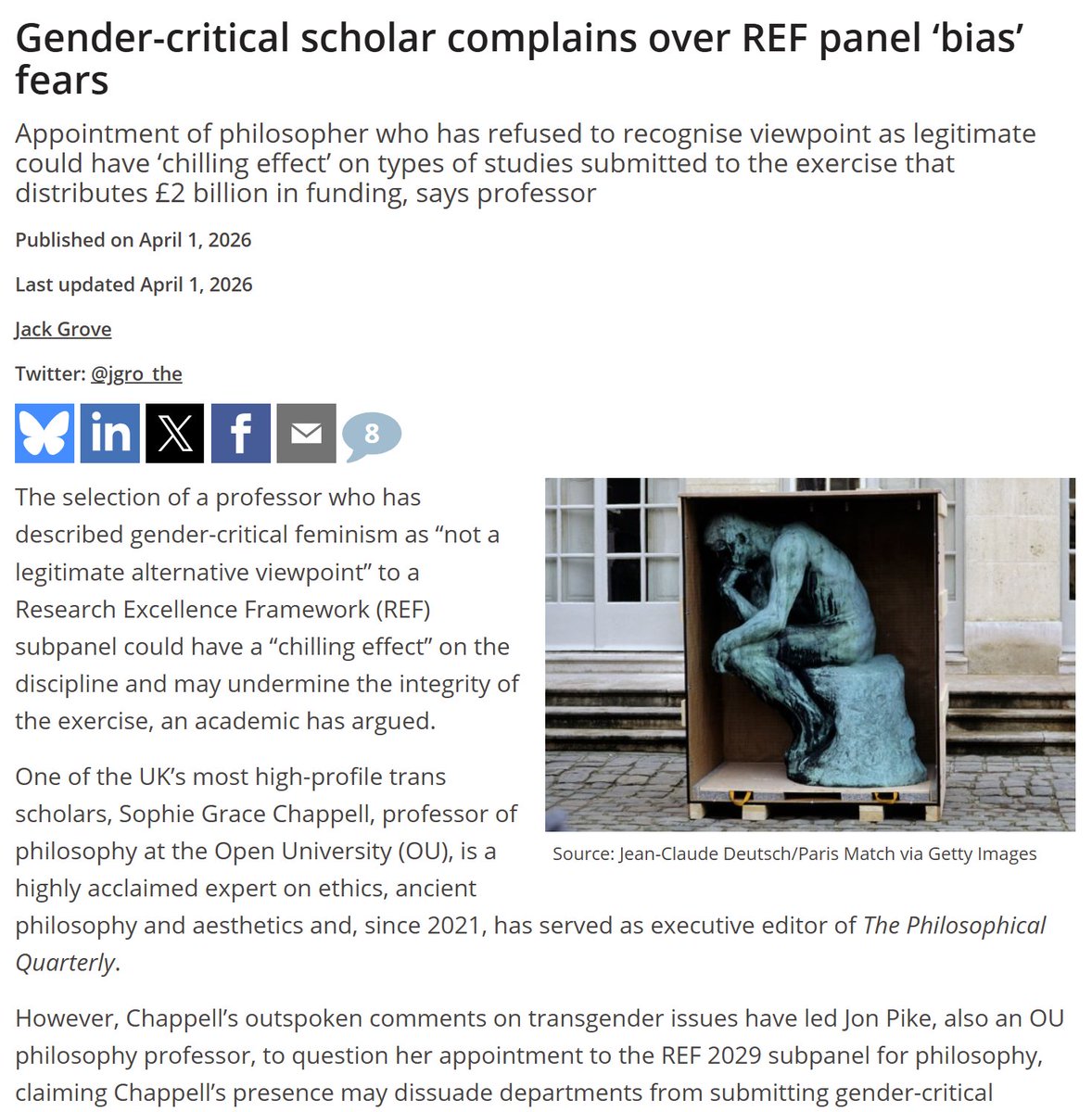
A complaint has been lodged over the appointment of a REF 2029 philosophy panel member responsible for judging research submissions who has publicly dismissed gender-critical views—protected under the Equality Act 2010 and forming part of mainstream research in the social sciences and arts—as “a cult of cruelty and exclusion”. With REF decisions shaping £2bn in research funding, concerns about impartiality, and a potential chilling effect on submissions, raise deeper questions about a system already criticised for reducing academic work to audit-driven metrics.
Alumni for Free Speech tweet media
English
1
4
7
245
Alumni for Free Speech
A criminology lecturer inviting an external speaker to discuss contested issues in criminal justice is exactly the kind of academically grounded, real-world engagement universities should support — so Abertay University was right to find no wrongdoing. The institution’s five-month investigation, prompted by more than 300 complaints, found no breach. Students who were actually present described the session as “fairly standard” and told investigators that they “did not recognise” the events in the lecture room from the descriptions later posted on social media. And yet, despite the investigation finding the session “appropriate in the context of this criminology module”, its recommendations are cause for concern: more guidance on trigger warnings, tighter oversight of external speakers, and greater managerial awareness of “controversial” teaching. With 86% of complaints coming from outside the university, this risks allowing externally mobilised campaigns, often driven by online reaction, to shape academic content. Universities should be led by academic judgment, not organised campaigns. If lawful teaching is retrospectively subjected to tighter controls, the chilling effect is obvious — and the long-term cost to academic freedom significant. thecourier.co.uk/fp/news/546242…
English
0
5
19
2.3K
Alumni for Free Speech retweetledi
Denise Fahmy
Denise Fahmy@DeniseFahmy·
If any senior managers in museums are actually using @uniofleicester 's new trans inclusive culture 'guidance' published by @LeicsMusStud - it's worth them bearing in mind that in my employment tribunal, when I experienced discrimination because of my my gender critical views, my employer, @arts_national, failed, in their defence, to prove they took all reasonable steps to prevent their staff from acting in an unlawful discriminatory way (EA section 109(4)). Museum and cultural leaders are advised to treat this 'guidance' very carefully .... with a barge pole. transinclusiveculture.le.ac.uk/wp-content/upl…
English
2
134
475
11.8K
Alumni for Free Speech retweetledi
Committee for Academic Freedom
Committee for Academic Freedom@ComAcFreedom·
🚨BREAKING: After an intervention by CAF, three colleges at the University of Cambridge have amended their #freespeech codes and reaffirmed protections under the Equality Act 2010 for students with gender-critical beliefs! The development follows concerns raised by CAF about the treatment of gender-critical students, including Christ’s College undergraduate @theasewell05, a founder of the Cambridge University Society for Women (CUSW), the only openly single-sex society for women at Cambridge. Sewell experienced sustained hostility after fellow students discovered that she had attended a talk by @HJoyceGender and read Trans: When Ideology Meets Reality. Within days, relations within her college deteriorated: she was confronted by fellow students, labelled a “bigot”, and ostracised. CAF Research Manager Freddie Attenborough wrote about her ordeal for The Critic here: thecritic.co.uk/the-dark-reali… In our letter to the Vice-Chancellor, we pointed out that gender-critical belief is a protected philosophical belief under the Equality Act and that conduct directed at Sewell and her CUSW colleagues on that basis may fall within the University’s own definitions of harassment and abusive behaviour. We also noted that the University’s Code of Practice on Freedom of Speech, together with its harassment procedures, already prohibits conduct that interferes with lawful speech or creates an intimidating or hostile environment. On that basis, we asked what steps Christ’s, in particular, had taken to enforce those rules. The letter also raised concerns about inconsistency between colleges. Accounts provided to CAF suggested that students holding gender-critical beliefs may receive markedly different levels of pastoral support depending on their college and the stance taken by individual tutors or senior staff. Finally, we identified inaccuracies in several college free-speech codes, which incorrectly stated that the Office for Students free-speech complaints scheme was already operational, directing students to a route of escalation that does not yet exist. In its response, the University confirmed that Christ’s, Newnham and Lucy Cavendish — the colleges attended by the CUSW’s founders — have now updated their codes and reaffirmed the rules governing freedom of expression and harassment. Read the full story here: afcomm.org.uk/2026/04/01/caf…
Committee for Academic Freedom tweet media
English
67
592
2.8K
46.8K
Alumni for Free Speech retweetledi
Alumni for Free Speech
UPDATE: AFFS is currently undertaking a major project examining the increasingly common practice of universities in England, Wales and Scotland requiring applicants for academic posts to demonstrate commitment to contested equality, diversity, and inclusion (“EDI”) frameworks. In many cases, such requirements are difficult to reconcile with universities’ legal obligations to protect academic freedom and freedom of speech. AFFS has now reviewed 164 universities in total and written to 69 raising concerns about potentially unlawful or non-compliant job advertisements. Following engagement from AFFS, 16 institutions — nearly a quarter of those contacted — have already revised their approach. Others, however, have failed or refused to act. In the case of English providers, AFFS has reported such concerns to the Office for Students, the regulator for higher education in England. Reported cases have included Anglia Ruskin, Birmingham Newman, Brunel and Harper Adams. The emerging picture suggests a growing divergence across the sector: while some institutions are engaging constructively and taking steps towards compliance, others appear content to maintain practices carrying significant legal risk. AFFS’s full report, due in May, will set out these findings in detail and is likely to raise serious questions about sector-wide compliance. Further updates will be shared in due course. Previous AFFS work on EDI in recruitment: affs.uk/edi-requiremen… AFFS research identifying a correlation between EDI spending and free speech non-compliance: affs.uk/edi-spending-c…
Alumni for Free Speech tweet media
English
0
10
17
1.7K
Alumni for Free Speech retweetledi
Professor Alice Sullivan
Professor Alice Sullivan@ProfAliceS·
"This pattern – bold characterisation, thin engagement – is worth flagging because it illustrates a broader tendency in debates about free speech and EDI. The data and the arguments in the AFFS report are there for anyone to read and scrutinise, and they deserve scrutiny that actually grapples with what the report says rather than with what critics would prefer it to have said." @AFFSUK wonkhe.com/blogs/edi-evid…
English
2
13
24
1.9K