Sabitlenmiş Tweet
Clinical AI
41 posts

Clinical AI
@AIForDoctors
Helping doctors understand AI Clinical ML • Medical AI • Healthcare GenAI Building in public
Katılım Mayıs 2026
5 Takip Edilen2 Takipçiler

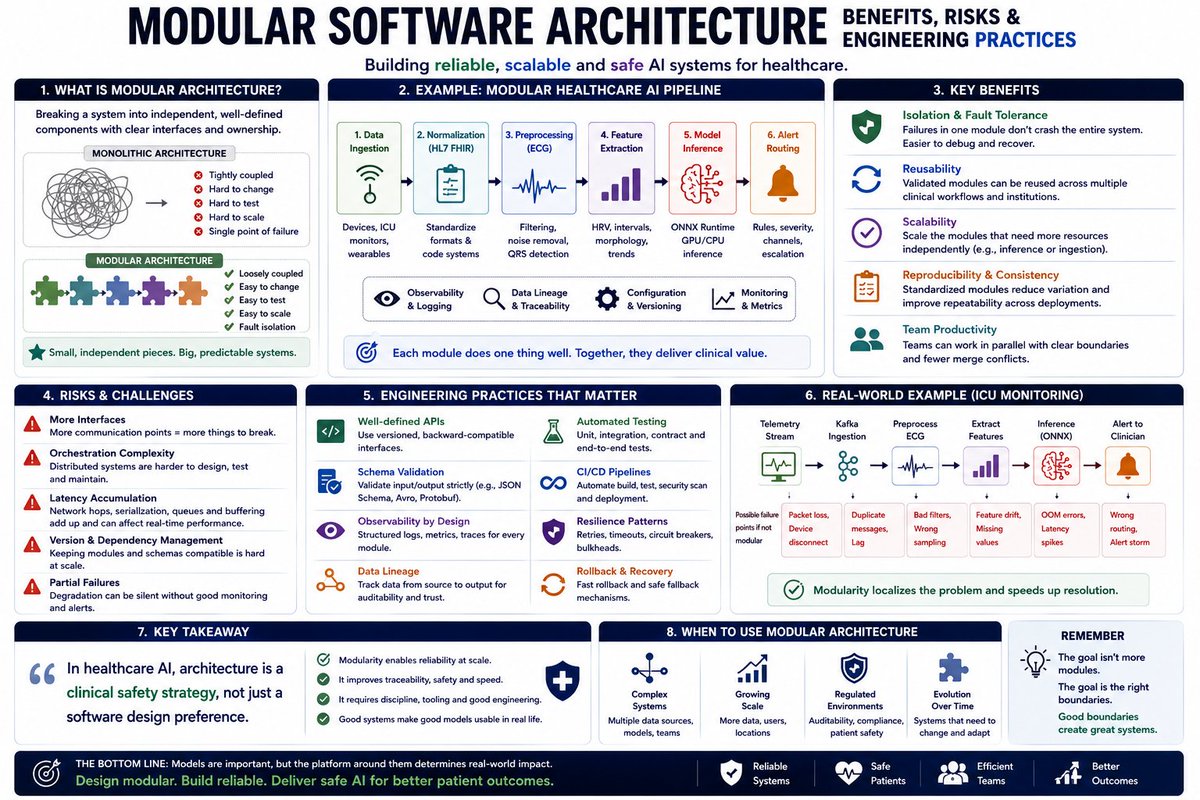
One of the most important shifts happening in healthcare AI is architectural, not algorithmic.
As clinical AI systems grow larger, modular software architecture is becoming essential for reliability, reproducibility, and patient safety.
A modular architecture breaks a system into independent components with clearly defined responsibilities.
Instead of one tightly coupled pipeline, the system contains separate modules for:
- telemetry ingestion
- HL7 FHIR normalization
- ECG preprocessing
- feature extraction
- model inference
- alert routing
- visualization
At first glance, this sounds like a pure engineering decision.
In reality, it has direct clinical consequences.
Consider a real-time ICU monitoring platform.
If an arrhythmia alert behaves incorrectly, clinicians and engineers need to determine quickly:
- Was the waveform corrupted?
- Did timestamp synchronization drift?
- Was there packet loss in telemetry ingestion?
- Did feature extraction fail?
- Did inference latency increase?
- Was alert routing delayed?
In monolithic systems, these failures become extremely difficult to isolate.
Modular systems improve:
- observability
- debugging
- reproducibility
- validation
- fault isolation
- deployment consistency
That matters enormously in medical AI.
A reusable ECG preprocessing module, for example, can be independently validated and reused across multiple clinical workflows:
- ICU telemetry
- wearable monitoring
- arrhythmia detection
- deterioration prediction
This reduces silent inconsistencies between deployments.
But modularity also introduces new risks.
Distributed systems create:
- orchestration complexity
- dependency management challenges
- interface mismatches
- latency accumulation
- version synchronization problems
Complexity does not disappear.
It relocates.
This is why mature AI systems require strong engineering practices:
- schema validation
- versioned APIs
- observability tooling
- Kafka event tracing
- audit logging
- rollback systems
- CI/CD validation pipelines
Especially in healthcare environments where failures directly affect patient care.
The deeper systems insight is fascinating:
Large healthcare AI platforms increasingly resemble hospital systems themselves.
Independent specialized units.
Shared communication protocols.
Escalation pathways.
Coordinated workflows.
At scale, software architecture begins mirroring clinical workflow architecture.
And that may explain why many technically strong medical AI models still struggle after deployment.
The limiting factor is often not intelligence.
It is operational architecture.
Which do you think is currently the bigger bottleneck in healthcare AI deployment: model capability or systems engineering maturity?
#HealthcareAI #ClinicalAI #AIInMedicine

English

One of the most important shifts happening in healthcare AI is architectural, not algorithmic.
As clinical AI systems grow larger, modular software architecture is becoming essential for reliability, reproducibility, and patient safety.
A modular architecture breaks a system into independent components with clearly defined responsibilities.
Instead of one tightly coupled pipeline, the system contains separate modules for:
telemetry ingestion
HL7 FHIR normalization
ECG preprocessing
feature extraction
model inference
alert routing
visualization
At first glance, this sounds like a pure engineering decision.
In reality, it has direct clinical consequences.
Consider a real-time ICU monitoring platform.
If an arrhythmia alert behaves incorrectly, clinicians and engineers need to determine quickly:
Was the waveform corrupted?
Did timestamp synchronization drift?
Was there packet loss in telemetry ingestion?
Did feature extraction fail?
Did inference latency increase?
Was alert routing delayed?
In monolithic systems, these failures become extremely difficult to isolate.
Modular systems improve:
observability
debugging
reproducibility
validation
fault isolation
deployment consistency
That matters enormously in medical AI.
A reusable ECG preprocessing module, for example, can be independently validated and reused across multiple clinical workflows:
ICU telemetry
wearable monitoring
arrhythmia detection
deterioration prediction
This reduces silent inconsistencies between deployments.
But modularity also introduces new risks.
Distributed systems create:
orchestration complexity
dependency management challenges
interface mismatches
latency accumulation
version synchronization problems
Complexity does not disappear.
It relocates.
This is why mature AI systems require strong engineering practices:
schema validation
versioned APIs
observability tooling
Kafka event tracing
audit logging
rollback systems
CI/CD validation pipelines
Especially in healthcare environments where failures directly affect patient care.
The deeper systems insight is fascinating:
Large healthcare AI platforms increasingly resemble hospital systems themselves.
Independent specialized units. Shared communication protocols. Escalation pathways. Coordinated workflows.
At scale, software architecture begins mirroring clinical workflow architecture.
And that may explain why many technically strong medical AI models still struggle after deployment.
The limiting factor is often not intelligence.
It is operational architecture.
Which do you think is currently the bigger bottleneck in healthcare AI deployment: model capability or systems engineering maturity?
#HealthcareAI #ClinicalAI #AIInMedicine

English

@AIForDoctors Same in every domain — the model is 10%, the platform around it is 90%. AI-first means event-driven data + guardrails, not just weights.
English

Many discussions about healthcare AI focus almost entirely on model architecture.
Transformers. CNNs. Foundation models. Parameter counts.
But large clinical AI systems often fail because of something far less glamorous:
Poor software modularity.
Reusable functions are one of the hidden reasons modern AI systems scale reliably across hospitals, monitoring systems, and clinical workflows.
A reusable function is simply a standardized block of logic used repeatedly across multiple parts of a system.
In healthcare AI, that may include:
ECG preprocessing
waveform filtering
timestamp synchronization
HL7 FHIR normalization
medication parsing
deterioration score calculation
alert routing
At first glance, this sounds like a software engineering detail.
In reality, it directly affects clinical reliability.
Consider a continuous ICU monitoring platform.
If different teams independently rewrite:
QRS detection logic
missing-data handling
telemetry parsing
feature extraction pipelines
small inconsistencies begin appearing immediately.
One pipeline filters ECG noise differently. Another handles missing timestamps differently. A third normalizes laboratory values using a different reference range.
Suddenly the “same” medical AI model behaves differently across deployments.
This is one reason reproducibility becomes difficult in clinical AI systems.
Reusable functions solve this by creating standardized, independently testable components.
That improves:
reproducibility
debugging
deployment consistency
regulatory auditing
computational efficiency
The systems-level impact is enormous.
Instead of validating entire pipelines repeatedly, teams can independently validate:
waveform preprocessing
Apache Kafka ingestion
ONNX inference modules
Redis caching layers
FHIR event transformation pipelines
This makes large healthcare AI systems far more maintainable.
There is also a deeper architectural insight here.
Large AI systems increasingly resemble hospital systems themselves:
Specialized components. Shared protocols. Independent responsibilities. Standardized communication layers.
At scale, software architecture begins mirroring clinical workflow architecture.
And that may explain why many technically impressive medical AI systems still struggle after deployment.
The problem is often not intelligence.
It is operational consistency.
How much of healthcare AI reliability do you think depends more on software architecture than on the model itself?
#MedicalAI #ClinicalAI #AIInMedicine

English

@ILYA_babay Completely agree.
At that scale, modularity becomes less about software elegance and more about deterministic behavior under complexity.
English

@AIForDoctors This is underrated. Most clinical AI failures I see trace back to the same issue: monolithic pipelines where you can't isolate what went wrong. When your system queries 36M+ PubMed papers, modular design isn't optional — it's how you maintain traceability from source to output.
English

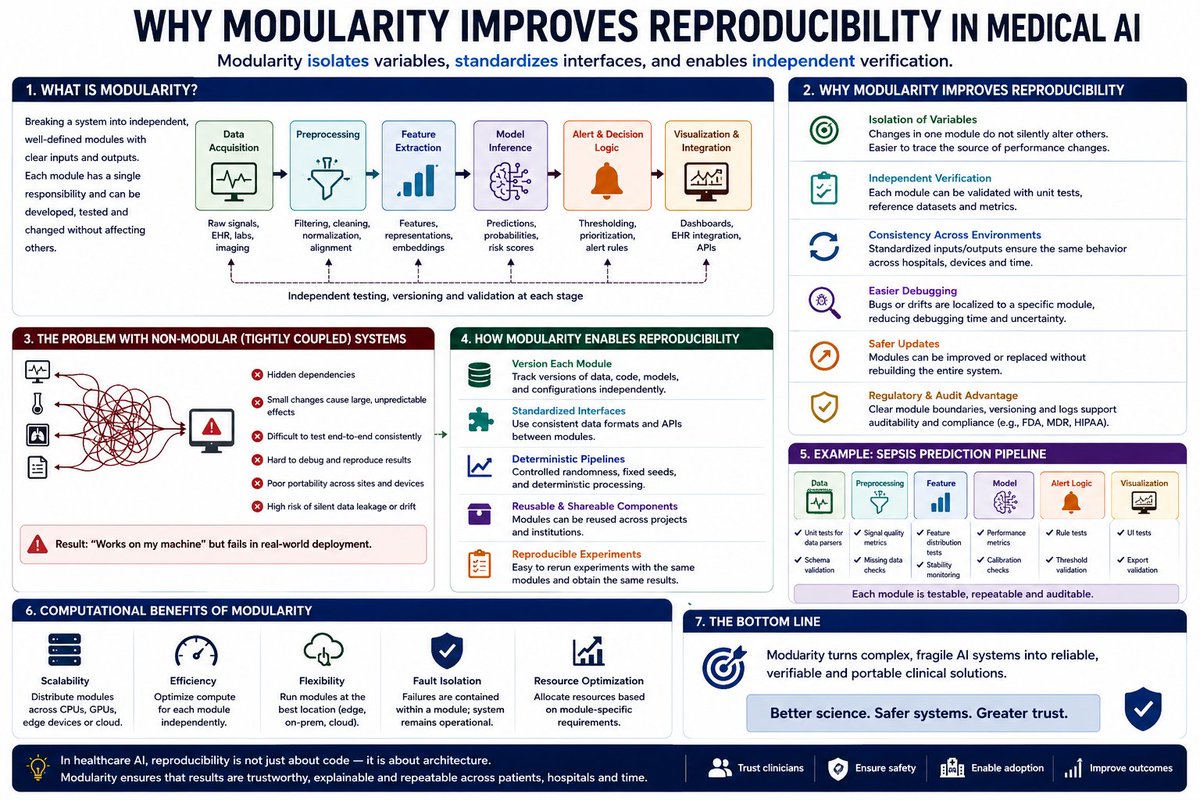
One of the least discussed reasons medical AI systems fail reproducibility tests is poor architectural design.
Not weak algorithms.
Not insufficient data.
Architecture.
Many healthcare AI pipelines are built as tightly coupled systems where:
- preprocessing
- feature extraction
- model inference
- visualization
- alerting
- deployment logic
are deeply intertwined.
That creates a major reproducibility problem.
A small upstream change can silently alter downstream clinical predictions.
For example:
- ECG filtering changes waveform morphology
- normalization logic changes laboratory distributions
- timestamp alignment shifts temporal relationships
- missing-data handling alters risk scores
Suddenly the “same” model no longer behaves the same way.
This becomes especially important in clinical environments.
A deterioration prediction model trained in one ICU may fail in another hospital because:
- device sampling frequencies differ
- EHR timestamp behavior changes
- laboratory coding varies
- telemetry packet loss patterns differ
- preprocessing pipelines are inconsistent
What appears to be model failure is often infrastructure inconsistency.
This is where modularity becomes essential.
A modular healthcare AI architecture separates systems into independently testable components:
- signal acquisition
- preprocessing
- feature extraction
- inference
- alert generation
- dashboard integration
Each module can then be validated independently.
That dramatically improves reproducibility, debugging, and deployment reliability.
There is also a computational advantage.
Modular systems support:
- distributed computing
- scalable streaming pipelines
- component-level optimization
- fault isolation
- safer model upgrades
This matters enormously for ICU telemetry, ECG monitoring, and continuous patient surveillance systems.
The most important insight may be this:
Reproducibility is not purely a statistics problem.
It is fundamentally a systems engineering problem.
Healthcare AI discussions often focus heavily on model architecture while underestimating pipeline architecture.
But in clinical deployment, infrastructure consistency may matter more than marginal accuracy gains.
How much of healthcare AI reproducibility failure do you think comes from the model itself versus the surrounding data pipeline and infrastructure?
#HealthcareAI #ClinicalAI #AIInMedicine

English

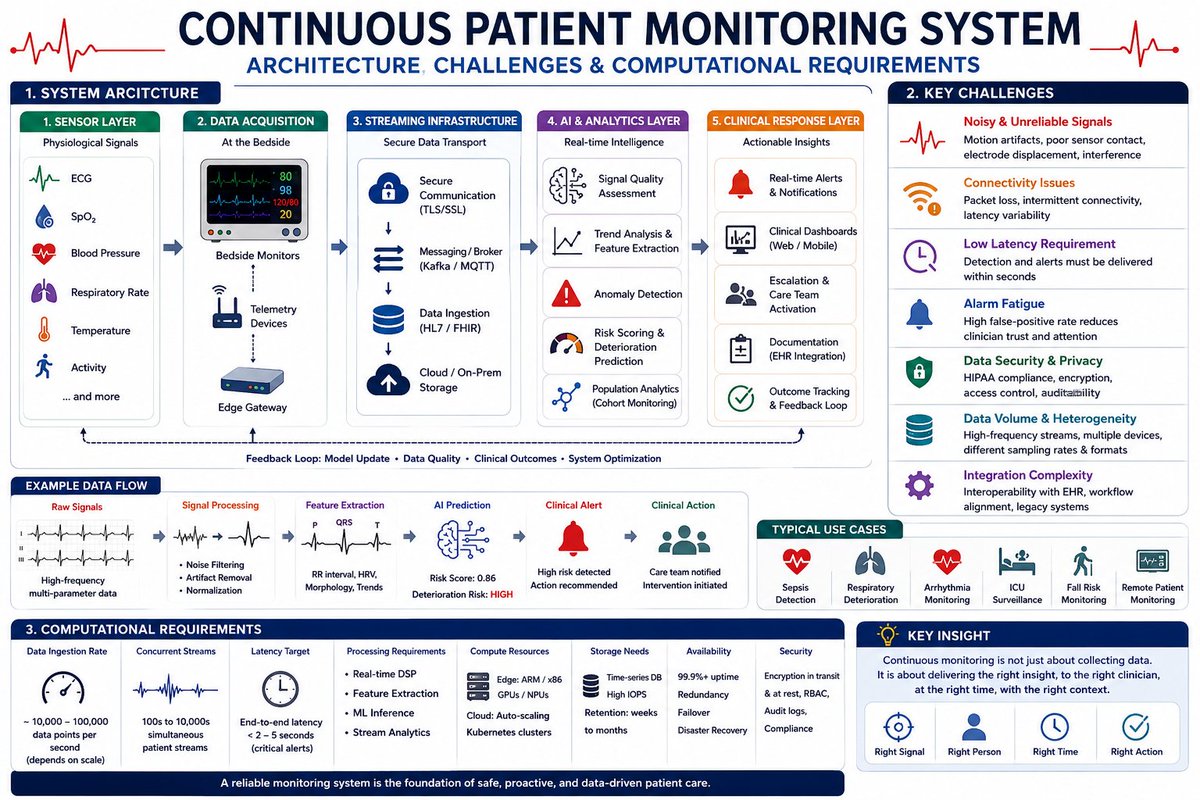
Continuous patient monitoring is quietly becoming one of the largest real-time data systems in healthcare.
Most people still think of monitoring as a bedside screen displaying heart rate and oxygen saturation.
But modern monitoring infrastructure is far more complex.
Hospitals now process continuous streams from:
- ECG telemetry
- pulse oximetry
- respiratory monitoring
- invasive blood pressure systems
- wearable sensors
- infusion devices
- ventilators
All simultaneously.
And increasingly, these streams feed healthcare AI systems designed for early deterioration detection and clinical decision support.
A modern continuous monitoring architecture usually contains five major layers:
1. Sensor layer
Physiological signal acquisition from bedside and wearable devices
2. Data acquisition layer
Telemetry gateways, bedside monitors, edge devices
3. Streaming and transport layer
HL7/FHIR pipelines, middleware, message brokers, cloud systems
4. AI and analytics layer
Trend analysis, anomaly detection, sepsis prediction, risk scoring
5. Clinical workflow layer
Alert routing, dashboards, escalation systems, rapid response activation
The difficult part is not building the prediction model.
The difficult part is building a system that remains clinically reliable under real-world conditions.
Physiological signals are inherently noisy.
Patients move.
Electrodes disconnect.
Devices lose power.
Telemetry packets drop.
Network latency fluctuates.
Healthcare data in production environments behaves very differently from curated research datasets.
Then there is the computational burden.
A hospital-wide monitoring platform may require:
- continuous time-series ingestion
- low-latency streaming computation
- fault-tolerant infrastructure
- real-time synchronization across devices
- scalable storage systems
- uninterrupted availability
This is effectively mission-critical distributed computing inside a clinical environment.
And yet the biggest challenge may still be human cognition.
Alarm fatigue already affects many ICUs and telemetry units.
Adding AI-generated alerts without understanding clinician attention limits can paradoxically worsen monitoring quality.
That leads to an uncomfortable but important insight:
More physiological data does not automatically create better clinical awareness.
Sometimes it creates more noise.
The future of continuous monitoring may depend less on collecting additional signals and more on building systems that understand which signals actually deserve immediate human attention.
Because in healthcare AI, prioritization may matter more than prediction.
How should hospitals redesign continuous monitoring systems to reduce cognitive overload while still catching early deterioration effectively?
#HealthcareAI #ClinicalAI #AIInMedicine

English

A highly accurate ECG AI model can still fail clinically if the system delivers the prediction too late.
That is one of the most misunderstood realities in real-time cardiac monitoring.
When people discuss AI in medicine, they often focus on model performance metrics: AUC. Accuracy. Sensitivity. F1 score.
But in real ICU telemetry systems, latency itself becomes a clinical variable.
A real-time ECG monitoring architecture is fundamentally a physiological streaming system.
The pipeline usually includes:
Signal acquisition
Electrodes, telemetry devices, bedside monitors
Signal preprocessing
Noise reduction, baseline correction, artifact filtering
Feature extraction
QRS detection, rhythm segmentation, waveform analysis
AI inference
Arrhythmia classification, ischemia prediction, deterioration detection
Clinical decision support
Alert routing, prioritization, visualization
Every layer introduces potential failure points.
And the bedside environment is computationally hostile.
Real ECG streams contain:
motion artifacts
electrode displacement
muscle noise
telemetry interruptions
missing waveform segments
asynchronous timestamps
Healthcare data in production looks nothing like benchmark datasets.
The computational burden is also underestimated.
Real-time ECG AI requires:
high-frequency waveform ingestion
continuous streaming computation
low-latency inference pipelines
fault-tolerant telemetry systems
scalable storage for time-series healthcare data
In large ICUs, these systems may process hundreds of simultaneous physiological streams continuously.
And then there is alarm fatigue.
This may be the single most important operational limitation in clinical AI monitoring systems.
Many telemetry environments already overwhelm clinicians with alerts.
If medical AI generates excessive false positives, clinicians gradually disengage from the system itself.
Trust becomes the true bottleneck.
That leads to a counterintuitive conclusion:
The future of ECG AI may depend less on building larger neural networks and more on building reliable real-time clinical infrastructure.
Because in cardiac telemetry, timing is not a technical detail.
Timing is part of the diagnosis.
How should hospitals balance aggressive real-time AI monitoring with the risk of clinician alarm fatigue and cognitive overload?
#HealthcareAI #ClinicalAI #AIInMedicine

English

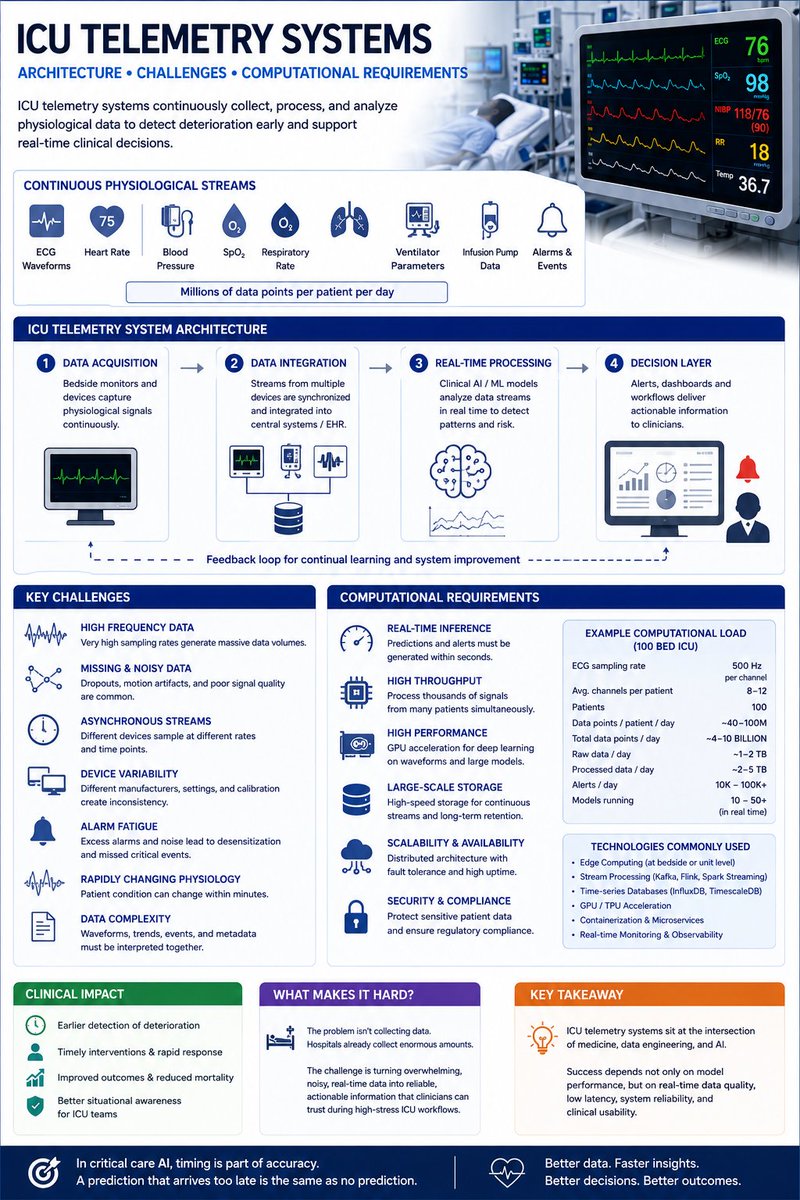
An ICU telemetry system is one of the most complex real-time data environments in healthcare.
Because the ICU is not generating “records.”
It is generating a continuous physiological stream.
Every second, telemetry systems collect:
ECG waveforms,
heart rate,
blood pressure,
SpO₂,
respiratory rate,
ventilator parameters,
infusion pump data,
and alarms from multiple bedside devices.
A modern ICU may generate millions of data points per patient per day.
This is where healthcare AI becomes both powerful and difficult.
The architecture of an ICU telemetry system usually has 4 layers:
1. Data acquisition
Bedside monitors continuously capture physiological signals.
2. Data integration
Streams from different devices are synchronized into centralized systems or EHR infrastructure.
3. Real-time processing
Clinical AI or medical machine learning models analyze patterns continuously.
4. Decision layer
Alerts, dashboards, and rapid response workflows deliver actionable information to clinicians.
The challenge is not collecting data.
Hospitals already collect enormous amounts.
The challenge is processing noisy physiological data fast enough to support clinical decisions in real time.
Because ICU telemetry data has difficult properties:
• high frequency
• missing values
• motion artifacts
• asynchronous sampling
• device variability
• alarm noise
• waveform complexity
• rapidly changing physiology
This creates massive computational requirements.
A healthcare AI system in the ICU may need to:
analyze streaming ECG waveforms,
track temporal trends,
run predictive inference continuously,
and generate alerts within seconds.
At scale, this becomes a distributed systems problem as much as a medical problem.
And there is another hidden issue many people underestimate:
Latency.
A prediction arriving 15 minutes late may be clinically useless in a deteriorating ICU patient.
In critical care AI, timing is part of accuracy.
This is why ICU telemetry systems increasingly rely on:
edge computing,
GPU acceleration,
stream processing architectures,
real-time databases,
and high-availability infrastructure.
But despite the technology, the hardest problem is still clinical.
How do you transform overwhelming streams of healthcare data into information clinicians can trust during high-stress ICU workflows?
That question may define the future of real-time clinical AI more than model performance alone.

English

Machine learning models learn through loops.
Not because programmers like repetition.
Because medicine is full of patterns that cannot be understood in a single pass.
Every training cycle in medical AI follows a loop:
1. The model makes a prediction
2. The prediction is compared with reality
3. The error is measured
4. The model adjusts itself slightly
5. The process repeats thousands or millions of times
This loop is the core of learning.
Without loops, there is no adaptation.
And in healthcare AI, adaptation matters because clinical data is noisy, incomplete, and highly variable.
An ECG waveform is never exactly identical.
ICU physiology constantly changes.
Radiology images vary across hospitals.
Clinical notes are inconsistent.
Medical machine learning systems learn by repeatedly seeing these variations and gradually identifying stable patterns beneath them.
This is why training large healthcare AI models can take enormous computational effort.
The model is not “memorizing medicine.”
It is continuously refining internal representations through iterative correction.
A useful way to think about it:
Clinical training for humans also works through loops.
A doctor:
sees patients,
makes decisions,
receives feedback,
adjusts reasoning,
and improves over time.
Machine learning training follows the same fundamental principle —
just mathematically and at massive scale.
But there is an important limitation.
If the feedback loop contains biased healthcare data,
poor labels,
or flawed clinical assumptions,
the model will repeatedly learn the wrong lessons more efficiently.
In AI for doctors, the quality of the loop often matters more than the complexity of the model itself.
The future of clinical AI may depend less on building bigger architectures —
and more on creating better feedback systems between models, clinicians, and real-world patient outcomes.

English

ICU data is considered time-series data because the patient is constantly changing over time.
That sounds obvious.
But it completely changes how healthcare AI must think.
In most industries, data is static.
A bank account balance.
A customer age.
A product price.
In the ICU, almost nothing is static.
Heart rate changes every second.
Blood pressure fluctuates minute to minute.
Oxygen saturation trends over hours.
Ventilator settings evolve continuously.
Lab values shift during treatment.
Every new measurement is connected to when it occurred.
That temporal relationship is critical.
A heart rate of 120 bpm means something very different if:
• it appeared suddenly
• it has been rising for 6 hours
• it improved after fluids
• it worsened despite vasopressors
This is why clinical AI in critical care is fundamentally different from ordinary prediction systems.
Medical machine learning models in the ICU do not just analyze values.
They analyze trajectories.
Patterns.
Velocity.
Variability.
Timing.
In healthcare AI, the sequence often matters more than the individual number.
A single blood pressure reading may look acceptable.
But a gradual downward trend over 4 hours may signal early shock long before collapse occurs.
This is one reason ICU prediction is so difficult.
Human clinicians naturally interpret patients as dynamic physiological stories unfolding over time.
AI systems must learn to do the same using fragmented healthcare data streams.
And this creates a major challenge:
Most hospital data systems were designed for documentation.
Not for continuous temporal reasoning.
The future of AI for doctors may depend less on bigger models —
and more on building systems that truly understand how illness evolves minute by minute inside real clinical workflows.

English

Rapid Response Systems were created to solve a simple hospital problem:
patients often show signs of deterioration hours before cardiac arrest.
But traditional healthcare systems are not designed to detect subtle decline early.
Vitals become fragmented across charts.
Nurses notice changes.
Junior doctors become concerned.
But escalation is often delayed.
This is where clinical AI is starting to reshape hospital medicine.
Modern Rapid Response Systems increasingly combine:
• bedside monitoring
• EHR data
• lab trends
• nursing documentation
• medical machine learning models
The goal is not just to identify a crashing patient.
The goal is to identify the patient who is quietly becoming unstable.
This sounds straightforward.
In reality, it is one of the hardest problems in healthcare AI.
Because clinical deterioration is rarely a single event.
It is usually a pattern:
slightly rising respiratory rate,
mild tachycardia,
subtle confusion,
increasing oxygen requirement,
small lab abnormalities.
Human clinicians recognize these patterns through experience.
Healthcare AI attempts to recognize them through healthcare data.
But there is an important limitation many people miss:
Rapid response AI systems do not predict “death” or “arrest.”
They predict statistical similarity to previous deteriorating patients.
That distinction matters.
A model may detect risk accurately while still missing clinical context:
post-op pain,
temporary anxiety,
medication effects,
baseline chronic disease.
This is why AI for doctors works best when it augments clinical reasoning rather than replacing it.
The future of Rapid Response Systems may not depend on building larger models.
It may depend on designing AI systems that clinicians trust enough to act on early — before the ICU transfer becomes inevitable.

English

ICU systems cannot rely on simple linear logic.
Because critically ill patients do not deteriorate in a straight line.
They branch.
Constantly.
This is why ICU healthcare AI requires branching logic.
A standard software workflow might look like this:
Input → Decision → Action
But ICU medicine is different.
Every patient state can split into multiple possible clinical paths depending on context.
Example:
A patient develops hypotension.
Now the system must ask:
- Is this sepsis?
- Hemorrhage?
- Sedation-related?
- Cardiogenic shock?
- Arrhythmia?
- Measurement artifact?
- Temporary post-procedure instability?
The same vital sign abnormality can mean completely different things.
And each possibility requires different actions.
This creates branching logic.
In ICU environments, decisions are rarely binary.
They are conditional and context-dependent.
An ICU AI system may need to evaluate:
- current vitals
- trends over time
- ventilator settings
- vasopressor use
- lab trajectories
- sedation status
- recent procedures
- active diagnoses
- code status
- clinician actions already taken
before deciding what happens next.
That complexity is why naive alert systems often fail in critical care.
Without branching logic, systems generate alerts that are technically correct but clinically disconnected.
Example:
A tachycardia alert may be dangerous if:
- the patient is bleeding
—but irrelevant if:
- the patient just received physiotherapy
- clinicians already acknowledged the issue
- treatment is already underway
Good ICU systems must continuously adapt to changing context.
This is why critical care AI increasingly behaves less like a calculator—
—and more like a dynamic decision tree.
The hidden challenge is that ICU workflows are not static.
Patients can transition between stability and instability within minutes.
A useful ICU AI system therefore needs:
- continuous reassessment
- context-aware escalation
- conditional pathways
- time-sensitive branching
- human override capability
- fallback safety rules
In other words:
The system must know not only what is happening—
—but also what clinical state the patient is moving toward.
This is where medical AI becomes fundamentally different from many consumer AI systems.
Because ICU care is not prediction alone.
It is real-time orchestration under uncertainty.
And in critical care, the wrong branch can change outcomes very quickly.

English

One of the most underrated concepts in healthcare AI is control flow.
Because intelligence alone is not enough.
A clinical AI system also needs to know:
“What happens next?”
That sequence of actions is called control flow.
In simple terms:
Control flow is the logic that determines how information moves through a clinical workflow.
Who gets alerted.
When escalation occurs.
What action is triggered.
When humans intervene.
When the system stops.
Without good control flow, even accurate medical AI can become clinically unsafe.
Example:
An AI model predicts high sepsis risk.
Now what?
Does it:
- alert the bedside nurse?
- notify the physician?
- recommend labs?
- trigger a rapid response workflow?
- repeat evaluation in 15 minutes?
- escalate only if vitals worsen?
The prediction itself is only one small part of the system.
Control flow determines how the prediction affects real patient care.
This is where many healthcare AI projects fail.
Teams focus heavily on model performance:
AUROC
Sensitivity
Specificity
Calibration
But clinicians experience workflows, not metrics.
A highly accurate model with poor workflow design can create:
- alert fatigue
- duplicated work
- unsafe escalation chains
- workflow bottlenecks
- ignored recommendations
- clinician distrust
The hidden reality:
Hospitals are complex distributed systems.
Nurses, residents, consultants, monitors, EHRs, labs, pagers, imaging systems, and AI tools are all interacting simultaneously.
Control flow is the architecture that coordinates these interactions safely.
And unlike consumer AI, clinical workflows contain real-world constraints:
Shift changes
Staffing shortages
Time pressure
Escalation hierarchies
Documentation requirements
Patient instability
An AI recommendation that arrives at the wrong moment may be clinically useless.
Or dangerous.
This is why the future of AI for doctors is not just better models.
It is better orchestration.
The most valuable healthcare AI systems may not be the ones with the smartest algorithms.
They may be the ones that integrate into clinical workflows with the least friction and the highest reliability.
Because in medicine, decision quality depends not only on what the AI predicts—
—but also on how the system responds.

English

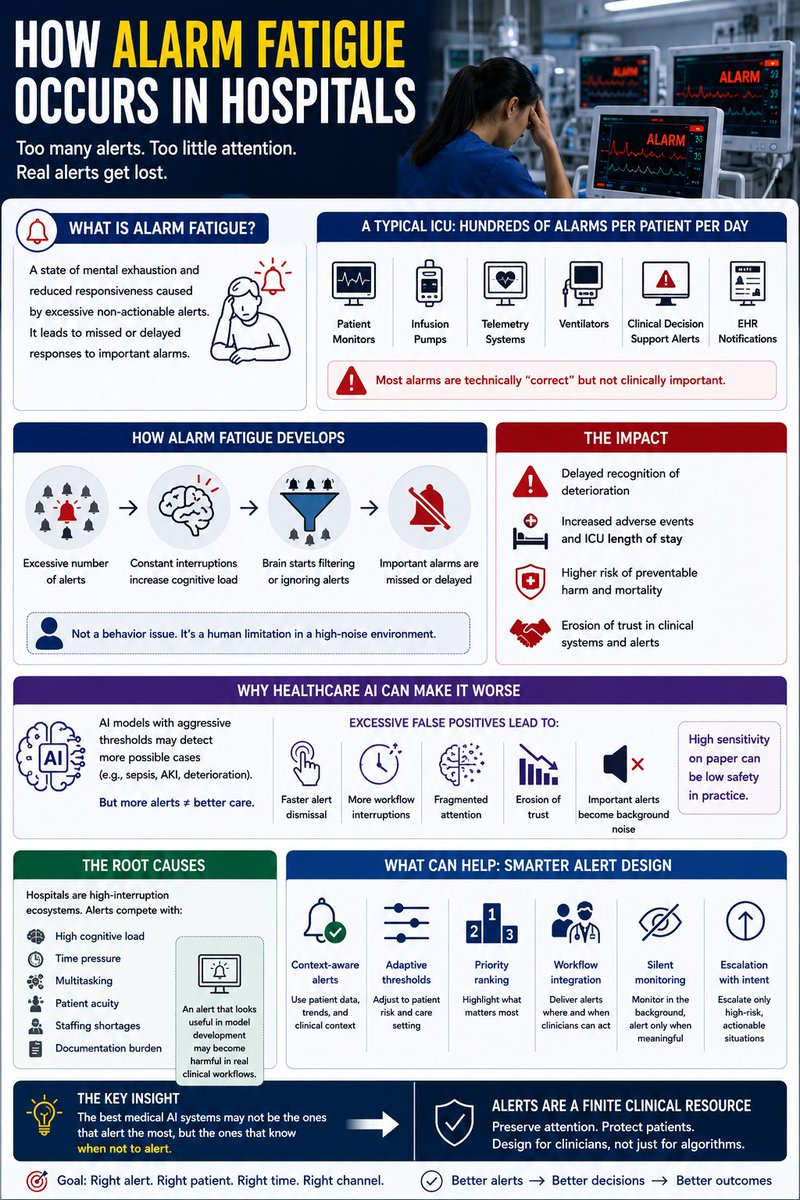
One of the biggest hidden patient safety problems in modern hospitals is not lack of data.
It is too many alerts.
This is called alarm fatigue.
And healthcare AI may unintentionally make it worse.
A typical ICU already produces hundreds of alarms per patient per day.
Monitors.
Infusion pumps.
Telemetry systems.
Ventilators.
Clinical decision support alerts.
EHR notifications.
Most are technically “correct.”
But many are not clinically important.
Over time, clinicians become desensitized.
The brain starts filtering alarms automatically.
Not because doctors or nurses are careless.
Because constant interruption is cognitively unsustainable.
This is how alarm fatigue develops.
The dangerous part:
Once trust in the alert system drops, even important alarms can be delayed, ignored, or dismissed.
This creates a paradox in healthcare AI:
More sensitivity can reduce real-world safety.
A sepsis prediction model with aggressive thresholds may detect more possible cases.
But if it generates excessive false positives:
- clinicians click through alerts faster
- workflow interruptions increase
- attention fragments
- trust erodes
- meaningful alerts become harder to recognize
Eventually, the system becomes background noise.
This is why clinical AI cannot be evaluated only by AUROC, accuracy, or sensitivity.
Human attention is part of the system.
And human attention is limited.
The deeper issue is that hospitals are not quiet environments for decision-making.
They are high-interruption ecosystems.
Every alert competes against:
- cognitive load
- time pressure
- multitasking
- patient acuity
- staffing shortages
- documentation burden
An alert that looks useful in model development may become harmful in real clinical workflows.
The future of healthcare AI will depend heavily on intelligent alert design:
Context-aware alerts
Adaptive thresholds
Priority ranking
Workflow integration
Silent background monitoring
Escalation only when clinically meaningful
The best medical AI systems may not be the ones that alert the most.
They may be the ones that know when not to alert.
Because in medicine, attention is a finite clinical resource.

English

@blckchnmaster We need intelligent alert design:
Context-aware alerts
Adaptive thresholds
Priority ranking
Workflow integration
Silent background monitoring
Escalation only when clinically meaningful
English

@AIForDoctors Alarm fatigue is such an underrated problem. How do you think blockchain could help verify or prioritize those critical AI alerts in healthcare?
English

One of the hardest problems in healthcare AI is not building the model.
It is choosing the threshold.
A clinical AI model may output:
“Sepsis risk: 0.73”
But the real question is:
At what probability should the system act?
50%?
70%?
90%?
That decision sounds technical.
In reality, it is deeply clinical.
Because every threshold changes patient care.
Lower thresholds increase sensitivity.
You catch more true cases early.
But you also generate more false positives.
More unnecessary alerts.
More alarm fatigue.
More antibiotic overuse.
More clinician distrust.
Higher thresholds improve specificity.
Fewer false alarms.
But now you risk missing deteriorating patients.
And in medicine, a missed case can matter far more than an unnecessary alert.
This is why threshold selection in medical AI is fundamentally different from most consumer AI systems.
Netflix can tolerate a bad recommendation.
An ICU cannot tolerate a bad prediction the same way.
The difficulty becomes even greater because healthcare data is unstable.
A model trained in one hospital may produce different risk distributions in another because of:
- documentation habits
- patient demographics
- lab timing
- workflow differences
- disease prevalence
- monitoring intensity
The same “0.73 risk score” may not mean the same thing everywhere.
That is why externally validated healthcare AI models can still fail operationally after deployment.
The hidden reality:
Thresholds are not purely mathematical decisions.
They are clinical risk decisions disguised as numbers.
And this is where many AI for doctors discussions become oversimplified.
A model with excellent AUROC can still perform poorly in real clinical workflows if threshold strategy is wrong.
The future of clinical AI will depend less on “accuracy alone” and more on adaptive thresholds:
Context-aware
Workflow-aware
Population-aware
Clinician-adjustable
Because in healthcare AI, prediction is only half the problem.
The harder question is:
“When should the system intervene?”

English

Most healthcare AI discussions confuse two very different systems:
Deterministic rules
vs
Probabilistic AI.
Understanding this difference explains why some clinical tools are reliable… and others fail unexpectedly.
A deterministic system follows fixed logic.
Example:
“If potassium > 6.5 mmol/L → trigger critical alert.”
Same input.
Same output.
Every time.
This is how many traditional clinical decision support systems work.
They are predictable.
Auditable.
Easy to validate.
But they break when medicine becomes messy.
Because real clinical workflows are rarely binary.
Now consider probabilistic AI.
A medical machine learning model does not “know” sepsis, stroke, or heart failure.
It estimates probability from patterns in healthcare data.
Instead of saying:
“This patient has sepsis.”
It says:
“Patients with similar patterns historically had high likelihood of sepsis.”
That difference matters.
Deterministic rules are explicit.
Probabilistic AI is statistical.
Rules operate on certainty.
AI operates on likelihood.
This is why healthcare AI can appear intelligent while still being wrong in clinically dangerous ways.
A sepsis rule may miss atypical patients.
But a probabilistic model may also overpredict because of biased training data, documentation habits, or hospital-specific workflows.
The deeper insight:
Clinical reasoning itself is partly probabilistic.
Doctors constantly update probabilities using symptoms, labs, imaging, context, and experience.
Modern clinical AI is attempting to imitate this uncertainty-driven reasoning using data patterns.
But unlike clinicians, many models cannot explain why they shifted probability.
That creates a major trust gap in AI for doctors.
The future of medical AI is probably not “AI replacing rules.”
It is hybrid systems:
Deterministic safeguards
probabilistic prediction
clinician oversight.
Because in medicine, reliability matters just as much as intelligence.
The real question is not:
“Can healthcare AI predict disease?”
It is:
“When should probability be trusted enough to influence patient care?”

English