That's all for AI Native Today Paper Digest. Follow our account for the latest insights on AI Native, and join us at member.ainativefoundation.org. If you found this helpful, a like or repost on the first tweet of this thread would be greatly appreciated!
13. Latent-Identity Tuning in Text-to-Image Personalization Models
🔑 Keywords: identity tuning, fine-grained editing, text-to-image, latent space, frozen encoder
💡 Category: Computer Vision
🌟 Research Objective:
- To develop a method for fine-grained identity tuning in text-to-image personalization models that allows for precise facial edits without losing identity consistency.
🛠️ Research Methods:
- Utilize the latent space of a pre-trained, frozen encoder to explore latent semantic directions for identity tuning.
- Leverage latent tokens to capture different identity aspects and enable locally coherent edits without additional training.
💬 Research Conclusions:
- Demonstrated meaningful, localized facial edits with preserved cross-image identity consistency through qualitative and quantitative experiments.
👉 Paper link: huggingface.co/papers/2607.11…
9. LATO.2: Factorized 3D Mesh Generation with Vertex and Topology Flow
🔑 Keywords: flow matching, latent representation, mesh generation, topology-aware, geometric fidelity
💡 Category: Generative Models
🌟 Research Objective:
- To develop LATO.2, a factorized flow matching framework for topology-aware mesh generation that separates vertex and connectivity flow processes.
🛠️ Research Methods:
- Utilize dedicated VAEs to underpin the two stages of mesh generation, leveraging a shared coarse voxel scaffold for enhanced precision and a continuous latent space.
💬 Research Conclusions:
- LATO.2 demonstrates superior geometric fidelity and connectivity quality compared to existing state-of-the-art methods, offering advantages such as higher-resolution meshes and topology-adaptive editing.
👉 Paper link: huggingface.co/papers/2607.10…
8. Motion4Motion: Motion Transfer Across Subjects at Inference
🔑 Keywords: Motion Transfer, Animation, Diverse Characters, Training-Free
💡 Category: Computer Vision
🌟 Research Objective:
- The study aims to explore motion transfer between videos, focusing on diverse characters beyond human or human-like figures.
🛠️ Research Methods:
- Motion4Motion is proposed as a training-free framework, modeling motion flow rather than relying on a skeleton structure.
💬 Research Conclusions:
- The method facilitates motion transfer across species and demonstrates superior performance compared to baseline methods.
👉 Paper link: huggingface.co/papers/2607.11…
📚 AI Native Daily Paper Digest - 2026-07-14🌟
Follow @AINativeF for the latest insights on AI Native.
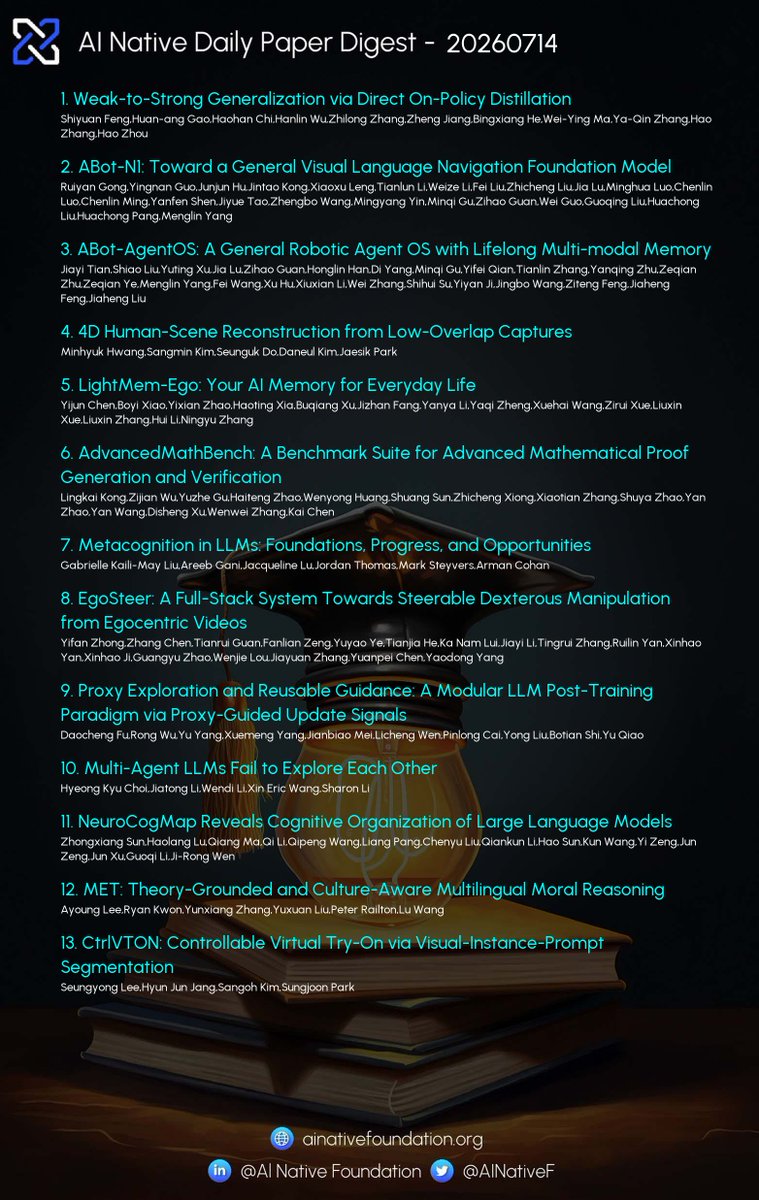
Covering AI research papers from Hugging Face, featured in the image.
💡 Stay updated with the latest research trends and dive deep into the future of AI! 🚀
#AI#HuggingFace#AIPaper#AINative#AINF
— Appendix: Today's AI research papers —
1. Weak-to-Strong Generalization via Direct On-Policy Distillation
2. ABot-AgentOS: A General Robotic Agent OS with Lifelong Multi-modal Memory
3. LightMem-Ego: Your AI Memory for Everyday Life
4. Metacognition in LLMs: Foundations, Progress, and Opportunities
5. Proxy Exploration and Reusable Guidance: A Modular LLM Post-Training Paradigm via Proxy-Guided Update Signals
6. NeuroCogMap Reveals Cognitive Organization of Large Language Models
7. CtrlVTON: Controllable Virtual Try-On via Visual-Instance-Prompt Segmentation
8. Motion4Motion: Motion Transfer Across Subjects at Inference
9. LATO.2: Factorized 3D Mesh Generation with Vertex and Topology Flow
10. A Theory of Contrastive Learning with Natural Images
11. Evidence-Backed Video Question Answering
12. Xiaomi-Robotics-U0: Unified Embodied Synthesis with World Foundation Model
13. Latent-Identity Tuning in Text-to-Image Personalization Models
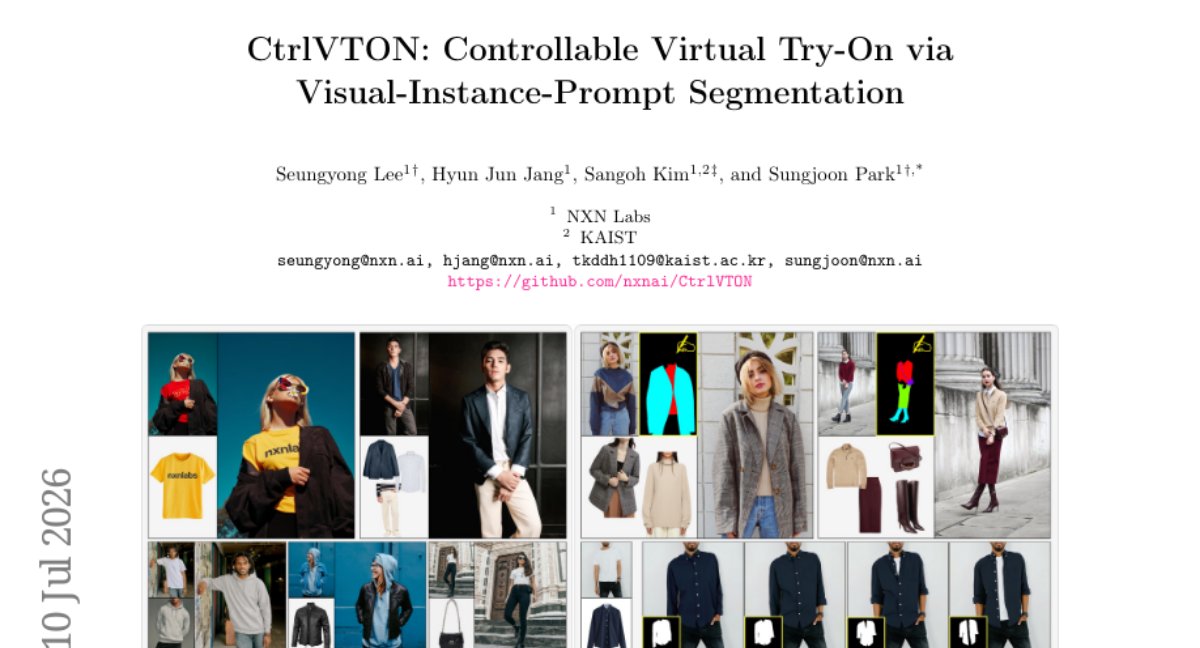
7. CtrlVTON: Controllable Virtual Try-On via Visual-Instance-Prompt Segmentation
🔑 Keywords: Virtual try-on, Visual-Instance-Prompt Segmentation, CtrlVTON, garment layout
💡 Category: Computer Vision
🌟 Research Objective:
- To enhance user control over how a garment is worn in Virtual try-on (VTO) systems by addressing garment size, style, and spatial placement.
🛠️ Research Methods:
- Developed VIP-SAM to tackle Visual-Instance-Prompt Segmentation, allowing instance-level garment segmentation on a person.
- Introduced CtrlVTON, a framework transforming VTO into an image editing process with added segmentation masks for detailed garment layout control.
💬 Research Conclusions:
- VIP-SAM and CtrlVTON achieve state-of-the-art results, with CtrlVTON generating images that accurately follow user-defined layouts while maintaining high garment fidelity.
👉 Paper link: huggingface.co/papers/2607.09…
6. NeuroCogMap Reveals Cognitive Organization of Large Language Models
🔑 Keywords: NeuroCogMap, Large Language Models, Human Cognition, Cognitive Neuroscience, Functional Organization
💡 Category: Natural Language Processing
🌟 Research Objective:
- The study aims to organize the internal features of large language models (LLMs) into functional parcels, linking them to interpretable functions, cognitive capabilities, and human cognition.
🛠️ Research Methods:
- Introduced a framework called NeuroCogMap, inspired by cognitive neuroscience, to map and connect the internal representations within LLMs to cognitive functions.
💬 Research Conclusions:
- NeuroCogMap establishes a stable organization of LLMs, revealing how major LLM failures correlate with disruptions in functional systems, and enhances the prediction of human cortical responses during language comprehension.
👉 Paper link: huggingface.co/papers/2607.00…
5. Proxy Exploration and Reusable Guidance: A Modular LLM Post-Training Paradigm via Proxy-Guided Update Signals
🔑 Keywords: Post-training, Large Language Models, Reward Optimization, Proxy-guided Update Signal Transfer, Computational Overhead
💡 Category: Natural Language Processing
🌟 Research Objective:
- The research proposes a novel framework, called Proxy-guided Update Signal Transfer (PUST), aimed to decouple update-signal exploration from distribution alignment in large language models.
🛠️ Research Methods:
- PUST utilizes a lightweight proxy model for efficient exploration and extracts relative improvement signals to guide the primary model's policy alignment, significantly reducing computational overhead.
💬 Research Conclusions:
- Systematic evaluations demonstrated that update signals from weaker proxy models could robustly enhance stronger primary models, transforming post-training into a modular, reusable, and cost-efficient process.
👉 Paper link: huggingface.co/papers/2607.11…
4. Metacognition in LLMs: Foundations, Progress, and Opportunities
🔑 Keywords: Metacognition, AI Systems, LLMs, Transparency, Intelligence
💡 Category: Natural Language Processing
🌟 Research Objective:
- To provide a comprehensive overview and analysis of metacognition in LLMs, bridging the gap in understanding its role and application in AI systems.
🛠️ Research Methods:
- Analyzing and categorizing the current knowledge on metacognition for LLMs, summarizing technical advancements, and discussing methods to measure, evaluate, and enhance metacognitive abilities.
💬 Research Conclusions:
- Highlighted the importance of metacognition for transparent AI systems, detailed the current state and implications of research, and pointed towards future applications and challenges in the field.
👉 Paper link: huggingface.co/papers/2607.11…
3. LightMem-Ego: Your AI Memory for Everyday Life
🔑 Keywords: Personal AI assistants, multimodal memory, egocentric visual and audio streams, lightweight memory system
💡 Category: Multi-Modal Learning
🌟 Research Objective:
- The paper aims to address the challenge of developing a lightweight multimodal memory that can continuously accumulate, organize, and retrieve long-term experiences for personal AI assistants.
🛠️ Research Methods:
- The research introduces LightMem-Ego, a system that captures egocentric visual and audio streams, aligns them on a shared timeline, and organizes them into hierarchical memories (current, short-term, long-term), dynamically routing retrievals based on user queries.
💬 Research Conclusions:
- LightMem-Ego supports deployment on smartphones and AI glasses, offering functionalities like object finding, conversation recall, life summarization, routine discovery, and personalized assistance, with accessible code for demonstration.
👉 Paper link: huggingface.co/papers/2607.11…
2. ABot-AgentOS: A General Robotic Agent OS with Lifelong Multi-modal Memory
🔑 Keywords: Agent Operating System, Embodied Agents, Multi-modal Memory, Runtime Evolution
💡 Category: Robotics and Autonomous Systems
🌟 Research Objective:
- The paper presents ABot-AgentOS, a general Agent Operating System designed to enhance long-horizon embodied agents by providing a deliberative layer above low-level controllers for better scene-conditioned planning and execution.
🛠️ Research Methods:
- Introduction of EmbodiedWorldBench, a comprehensive benchmark featuring a variety of tasks and scenes to evaluate the effectiveness of the agent operating system in diverse scenarios.
💬 Research Conclusions:
- ABot-AgentOS demonstrates enhanced task success and goal completion over baseline systems, attributed in part to its Universal Multi-modal Graph Memory and self-evolution capabilities, leading to improvements in persistent, auditable memory for continued interaction.
👉 Paper link: huggingface.co/papers/2607.10…
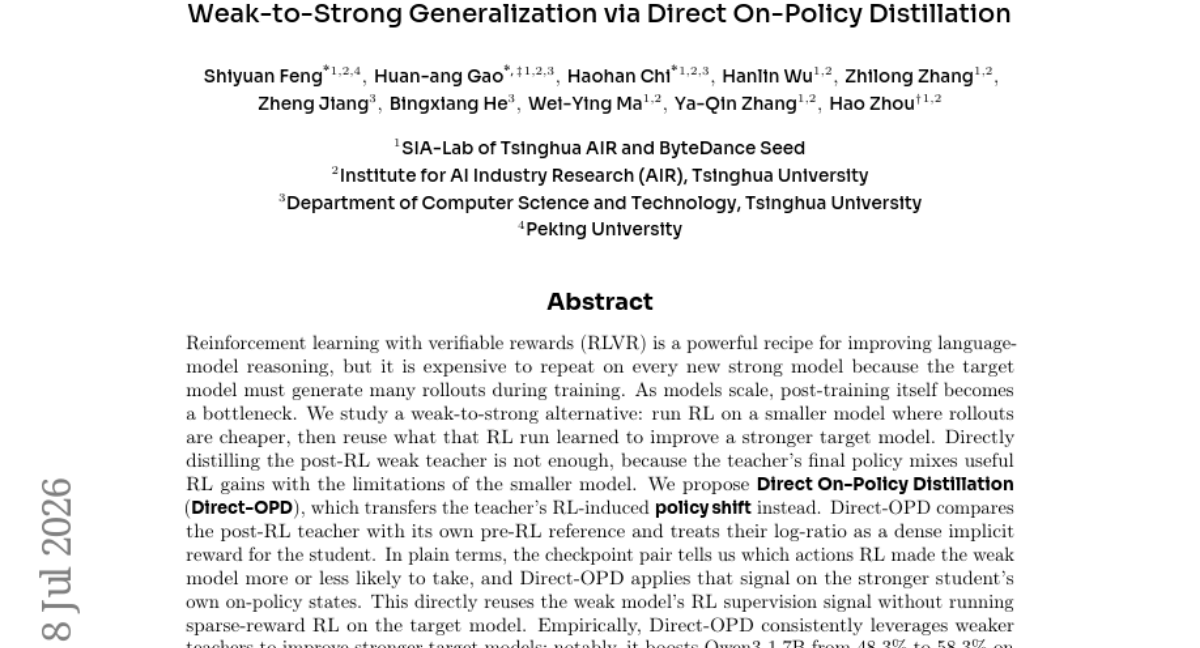
1. Weak-to-Strong Generalization via Direct On-Policy Distillation
🔑 Keywords: Direct On-Policy Distillation, Reinforcement Learning, policy shift, implicit reward
💡 Category: Reinforcement Learning
🌟 Research Objective:
- The main goal is to efficiently transfer reinforcement learning improvements from smaller models to larger models without rerunning expensive RL processes.
🛠️ Research Methods:
- Introduction of Direct On-Policy Distillation, which uses the policy shift-induced reward signal from a smaller model to enhance a stronger target model's performance.
💬 Research Conclusions:
- Direct On-Policy Distillation consistently improves stronger models by leveraging signals from weaker teacher models, significantly enhancing performance and efficiency.
- Notably, it increases Qwen3-1.7B performance on AIME 2024 from 48.3% to 58.3% in just 4 hours using 8 A100 GPUs.
👉 Paper link: huggingface.co/papers/2607.05…
Gemma 4 27B Multimodal Model Launches on Cerebras at 1,500+ Tokens per Second
Google's Gemma 4 31B open-weight multimodal model is now available on Cerebras, delivering over 1,500 tokens per second in inference speed. Cerebras describes this as the fastest multimodal inference available, representing approximately a 15x speedup compared to conventional GPU-based setups. The performance improvement is intended to enable real-time visual processing and agentic AI loops without the latency typically associated with GPU inference.
Read more: cerebras.ai/blog/gemma-4-o…@googlegemma
🎥 Credit: @googlegemma on X
🌟 Today’s Global AI Native Industry Insights include:
1. xAI Adds Zero Data Retention Support and Privacy Command to Grok Build CLI
2. Anthropic Publishes Study on How Claude's Expressed Values Vary Across Models and Languages
3. Gemma 4 27B Multimodal Model Launches on Cerebras at 1,500+ Tokens per Second
🔍 Dive into the in-depth insights in the thread below. Here’s what’s shaping the future of AI: 👇