Alex

6.1K posts

Alex banner
Alex

Alex

@Alex_Intel_

🇺🇲🦅

Katılım Ekim 2013
339 Takip Edilen3K Takipçiler
Sabitlenmiş Tweet
Alex
Alex@Alex_Intel_·
Great thread I'm quite excited about the possibilities of xLight or Substrate's XRL Tool (Make Steppers great again) One of these players will change the economics of Foundries in the US. We must not sell or export this technology Hope Intel buys or partners with the winner
🌿 lithos@lithos_graphein

🧵 1/... Substrate's Dark Horse. Going to make some observations about the new Substrate announcement—where it's again implied this XRL tool can bypass ASML's EUV monopoly. They shared some interesting SEM images, and in the text there were some more clues. FYI, I'm on vacation, so these posts are going to be spread out.

English
1
4
34
5.9K
Alex
Alex@Alex_Intel_·
@jukan05 Jensen buying a PC ODM only makes sense if think he's going to make some new 'AI' OS/Product or try to transform Linux (bad blood) and make Nvidia some apple competitor If that's what happens ok, but Charlie has recently been off base (MAIA being 18A, Qualcomm story etc)
English
0
0
7
339
Jukan
Jukan@jukan05·
Jensen must have more money than he knows what to do with. Why is he doing this?
Jukan tweet media
English
35
12
175
34.6K
Alex
Alex@Alex_Intel_·
@bubbleboi Turns out an American Foundry is bullish Lip-Bu Tan is the man and is making Semiconductor manufacturing great again in America
English
0
0
1
139
Alex
Alex@Alex_Intel_·
@AIStockSavvy These guys are very bad at modeling out year EPS and understanding wafer starts But I'll take their positive outlook
English
1
0
6
155
Hardik Shah
Hardik Shah@AIStockSavvy·
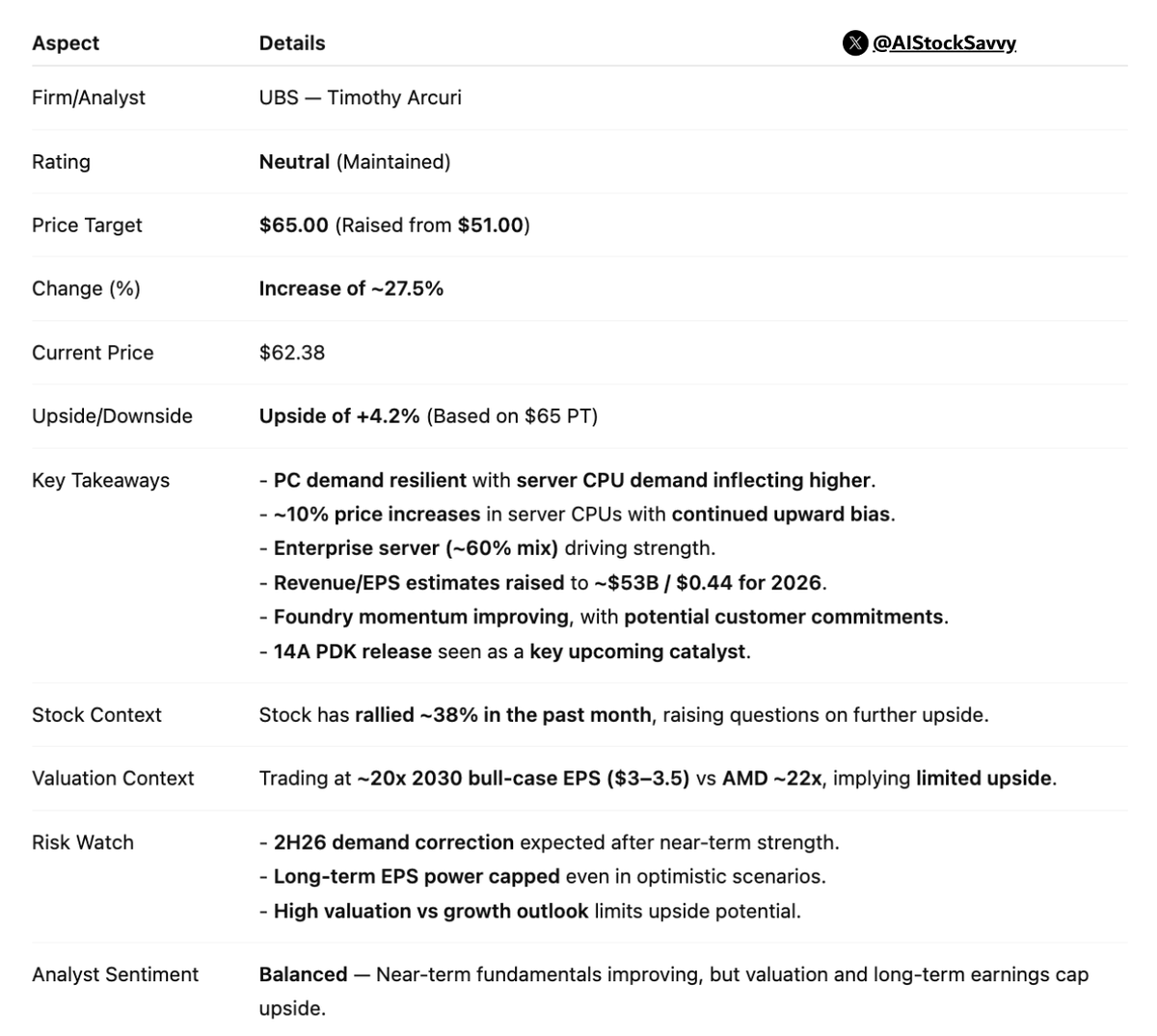
$INTC | 𝐈𝐧𝐭𝐞𝐥: UBS maintains 𝐍𝐞𝐮𝐭𝐫𝐚𝐥, raises 𝐏𝐓 𝐭𝐨 $𝟔𝟓, 'We See a Clear Upside Bias for Results and Guidance' Analyst sees near-term revenue upside and strong server demand, but flags limited long-term EPS upside despite foundry catalysts.
Hardik Shah tweet media
English
2
6
29
3.1K
Alex
Alex@Alex_Intel_·
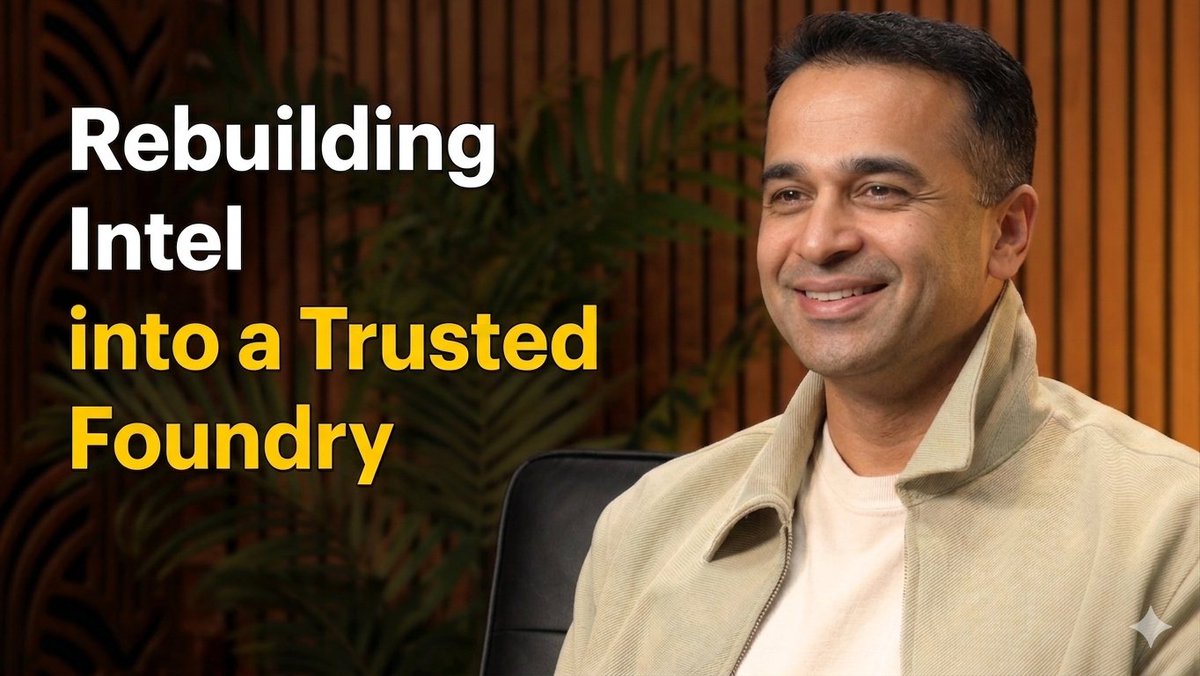
Lip-Bu: "Customers are coming to me for 18A now and 14A early customers are talking about volume commitments" SemiAnalysis: "Nothing to see here, only TSMC can make wafers, Apple isn't leaving we swear!"
English
6
5
51
7.9K
Alex
Alex@Alex_Intel_·
@JulienTechInvst "Intel $INTC foundry has never really been of interest for its foundry capabilities" ?
English
1
0
1
152
Alex
Alex@Alex_Intel_·
@WayWLeung Doubt allows you to arbitrage $
English
0
0
0
259
CHUIP LEUNG
CHUIP LEUNG@WayWLeung·
@Alex_Intel_ Just make your own money and let these people stick to their arrogance and prejudice. In the world of adults, there is no one to persuade anyone.
English
1
0
5
295
Alex
Alex@Alex_Intel_·
@caozhuozi @jukan05 You should also read into this that Rapidus isnt going to work SF2 is significantly less dense and they have dramatically more resources No way they are going to yield unless they stole TSMC 2nm
English
0
0
7
221
Jukan
Jukan@jukan05·
[Exclusive] Samsung Foundry 2nm Yield at 55%… Stuck Below the 'Mass Production 60%' Threshold Samsung Electronics' foundry business — a key future growth engine — has hit a wall at the '60% mass production' threshold for its 2nm (nanometer; 1nm = one-billionth of a meter) process. With yields stuck in the mid-50% range and failing to enter stable mass production territory, effective yields are expected to drop to the 40% range once back-end processing is factored in. While the company has succeeded in achieving technical entry, the consensus is that it remains insufficient to win orders from global Big Tech clients. According to semiconductor industry sources on the 13th, Samsung Electronics' foundry division's average yield for the 2nm process is understood to be approximately 55%. This is lower than the '60%-plus' estimates floated by some, signaling that additional time is still needed to reach mass production stability. A source with knowledge of internal affairs stated, "The 2nm process yield is in the 50–60% range, with an average around 55%," adding, "The process is running, but it is still a long way from a stable mass production phase." The pace of yield improvement itself has been rapid. Samsung's foundry 2nm yields were reportedly stuck in the 20% range as recently as the second half of last year. Reaching the mid-50s in less than a year is assessed as technically reaching a level where the mass production line can be operated. This is attributed in part to the accumulation of process experience driven by incoming orders for Bitcoin mining chips from China's Canaan and MicroBT, among others. Given the extreme difficulty of the 2nm ultra-fine process, some consider this an exceptionally fast rate of improvement. However, the prevailing view in the industry is that it remains a "half-process" at best. In a structure where nearly half of all wafer input is discarded as defective, the process fails on both price competitiveness and delivery reliability. In particular, when factoring in losses from performance binning and packaging, the actual percentage of chips that can generate profit is estimated to fall as low as 40%. Considering that a single wafer for cutting-edge processes costs tens of millions of won, a 1% difference in yield translates to annual operating profit differences ranging from hundreds of billions to trillions of won. This is bound to significantly derail Samsung Electronics' efforts to improve foundry business profitability. An industry source said, "A yield in the 50% range only means the process 'runs' — it is not a stage where customers can entrust orders with confidence," adding, "It is a zone where both delivery and quality variability coexist." By contrast, rival TSMC is reported to have secured stable yields of 60–70% for its 2nm process. Samsung Foundry's current mid-50% yield is therefore assessed as corresponding to the technical entry stage, but falling short for securing major customers — a "transitional zone." Significant progress has been made, but analysis suggests actual mass production remains premature. In practice, Samsung has secured some customer and internal volumes, but has yet to achieve results in winning key clients such as Apple, NVIDIA, and AMD. Notably, Qualcomm — a global mobile application processor (AP) company that had raised expectations for new orders — is also showing signs of returning to TSMC, citing process yield and stability concerns. Additionally, the 'AI6' advanced autonomous driving chip contracted with Tesla is scheduled for mass production this year, and the yield level achieved at the actual production milestone will be critical in determining profitability and supply stability. Meanwhile, Samsung Electronics' strategy is to win new orders, run its facilities, and improve yields going forward. At Samsung Electronics' annual general meeting on March 18, Han Jin-man, head of the foundry business division (President), stated, "For the 2nm process as well (which is at a higher level than the 4nm process), we can build up order experience with major companies and secure yields through that process." $INTC $TSM
English
21
30
325
125.4K
Alex
Alex@Alex_Intel_·
@insane_analyst Also the lead is sorta burried that real yields for Exynos are in the 40s SRAM test chips are probably the mid 50s
English
0
0
8
455
Alex
Alex@Alex_Intel_·
@insane_analyst Really? They still have to compete with Apple perf
English
1
0
9
880
Irrational Analysis
Irrational Analysis@insane_analyst·
55% for smartphone chip good enough to dump $QCOM
Jukan@jukan05

[Exclusive] Samsung Foundry 2nm Yield at 55%… Stuck Below the 'Mass Production 60%' Threshold Samsung Electronics' foundry business — a key future growth engine — has hit a wall at the '60% mass production' threshold for its 2nm (nanometer; 1nm = one-billionth of a meter) process. With yields stuck in the mid-50% range and failing to enter stable mass production territory, effective yields are expected to drop to the 40% range once back-end processing is factored in. While the company has succeeded in achieving technical entry, the consensus is that it remains insufficient to win orders from global Big Tech clients. According to semiconductor industry sources on the 13th, Samsung Electronics' foundry division's average yield for the 2nm process is understood to be approximately 55%. This is lower than the '60%-plus' estimates floated by some, signaling that additional time is still needed to reach mass production stability. A source with knowledge of internal affairs stated, "The 2nm process yield is in the 50–60% range, with an average around 55%," adding, "The process is running, but it is still a long way from a stable mass production phase." The pace of yield improvement itself has been rapid. Samsung's foundry 2nm yields were reportedly stuck in the 20% range as recently as the second half of last year. Reaching the mid-50s in less than a year is assessed as technically reaching a level where the mass production line can be operated. This is attributed in part to the accumulation of process experience driven by incoming orders for Bitcoin mining chips from China's Canaan and MicroBT, among others. Given the extreme difficulty of the 2nm ultra-fine process, some consider this an exceptionally fast rate of improvement. However, the prevailing view in the industry is that it remains a "half-process" at best. In a structure where nearly half of all wafer input is discarded as defective, the process fails on both price competitiveness and delivery reliability. In particular, when factoring in losses from performance binning and packaging, the actual percentage of chips that can generate profit is estimated to fall as low as 40%. Considering that a single wafer for cutting-edge processes costs tens of millions of won, a 1% difference in yield translates to annual operating profit differences ranging from hundreds of billions to trillions of won. This is bound to significantly derail Samsung Electronics' efforts to improve foundry business profitability. An industry source said, "A yield in the 50% range only means the process 'runs' — it is not a stage where customers can entrust orders with confidence," adding, "It is a zone where both delivery and quality variability coexist." By contrast, rival TSMC is reported to have secured stable yields of 60–70% for its 2nm process. Samsung Foundry's current mid-50% yield is therefore assessed as corresponding to the technical entry stage, but falling short for securing major customers — a "transitional zone." Significant progress has been made, but analysis suggests actual mass production remains premature. In practice, Samsung has secured some customer and internal volumes, but has yet to achieve results in winning key clients such as Apple, NVIDIA, and AMD. Notably, Qualcomm — a global mobile application processor (AP) company that had raised expectations for new orders — is also showing signs of returning to TSMC, citing process yield and stability concerns. Additionally, the 'AI6' advanced autonomous driving chip contracted with Tesla is scheduled for mass production this year, and the yield level achieved at the actual production milestone will be critical in determining profitability and supply stability. Meanwhile, Samsung Electronics' strategy is to win new orders, run its facilities, and improve yields going forward. At Samsung Electronics' annual general meeting on March 18, Han Jin-man, head of the foundry business division (President), stated, "For the 2nm process as well (which is at a higher level than the 4nm process), we can build up order experience with major companies and secure yields through that process." $INTC $TSM

English
3
0
68
19.2K
Pushkar Ranade
Pushkar Ranade@magicsilicon·
Working on fixing this.
English
6
5
58
3.9K
Tesla Yoda
Tesla Yoda@teslayoda·
@phillearning While Intel does not have the recipe for advanced node manufacturing 3nm below required for AI chips, it has accumulated process technology from legacy nodes. This is worth something. I explored this in Chip by Chip, more in the new book! I hope you check it out.
English
1
0
4
195
Tesla Yoda
Tesla Yoda@teslayoda·
如果你相信 Tesla,你其實已經在押注 AI。 但 AI 不只靠程式碼運行,它靠的是晶片。 如果台積電的晶圓廠明天停擺,AI 革命不會變慢—而是會直接停止。 有一家公司製造了這個世界運轉所依賴的晶片,但很少人真正理解它的價值。 《Chip by Chip》揭示了為什麼即使投入 1000 億美元也無法複製台積電—以及為什麼博士們會在凌晨三點衝進無塵室,只為讓它持續運轉。 接著,這些經驗將與半導體史上最大膽的賭注相遇:Terafab。 多數 Tesla 投資人,還沒看懂這層關係。 這件事,你不能不懂。 《晶片之路:從台積電到兆級晶圓廠》 Amazon 現已上架 amazon.com/dp/B0GWXSMGVC
Tesla Yoda tweet media
中文
5
1
37
4.2K
Alex
Alex@Alex_Intel_·
@jukan05 Debt markets for investment grade are very liquid. CAPEX will be fine If companies can fire workers by using AI they'll still do it in a down cycle
English
0
1
8
609
Jukan
Jukan@jukan05·
How likely do you think it is that, if the Iran situation drags on, big tech could face funding problems and AI capex could be affected?
English
105
10
453
72.8K