Sabitlenmiş Tweet
AlbertoMingardi
30.1K posts

AlbertoMingardi retweetledi

This just in—more images of Earth from Artemis II! 🤩
This view from @astro_reid shows the divide between night and day, also known as the terminator, as seen from the Orion capsule.

English
AlbertoMingardi retweetledi
When I had the honor of being selected President of MPS, it was during a particularly intense period of the scholarly critique of neoliberalism. In that critique, imho, there were serious misunderstandings about the purpose and history of MPS. I went back to the founding documents and read the history, and drew on my own experiences. The MPS in the neoliberal critique didn’t match any of this: not intent, not history, not practice. At the same time, my study gave me a deeper appreciation both of Lionel Robbins’s work, and the argument being made for true radical liberalism in the aftermath of WW2. I decided to write about this for the opportunities I was given … these talks were published in a variety of outlets and can be found in my Struggle for a Better World. Bottom line, the MPS vision was to create a community of accomplished scholars and intellectuals freely discussing the refinements and reconstruction of the case for cosmopolitan liberalism in the world of the 20th and now 21st century. Cosmopolitan liberalism NOT conservatism; scholarship and dialogue NOT activism was the purpose of MPS.
Critics should always make sure to criticize in a way that those being criticize can actually recognize themselves in the narrative being constructed. If critics impose on those being criticized positions and intentions which those who are the subject of the study do not recognize as their position let alone their intentions the critic runs the risk of working with a confirmation bias that blocks understanding and thus cannot achieve what they think they can. We just preferred narratives, not intellectual history.
English
AlbertoMingardi retweetledi
"Thirty years after the repeal of the Corn Laws, the Political Economy Club in London, which had been founded in 1821 by advocates of economic liberty, celebrated the 100th anniversary of the publication of Adam Smith’s Wealth of Nations with a grand banquet dinner on the evening of May 31, 1876. ... An honored guest that evening was Leon Say (1826–1896), the French minister of finance and the grandson of the famous free-market, liberal economist Jean-Baptiste Say. He hailed the slow but important impact that Adam Smith’s ideas had and were having in France, in spite of the heavily protectionist sentiments there. Smith had inspired a free-trade intellectual undercurrent, especially through the impact of Jean-Baptiste Say’s writings that had been founded on Adam Smtih’s great work. Indeed, Leon Say said that in 1814, his grandfather traveled to Great Britain and while in Scotland went to Glasgow University and sat in the chair that Smith used while lecturing. Jean-Batiste Say, “buried his head in his hands, and — this was his expression — to bring back to France a spark of the master’s genius.”"
fff.org/explore-freedo…
English
AlbertoMingardi retweetledi

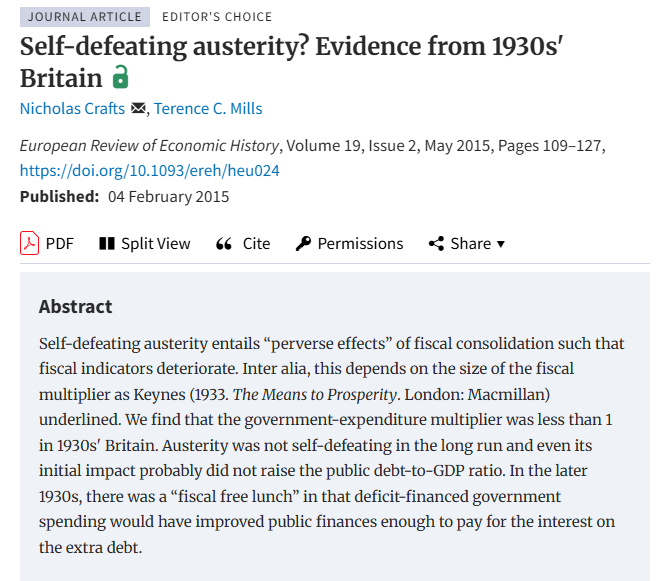
In the 1930s, Britain did fiscal austerity. Nick Crafts and Terence Mills found that it pretty much worked (with some nuances). But one thing that must be noted (and that Mills and Crafts also noted) is that the construction sector was immensely active.
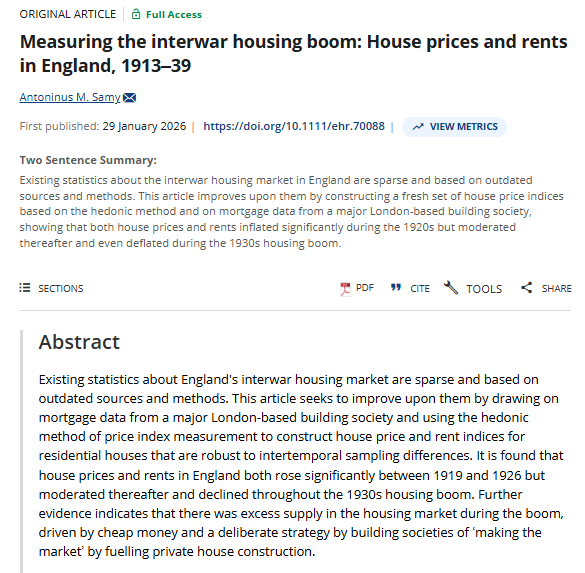
A new article (second image) in the Economic History Review by Antonius Samy goes into details of that housing boom. The simple answer is that it was largely supply-led.
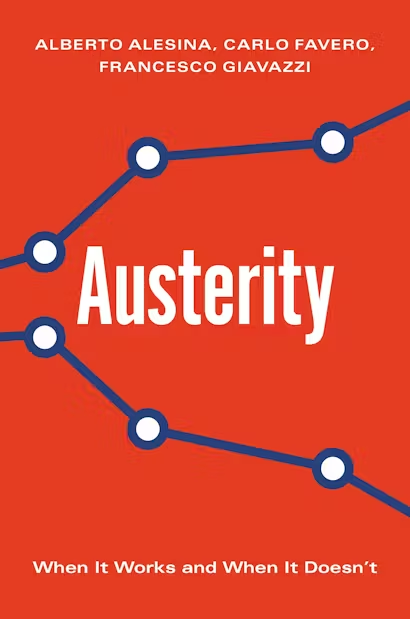
Between you, me and the flies on the wall -- this illustrates an underappreciated point in Alberto Alesina's (with Favero and Giavazzi) work on Austerity (image 3): austerity measures work when the supply-side of the economy is not shackled. The more supply-side restrictions exist, the likelier it is that fiscal consolidation will lead to economic contraction in the short-run (regardless of whether it happens via tax hikes or spending cuts).


English
AlbertoMingardi retweetledi

«Trivers è diventato il caso di studio più eloquente delle proprie teorie: un cooperatore che ha smesso di cooperare, un innovatore che ha pagato la propria lucidità con l’isolamento» Gilberto Corbellini e @amingardi
rivistailmulino.it/a/robert-trive…


Italiano
AlbertoMingardi retweetledi

Solidarietà a #sansonetti, per il quale il pm ha chiesto 3 anni di carcere (!!!) perché Scarpinato (5Stelle) si è sentito diffamato dalle sue domande.
Italiano
AlbertoMingardi retweetledi

AlbertoMingardi retweetledi

Sono passate più di 18 ore dal comunicato di Meloni di ieri sera. Il problema, comunicativo e politico, per Meloni è questo: dopo una nota del genere, ogni minuto che passa senza dimissioni di Santanché è un minuto in cui credibilità e capitale politico si erodono.
Lorenzo Pregliasco@lorepregliasco
Bordata di Meloni contro Santanché, con richiesta pubblica di dimissioni
Italiano
AlbertoMingardi retweetledi

Dalla Generazione apatica alla Generazione che ha salvato Costituzione e Democrazia.
Svolgimento: due giorni.
Ok, dai.
#narrazioni
Italiano
AlbertoMingardi retweetledi

L'Area C di Milano vota Sì, in tutto il resto della città dilaga il No. Un rovesciamento del teorema Ztl?
Youtrend@you_trend
👉 A #Milano il Sì vince solo nel Municipio 1, che copre il Centro fino alla Circonvallazione interna.
Italiano
AlbertoMingardi retweetledi

👋🏻Cosa fa “La Ricchezza delle Nazioni”?
Episodio 3 – La mano invisibile
Quello della "mano invisibile" è forse il concetto più famoso — e più frainteso — de La ricchezza delle nazioni.
Smith usa questa metafora per descrivere una situazione molto specifica: quella di chi preferisce investire nel proprio territorio, anche accettando rendimenti inferiori, per ragioni di sicurezza e fiducia
Italiano
AlbertoMingardi retweetledi

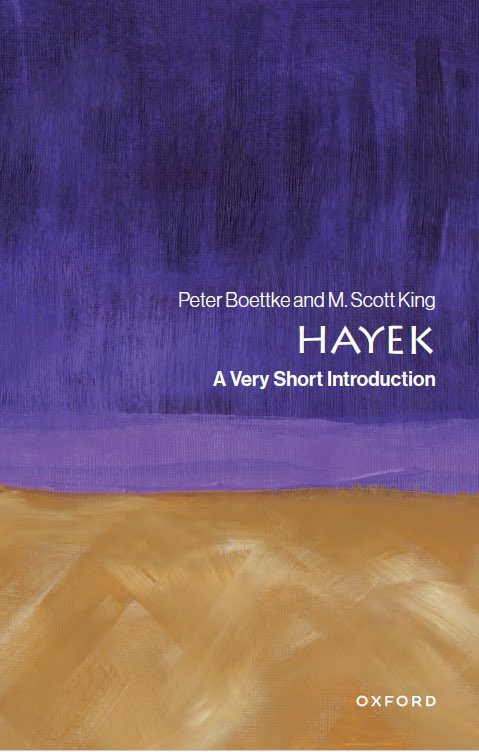
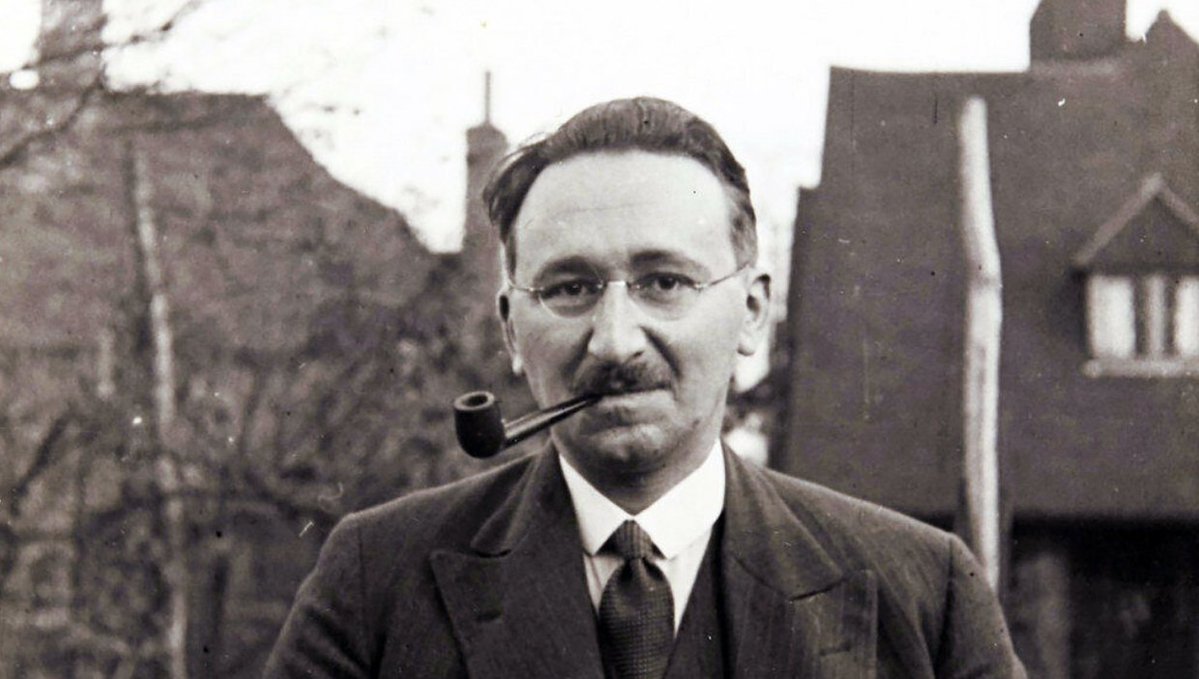
On this date in 1992, we lost one of our greatest minds: Friedrich A. von Hayek.
His writing shone a light on the horrors of totalitarianism. He mounted vital critiques of centrally planned economies and theorised how knowledge moves through society using markets and their signals.
His theories grounded some of the best economic reforms of the 20th century. Thanks to Hayek, we are all better off.

English