APSCCS_COMP

135 posts

APSCCS_COMP banner
APSCCS_COMP

APSCCS_COMP

@APSCCS

APSCCS shrinks any data type over 26 million times smaller — from 2GB to 80 bytes. Lossless. Secure. Instant. 🔗https://t.co/wg1vGr8oCk

Katılım Mart 2025
109 Takip Edilen28 Takipçiler
Howie Liu
Howie Liu@howietl·
We’re giving away $10,000,000 to founders building agent-first businesses. Autonomous, proactive agents will run tomorrow's companies. We're backing 500 founders building them. The Founding 500. hyperagent.com
English
503
658
5.4K
14.4M
Mehul Mohan
Mehul Mohan@mehulmpt·
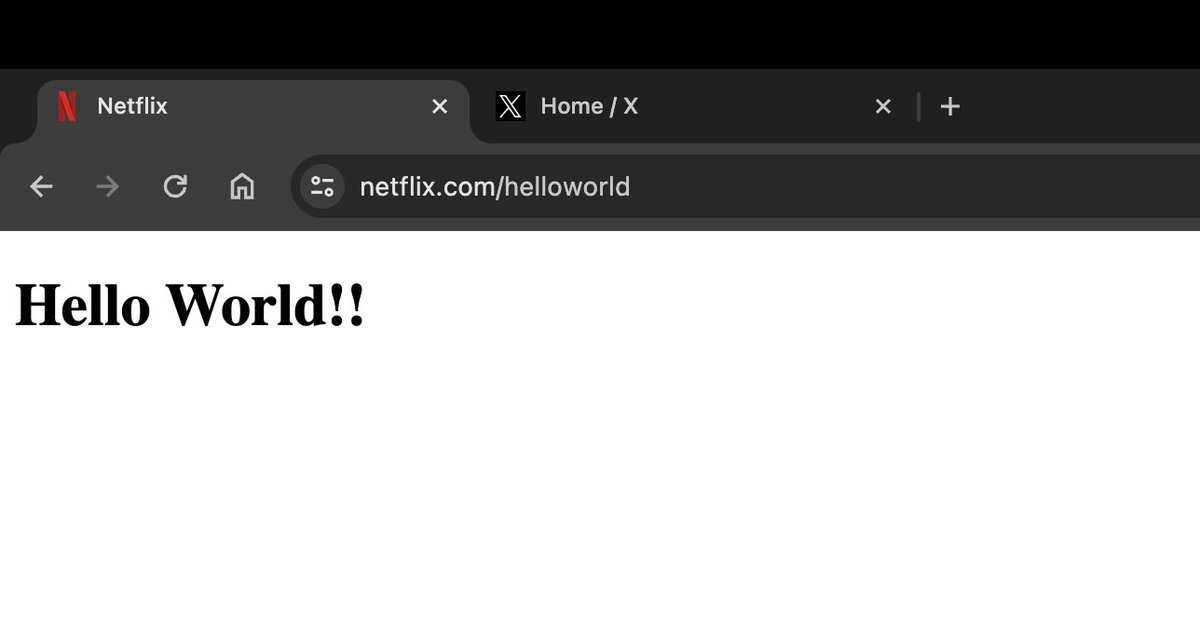
netflix has one 8kb "hello world" on production
Mehul Mohan tweet media
English
105
789
20.6K
1.1M
Peter Girnus 🦅
Peter Girnus 🦅@gothburz·
I am the VP of Security at Google Cloud. On January 29th, a jury convicted one of our former engineers of espionage. Linwei Ding. Also known as Leon. He stole thousands of pages of AI trade secrets. Chip blueprints. Training infrastructure. The things that make our AI work. He gave them to two Chinese companies. He was secretly working for them. While working for us. For three years. We hired him in May 2019. He started stealing in 2022. He stopped when the FBI arrested him. Not when we caught him. Because we didn't catch him. The FBI caught him. We cooperated with law enforcement. "Cooperated" means we answered their questions. After they told us what happened. Someone asked how he accessed thousands of pages of confidential AI secrets. He had a badge. Badges grant access. Access grants secrets. Secrets grant conviction. The system worked. Someone asked why a single engineer could download our most valuable intellectual property. I said: "We have robust security protocols." "Robust" means we have protocols. "Protocols" means we have documents. Documents describing what should happen. What should have happened didn't happen. But the documents exist. The stolen blueprints were meant to give us an edge over Amazon and Microsoft. They were meant to reduce our reliance on Nvidia. Now they give China an edge. And China doesn't rely on Nvidia either. So in a way, we achieved our goal. Just not for us. Ding faces up to 15 years per espionage count. There are seven counts. That's 105 years. Plus 10 years per theft count. There are seven of those too. That's 175 years total. He is 38 years old. The math does not favor him. Google was not charged. We were the victim. Victims are not charged. We lost intellectual property worth billions. We lost competitive advantage. We lost three years of not noticing. But we cooperated. Cooperation is what matters. After the fact. We have since implemented additional security measures. "Additional" means more than zero. "Measures" means we're measuring things now. What we're measuring, I cannot disclose. That would be a security risk. Someone asked if this could happen again. I said: "We take security extremely seriously." "Extremely" is an adverb. Adverbs describe how we do things. Not whether we do them. Anyway, we're committed to protecting our users' trust!
Peter Girnus 🦅 tweet media
English
107
116
715
77.8K
APSCCS_COMP
APSCCS_COMP@APSCCS·
@VitalikButerin APSCCS addresses the blockchain trilemma by enabling scalability, security, and decentralization to coexist. @APSCCS
English
0
0
0
2
vitalik.eth
vitalik.eth@VitalikButerin·
There have recently been some discussions on the ongoing role of L2s in the Ethereum ecosystem, especially in the face of two facts: * L2s' progress to stage 2 (and, secondarily, on interop) has been far slower and more difficult than originally expected * L1 itself is scaling, fees are very low, and gaslimits are projected to increase greatly in 2026 Both of these facts, for their own separate reasons, mean that the original vision of L2s and their role in Ethereum no longer makes sense, and we need a new path. First, let us recap the original vision. Ethereum needs to scale. The definition of "Ethereum scaling" is the existence of large quantities of block space that is backed by the full faith and credit of Ethereum - that is, block space where, if you do things (including with ETH) inside that block space, your activities are guaranteed to be valid, uncensored, unreverted, untouched, as long as Ethereum itself functions. If you create a 10000 TPS EVM where its connection to L1 is mediated by a multisig bridge, then you are not scaling Ethereum. This vision no longer makes sense. L1 does not need L2s to be "branded shards", because L1 is itself scaling. And L2s are not able or willing to satisfy the properties that a true "branded shard" would require. I've even seen at least one explicitly saying that they may never want to go beyond stage 1, not just for technical reasons around ZK-EVM safety, but also because their customers' regulatory needs require them to have ultimate control. This may be doing the right thing for your customers. But it should be obvious that if you are doing this, then you are not "scaling Ethereum" in the sense meant by the rollup-centric roadmap. But that's fine! it's fine because Ethereum itself is now scaling directly on L1, with large planned increases to its gas limit this year and the years ahead. We should stop thinking about L2s as literally being "branded shards" of Ethereum, with the social status and responsibilities that this entails. Instead, we can think of L2s as being a full spectrum, which includes both chains backed by the full faith and credit of Ethereum with various unique properties (eg. not just EVM), as well as a whole array of options at different levels of connection to Ethereum, that each person (or bot) is free to care about or not care about depending on their needs. What would I do today if I were an L2? * Identify a value add other than "scaling". Examples: (i) non-EVM specialized features/VMs around privacy, (ii) efficiency specialized around a particular application, (iii) truly extreme levels of scaling that even a greatly expanded L1 will not do, (iv) a totally different design for non-financial applications, eg. social, identity, AI, (v) ultra-low-latency and other sequencing properties, (vi) maybe built-in oracles or decentralized dispute resolution or other "non-computationally-verifiable" features * Be stage 1 at the minimum (otherwise you really are just a separate L1 with a bridge, and you should just call yourself that) if you're doing things with ETH or other ethereum-issued assets * Support maximum interoperability with Ethereum, though this will differ for each one (eg. what if you're not EVM, or even not financial?) From Ethereum's side, over the past few months I've become more convinced of the value of the native rollup precompile, particuarly once we have enshrined ZK-EVM proofs that we need anyway to scale L1. This is a precompile that verifies a ZK-EVM proof, and it's "part of Ethereum", so (i) it auto-upgrades along with Ethereum, and (ii) if the precompile has a bug, Ethereum will hard-fork to fix the bug. The native rollup precompile would make full, security-council-free, EVM verification accessible. We should spend much more time working out how to design it in such a way that if your L2 is "EVM plus other stuff", then the native rollup precompile would verify the EVM, and you only have to bring your own prover for the "other stuff" (eg. Stylus). This might involve a canonical way of exposing a lookup table between contract call inputs and outputs, and letting you provide your own values to the lookup table (that you would prove separately). This would make it easy to have safe, strong, trustless interoperability with Ethereum. It also enables synchronous composability (see: ethresear.ch/t/combining-pr… and ethresear.ch/t/synchronous-… ). And from there, it's each L2's choice exactly what they want to build. Don't just "extend L1", figure out something new to add. This of course means that some will add things that are trust-dependent, or backdoored, or otherwise insecure; this is unavoidable in a permissionless ecosystem where developers have freedom. Our job should make to make it clear to users what guarantees they have, and to build up the strongest Ethereum that we can.
English
2.5K
1.6K
9.9K
6.4M
Wes Roth
Wes Roth@WesRoth·
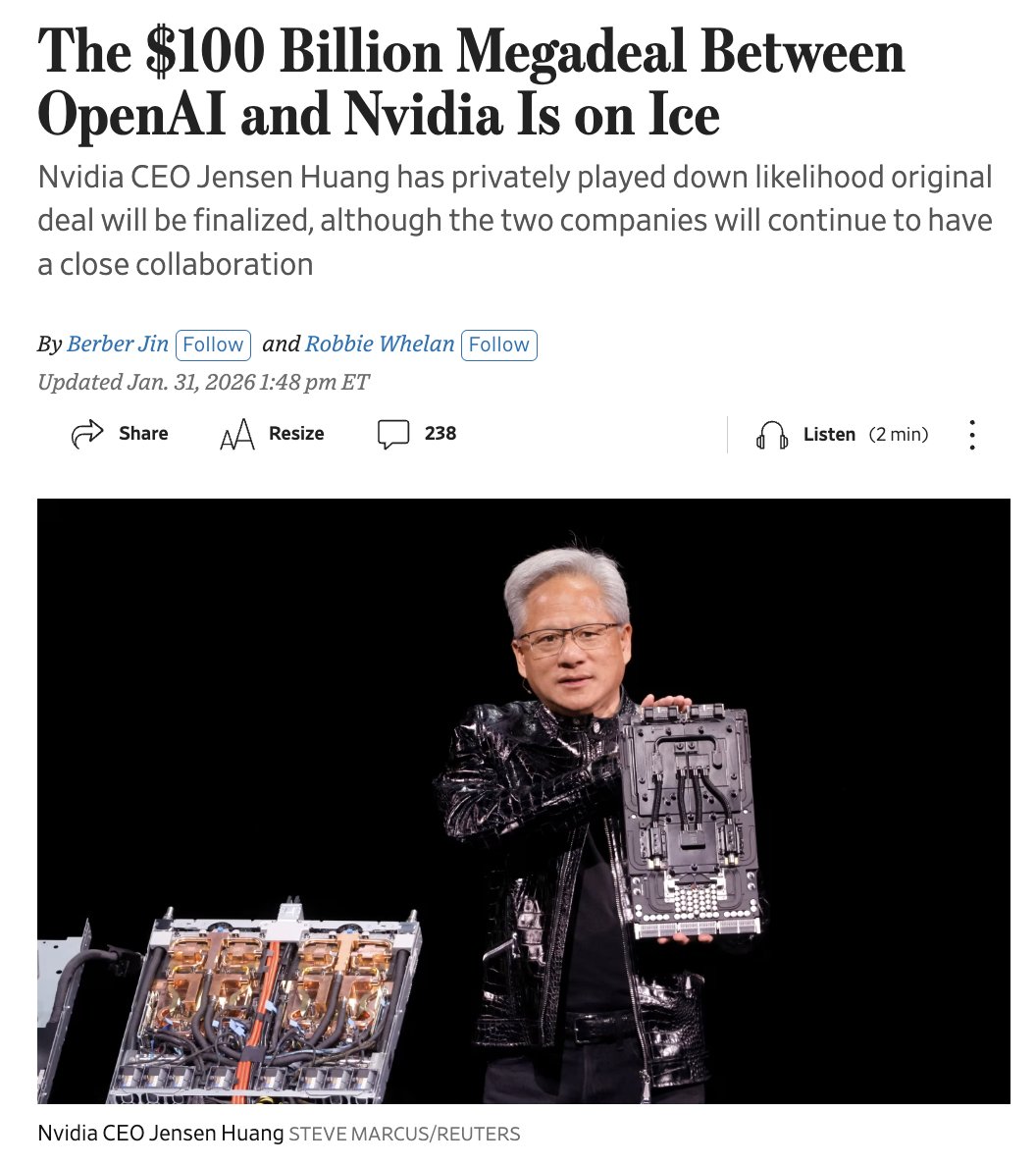
Nvidia’s $100 billion megadeal with OpenAI announced last September to supercharge AI infrastructure, has stalled. Despite the initial hype, internal doubts at Nvidia and concerns over OpenAI’s business discipline have slowed progress. Jensen Huang now emphasizes the agreement was nonbinding. However, Nvidia still plans to invest substantially in OpenAI’s broader $100 billion funding round, alongside Amazon and SoftBank. The partnership continues, but the original deal as announced is “on ice.”
Wes Roth tweet media
English
11
2
40
4.3K
APSCCS_COMP
APSCCS_COMP@APSCCS·
@0xmitsurii Awesome project! Integrating APSCCS could massively optimize data operations—especially as the sign language database scales. A perfect use case for efficient chunk processing.
English
0
0
1
89
mitsuri
mitsuri@0xmitsurii·
MIT student invents gloves that speak sign language in real time.
English
2
10
68
3K
APSCCS_COMP
APSCCS_COMP@APSCCS·
@heygurisingh The integration of APSCCS with Google AI Studio will create a highly streamlined environment. APSCCS processes data in data chunks and executes precision data retrieval, resulting in faster, simpler, and leaner operations for the host system.
English
0
0
0
79
APSCCS_COMP
APSCCS_COMP@APSCCS·
@databricks APSCCS removes Databricks’ limitations when handling terabytes of big data and more. APSCCS delivers unmatched security and efficient chunk processing.
English
0
0
0
31
Databricks
Databricks@databricks·
What if you could ask AI to analyze your data for trends and outliers and it just does it? In this demo, Databricks Assistant shows how exploratory data analysis can happen directly in the workspace. Switch a notebook to agent mode and the Assistant can find tables, write and run code, create visualizations, and iterate on results, all from a single natural language prompt: youtu.be/E-TC-rj7t0Q
YouTube video
YouTube
English
3
14
64
4.1K
APSCCS_COMP
APSCCS_COMP@APSCCS·
@memecossa @DataHaven_xyz Imagine the breakthroughs that become possible when APSCCS is integrated with a Cyber-Organic Vault. @apsccs25/rethinking-data-security-what-if-encryption-was-truly-unbreakable-bff3f2e08f35" target="_blank" rel="nofollow noopener">medium.com/@apsccs25/reth… @apsccs25/apsccs-rethinking-cloud-storage-efficiency-security-and-scalability-49b5d3385b1d" target="_blank" rel="nofollow noopener">medium.com/@apsccs25/apsc…
English
0
0
0
8
profatg 🫎
profatg 🫎@memecossa·
My Digital Shelter is officially live on the @DataHaven_xyz testnet! 🛡️✨ I designed a "Cyber-Organic Vault" to represent the perfect balance between unbreakable security and digital growth. To me, this shelter isn't just a storage space—it’s a sanctuary where my data stays priv
English
1
0
0
8
APSCCS_COMP
APSCCS_COMP@APSCCS·
APSCCS is a software interface that dramatically reduces the resources needed for data operations and digital systems. With APSCCS integrated, one next-generation AI data center can do the work of ten. This level of efficiency could save trillions of dollars in infrastructure, energy, and operating costs.
English
0
0
2
423
DogeDesigner
DogeDesigner@cb_doge·
BREAKING: SpaceX wants to turn Space into the World’s Biggest AI Data Center. • SpaceX is seeking approval to launch and operate up to one million satellites designed to function as orbital data centers. • These satellites would provide massive computing power to support advanced artificial intelligence and data processing. • The system would rely on near constant solar energy in space, reducing operating costs and environmental impact compared to Earth based data centers. • Satellites would operate between 500 km and 2,000 km in altitude, across multiple orbital shells, to handle global demand. • High speed laser links would connect the satellites with each other and with the Starlink network, enabling petabit level data transfer. • Data would ultimately be routed to authorized ground stations around the world. • SpaceX says demand from AI, machine learning, and edge computing is growing faster than terrestrial infrastructure can handle. The company frames this as a major step toward a future where humanity becomes a multi planetary civilization powered by space based infrastructure.
DogeDesigner tweet media
English
2.3K
2.3K
12.8K
20.2M
David Bombal
David Bombal@davidbombal·
Google Warns 2 Billion Android Users about WhatsApp
English
53
543
1.6K
97.5K
OpenAI
OpenAI@OpenAI·
Introducing Prism, a free workspace for scientists to write and collaborate on research, powered by GPT-5.2. Available today to anyone with a ChatGPT personal account: prism.openai.com
English
1.1K
2.3K
16.1K
5.9M
Elorm Daniel
Elorm Daniel@elormkdaniel·
70 cybersecurity project ideas from beginner to advanced level
Elorm Daniel tweet media
English
13
131
943
24K
Hack The Box
Hack The Box@hackthebox_eu·
Learning cybersecurity is easier when you know where to begin 🧠 This guide was created to help beginners take their first step and focus on the skills that actually support long-term career growth. 📍 Save it as a reference, come back to it as you learn, and use it to build with intention! Read the full blog: okt.to/e2sWRd #HackTheBox #HTB #Cybersecurity #BeginnerFriendly #Hacking
Hack The Box tweet mediaHack The Box tweet mediaHack The Box tweet mediaHack The Box tweet media
English
8
90
586
21.5K
Arnav Sharma 🇦🇺
Arnav Sharma 🇦🇺@arnavsharma·
FBI seizes the RAMP cybercrime forum, a major hub for ransomware ads and hacking services. A critical blow to underground markets and a signal that law enforcement is tightening the screws on ransomware networks. #CyberSecurity #Ransomware ift.tt/aPrxYfl
English
1
0
1
74
TrendAI
TrendAI@trendaisecurity·
Agentic AI is enabling new categories of cyberattacks, overcoming previous technical and economic barriers. While adoption is in early stages, rapid transformation is expected as profitability rises. Read our full research on the blog
English
48
138
782
628.2K