

Richie Caputo
736 posts


Introducing TigerFS - a filesystem backed by PostgreSQL, and a filesystem interface to PostgreSQL.
Idea is simple: Agents don't need fancy APIs or SDKs, they love the file system. ls, cat, find, grep. Pipelined UNIX tools. So let’s make files transactional and concurrent by backing them with a real database.
There are two ways to use it:
File-first: Write markdown, organize into directories. Writes are atomic, everything is auto-versioned. Any tool that works with files -- Claude Code, Cursor, grep, emacs -- just works. Multi-agent task coordination is just mv'ing files between todo/doing/done directories.
Data-first: Mount any Postgres database and explore it with Unix tools. For large databases, chain filters into paths that push down to SQL: .by/customer_id/123/.order/created_at/.last/10/.export/json. Bulk import/export, no SQL needed, and ships with Claude Code skills.
Every file is a real PostgreSQL row. Multiple agents and humans read and write concurrently with full ACID guarantees. The filesystem /is/ the API.
Mounts via FUSE on Linux and NFS on macOS, no extra dependencies. Point it at an existing Postgres database, or spin up a free one on Tiger Cloud or Ghost.
I built this mostly for agent workflows, but curious what else people would use it for. It's early but the core is solid. Feedback welcome.
tigerfs.io
English


Excited to share that I've joined Vercel's Board of Directors. Vercel is made up of builders and tastemakers that continually ship things that deeply impact how developers work: Next.js, AI SDK, v0, etc. I can't think of a more exciting place to be. Let's fucking ship. ▲
My relationship with Vercel goes back to the earliest days. HashiCorp was an early adopter of NextJS and Vercel (~10 years ago!) and it remains my default tech stack and deployment platform to this day. Ghostty's website is all on Vercel, too!
Beyond that, I've been continually impressed with the teams relentless focus on shipping meaningful software. And importantly, software that has incredible taste.
Now we are in the age of agentic software development. Vercel is building agentic infrastructure that I think every app and agent will need (I certainly need it!) and I can't think of a more exciting place to be.
Huge thanks to @rauchg , Jeanne, Marten, @cramforce, @tomocchino and the entire Vercel team for the warm welcome. Time to work.

English

@georgecurtiss Schema and data living together is a convenient paradigm for LLMs. They can both evolve together an you don’t need to be very opinionated a head of time
English

@NickADobos Man made horrors beyond comprehension for security engineers
English

@ah20im Similar sdk harness to Claude agent sdk for general purpose tasks
English

@IndraVahan I am convinced anything past 1m rows requires vectors and even then you should still use vectors + tsvector or bm25
English

this is probably the last time i'm gonna tweet about this crap. please try these "vector killers" on 100k+ documents & let me know how they perform against embeddings. none of this scales. none of this will survive serious enterprise production. don't fool yourself
Nav Toor@heynavtoor
🚨 This Python tool just made vector databases optional for RAG. It's called PageIndex. It reads documents the way you do. No embeddings. No chunking. No vector database needed. Here's the problem with normal RAG: It takes your document, cuts it into tiny pieces, turns those pieces into numbers, and searches for the closest match. But closest match doesn't mean best answer. PageIndex works completely different. → It reads your full document → Builds a tree structure like a table of contents → When you ask a question, the AI walks through that tree → It thinks step by step until it finds the exact right section Same way you'd find an answer in a textbook. You don't read every page. You check the chapters, pick the right one, and go straight to the answer. That's exactly what PageIndex teaches AI to do. Here's the wildest part: It scored 98.7% accuracy on FinanceBench. That's a test where AI answers real questions from SEC filings and earnings reports. Most traditional RAG systems can't touch that number. Works with PDFs, markdown, and even raw page images without OCR. 100% Open Source. MIT License.
English
@bcardarella Can confirm, but typically they are sourcing said deals too so not entirely grift
English

A friend in the VC/PE space told me there is an entire cottage industry of grifters that will analyze VC portolios to see if they have any gaps in market penetration then pitch on that gap because the investors have FOMO.
Is this true, any verifiable evidence?
English
Richie Caputo retweetledi

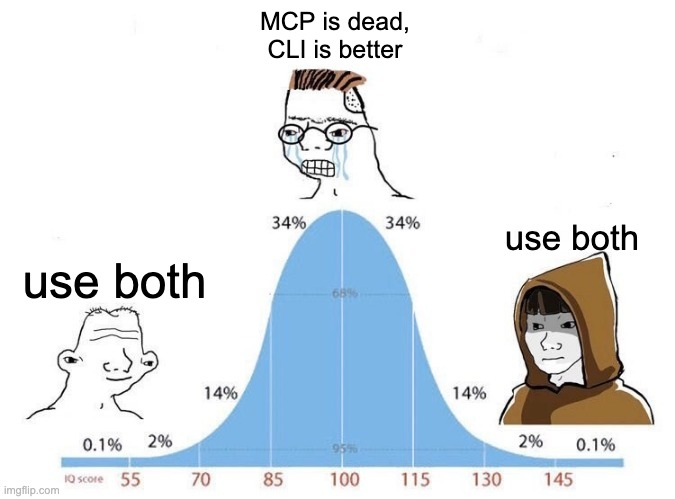
The current "MCP is dead discourse" is my current favorite example of the really annoying "simplicity" brainrot that's been plaguing tech for a while
On paper "just use a cli agents already know bash" sounds really good. It makes sense and is true, but it misses the bigger picture:
> how do they know about the commands + their shape?
> just put it in your agents md file or make a skill
> ok, so then what happens if the cli's shape changes
> well then u just update the markdown file
> fine let's pretend people will actually do that (they will not) and this actually works, how are you going to scope authentication and authorization?
> use the cli auth tools like what AWS has
> ok so we need eng's or agents to be manually making sure every project switches the auth to the correct scopes for each project so that prod can't get vibe killed and then to connect to our internal services over cli in cloud agents we need to run basic agents in sandboxes now b/c we're not using mcp and...
You get the point.
It sounds really simple, and it is in the toy case, but in the real world an external API gated through MCP is actually way simpler, more secure, and manageable in a lot of cases.
This post & article from @GergelyOrosz is a very good example: x.com/GergelyOrosz/s…
It's the same thing with the $5 VPS or htmx or postgres or whatever other "simple" enlightened solution that works great in dumb indie hacker demos while making zero sense in the real world. I hate to break it to you guys, but there's no conspiracy. If modern tech solutions really were over complex slop do u really think these companies wouldn't take the free win to just do it the "simple" way? There are tons of problems with the tech, but it exists for a reason.
I like CLIs a lot, and in a lot of cases skills make sense, clis make sense, etc. There are a lot of ways to do things, and they all solve different problems.
But no, MCP is not dead. It or something like it isn't going anywhere. And there are a lot of good new ideas of how to make it better!
Dumping an MCP with 60+ random tools into context sucks I completely agree and needs to be fixed. A lot of the code run solutions are very compelling like @RhysSullivan 's executor, cloudflare's code mode, and others. There are ways to fix this, but a "god mode bash tool" isn't it.
English
@bcardarella Damn beat me to it - how about calling it pig so you don’t need to use .zip?
English
Ok, here is the spec of the "bad idea"
Zip - an Elixir-like syntax that lowers to Zig IR
gist.github.com/bcardarella/79…
English

i want to refactor my entire codebase (website and API) to typescrypt, what are the chances that claude code will one shot it
English

Richie Caputo retweetledi

@cjzafir @ud_ambwani It’s been solved with tool search months ago. MCP is actually back for that reason. JSON Schema beats CLI currently
English

@ud_ambwani Unless we fix the context window issue, MCPs can't work. Its just a bloatware right now.
English
Some secrets:
1. Opus 4.5 > Opus 4.6
2. Codex 5.4 1M context is actually 512k
3. Qwen 3.5 is best OS model series (RN)
4. MCPs are dead
5. Openclaw was a prototype
6. Apple is the new NVIDIA
7. Perplexity is biggest grifter
8. Paper. design > figma
9. Ollama is just a crappy wrapper
10. Open source AI is ahead already.
English


Update: this is now rolled out to 100% of users
Boris Cherny@bcherny
🎶 I've been using voice mode to write much of my CLI code this last week Can't wait to hear what you think.
English
@leflushroyale @seatedro Agree - dbs need to be deterministic and reproducible. Vectors have point points but they work totally fine on 10m+ and better than text search alone (both is best)
English

@ARCaputo3 @seatedro It's not going to work reliably and will cost a small fortune to maintain. Vector bases are here to stay. LLMs, agentic or otherwise, are not the answer.
English

healthy dose of word salad and launch slop
Nishkarsh@contextkingceo
We've raised $6.5M to kill vector databases. Every system today retrieves context the same way: vector search that stores everything as flat embeddings and returns whatever "feels" closest. Similar, sure. Relevant? Almost never. Embeddings can’t tell a Q3 renewal clause from a Q1 termination notice if the language is close enough. A friend of mine asked his AI about a contract last week, and it returned a detailed, perfectly crafted answer pulled from a completely different client’s file. Once you’re dealing with 10M+ documents, these mix-ups happen all the time. VectorDB accuracy goes to shit. We built @hydra_db for exactly this. HydraDB builds an ontology-first context graph over your data, maps relationships between entities, understands the 'why' behind documents, and tracks how information evolves over time. So when you ask about 'Apple,' it knows you mean the company you're serving as a customer. Not the fruit. Even when a vector DB's similarity score says 0.94. More below ⬇️
English