Afghanistan Womens And Children S.W.O

4.3K posts

Afghanistan Womens And Children S.W.O banner
Afghanistan Womens And Children S.W.O

Afghanistan Womens And Children S.W.O

@AWCSWO

Maryam Marof Arwin Leader And Founder Of 👉https://t.co/LppMvgCKUC ||👉https://t.co/nA1ddgvmjf Email:[email protected] || 👉Email:[email protected]

Afghanistan Katılım Mart 2022
719 Takip Edilen8.5K Takipçiler
Afghanistan Womens And Children S.W.O
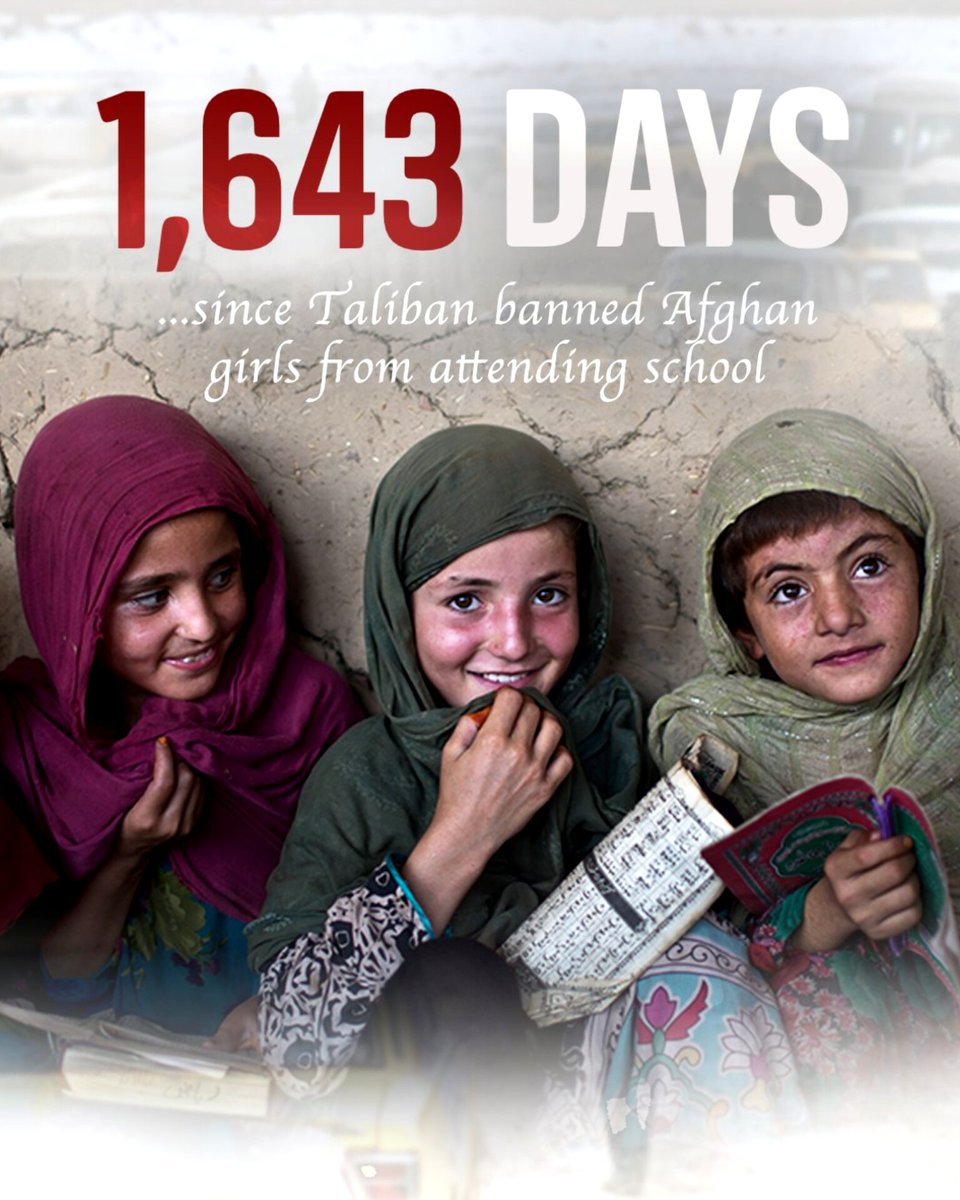
1,644 Days of Deprivation: Millions of Girls in Afghanistan Denied Their Right to Education—A Violation of One of the Most Fundamental Human Rights for Women and Girls in Afghanistan The widespread and systematic denial of educational access for girls in Afghanistan represents a stark and unequivocal violation of fundamental human rights in the contemporary era. This deprivation not only threatens the individual futures of millions of girls but also undermines Afghanistan’s prospects for development, stability, and social progress. Education is an essential and inalienable right for all human beings. Denying girls this right equates to stripping away opportunities for personal growth, social participation, and the nurturing of talents that could play a decisive role in shaping a better future. The continuation of this situation carries profound humanitarian, cultural, and economic consequences, placing Afghan society at increasing risk of enduring crises. Over the past nearly five years, women and girls in Afghanistan have fought for their right to education, facing numerous threats and risks imposed by the Taliban. They call for meaningful and robust support and intervention from the international community and the United Nations to end gender apartheid against women in Afghanistan. Emphasizing the urgent need to uphold human rights and the dignity of women and girls, we call for the immediate cessation of this deprivation, the application of international and domestic pressure on the Taliban, the provision of equal access to education, and the establishment of safe and equitable conditions for the education of all girls in Afghanistan. #EducationIsAHumanRight #right_justice_freedom #حق_عدالت_آزادی @antonioguterres @UNAMAnews @EUCouncil @TWennesland @Europarl_EN @EU_Commission @realDonaldTrump @EUinAfghanistan @MELANIATRUMP
Afghanistan Womens And Children S.W.O tweet media
English
3
4
8
103
Afghanistan Womens And Children S.W.O
Raise your voice of opposition to the Taliban through the celebration of Nowruz. Members of the Purple Saturdays Movement, in a public statement, have described the celebration of the New Year (Nowruz) as a symbol of cultural resistance against the restrictions imposed by the Taliban. They have called on the people of Afghanistan to commemorate this occasion in a conscious and dignified manner. The members of this movement have strongly criticized the Taliban’s ban on Nowruz celebrations. They state that by prohibiting this ancient and historical festival in Afghanistan, and by replacing joy, poetry, art, music, and culture with violence, repression, gender apartheid against women, linguistic discrimination against Dari Persian speakers, corporal punishment, hate propagation, and systemic abuses, the Taliban seek to undermine and erase essential elements of the country’s cultural and historical identity. Such policies, they warn, are driving the nation toward a fragile and deeply distressing humanitarian and cultural crisis. awna.af/?p=51499
English
1
5
8
129
Afghanistan Womens And Children S.W.O
March 8: The Taliban Have Transformed Afghanistan into a "Forbidden-stan" for Women: Afghanistan women mark International Women’s Day at a time when the Taliban—by imposing a system of gender apartheid and an inhumane, ruthless approach that signals a complete regression to the 1990s—have turned Afghanistan into a "Forbidden-stan" (Mamnoostan) for women; a place where being a woman is deemed a crime and their presence in society is met with comprehensive prohibitions. Gender apartheid is the official policy of the Taliban. We express our sincere gratitude and appreciation for the realistic and courageous stance of those nations that have refused to recognize the Taliban’s self-proclaimed government and have instead supported the women of Afghanistan, human rights values, and justice. We call upon them to support the struggles of Afghanistan women, the prosecution of Taliban leaders, and an end to the "engagement policy" with this group, while playing an active and pioneering role in this endeavor. We demand increased pressure on countries that support the Taliban and the restoration of Afghanistan's diplomatic missions that have been usurped by this group. We view the escalation of regional and global conflicts and tensions with deep concern, emphasizing that this situation not only poses a serious threat to global peace and security but also marginalizes the issue of women by normalizing violence and human rights violations—a condition that, more than ever, provides the ground for increased repression of women and the Taliban's crimes against humanity. Ideological, criminal, and terrorist regimes and groups like the Taliban share a common message: "No" to women, "No" to freedom, "No" to democracy, and "No" to equality. Therefore, we warn that the Taliban, alongside their "transborder jihad," seek to export gender apartheid beyond Afghanistan's borders. Should the Taliban’s self-proclaimed rule continue, gender apartheid will certainly not remain confined to Afghanistan. We believe that the fight against gender apartheid is a collective struggle to defend humanity, justice, and a future free from discrimination and oppression. The freedom of women is the yardstick for the freedom of society; no society is free and no justice is complete if its women are in chains. Gender apartheid will not be stopped unless we stand together, united and resolute, against it today. #Right_Justice_Freedom Purple Saturdays Movement
English
0
16
32
702
Afghanistan Womens And Children S.W.O
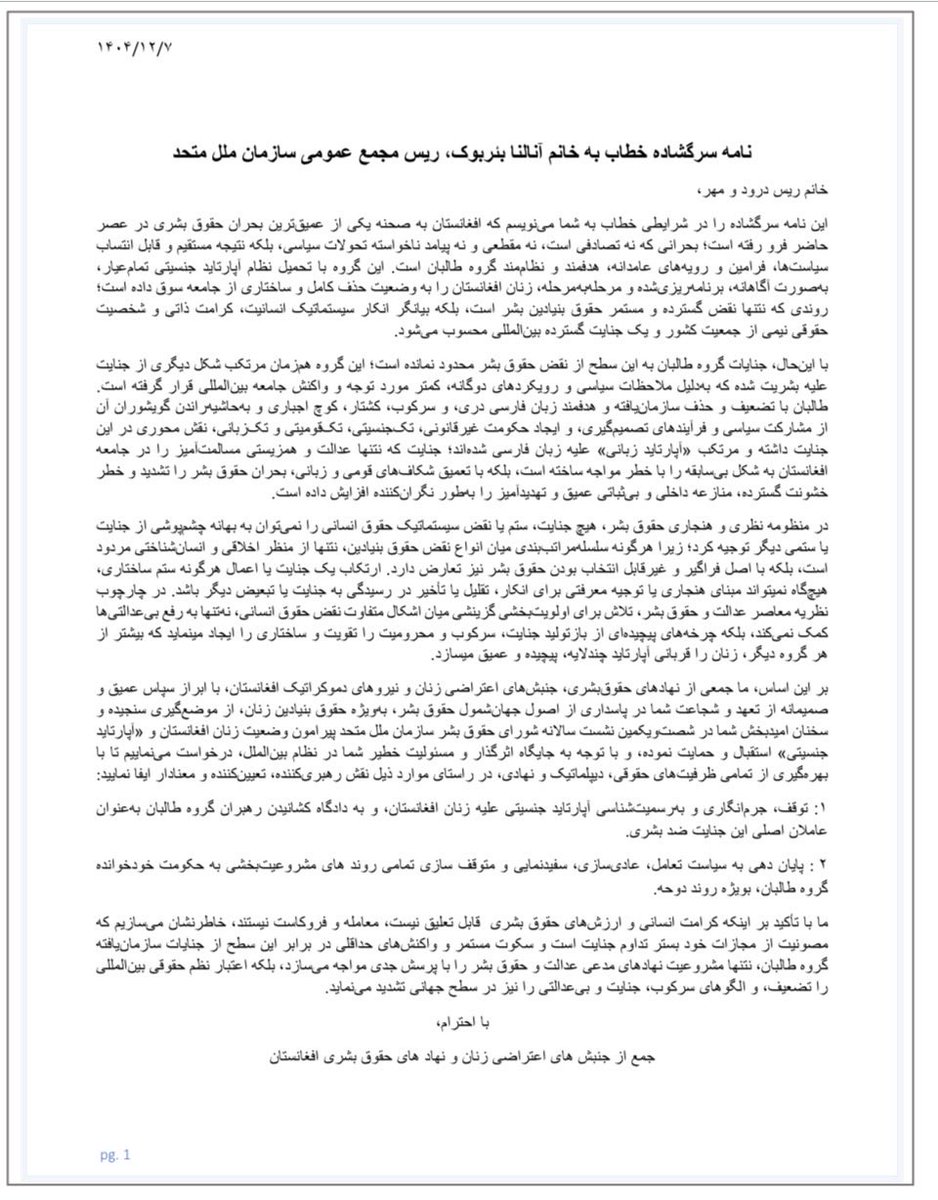
Open letter from Afghanistan women activists to UN General Assembly President Annalena Baerbock: Afghanistan faces severe gender apartheid under Taliban rule—systematic exclusion of women from education, work, movement, and public life. They urge immediate action: end all gender persecution, create international accountability mechanisms. Criticize weak verbal responses; demand real protection and prioritization of Afghanistan women’s rights. #Right_Justice_Freedom @UN_PGA @heatherbarr1 @unwomenafghan
English
5
33
52
1.5K
Afghanistan Womens And Children S.W.O
نامه سرگشاده فعالان زن افغان به رئیس مجمع عمومی سازمان ملل، آنالنا بائربوک:
Afghanistan Womens And Children S.W.O tweet mediaAfghanistan Womens And Children S.W.O tweet mediaAfghanistan Womens And Children S.W.O tweet media
فارسی
0
6
12
306
Afghanistan Womens And Children S.W.O
Open Letter to Ms. Annalena Baerbock, President of the General Assembly of the United Nations : Dear Madam President, With this open letter, we address you at a time when Afghanistan is experiencing one of the most severe crises in the history of human rights. The current situation is neither accidental nor superficial; it is a deliberate, systematic, and institutionalized policy of gender apartheid. This is evident in the complete exclusion of women from public life, education, employment, travel, and even the most basic social interactions—policies enforced by the Taliban with full intent and design. The suffering inflicted upon Afghan women is not limited to sporadic violations; it constitutes a comprehensive and structural system of gender-based persecution. The Taliban have institutionalized discrimination and oppression against women to an extent that has drawn global condemnation as one of the most extreme forms of gender apartheid in the contemporary world. This includes the erasure of women from all spheres of public life, the prohibition of education beyond primary levels for girls, severe restrictions on movement, forced veiling, and the criminalization of many ordinary activities for women. In this context, we believe that the international community—particularly the United Nations system—bears a special responsibility. The systematic denial of women’s rights in Afghanistan is not merely a domestic Afghan issue; it is a grave violation of international human rights norms and obligations that the international community has committed itself to uphold. We are deeply concerned that, despite repeated condemnations, the international response has often remained at the level of verbal statements without sufficient practical consequences or pressure on the Taliban. We therefore urge you, as President of the UN General Assembly, and through you the entire international community, to take concrete and effective steps in the following areas: 1. Immediate and unconditional cessation of all forms of gender-based persecution and apartheid against Afghan women, including the lifting of bans on education, work, freedom of movement, and participation in public life. 2. Implementation of accountability mechanisms, including the establishment of independent international investigative and fact-finding missions, documentation of crimes, and referral of systematic violations to relevant international judicial bodies. We emphasize that tolerance of or engagement with a system that institutionalizes gender apartheid—under the guise of humanitarian aid, dialogue, or political pragmatism—is unacceptable and incompatible with the principles of human rights and the UN Charter. We respectfully request that you place special focus on the situation of Afghan women in your presidency of the General Assembly, raise this issue prominently in international forums, and advocate for decisive action so that the voices of Afghan women are not only heard but lead to real protection and change. We believe that silence or inaction in the face of such systematic and intentional crimes against humanity will have long-term consequences for the credibility of the international human rights system. With utmost respect, Collective of Afghan Women Protesting Human Rights Violations and Gender Apartheid in Afghanistan @UN_PGA @unwomenafghan @heatherbarr1
Afghanistan Womens And Children S.W.O tweet mediaAfghanistan Womens And Children S.W.O tweet media
English
0
18
21
1K
Afghanistan Womens And Children S.W.O retweetledi
L'important
L'important@Limportant_fr·
«L'inaction de la communauté internationale face aux talibans revient à accepter la normalisation de la discrimination, de la violence et de l'exclusion systématique des femmes de la vie publique en Afghanistan» @AWCSWO
Français
10
195
292
6.6K
Afghanistan Womens And Children S.W.O
The systematic exclusion of women from social, political, educational, and economic spheres, and the normalization of violence and deprivation against them under Taliban rule in Afghanistan, constitutes one of the most severe contemporary human rights crises. These policies have not only resulted in the deliberate marginalization of half of the country’s population, but have also institutionalized structural violence against women, with profound, long-lasting, and destructive consequences for Afghanistan society as a whole. In the absence of any protective legal framework, the Taliban have shut down or effectively dismantled all institutions advocating for women’s rights and independent human rights organizations. As a result, women and girls who are victims of domestic, sexual, and social violence are entirely deprived of access to justice mechanisms and have no safe and independent avenues to file complaints, seek support, or pursue accountability. This situation has strengthened the cycle of impunity for perpetrators and intensified violations of women’s rights. At the same time, field evidence and credible reports indicate an unprecedented rise in underage marriages, forced marriages, child marriage, and harmful practices such as baad (the practice of giving girls to settle disputes). These practices, which already constitute clear violations of the rights of women and children under normal circumstances, have in the current context become survival strategies for families facing poverty, insecurity, and instability. The continuation of this trend poses severe threats to the physical and psychological well-being of girls and places the future of an entire generation at serious risk. Taken together, these policies and practices demonstrate the emergence of a deep and systemic human rights crisis in Afghanistan that targets not only women, but also the country’s social fabric, human development, and long-term stability. Failure by the international community to respond to this situation amounts to accepting the normalization of discrimination, violence, and the systematic exclusion of women from public life in Afghanistan. Clip: Heela Shinwari, member of the Purple Saturdays Movement in Jalalabad #Right_Justice_Freedom
English
2
48
98
5.1K
Afghanistan Womens And Children S.W.O
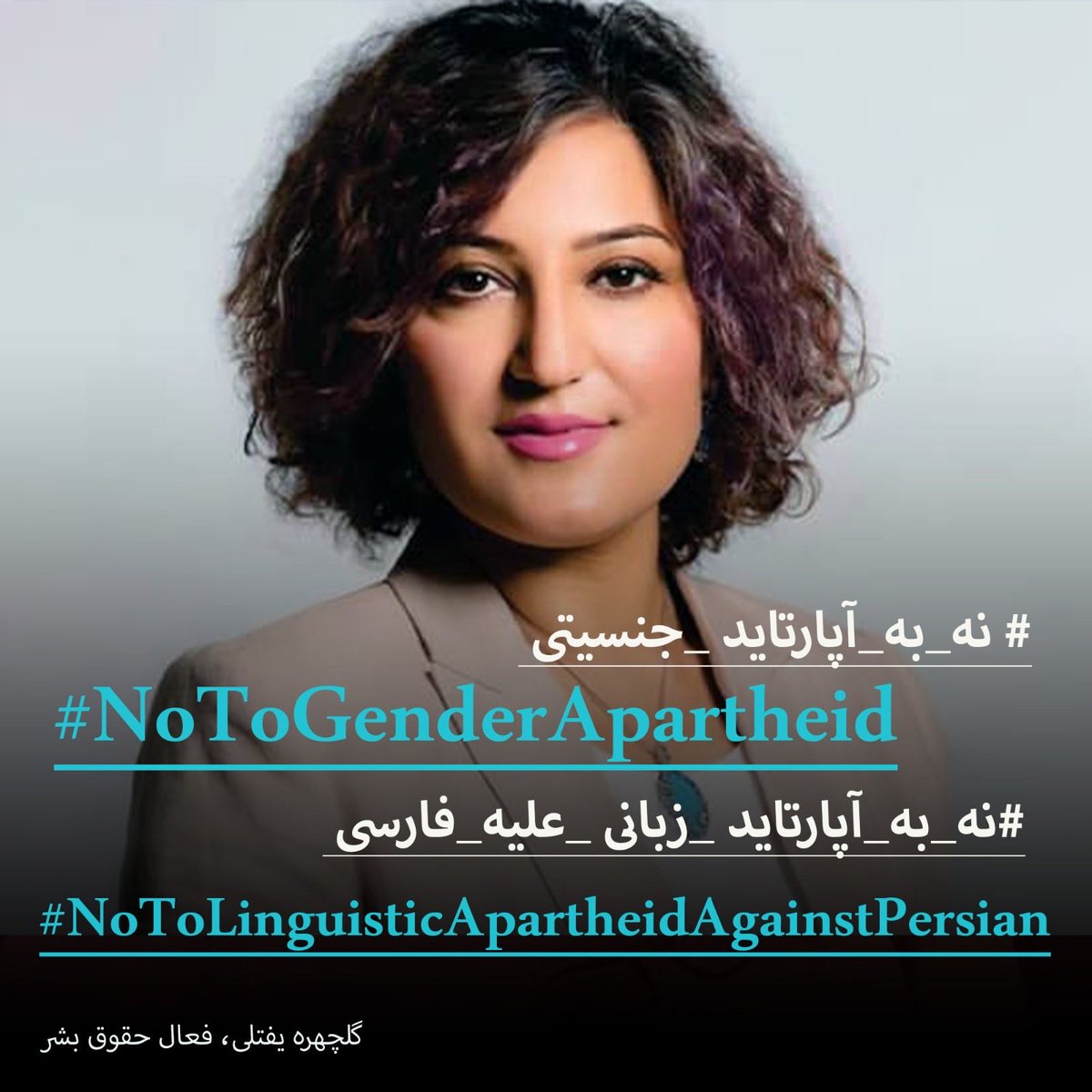
Day Six: Joint Campaign Against Gender Apartheid and Linguistic Apartheid : Over the past nearly five years, the Taliban have instituted a system of structural and intentional discrimination, committing gender apartheid against women and linguistic apartheid against the Persian language in Afghanistan. By banning girls’ education, restricting women’s participation in society, issuing dozens of repressive decrees, and completely removing them from public life, the group has systematically and extensively violated women’s fundamental rights and human dignity, stripping them of their social and civic roles. Through the continuation of gender apartheid and the creation of an atmosphere of fear and intimidation, the Taliban have arbitrarily detained, tortured, sexually abused, and, in numerous cases, mysteriously killed hundreds of women, including protesting women and civil activists. The recent arrests of Khadija Ahmadzada, an athlete, and Nazira Rashidi, a journalist, constitute further examples of this organized repression and have sparked serious concern. We firmly condemn the arbitrary and repressive detention of women by the Taliban and call for the immediate and unconditional release of Khadija Ahmadzada and Nazira Rashidi. We also emphasize the urgent need for independent, transparent, and accountable investigations into the targeted and mysterious killings of women in Afghanistan, and we call on the United Nations Assistance Mission in Afghanistan (UNAMA) and international human rights organizations to take swift, effective, and responsible action in response to these organized crimes, and to strengthen international pressure on the Taliban in a meaningful, practical, and sustained manner. The disregard for these crimes and the lack of political will to adopt effective measures against the Taliban have emboldened the group. Not only have they intensified gender apartheid, but they have also carried out targeted policies against the Persian language, thereby committing linguistic apartheid. By enforcing a mono-lingual and mono-ethnic administrative structure, removing Persian from official correspondence, altering public signs and place names, restricting Persian-language media, destroying cultural heritage, and deliberately reducing educational content in Persian, the Taliban have implemented a systematic policy of linguistic and cultural erasure. These measures, accompanied by security pressures, forced displacement, land confiscation, administrative discrimination, and coerced demographic changes against Persian speakers—constitute clear instances of crimes against humanity, ethnic discrimination, and cultural destruction. These policies are not isolated actions; rather, they form part of a broader plan by the Taliban for social engineering, identity elimination, and the consolidation of discriminatory dominance, a process that has deepened the human rights crisis and may even pave the way for internal conflict and the collapse of Afghanistan’s social fabric. Therefore, we, a collective of protesting women, human rights defenders, and democratic forces, on the sixth day of the campaign “Joint Struggle Against Gender Apartheid and Linguistic Apartheid”, call upon the international community, the United Nations, and global human rights organizations to awaken to the gravity of the situation and to take swift, effective, and visible steps in response to organized crimes, gender apartheid against women, linguistic apartheid against the Persian language, and the ongoing identity erasure in Afghanistan by the Taliban. #NoToGenderApartheid #NoToLinguisticApartheidAgainstPersian #FreeNaziraRashidi #FreeKhadijaAhmadzada Date: January 19, 2026
English
0
6
10
406
Afghanistan Womens And Children S.W.O
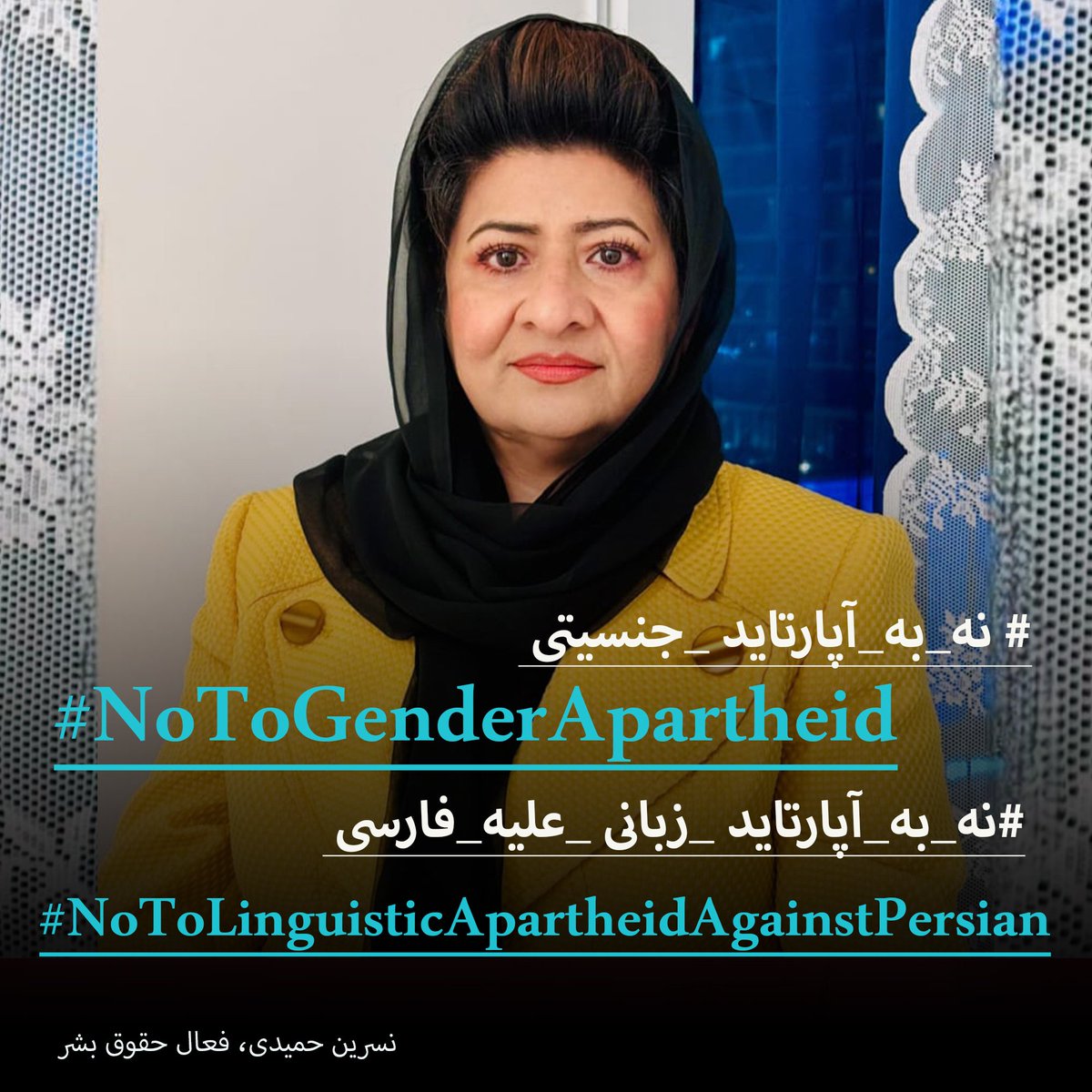
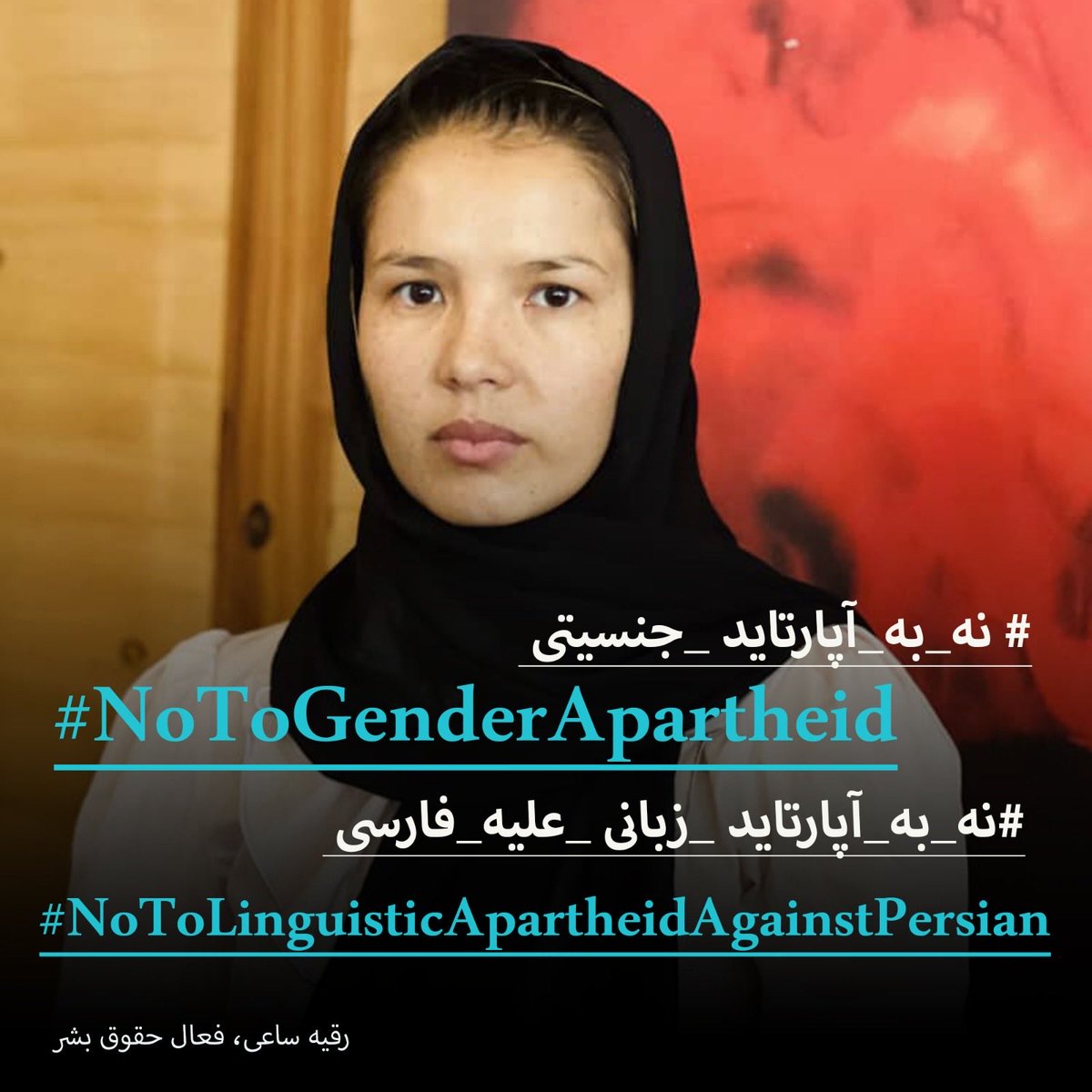
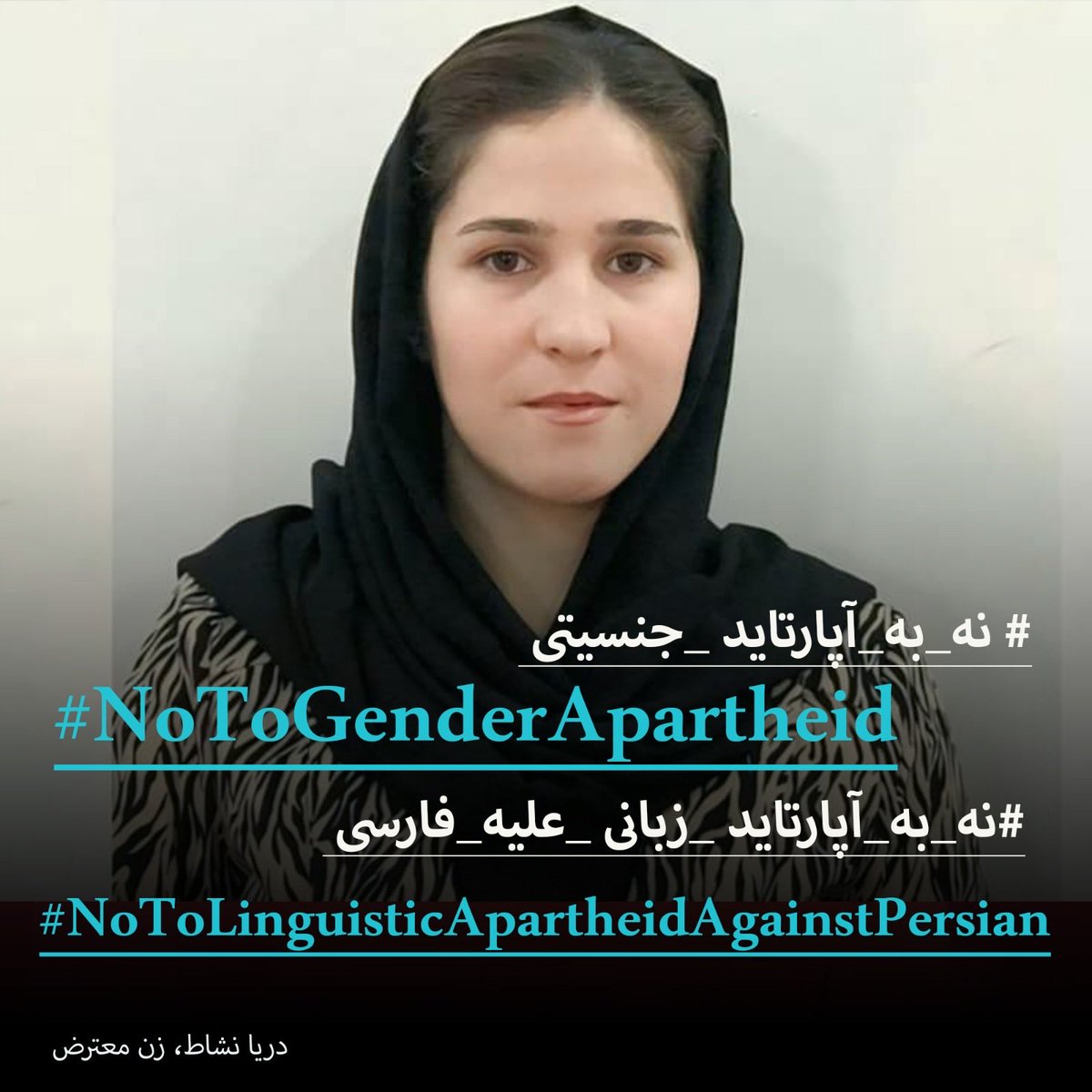
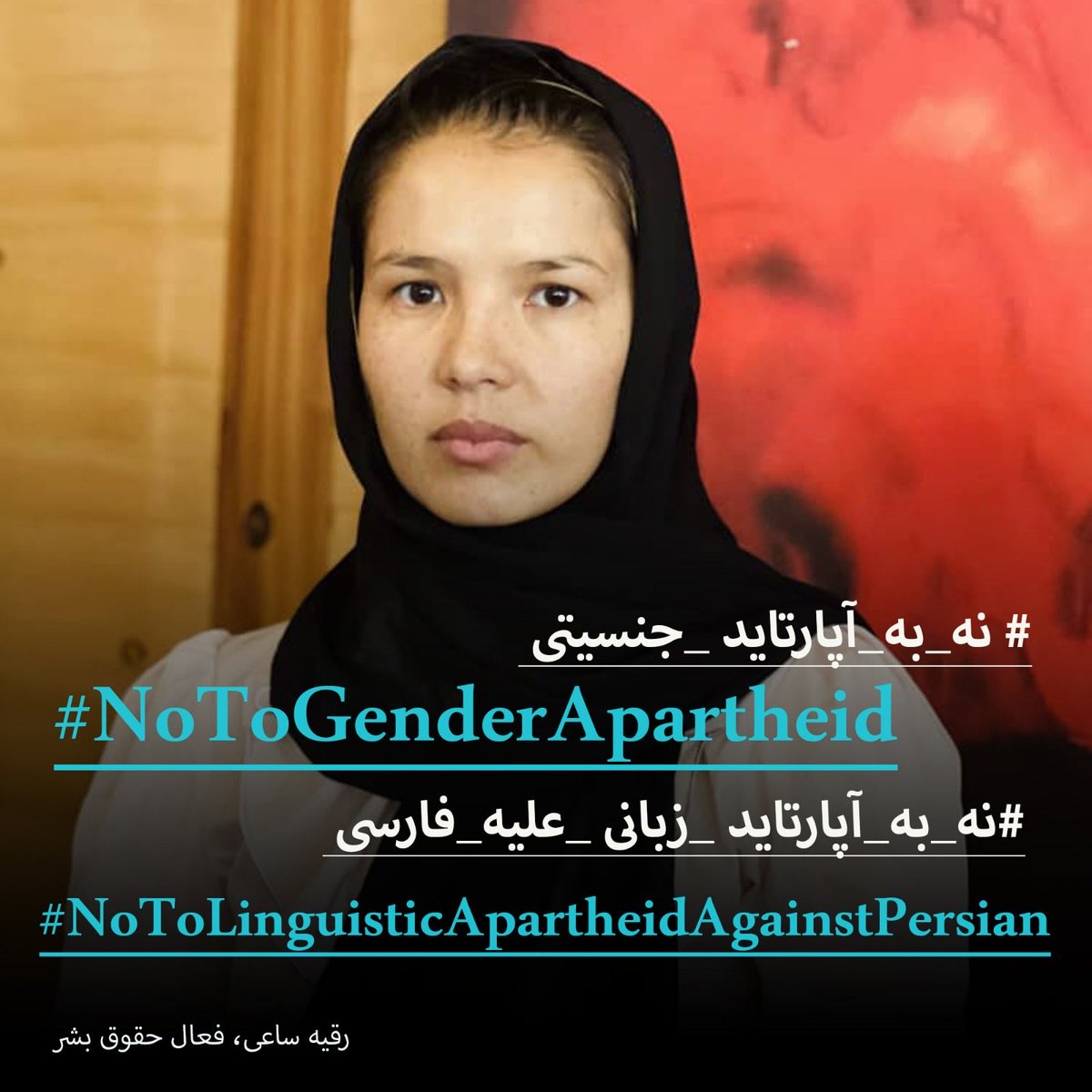
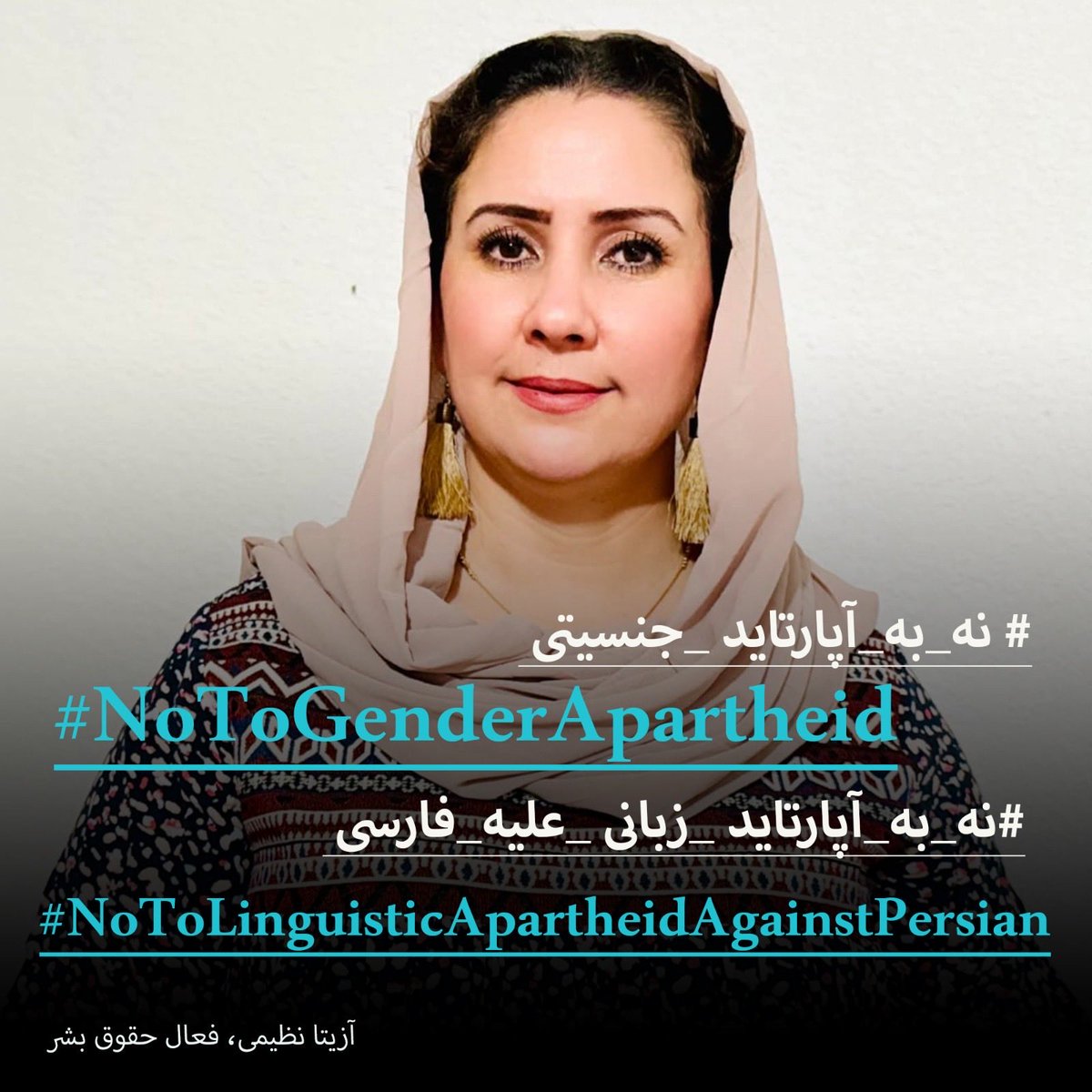
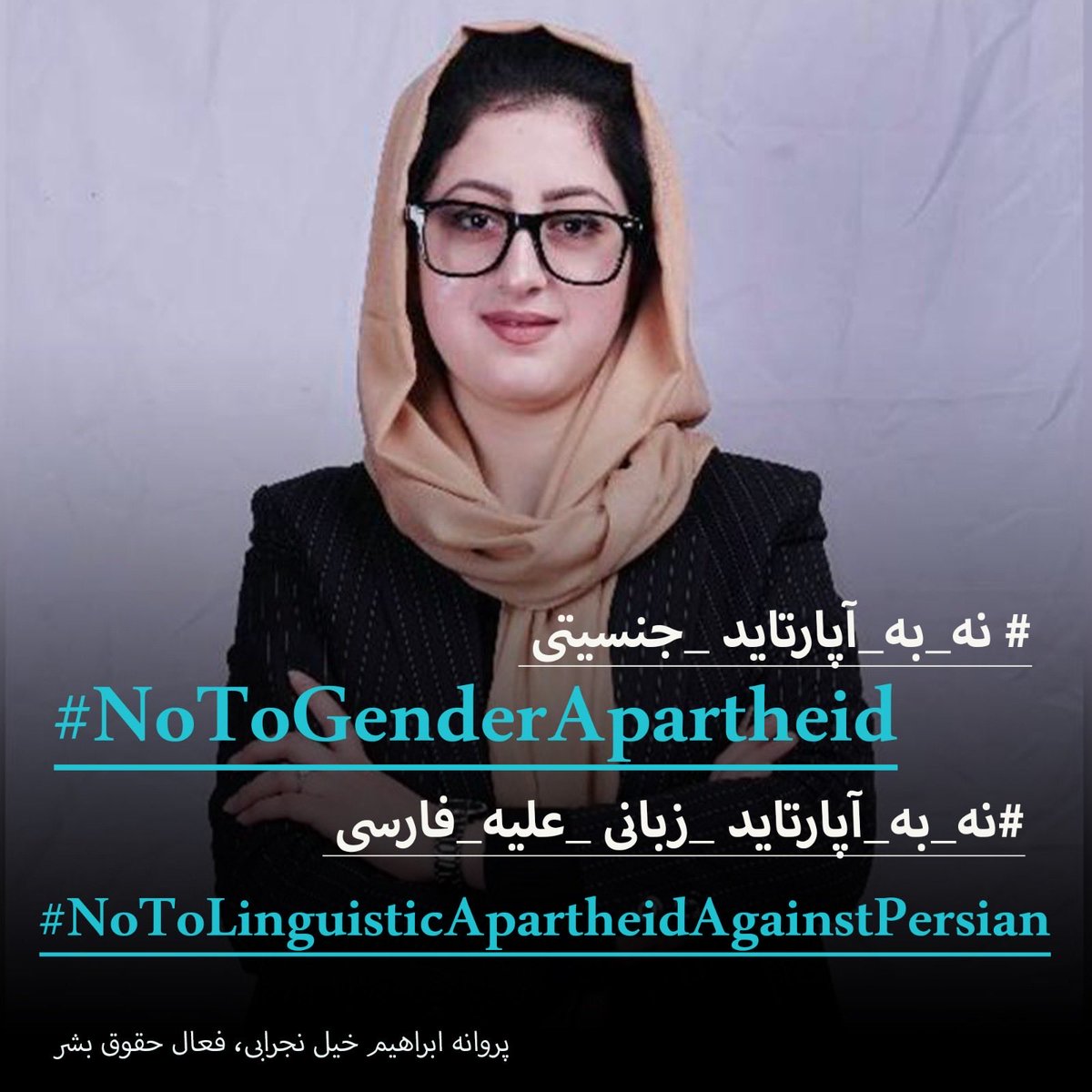
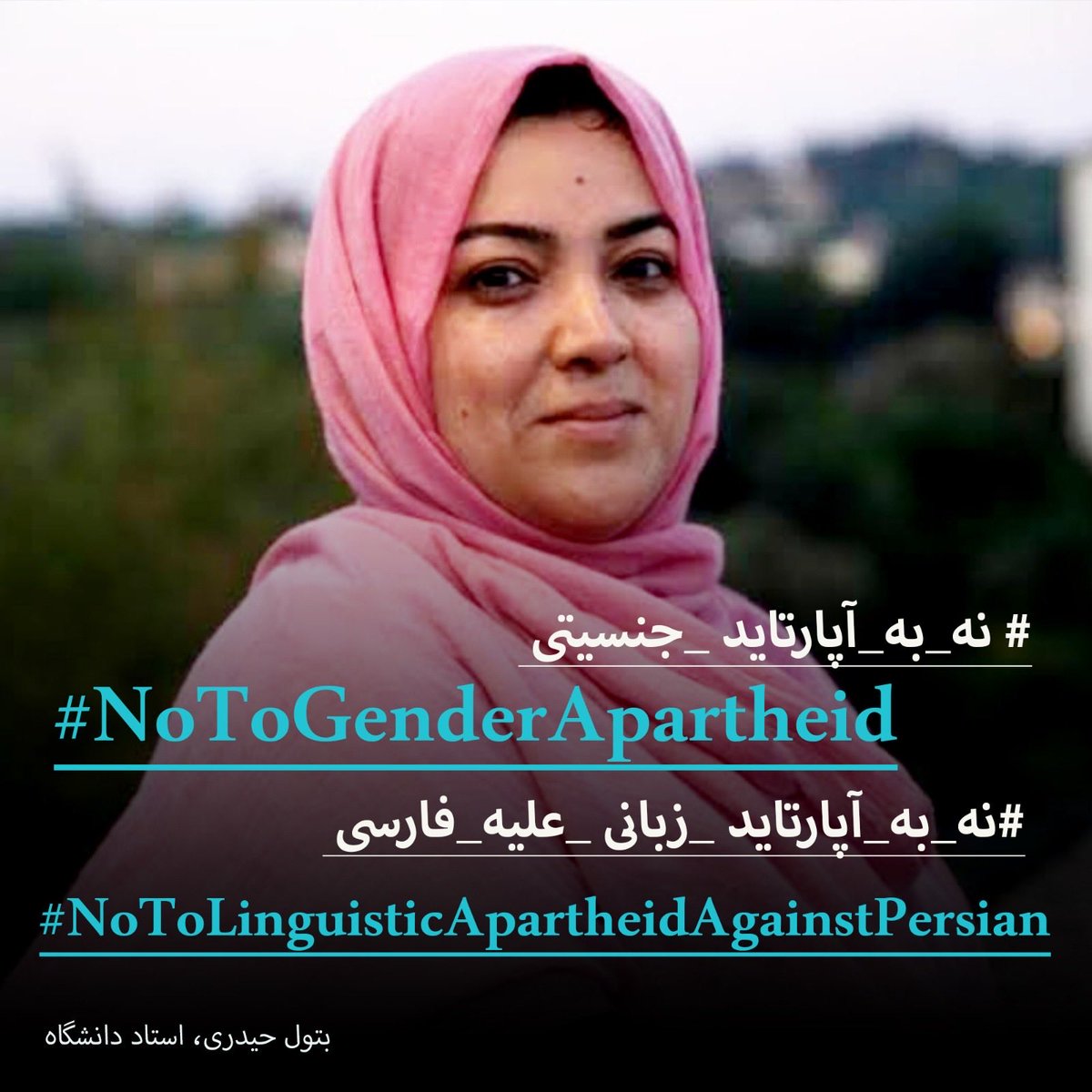
Joint Campaign Against Gender Apartheid and Linguistic Apartheid Within the normative and theoretical framework of human rights, no form of atrocity, oppression, or systematic violation of fundamental human rights can be justified by overlooking or downplaying another form of atrocity or oppression. Any attempt to establish a hierarchy among different types of fundamental rights violations is not only ethically and anthropologically indefensible but also fundamentally incompatible with the universal and non-selective nature of human rights. On this basis, concerns regarding the potential impact of articulating the concept of “linguistic apartheid” on the level of attention given to “gender apartheid” must not lead to the reproduction of mechanisms of marginalization or the denial of structural discrimination. The commission of one atrocity or the imposition of any form of structural oppression can never provide normative grounds or epistemic justification for denying, minimizing, or postponing the addressing of another atrocity or form of discrimination. In contemporary theories of justice and human rights, any effort to create hierarchies or selective prioritization among different forms of human rights violations not only fails to remedy injustice but also generates complex cycles of reproducing violence, repression, and deprivation. “Gender apartheid against women” and “linguistic apartheid against Persian–Dari” by the Taliban constitute two distinct yet deeply interlinked crimes; each targets a different dimension of social life, and together they construct a system that places not only women and Persian–Dari speakers but society as a whole in a condition of powerlessness, silence, and erasure. The simultaneity of these two crimes has multiplied the severity and scope of harm in Afghanistan, rendering it multilayered, intricate, and intensified, and elevating the Taliban’s pattern of repression from the level of “human rights violations” to the level of “crimes against humanity.” This creates a different legal and political threshold for the international community. We believe that the more extensively the intersections between gender apartheid and linguistic apartheid are documented and emphasized, the clearer, more comprehensive, and more accurate the international community’s understanding of the nature of the Taliban’s apartheid and repressive regime will become. This clarification not only does not weaken the struggle against gender apartheid, but in fact deepens the understanding of the Taliban’s multilayered atrocities and discriminatory mechanisms. Accurately illustrating this interconnection accelerates the activation of legal mechanisms such as fact-finding commissions, enhances the capacity for pursuing justice at national and international levels, mobilizes global institutions, prevents the continuation of these atrocities, and increases the likelihood of a faster and more decisive response from the international community. Therefore, we, a collective of human rights defenders, leaders of protest movements, protesting women, civil society activists, and democratic forces of Afghanistan, by launching a one-week campaign entitled “Joint Struggle Against Gender Apartheid and Linguistic Apartheid in Afghanistan,” aim, in addition to raising awareness regarding the harms of these crimes against humanity and presenting the depth of the crisis in Afghanistan, to call on the international community, the United Nations, and human rights institutions to exert effective pressure and take urgent and responsible action to stop the Taliban’s atrocities and hold them accountable. #حق_عدالت_آزادی #right_justice_freedom #نه_به_آپارتاید_جنسیتی #NoToGenderApartheid #نه_به_آپارتاید_زبانی_علیه_فارسی‌ #NoToLinguisticApartheidAgainstPersian Date: 14 January 2026
Afghanistan Womens And Children S.W.O tweet mediaAfghanistan Womens And Children S.W.O tweet mediaAfghanistan Womens And Children S.W.O tweet mediaAfghanistan Womens And Children S.W.O tweet media
English
2
3
18
683
Afghanistan Womens And Children S.W.O
Through an apartheid-based, repressive, terrorist, and illegitimate rule, the Taliban have plunged Afghanistan into multiple deep crises: economic collapse; an educational crisis and the exclusion of girls from schooling; a cultural and identity crisis caused by suppressing Persian–Dari and erasing literature and history; psychological and social trauma resulting from the repression of women and citizens of Afghanistan; political regression and isolation; technological and scientific stagnation; intergenerational breakdown; social and economic fragmentation; obstruction of sustainable development; rising inequality and social tension; and the mass migration of skilled individuals. Together, these developments have weakened national cohesion and heightened the risk of disintegration and the destruction of Afghanistan.
Afghanistan Womens And Children S.W.O tweet mediaAfghanistan Womens And Children S.W.O tweet mediaAfghanistan Womens And Children S.W.O tweet mediaAfghanistan Womens And Children S.W.O tweet media
English
1
6
24
837
Afghanistan Womens And Children S.W.O
1. In authoritarian systems, controlling women’s bodies and suppressing the language of communities function simultaneously to produce obedience and subjugation. Gender apartheid begins by restricting women’s roles and presence, while linguistic apartheid continues by silencing the mother tongue. The result of these two crimes is a society rendered voiceless, powerless, and unable to defend its rights. 2. Gender apartheid in Afghanistan destroys the potential of half of the population, while linguistic apartheid disables the social, political, economic, and identity-based capacities of an entire society. None of these crimes committed by the Taliban can be ignored, as both structurally undermine the foundations of human development and the possibility of equal life, plunging society into a deep humanitarian crisis. 3. From the exclusion of women from public life to the removal of Persian from administrative systems, all stem from one agenda: eliminating voices that do not align with the center of power. Through this policy, the Taliban target the identity and social capacity of a nation. 4. In totalitarian regimes, language and gender are two sensitive arenas of social control. Imposing restrictions on bodies and language becomes a tool for controlling the collective mind and memory. This is the cycle activated by both forms of apartheid. 5. When a woman is denied the right to education and a language is denied the right to exist publicly, this is not merely a human rights violation; it is an attempt to construct a Talibanized society—silent and stripped of color and diversity. 6. Closing school doors to girls and silencing the Persian language are both signs of the same policy: fear of awareness. Wherever women and language are suppressed, freedom is suffocated. 7. Gender apartheid means removing women from public life. Linguistic apartheid means erasing Persian from collective memory. Both forms of erasure are wounds that bleed into the future of Afghanistan. 8. When girls are deprived of education and the Persian language is removed from media and public administration, the world must understand that this is not merely a “restriction.” It is apartheid—apartheid against humanity and against culture in the 21st century. 9. Silencing women through imprisonment and silencing Persian through systematic removal are two components of a single project with one objective: controlling society through enforced silence. 10. No nation can flourish by driving women out of public life and exiling its mother tongue. Women are the pillars of the future; language is the pillar of identity. The Taliban have targeted both—and we must be the voice for both. 11. In today’s Afghanistan, the voice of women is forbidden and the voice of Persian is suppressed. Gender repression and linguistic repression are two central, criminal, and oppressive faces of Taliban rule that must be exposed. 12. Through an apartheid-based, repressive, terrorist, and illegitimate rule, the Taliban have plunged Afghanistan into profound crises: economic collapse; an educational crisis and the exclusion of girls from school; a cultural and identity crisis caused by suppressing the Persian language and erasing history and literature; psychological and social trauma resulting from the repression of women and society; political regression and isolation; technological and scientific stagnation; intergenerational breakdown; social and economic fragmentation; deprivation of sustainable development; rising inequality and social tension; and the mass migration of educated elites. Together, these have weakened national cohesion and increased the risk of fragmentation and the destruction of Afghanistan.
Afghanistan Womens And Children S.W.O tweet mediaAfghanistan Womens And Children S.W.O tweet mediaAfghanistan Womens And Children S.W.O tweet mediaAfghanistan Womens And Children S.W.O tweet media
English
0
7
19
788
Afghanistan Womens And Children S.W.O
Joint Campaign Against Gender Apartheid and Linguistic Apartheid : Within the normative and theoretical framework of human rights, no form of atrocity, oppression, or systematic violation of fundamental human rights can be justified by overlooking or downplaying another form of atrocity or oppression. Any attempt to establish a hierarchy among different types of fundamental rights violations is not only ethically and anthropologically indefensible but also fundamentally incompatible with the universal and non-selective nature of human rights. On this basis, concerns regarding the potential impact of articulating the concept of “linguistic apartheid” on the level of attention given to “gender apartheid” must not lead to the reproduction of mechanisms of marginalization or the denial of structural discrimination. The commission of one atrocity or the imposition of any form of structural oppression can never provide normative grounds or epistemic justification for denying, minimizing, or postponing the addressing of another atrocity or form of discrimination. In contemporary theories of justice and human rights, any effort to create hierarchies or selective prioritization among different forms of human rights violations not only fails to remedy injustice but also generates complex cycles of reproducing violence, repression, and deprivation. “Gender apartheid against women” and “linguistic apartheid against Persian–Dari” by the Taliban constitute two distinct yet deeply interlinked crimes; each targets a different dimension of social life, and together they construct a system that places not only women and Persian–Dari speakers but society as a whole in a condition of powerlessness, silence, and erasure. The simultaneity of these two crimes has multiplied the severity and scope of harm in Afghanistan, rendering it multilayered, intricate, and intensified, and elevating the Taliban’s pattern of repression from the level of “human rights violations” to the level of “crimes against humanity.” This creates a different legal and political threshold for the international community. We believe that the more extensively the intersections between gender apartheid and linguistic apartheid are documented and emphasized, the clearer, more comprehensive, and more accurate the international community’s understanding of the nature of the Taliban’s apartheid and repressive regime will become. This clarification not only does not weaken the struggle against gender apartheid, but in fact deepens the understanding of the Taliban’s multilayered atrocities and discriminatory mechanisms. Accurately illustrating this interconnection accelerates the activation of legal mechanisms such as fact-finding commissions, enhances the capacity for pursuing justice at national and international levels, mobilizes global institutions, prevents the continuation of these atrocities, and increases the likelihood of a faster and more decisive response from the international community. Therefore, we, a collective of human rights defenders, leaders of protest movements, protesting women, civil society activists, and democratic forces of Afghanistan, by launching a one-week campaign entitled “Joint Struggle Against Gender Apartheid and Linguistic Apartheid in Afghanistan,” aim, in addition to raising awareness regarding the harms of these crimes against humanity and presenting the depth of the crisis in Afghanistan, to call on the international community, the United Nations, and human rights institutions to exert effective pressure and take urgent and responsible action to stop the Taliban’s atrocities and hold them accountable. #حق_عدالت_آزادی #right_justice_freedom #نه_به_آپارتاید_جنسیتی #NoToGenderApartheid #نه_به_آپارتاید_زبانی_علیه_فارسی‌ #NoToLinguisticApartheidAgainstPersian Date: 14 January 2026
Afghanistan Womens And Children S.W.O tweet mediaAfghanistan Womens And Children S.W.O tweet media
English
0
1
16
327
Afghanistan Womens And Children S.W.O
Urgent Warning on the Enforced Disappearance of Journalist Nazera Rashidi !!! Five days have passed since the arrest of Nazera Rashidi, a female journalist, by the Taliban in Kunduz Province, and her fate and whereabouts remain unknown. The lack of information about her condition raises grave concerns about her safety and constitutes a serious violation of fundamental human rights, including freedom of expression and the right to personal security. The Purple Saturdays Movement issues an urgent warning to international human rights organizations, the United Nations, the UN Security Council, and women’s rights advocacy groups to take immediate and decisive action against the ongoing crimes committed by the Taliban. In recent months, violence and systematic repression against women in Afghanistan have increased at an alarming rate. Female journalists, activists, and civil society members are being arbitrarily detained, silenced, and subjected to enforced disappearance simply for exercising their basic rights. The continued silence and inaction of the international community only embolden the Taliban to intensify their crimes. We strongly urge global institutions and decision-makers to: •Demand the immediate disclosure of Nazera Rashidi’s whereabouts •Ensure her unconditional release and safety •Hold the Taliban accountable for crimes against women •Take urgent measures to prevent further human rights violations in Afghanistan Failure to act now will have devastating consequences for Afghanistan women and for press freedom worldwide. The world must not turn away while women are erased and silenced. #Right_justice_Freedom @heatherbarr1 @SR_Afghanistan @UN @Fr_Bechieau @jmalbares @LinaRozbih @HNajafizada
Afghanistan Womens And Children S.W.O tweet media
English
0
11
28
1.6K