Lowcap Connoisseur.

8.3K posts

Lowcap Connoisseur.

Lowcap Connoisseur.

@AaronComics

Current: AI Maximalist Previous: EduTech (Exited)

Central Region, Singapore Katılım Şubat 2013
39 Takip Edilen443 Takipçiler
Lowcap Connoisseur.
Lowcap Connoisseur.@AaronComics·
@Biotech2k1 cheap sectors are mining/raw materials, reits maybe. some software names still cheap like $adbe and $duol but nore sure if they are good buys
English
0
0
0
19
Biotech2k
Biotech2k@Biotech2k1·
The worst bubbly sectors of the market are: Space Chips Data Centers Biotech The cheap sectors of the market are: Fintech ???? Though days for value investors as there is no value. Its just different levels of bubbly.
English
5
1
12
2.2K
Babyfolio
Babyfolio@babyfolio·
I know sentiment around South Korea is terrible right now, this makes $SKHY very attractive for me. Where do you think this bottoms?
English
63
2
152
30.1K
Lowcap Connoisseur.
Lowcap Connoisseur.@AaronComics·
@DrTomsLens what is your average entry if you dun mind disclosing? Wondering if it is too early for me to buy $asts seriously
English
0
0
0
176
Dr. Tomislav Marinovic
Dr. Tomislav Marinovic@DrTomsLens·
Sentiment around $ASTS is rock bottom these days, so I decided to lean into the pessimism and add to my position. The thesis is completely unchanged: $ASTS is building an orbital connectivity network, positioning itself as a foundational layer for space AI, sovereign AI, always-on and everywhere-on physical AI and autonomy, as well as critical space and terrestrial defense systems. Last but not least, $ASTS brings connectivity, access, and economic opportunity to millions of people in underserved regions of the planet. I believe it takes a special lost-in-the-woods kind of ignorance not to see any of this. After building the position over the past 12 months, I’m now perfectly happy with its size: ~7% of the portfolio. Anything beyond this would be a bonus. And I’d never bet against the collective market IQ giving even better entries. (Not investment advice. Always do your research.)
English
9
8
139
8.5K
Five Points Capital
Five Points Capital@fivepointscap·
Added two new stocks to the portfolio today. $ASR and $FER ASR operates the Cancun International Airport, as well as several others in Mexico, Colombia, and Puerto Rico. They also recently acquired the rights to retail/commercial concessions at several terminals across JFK, LAX and O’Hare. Ferrovial’s main business is highways and toll roads. They own stakes in the operation of several stretches of highway across the U.S., Canada and elsewhere. They also own a 49% stake in the operation of New Terminal One at JFK, among other infrastructure, construction, and energy assets around the world. These companies operate government owned assets that have long term (usually 50-100 year) leases that allow them to operate and collect the economic profits of the infrastructure. I have had both companies on my watchlist for a long time, and decided to buy on some recent weakness (especially in ASR). The economics of the businesses are strong, the moats are truly impenetrable, and they compliment my existing portfolio nicely.
English
31
0
11
1.3K
Pigsapple
Pigsapple@Pigsapple113320·
You knew as soon as this tweet came out, we’d have a bloodbath in the sector. As the biggest market cap #uranium stocks sell off 6%+ in one day. It’s like clockwork. The best contrarian indicator in the sector. $NXE $CCJ
Pigsapple tweet media
English
11
1
28
2.8K
Lowcap Connoisseur.
Lowcap Connoisseur.@AaronComics·
@davey_juice But $pltr's cap already 3x of $now? seems overvalued instead of under if that is your tweet's intention
English
0
0
0
57
Lowcap Connoisseur.
Lowcap Connoisseur.@AaronComics·
@TemptInvest Correct me if wrong but $tmdx is not the only operator. Traditional cold static preservation (ice boxes and charter flights) still accounts for a significant portion of organ moves, especially for short-distance pairings. so Competitors such as Strata Critical Medical Exist
English
1
0
1
203
Patrick
Patrick@TemptInvest·
$TMDX has the toll road on scarcity. Every organ that gets transplanted in America has to move from a donor to a recipient. That movement is not optional. It cannot be done digitally. It cannot be outsourced to a cheaper provider. It cannot be delayed. A heart outside the body has four hours. A liver has maybe twelve. There is no margin for error, no alternative route, no substitute technology. TransMedics owns the only viable infrastructure for moving that organ at scale. 22 aircraft. 19 hubs. 140 pilots. FDA approved warm perfusion across three organs. A decade of institutional relationships with transplant centers that have built their entire clinical workflow around the NOP showing up. And… the toll gets higher every year, without $TMDX even having to do anything. The donor pool is growing. Because transplant medicine keeps advancing. Because every new drug that improves post transplant survival makes the surgery more worth doing for older and sicker patients who previously wouldn’t have been candidates. Because every new surgical technique that expands the definition of a viable donor organ creates another organ that needs the infrastructure TransMedics built to move it. Medical progress is TransMedics sales team. And medical progress doesn’t take quarters off. Now, this toll road adds new lane at near zero marginal cost is not a linear revenue story. Then there’s Europe. PAD Aviation. Italy first. Eventually Germany, France, UK. TransMedics is about to replicate the US toll road on a continent with comparable transplant volume, and they’re doing it with an infrastructure partner already in place rather than building from scratch the way they did domestically. Two new toll lanes. One domestic. One continental. Both sitting on top of fixed infrastructure that’s already built and mostly paid for. (Love this moat) They’re in the 2027 IDE submission and the PAD Aviation agreement that already closed. That’s not speculation. That’s a signed contract and a regulatory filing. 103,000 people on the waitlist. 22 aircraft already flying. Two toll lanes under construction that barely cost anything because the road is already built. The toll road thesis isn’t about what TransMedics has done. It’s about what happens when you own the only road and you just got permission to build two more lanes.
English
4
4
37
3.4K
Value Investor
Value Investor@ValueInvestShow·
$PYPL is not a dying business, that is a mature cash machine the market is pricing like it already lost. The implied growth rate says PayPal’s free cash flow shrinks ~9.3% a year for the next decade, which is funny to me because the last three years of revenue growth were 8.2%, 6.8%, and 4.3%, while free cash flow was still $4.2B, $6.8B, and $5.6B. My favorite part is the psychology of it. Nobody wants to own a “zombie”, which is exactly why the stock can stay cheap longer than feels rational, but the business does not need hero growth to work from here. It just needs to keep slowly cannibalizing itself with buybacks and let time do the rest.
Value Investor tweet media
English
5
2
36
2.6K
Value Investor
Value Investor@ValueInvestShow·
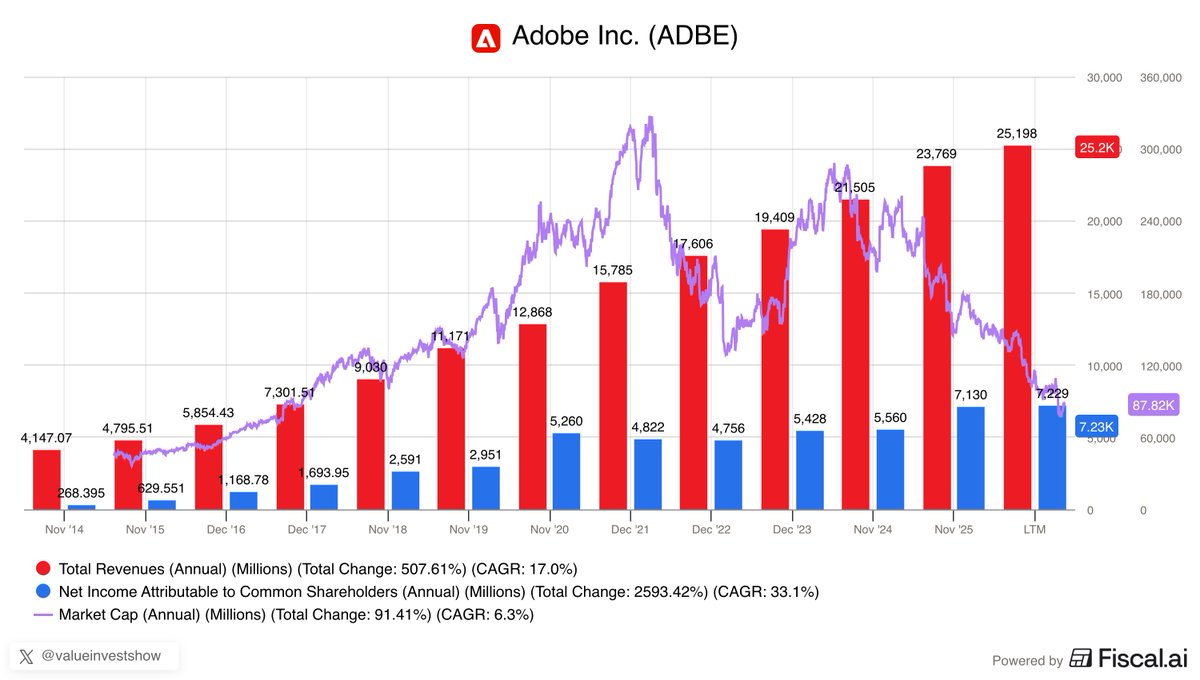
$ADBE I think the market is making one of those classic mistakes where it confuses competition with disruption. Adobe is not just a better mouse trap, it is a platform with a knowledge effect and a real network effect layered on top of it, which is exactly why this feels more like Microsoft Office than some fragile creative tool that disappears the second a shiny new AI model comes along. If you are a professional in the creative world, you are expected to know Photoshop, Illustrator, Premiere, the whole stack, and once that becomes the language of the industry, switching stops being a product decision and becomes an organizational tax. That is why I keep looking at the selloff and thinking the same thing: the market is pricing Adobe like a single app being attacked, when in reality it is still the operating system of creative work.
Value Investor tweet media
English
2
7
55
5K
Patrick
Patrick@TemptInvest·
I've been following $NBIS for a while now. I was an early investor, sold far too soon, and recently started adding back to my position during the recent pullback. The more I've thought about the business, the more I think the market is looking at it through the wrong lens. Most people see a company renting out GPUs. I think that's only part of the story. To me, the real advantage is that operating one of the largest AI infrastructure platforms creates knowledge that compounds over time. As $NBIS adds more GPUs, it can win larger customers with increasingly demanding workloads. Those workloads force the company to continuously improve scheduling, networking, cluster management, reliability, and overall efficiency. The result isn't just more revenue... It's a better operating business. Higher GPU utilization means lower effective costs, better margins, and more capital to reinvest into additional capacity. That, in turn, attracts even larger customers, who push the platform to become even more capable. This is why I don't think AI infrastructure is as commoditized as many investors assume. Anyone with enough capital can buy GPUs. What's much harder to replicate is the experience that comes from operating thousands of them at scale, for some of the most demanding AI workloads in the world. That operational expertise doesn't show up as a line item on the balance sheet, but it could become one of the company's most valuable assets over the next few years. The question isn't who can buy the most GPUs. It's who can consistently get the most out of them. I think that's where the real moat could emerge. That's the part of the $NBIS story I'm increasingly focused on.
English
2
1
10
3K
Lowcap Connoisseur.
Lowcap Connoisseur.@AaronComics·
@mind1nvestor $rddt is almost 50% up from the lows of $140. I don't think the market is as asleep for $rddt as others.
English
0
0
0
232
Mind Investor
Mind Investor@mind1nvestor·
10 Stocks I believe Wall Street is still underestimating: 1. $RDDT Reddit The internet's largest archive of human knowledge and authentic conversation. 2. $CRWV CoreWeave Selling the infrastructure behind the AI revolution. 3. $TEM Tempus AI Building the operating system for AI-powered precision medicine. 4. $RDW Redwire Building the infrastructure behind the commercial space economy. 5. $SYM Symbotic AI-powered warehouse robotics at Walmart scale. 6. $CELH Celsius Holdings The energy drink challenger taking real market share from Monster and Red Bull. 7. $NU Nu Holdings Reinventing banking for hundreds of millions across Latin America. 8. $UUUU Energy Fuels The two most critical inputs for nuclear power and EV motors, both onshored in the U.S. 9. $SE Sea Limited Southeast Asia's leading digital ecosystem spanning e-commerce, fintech and gaming. 10. $TE T1 Energy America's first vertically integrated silicon-based solar company powering the AI data center buildout with domestic clean energy.
English
11
12
198
25.4K
ppdd
ppdd@usppdd·
Many people will retire on $OUST if they're as patient as I am. 😂 Today, there are about 350,000 signalized intersections in the U.S. Ouster has deployed at only ~800 of them, leaving a massive runway for growth. Thanks to its BlueCity perception software and BABA (Build America, Buy America) certification, Ouster has built a strong competitive moat in this market. Let's look at the unit economics per intersection: • ~$20K upfront revenue from hardware and deployment, at roughly 45% gross margin • ~$3K in annual recurring software revenue, with 85%+ gross margins Now the power of scale (20% market penetration): Reaching just 20% penetration (70,000 intersections) would translate into: 🔹 $1.4B in upfront hardware revenue in the U.S. intersections alone 🔹 $210M in high-margin annual recurring software revenue (ARR) Every new intersection isn't just a one-time hardware sale—it's a high-margin recurring revenue stream that continues to expand Ouster's overall margin profile. Ouster is evolving from a LiDAR manufacturer into the perception layer for robotics and Physical AI. Smart intersections are just one segment of the smart infrastructure market—one of Ouster's four key verticals. Its software attachment rate increased from 6.8% in 2024 (1,169 of 17,200 sensors shipped) to 15% in 2025 (3,825 of 25,500 sensors shipped). If it surpasses 20% in 2026—which I believe is a conservative assumption—that would add more than 7,000 software-attached LiDAR sensors, bringing the total to roughly 12,000 sensors generating recurring software revenue at 85%+ gross margins by the end of 2026. 25,000 sensors generating recurring software revenue by the end of 2027, assuming 25% sensors sales are software attached and 40% growth in sensor shipment. I didn't even include software sales from StereoLabs. That's exactly the kind of business transformation the market tends to reward. $OUST
mon@moninvestor

$OUST – robotics and physical AI opportunity is great, but I believe its traffic management business could become one of its strongest long-term opportunities. One thing I realised while sitting in traffic is how valuable this technology could be in the UK. Many traffic lights still operate using fixed timings or outdated road sensors. They do not always understand how much traffic is building up, how many pedestrians are waiting or which direction needs priority. Ouster’s BlueCity system places lidar sensors above an intersection. These sensors create a live 3D view of every car, pedestrian and cyclist approaching the lights. The software then sends that information to the existing traffic controller, allowing the lights to respond to actual road conditions instead of relying solely on fixed timers. For example, the system can keep a green light open longer when traffic is heavy, give pedestrians more time to cross, detect someone running a red light and identify vehicles travelling in the wrong direction. Ouster’s Rev8 sensors can detect road users from up to 500 feet away and continue working in darkness and difficult weather conditions. The opportunity becomes much easier to understand when you think about how many intersections exist around the world. Congestion costs cities billions, wastes fuel and creates unnecessary emissions. Poorly managed intersections also increase the risk of accidents involving drivers, cyclists and pedestrians. BlueCity is already working in real environment. Ouster has contracted deployments across nearly 700 sites, including more than 120 intersections in Chattanooga, more than 100 in Nashville, more than 100 in Utah and over 40 highway locations in New Jersey. Plus, BlueCity now complies with Build America, Buy America requirements. This means US cities and transport departments can use federal funding to purchase the system. That removes an important barrier because many large public infrastructure projects depend on government funding. For us investors, it's important to understand that Ouster is not simply selling a lidar sensor once. It can generate revenue from the sensors, edge-computing equipment and software licences. Once BlueCity is installed across a city’s traffic network, Ouster could also benefit from further expansion as more intersections are added over time. This could create a sticky business. Cities are unlikely to replace an entire traffic management system regularly once it is installed and integrated. A successful deployment in one part of a city could also make it easier for Ouster to win additional intersections and larger contracts. So, the long-term opportunity is very clear. Ouster has technology that can help cities reduce congestion, improve road safety and modernise outdated infrastructure. The robotics and physical AI opportunity remains the core thesis, but BlueCity could become one of the company’s strongest and most scalable businesses.

English
7
11
144
24.2K
Biotech2k
Biotech2k@Biotech2k1·
I went through the $FINX looking for good ideas. I think I already own the best companies in that index.
English
2
0
8
3.8K
Lowcap Connoisseur.
Lowcap Connoisseur.@AaronComics·
Long $crcl
Patrick@TemptInvest

2 days ago I posted about why the Open USD selloff in $CRCL was the wrong read. That banks launching a competing stablecoin was actually the thing that legitimizes the entire category, not the thing that kills Circle. Then this happened. The Office of the Comptroller of the Currency, the same federal agency that charters JPMorgan, Bank of America, and every major national bank in America, just approved Circle to establish its own national trust bank. Legally named First National Digital Currency Bank, N.A. Doing business as Circle National Trust. This is the thing I was trying to describe in my last post but couldn’t name yet because it hadn’t happened. The process of Circle becoming indistinguishable from regulated banking infrastructure just completed its most important step. Before today, Circle operated under a patchwork of state money transmitter licenses, 50 different regulatory frameworks, 50 different compliance requirements, 50 different counterparty risk assessments every institutional investor had to run before touching USDC. That friction is exactly why conservative institutional capital has stayed on the sideline. That friction is now gone. One federal charter. Direct OCC oversight. The same legal framework that governs the most trusted custodians of institutional capital in the country. And then there’s what comes next. Compass Point expects Circle and Coinbase to renew their USDC partnership in August, the single biggest valuation overhang on this stock right now. Nomura just announced a partnership to launch instant FX settlement in Japan using USDC by 2027. Standard Chartered became the first Global Systemically Important Bank to offer USDC minting and redemption to institutional clients. BNY Mellon already lets clients hold USDC in custody. JPMorgan. Standard Chartered. BNY Mellon. Nomura. Coinbase renewal pending. The banks didn’t launch Open USD to kill Circle. They launched it to get a seat at the table in a category Circle built. And Circle just pulled so far ahead on the regulatory infrastructure race that the competition has to work significantly harder to catch up. 2 days ago I said the banks validating stablecoins was bullish for Circle. And now the federal government made Circle a bank. That’s the follow up I didn’t know was coming lol.

English
1
0
3
327
Schurik
Schurik@Multibaghunter·
@CKCapitalxx No one is profitable, super low margins. What's your thesis?
English
4
0
2
475
kirasss
kirasss@kirasss18086·
@TempusAI @lefkofsky @TempusAI $TEM This is truly your last chance. If you betray the shareholders again, you’d better be prepared for the consequences. Don’t kill your shareholders.
English
1
0
1
175
Tempus
Tempus@TempusAI·
We will report financial results for the second quarter ended June 30, 2026, on Thursday, July 30, 2026 at 4:30 p.m. ET. The conference call and live audio webcast will discuss the quarter’s results and provide a business update, led by Tempus Founder and CEO, Eric Lefkofsky, and Chief Financial Officer, Jim Rogers. The live audio webcast will be accessible through the “Events” section of the Tempus Investor Relations website or by clicking here:
English
4
2
52
8.9K
Lowcap Connoisseur.
Lowcap Connoisseur.@AaronComics·
@Biotech2k1 Appreciate if you can explain the reasons for your $betr and $upst positions. I consulted ai and they seem high risks plays?
English
1
0
0
534
Biotech2k
Biotech2k@Biotech2k1·
I think in 20 years BNPL will take over from credit cards as its controlled borrowing. You can add money, gain interest, spend from balance, and borrow when necessary. $AFRM $KLAR. Getting in on these companies could be like buying Visa and Mastercard 50 years ago.
English
2
0
21
4.8K