Aaron Fleksher

3.1K posts

Aaron Fleksher banner
Aaron Fleksher

Aaron Fleksher

@AaronFlek

What do I DO, you ask? I DO my best to be a good Jew, father, and husband. During the week, I work as an educator & grade dean in a growth-minded school

Katılım Şubat 2011
230 Takip Edilen608 Takipçiler
Aaron Fleksher
Aaron Fleksher@AaronFlek·
@DBashIdeas The other bookend of a perfectly clean kittel at the end of the Seder
English
0
0
1
76
Aaron Fleksher
Aaron Fleksher@AaronFlek·
Dear friends, every year I have the zechus of publishing and sharing my Haggadah, my personal collection of inspiring and powerful ideas to enhance the Seder. I would like to offer the following - for a minimum donation of $18 (ALL proceeds go to tzedaka) you can be a sponsor
English
1
0
0
191
Aaron Fleksher
Aaron Fleksher@AaronFlek·
@RabbiGoldberg Not being makpid on makom kavua at the expense of making someone uncomfortable or making them feel unwelcome
English
0
0
0
76
Aaron Fleksher retweetledi
Daniel Z. Feldman
Daniel Z. Feldman@dzfeldman·
It may seem ironic that this Shabbat, we omit any reference to our greatest hero, Moses, while going out of our way to remember our greatest enemy, Amalek. It’s not so strange, however, when we consider the explanation of many commentators, based on the Zohar, for the omission of Moses in the first place: it is the result of his plea for forgiveness for the Jewish people, that we read next week, which includes the alternative: “but if not, erase me from the book which You have written!” (Ex. 32:32). Even though the Jews are forgiven, his words are taken seriously, and he is indeed partially erased, from the portion immediately prior to that one , ie Tetzaveh. That itself might seem strange. Because Moses went so far in his readiness to sacrifice himself for the Jewish people, he deserves this consequence, to “be taught a lesson“ about being careful with his statements? It seems that the point is just the opposite. It is the very fact that Moses wanted to sacrifice himself for the well-being of his people that is being commemorated here. He himself, of course is not erased from the Torah. But there is one symbolic section without him explicitly mentioned - in a glaring way, addressed as “you” - to display that very act of nobility itself, to honor his devotion and commitment with the symbolic “erasure” that he was ready to willingly take on. For truly great men, it is far more important that their legacies and impact endure, even when their names do not. And the contrast this Shabbat reminds us that the alternative, having your name remembered, and your impact blotted out, is what nobody wants, and is the destiny of those who do evil. Be like Moses.
English
1
5
23
3.2K
Aaron Fleksher retweetledi
Hillel Fuld
Hillel Fuld@HilzFuld·
Holy wow. This is one of the most beautiful and also insane stories I’ve ever heard. Trust me, it’s worth your 3.5 minutes to watch. It’s amazing. Truly. Wow.
English
140
498
1.7K
60K
Aaron Fleksher retweetledi
Hillel Fuld
Hillel Fuld@HilzFuld·
I heard a super nice thought on Yom Kippur. My rabbi, Rabbi Rosner shared it. You see, on Yom Kippur, one of the most common prayers that we repeat over and over is “Ashamnu Bagadnu”. It is a prayer in which we list all the possible transgressions of the past year. It is in alphabetical order. We mention them as part of our repentance process. Ashamnu: We were guilty. Bagadnu: We betrayed Hashem. Gazalnu: We stole. And on and on. The rabbi, at the end of the day and as we were nearing the final prayer, said, “God, it’s true that we were guilty of bad things, but please don’t forget all the good things we did this past year.” And then, he read a list that is similar to the Ashamnu prayer, only instead of sins, he listed the beautiful things we did this year, the mitzvot. It was a really beautiful list and a really beautiful idea, so I made a list of my own. Here goes. Dear Hashem, I, we are not angels. We make mistakes and this past year was no different. But we are also Your children who did and do some amazing things. And I wanted to remind you who Your beautiful children are. So here’s my list: - Aleph: Ichadnu: We unified. - Bet: Batachnu: We believed (in you). - Gimmel: Gadalnu: We grew. - Daled: Dibarnu Yofi: We spoke beautifully. - Hey: Hitpalalnu: We prayed. - Vav: Veherachnu: We appreciated. - Zayin: Zarachnu: We shined. - Chet: Chibadnu: We respected (Each other). - Tet: Tipalnu: We cared (for others). - Yud: Yitzagnu: We represented (truth). - Kaf: Kibadnu: We respected (others). - Lamed: Lamadnu: We learned (your Torah). - Mem: Miharnu: We rushed (to do mitzvot). - Nun: Nilchamnu: We fought (for Your land) - Samech: Siparnu: We told (the truth). - Ayin: Azarnu: We helped (each other). - Pey: Parachnu: We grew and blossomed. - Tzadi: Tzirafnu: We joined together. - Kuf: Kiravnu: We brought (others) closer. - Reish: Raeenu: We saw (the good) - Shin: Shiratnu: We served (you and the country). - Taf: Taramnu: We donated (to charity) While this past year was one of the hardest in our history, it was also one of the most beautiful. The Jewish people came together like never before. The Jewish people had more moral clarity than ever before. This past year, there was so much beauty. All you had to do was open your eyes; and you’d see it. So, as Rabbi Rosner said, Hashem, while you’re judging us and deciding what will be this coming year, please remember all the good we did, all the amazing things Your Children did this past year.
Hillel Fuld tweet media
English
33
104
559
24.9K
Aaron Fleksher retweetledi
Rabbi Efrem Goldberg
Rabbi Efrem Goldberg@RabbiGoldberg·
The whole world went outside yesterday to look at something unusual and extraordinary. Jews went outside today to look at and make a blessing on something usual and ordinary. In Nissan, during the season of redemption, when a fruit tree produces the flower that precedes the fruit we say thank you Hashem for the ongoing renewal of creation.
Rabbi Efrem Goldberg tweet mediaRabbi Efrem Goldberg tweet media
English
1
2
15
1.7K
David/Dovid Bashevkin
David/Dovid Bashevkin@DBashIdeas·
The victory of the Purim story comes about because Esther had the courage to approach the King without being called. That’s what Purim allows. A connection to something transcendant even when it feels like it’s been a very very long since the King of all Kings openly called upon us. But we approach anyways. So we it doesn’t feel like God is inviting us to engage. Engage anyways. Connect anyways. Find sincerity even after it feels lost. ובכן אבוא אל המלך אשר לא כדת Lchaim, Lchaim. A Freilichin, friends.
David/Dovid Bashevkin tweet media
English
12
22
138
11.4K
Aaron Fleksher retweetledi
Rabbi Tzvi Pittinsky
Rabbi Tzvi Pittinsky@TechRav·
Abraham washed people’s feet way before Jesus. Just saying…
English
2
1
1
336
David/Dovid Bashevkin
David/Dovid Bashevkin@DBashIdeas·
Just to explain: Yom Tov in Hebrew means Good (Tov) Day (Yom) so saying Good Yom Tov is redundant. Not sure why but it feels like Jews have a bunch of these. Good list. Important list.
English
3
0
3
1.1K
Aaron Fleksher retweetledi
George Mack
George Mack@george__mack·
What idea changed how you view the world? Here's mine: High Agency. The high agency library: (19 best examples I've found in 4 years)
George Mack tweet media
English
139
1.1K
8.8K
3.3M
Aaron Fleksher retweetledi
#MKY מי כעמך ישראל
💔💔💔 הנאהבים והנעימים בחייהם ובמותם לא נפרדו Beloved and sweet in their lifetimes, and in their death, they remained bound together
Yeshivat Har Etzion@inthegush

Română
2
5
95
9.4K
Aaron Fleksher retweetledi
Yitzchak Schochet
Yitzchak Schochet@RabbiYYS·
In Israel, that's how we roll: Last Friday, Yanon, from Jericho, was returning from his base. His wife asked him if he could pick up challah for Shabbat. He popped into a familiar bakery in Jerusalem for his purchase. On his way out, he noticed a new herring store and decided to venture in. Before long, he picked up some nice herring, liver, vegetables, and kugel. Then he went to pay ... A man who entered the shop observed him in tactical gear and gun, slapped down his credit card, and announced: "It's on me." A young "kollel" man called out: "Hey, you're taking away my mitzvah! I was planning to pay for him!" The store owner then turned to them: "You're both wrong! I never planned to take any money off this soldier in the first place!" Yanon left with food in his hand and so much love in his heart. Love for a nation that truly cares for one another. 'Cause in Israel, that's how we roll!
Yitzchak Schochet tweet media
English
148
520
3.3K
141.9K
Aaron Fleksher retweetledi
David/Dovid Bashevkin
David/Dovid Bashevkin@DBashIdeas·
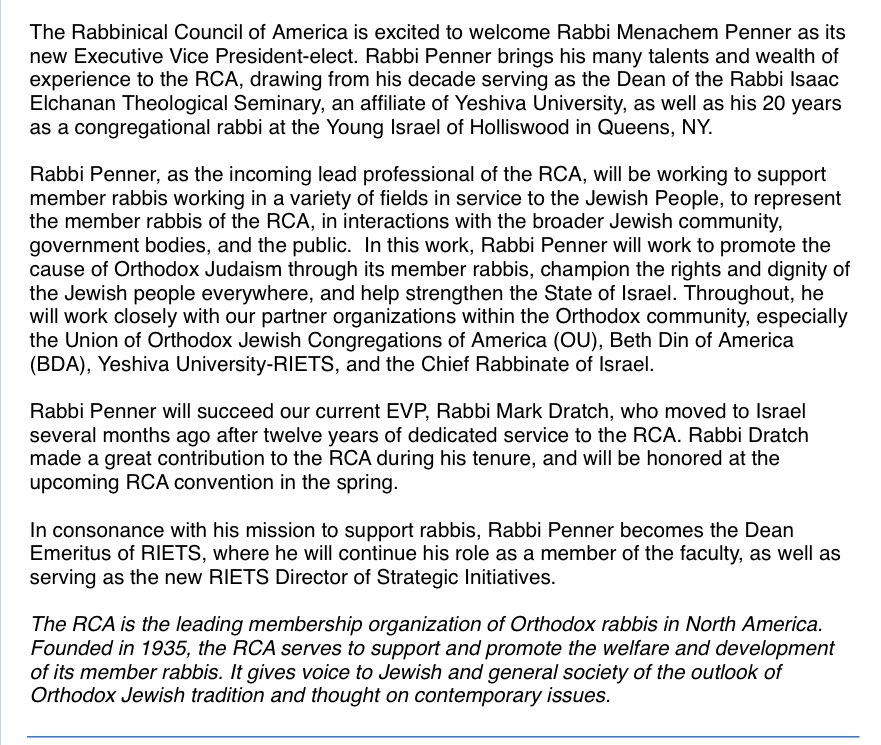
Mazel Tov to Rabbi Menachem Penner on being appointed EVP of the RCA
David/Dovid Bashevkin tweet media
English
4
7
63
9.1K
Aaron Fleksher retweetledi
Gedaliah Wielgus
Gedaliah Wielgus@GedaliahWielgus·
I will probably regret this later, but here goes. Story time: /1
English
22
13
128
70.1K