Attharv - McNuke/acc 🚀

11.7K posts

Attharv - McNuke/acc 🚀 banner
Attharv - McNuke/acc 🚀

Attharv - McNuke/acc 🚀

@Absolutemadlado

Curious Ceaselessly Calm Cook (C4) | AnCap | Dharma = Liberty

"श्रीगुरुचरणकमलयोः" Katılım Eylül 2023
535 Takip Edilen497 Takipçiler
Sabitlenmiş Tweet
Attharv - McNuke/acc 🚀
Attharv - McNuke/acc 🚀@Absolutemadlado·
One Tweet to Rule Them All : All My Works Down Here ↓
English
2
0
4
5.5K
Attharv - McNuke/acc 🚀
Attharv - McNuke/acc 🚀@Absolutemadlado·
@RishiJoeSanu Well you have to make tradeoff at the end of the day, but i think it can be manageable if done correctly. Meanwhile having very less deadweight loss.
English
1
0
1
26
Rishi 🌐🗽🥥🔰🏙
@Absolutemadlado >Regressiveness can be handled by rebates tbh That'll just complicate the tax structure and raise compliance costs. Out GST regime fell for that trick.
English
1
0
1
25
Attharv - McNuke/acc 🚀
Attharv - McNuke/acc 🚀@Absolutemadlado·
@RishiJoeSanu on paper DWL is zero for LVT. Regressiveness can be handled by rebates tbh, as an AnCap it doesn't matter which tax it is as long as the percentage is zero
English
2
0
0
24
Rishi 🌐🗽🥥🔰🏙
@Absolutemadlado LVT has much lower DWL. Consumption tax is preferable because in the current regime, it's easier to implement. Nobody likes writing a large check all at once. It's easier to put wool in the eyes with consumption tax. Ofc consumption tax is also regressive.
English
1
0
1
47
Attharv - McNuke/acc 🚀
Attharv - McNuke/acc 🚀@Absolutemadlado·
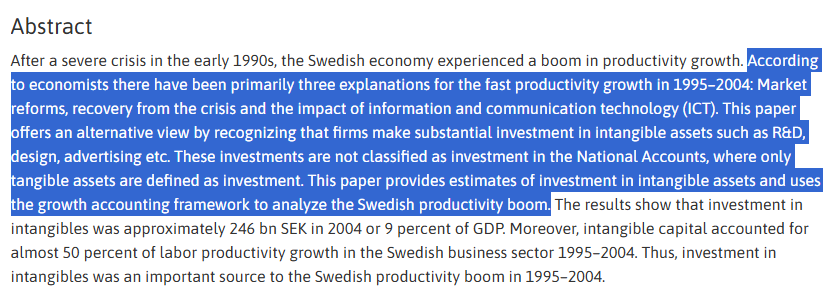
we started on welfare and evidence on that is actually straightforward between 1980 and 2000 sweden liberalised heavily but the welfare state wasn't dismantled. bergh calls it liberalisation without retrenchment. reforms made the welfare state sustainable instead of smaller. bergh calls sweden a "hayekian welfare state" one that combines a large public sector with high levels of economic freedom, because the welfare system relies on decentralized choice rather than central planning. pension reform is his key example - publicly funded but with private accounts and individual choice. so the causal link isn't that reforms created welfare. It's that they're why it survived the crisis and still works today. that was my original point
English
0
0
1
11
Marthe 🇳🇴
Marthe 🇳🇴@prinsessmarthe·
@Absolutemadlado @PraxLemon The point is that the Nordics do not fall neatly into a box. We have always been a capitalist economy, so when "reforms" happen, it is seen as a big deal. It reality, it is a combination of different factors.
English
1
0
1
17
Attharv - McNuke/acc 🚀
Attharv - McNuke/acc 🚀@Absolutemadlado·
you've said the crisis shows reforms "can" matter. i consider that as a small win. Consider one clean case South Korea after 1997 - crisis was triggered by rapid financial liberalisation then Korea passed pro-competitive reforms targeting chaebol-dominated industries. firm-level data shows productivity rose sharply in exactly those industries and not in others. Global ICT, the tech cycle, and monetary conditions affected all industries equally. reforms are the only variable that explains the concentrated pattern. across sweden, finland, korea, and new zealand, the same sequence appears that financial liberalisation helps trigger a crisis, deeper structural reforms follow, and then a productivity surge comes after. In every case the first reform was potent enough to be part of a destructive mix so here's what i'm genuinely trying to understand - if we agree that reforms can be causally powerful in one context, what's the reasoning that lets us conclude they had "zero" role in the recovery context even as one modest factor among ICT, monetary policy, and intangibles? I'm not asking you to abandon your view. I'm asking what rule you're applying that works consistently across these countries.
English
1
0
0
16
Marthe 🇳🇴
Marthe 🇳🇴@prinsessmarthe·
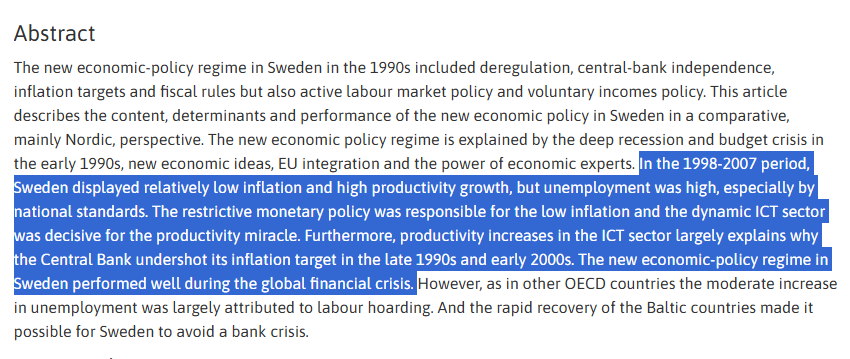
@Absolutemadlado @PraxLemon The crisis shows reforms matter. But it does not show that all “market reforms” have the same effects, or other things could have contributed besides the reforms. I have already cited the ICT boom, the change in monetary regime, and fiscal consolidation. None are special pleding.
English
1
0
0
19
Attharv - McNuke/acc 🚀
Attharv - McNuke/acc 🚀@Absolutemadlado·
You argue that the 1990s–2000s productivity boom was not driven by market reforms, but by tight monetary policy and intangible investment. Let’s apply that exact same lens to the period before 1990. Sweden suffered a massive banking crisis in the early 1990s GDP fell for three straight years, unemployment went from 1.5% to over 10%, and the banking system nearly collapsed. The overwhelming consensus among economic historians is that this crisis was a direct consequence of the financial deregulation of the 1980s. That was a major pro-market reform. The removal of credit controls allowed a lending boom that inflated asset prices, and when the bubble burst, it wrecked the economy. This isn’t a fringe view it’s actually the mainstream account (e.g., Englund 1999, Jonung 2008). Now, can you explain that crisis using only your preferred variables i,e, monetary policy and intangible investmentwithout invoking the market reform? Monetary policy was loose, yes, but why was it loose and ineffective? Because the deregulated financial system had made credit expansion uncontrollable with the Riksbank’s existing tools. The reform was a necessary condition. As for intangible investment, Sweden was already a heavy R&D spender in the 1980s business R&D rose from 1.7% to 2.4% of GDP between 1985 and 1995 yet that didn’t prevent the crisis. So intangible investment cannot discriminate between a boom and a depression. Contradiction I see in your position is If a market reform was powerful enough to cause a depression, it is highly implausible that a much broader set of structural reforms (product market deregulation, labour market reforms, tax reform) had no causal effect on the recovery. you can’t claim that reforms are a non-factor for the boom while simultaneously relying on a reform to explain the bust. either reforms matter or they don’t. i’m not saying monetary policy and intangibles were unimportant. But the burden is now on you to explain why one class of reform had massive, destructive effects while another, more comprehensive class of reform had none at all, even though both were shifts toward greater “economic freedom.” If you can’t, then your dismissal of the Heyman, Norbäck & Persson thesis looks like special pleading.
English
1
0
0
18
Marthe 🇳🇴
Marthe 🇳🇴@prinsessmarthe·
@Absolutemadlado @PraxLemon The Swedish 1990s reforms are tightly linked to better allocative efficiency and higher productivity but the 1990s turnaround, the evidence is best described as strong association ith causality shared with other factors like ICT and intangible investment rather than reforms.
English
2
0
0
30
Attharv - McNuke/acc 🚀
Attharv - McNuke/acc 🚀@Absolutemadlado·
For some reason, it shows an error 404 when I try to open the actual paper. Is there any other link that you can provide that would be very helpful? anyways i want to push you on the point regarding monetary policy just because something explains the say the effects, when we have competing explanations we need something to measure those competing explanations against, otherwise we go down the unnecessary rabbit hole of asserting our own explanation is indeed the correct one. how strong an explanation is, how validly supported the data evidence we have with respect to it. We can surely see what drove what. Also, what do you consider the barometer of economic freedom?
English
3
0
0
33
Attharv - McNuke/acc 🚀
Attharv - McNuke/acc 🚀@Absolutemadlado·
@LilyWonderland5 The latter part is not proven, though, most countries try it, and it doesn't work; the so-called well-being comes at the cost of the well-being of not just the economy but even well-being itself.
English
1
0
0
15
Lily Wonderland
Lily Wonderland@LilyWonderland5·
@Absolutemadlado I'm not disagreeing. These countries often have better economic freedom than places like the US. Again proving that you can have good economics and ensure the wellbeing of all people. Both should be done.
English
1
0
0
23
Attharv - McNuke/acc 🚀
Attharv - McNuke/acc 🚀@Absolutemadlado·
facts don't change themselves on whether I know not, or on my level of knowledge, pretense. I would gladly answer your questions, and do expect the same from you. I am citing actual peer-reviewed material on the topics, which are well-established. 1) Heyman, F., Norbäck, P. J., & Persson, L. (2019). "The Turnaround of the Swedish Economy: Lessons from Large Business Sector Reforms." The World Bank Research Observer, 34(2), 274–308. Or the even the most comprehensive work on the topic 2) The Nordic Model: Embracing Globalization and Sharing Risks Authors: Torben M. Andersen, Bengt Holmström, Seppo Honkapohja, Sixten Korkman, Hans Tson Söderström, and Juhana Vartiainen which can be read for free etla.fi/wp-content/upl… Now coming to actual things at hand, I just read your next response where you claimed to give counterfactuals, my understanding was incorrect and you dismiss it outright, without establishing how it is incorrect, sorry by that's not how counterfactuals actually work. Anyways i continuing this convo so that if there is any room for me to learn and improve i will exhaust this opportunity. So, what do you consider as the barometer of say economic freedom, maybe if we agree on some standard it will be easier for us to reach a mutual conclusion ?
English
1
0
0
23
Marthe 🇳🇴
Marthe 🇳🇴@prinsessmarthe·
@Absolutemadlado @PraxLemon You do not have to pretend to know things you do not actually know. What policies do you think lead to this increase in "economic freedom," which I have not acknowledged is an accurate barometer of economic freedom?
English
2
0
0
30
Attharv - McNuke/acc 🚀
Attharv - McNuke/acc 🚀@Absolutemadlado·
@AvneeshKasture I imagine akhanda bharat where i can travel freely (free movement) I envison akhanda bharat where there is no tariffs or customs to be paid between provinces (as one sovereign nation) I envison akhanda bharat where ideas are exchanged freely, from taxila to nalanda.
English
1
0
3
39
Attharv - McNuke/acc 🚀
Attharv - McNuke/acc 🚀@Absolutemadlado·
Look i don’t want to get onto tangents, i think you highly capable of good reasoning, what we are talking here is about causation, but i think you still want to keep poking on my historical knowledge regarding nordic countries. To your claim that nordic countries were always welfare state my rebuttal is one simple line they were always free market economies to begin with. We can keep arguing which was came before welfarism or laissez faire but again the point we will miss then is which had an effect. Let me give counterfactual post 1990s policies in Sweden lead towards more Free market leaning and that shows clearly in How Sweden climbed a few points up the economic freedom index, continued to be prosperous. Atleast provide some evidence that general in nature that either shows otherwise, or give a strong counterfactual, i am assuming here you have better historical knowledge regarding these things and would be sufficiently capable of providing sufficient evidence to refute my entire point instead of just pointing out my probably historical ignorance. Awaiting strong evidence if any.
English
1
0
0
25
Marthe 🇳🇴
Marthe 🇳🇴@prinsessmarthe·
@Absolutemadlado @PraxLemon "When it came into it's present form?" Are you trying to suggest that our health care system, poor relief, old-age pension, etc., were more expansive in the past than they are today? Because that is obviously not true. I do not know what you mean by "present form."
English
1
0
0
28
Attharv - McNuke/acc 🚀
Attharv - McNuke/acc 🚀@Absolutemadlado·
Okay let’s begin by saying, although i can push you regarding my knowledge of historical trends but the thing is not whether welfarism was already in picture, it is when it came into it’s present form, and for each of those policies what were the before and after effects because we are to claim causation that these policies created those conditions then we have to show their effect on empirically, if the effects were hardly worth considering the co-relation still remains weak with welfarism compared to free market policies. And i think this can be cross tested not just with countries which are nordic but all the high performer countries on economic freedom index. I am waiting for any hard evidence that can be provided from your side.
English
1
0
0
20
Marthe 🇳🇴
Marthe 🇳🇴@prinsessmarthe·
@Absolutemadlado @PraxLemon Well, I do not think your history of the Nordics is very accurate. They were always welfare states. For example, Norway has had a wealth tax for 130+ years, and Sweden/Norway adopted universal health care around the same time in the 1950s.
English
1
0
0
23
Attharv - McNuke/acc 🚀
Attharv - McNuke/acc 🚀@Absolutemadlado·
Well the Nordic countries were already rich due to lassez faire way before Welfarism came into picture. If socialist policies were the cause we would have seen a huge shift from worse conditions to to good conditions, infact if we observe the counterfactuals correctly i don’t think the government involvement is directly linked to free markets. Historical trends almost paint a good enough picture
English
1
0
0
19
Marthe 🇳🇴
Marthe 🇳🇴@prinsessmarthe·
@Absolutemadlado @PraxLemon I am not sure what makes us so economically free compared to the US, anyway. We have a high degree of government involvement. I do not know if that is "socialist." We do prioritise workers over owners of capital (via higher labour share compensation), which is a good thing.
English
1
0
0
20
Marthe 🇳🇴
Marthe 🇳🇴@prinsessmarthe·
@Absolutemadlado @PraxLemon The Nordic countries have always been highly regulated capitalist countries with high welfare. They all have different aspects, but economic liberals are just now noticing that Sweden allows slightly more market integration in certain sectors. That is all.
English
1
0
0
24
Attharv - McNuke/acc 🚀
Attharv - McNuke/acc 🚀@Absolutemadlado·
We are contesting that the socialistic policies themselves created highest quality of life and good economies. Countries which rank higher on quality of life and being economically sound are the countries with higher economic freedom. This is in direct co-relation btw you will have to disprove this if you want assert that socialistic policies themselves created all the good things. Sadly when we look at the actual evidence there is no other way to explain what is obvious.
English
1
0
0
30
Lily Wonderland
Lily Wonderland@LilyWonderland5·
@Absolutemadlado That would be a problem, except that these social democratic policies are what have created the highest quality of life and good economies. I don't get why you want people to suffer so badly that you want to ignore the fact that places like Denmark prove its possible and works.
English
1
0
0
61
Marthe 🇳🇴
Marthe 🇳🇴@prinsessmarthe·
@PraxLemon @Absolutemadlado Sweden did not significantly roll back Social Democracy. That is a common narrative, and I do not know where that comes from. I am guessing it came from the people who created that index of economic freedom you are touting.
English
2
0
2
34
Attharv - McNuke/acc 🚀
Attharv - McNuke/acc 🚀@Absolutemadlado·
1) Okay let's say i agree with you point that public research supposedly motivated by profit but removing the profit motive doesn't remove human incentives, it just redirects them. In private research, the incentive is profit, which at least loosely ties reward to results. In government research, the incentive becomes grant capture, budget preservation, and bureaucratic expansion none of which require the research to actually produce anything. At the end of the day, its for profit motive even if we say that it is not intended to, just profit for researchers and bureaucrats with spillover effects to the actual people who funded them. Whenever you remove profit-seeking tendency you just replace it with rent seeking tendancy. This is textbook public choice theory, the people allocating the money and the people receiving it both benefit from spending more, regardless of outcomes. So "no profit motive" is not an actual defense of efficiency, it's actually an argument for more scrutiny, not less. If we don't ask hard questions about what the money is producing, we're not protecting public interest but we're funding a system that has every structural incentive to waste. 2) On the second point, I'll actually concede more ground here than you expect. The religious origin of a research question doesn't automatically disqualify it. The real question is whether the government needs to fund it. Private Ayurvedic companies already conduct this research commercially, they have the motivation, the domain knowledge, and a direct market incentive to do it properly. When private actors are already covering a research area, government entry doesn't add value, The religious angle isn't why I'm skeptical but about the redundancy. By this same logic, I'd oppose government funding for camel urine research, or any other niche biological inquiry that private or religious institutions are better positioned and more motivated to pursue. 3) All research can be justified, but at what cost? The argument that research could be beneficial is true of virtually everything, it proves too much and therefore proves nothing. The relevant question is never "can we imagine a benefit?" but "what is the expected return relative to alternatives?" funding lower-probability research over higher-probability research isn't humility or open-mindedness, it's poor resource allocation. And unlike a private investor who can diversify across many bets, a government budget has real constraints, every rupee allocated is a rupee foreclosed elsewhere. We owe it to taxpayers to be ruthless about expected value, not just possibility. funding lower-probability research over higher-probability research isn't humility or open-mindedness but poor resource allocation. And unlike a private investor who can diversify across many bets, a government budget has real constraints every rupee allocated is a rupee foreclosed elsewhere. We owe it to taxpayers to be ruthless about expected value, not just possibility. awaiting your reply.
Ambuj Deshwal@AmbujDeshwal

Three possible directions for me to take this, I am a little busy so I’ll give you all at once and you can extrapolate on them yourself. 1. Government funded research is done precisely on topics where return on investment would not justify a profit motive, they are done for public good 2. There are plenty of pointless research topics that are never questioned, cow related research being linked to a specific religion is the reason for questions, a dumb and blind person can observe that 3. Plenty of ways this research can be extremely beneficial; bio fuels being one The rest you can simply google with the same device and internet connection you used for this comment

English
0
0
1
96
Attharv - McNuke/acc 🚀
Attharv - McNuke/acc 🚀@Absolutemadlado·
@OKAYASYOUSEE The movement god acts to create something he is in quatam entanglement with space and time. He can only remain outside of it as long as he doesn’t create anything.
English
0
0
1
9
VARUN KURUP
VARUN KURUP@OKAYASYOUSEE·
Sort of interesting argument Creation or causation is temporal. Any creation or act of will requires a change in state of a mind. God is not bound by time and space so God has a static mind. So God cannot will something..or otherwise God has to come into a temporal state .
English
1
0
1
80
Attharv - McNuke/acc 🚀
Attharv - McNuke/acc 🚀@Absolutemadlado·
If it’s hundred dollar denomination as shown in the picture, then taking a rough fermi estimate, considering a 100 dollar bill weighs 2 grams, so 1 kg of dollar bills will be around 500 bills in total. 500*500 = 2,50,000 USD, Similarly considering gold is around 200 dollars per gram a high end figure, i don’t even think we need do any calculations here, gold will be approximately a factor of 1-2x more valuable than dollar bills if the initial assumption of 2 grams is accurate. Also the fact that you can liquidate the dollar bills much better than gold, but then gold will take less space(volume) for the same value of money. Thinking about Inflation would make one choose gold, but liquidity is big thing, and considering no-one is coming after you or no other side effects on principle of total value i think Gold is the better choice, but in the world we live in getting Dollars is sane choice. Just get a large enough space to store them.
Nicco™@iLnico4real

500 kgs of U.S dollars or 500kgs of gold. What are you picking??

English
0
0
1
92