
Matt Achariam retweetledi
Matt Achariam
1.1K posts
Matt Achariam
@Achariam
Co-founder @MeshHQ (fka Clay)
San Francisco, CA Katılım Nisan 2009
163 Takip Edilen925 Takipçiler


Matt Achariam retweetledi

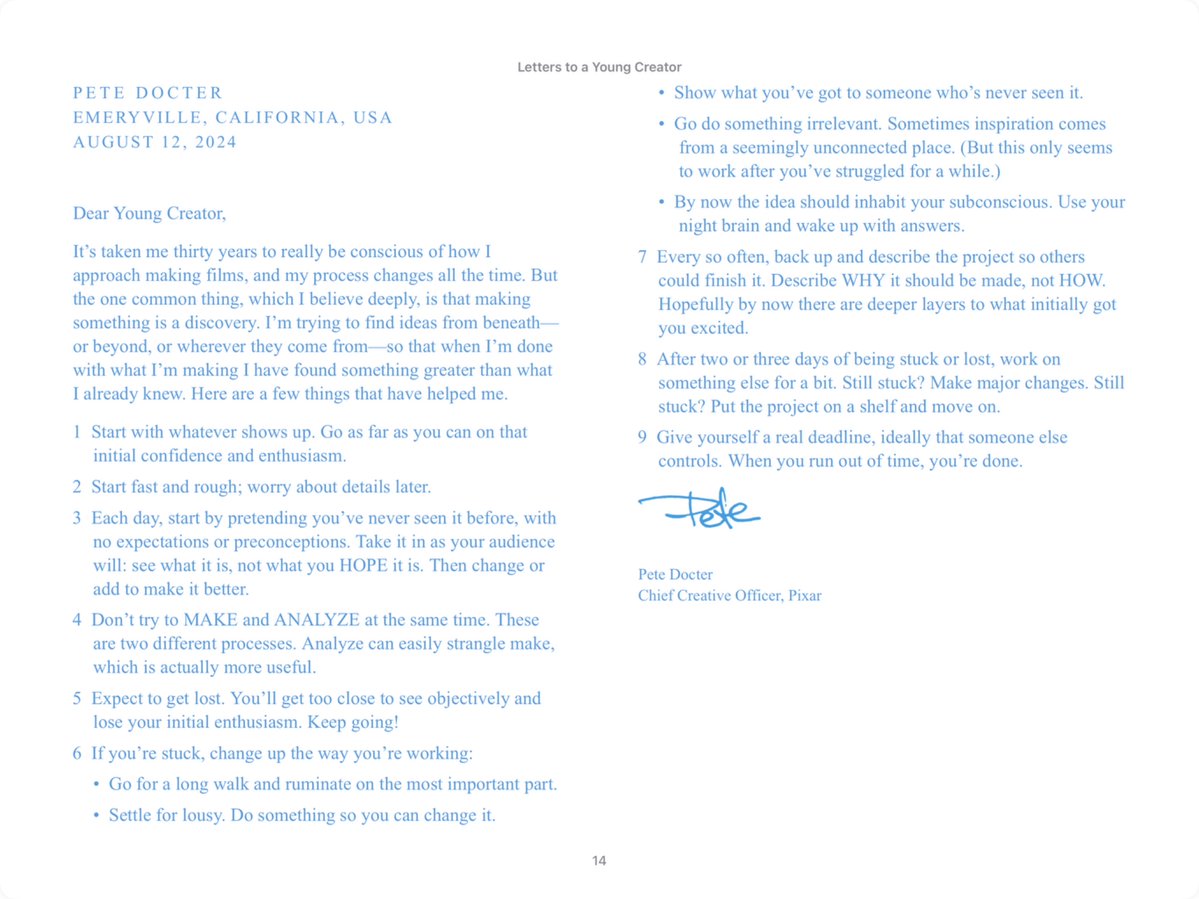
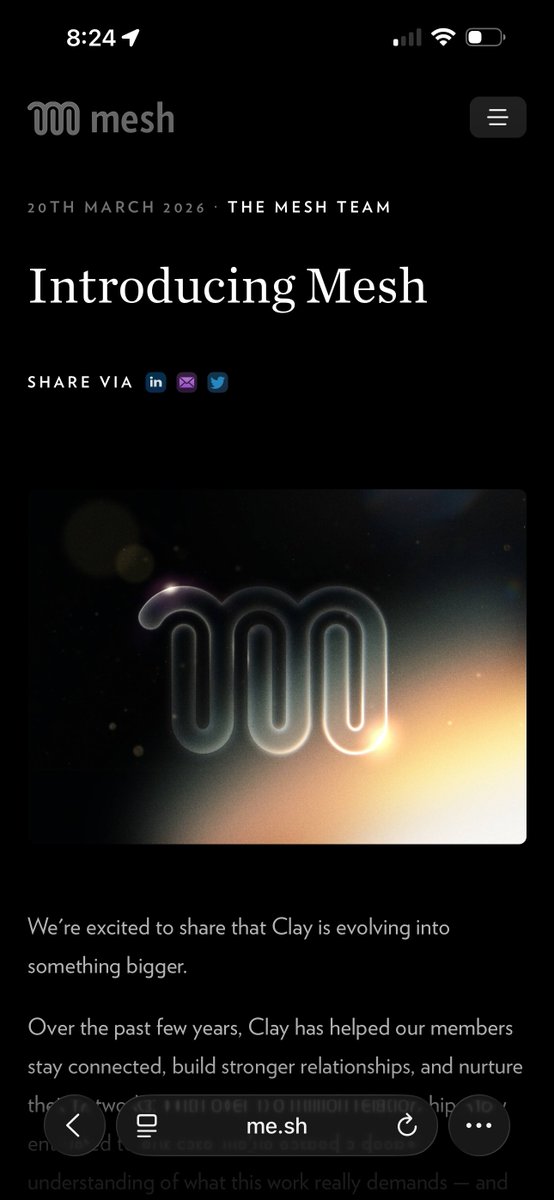
The most important product on my phone (and my laptop!) for the past eight years in a row has a new name

English
Matt Achariam retweetledi
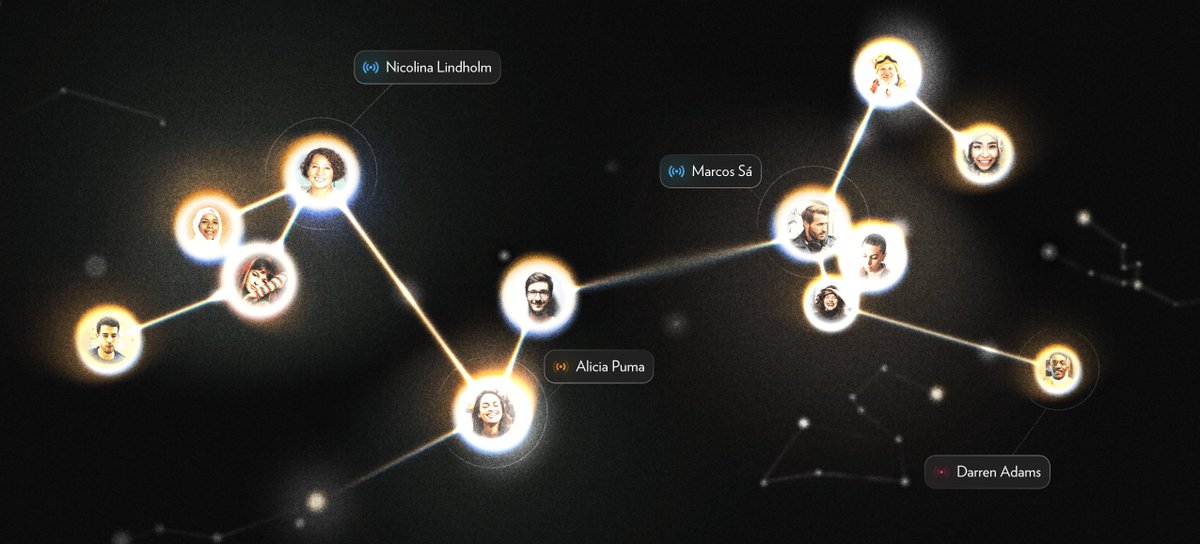
Check out me.sh, an @Automattic project, and A central nervous system for your relationships in an AI era.
English

Awesome rebrand.
Going to miss the Clay name/brand, but the team killed it with the overhaul. Incredible domain, too. 10/10.
Mesh@MeshHQ
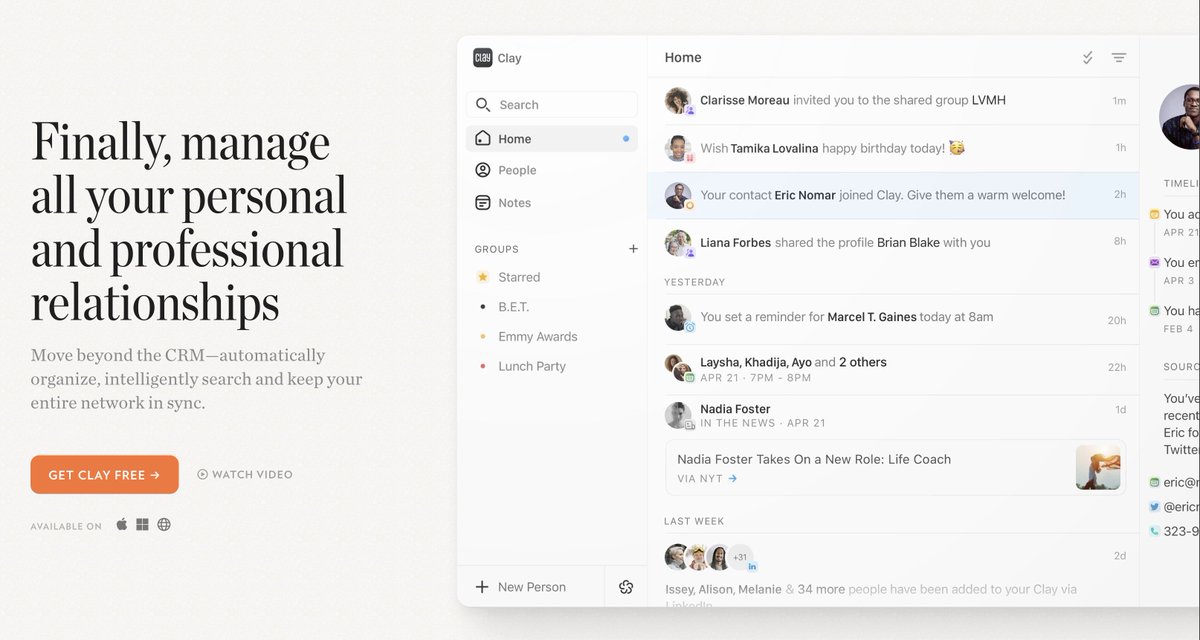
Introducing Mesh! Everything you know and love, now called Mesh. Same team, same mission, new name.
English
English

@newdotwebsite has been acquired by Vercel! ▲
We built a way to turn a simple description into a fully functional site in minutes, with forms, automations and integrations that work agentically out of the box. Now we’re joining @v0 to take it further.
This wouldn’t have happened without our team and the people who believed in us early. Grateful to @vercel for taking a chance on what comes next.
English
Matt Achariam retweetledi

Matt Achariam retweetledi

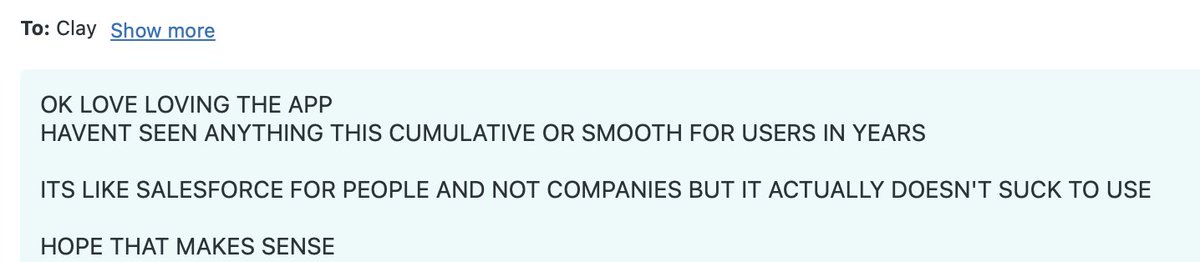
Praise to the @meshhq for getting their MCP right. One of the biggest barriers to entry for Clay was the overwhelming nature of having to organize all of your contacts yourself. With the release of Nexus 4.0, it's all done for you using their LLM. Subscribing now!
English

Matt Achariam retweetledi

I use @meshhq because I forget people I truly care about exist.
Not maliciously. With just so much going on and so many people in personal/proffessional life, find it hard to juggle all balls at once and show up in the way I want to for each person.
English
Matt Achariam retweetledi

"What’s this? What’s this? There's white things in the air."
"What's this? There's footsteps everywhere."
English
Matt Achariam retweetledi

Some big news to close out 2025: @stephen_wolfram has officially joined Automattic as a Special Advisor.
Exceptional products are shaped by visionary leadership, rigorous expertise, and long-term thinking. For decades, Stephen has encapsulated those values and, as one of the most influential thinkers in computation, will help guide our open-source mission into 2026 and beyond.

English
Matt Achariam retweetledi

I think this might be the first time we have Open Source at the majority of the top 5,000 sites, which is a big win.

English
Matt Achariam retweetledi

Always Go To The Funeral
“Always go to the funeral” means that I have to do the right thing when I really, really don’t feel like it. I have to remind myself of it when I could make some small gesture, but I don’t really have to and I definitely don’t want to. I’m talking about those things that represent only inconvenience to me, but the world to the other guy. You know, the painfully under-attended birthday party. The hospital visit during happy hour. The Shiva call for one of my ex’s uncles. In my humdrum life, the daily battle hasn’t been good versus evil. It’s hardly so epic. Most days, my real battle is doing good versus doing nothing.”
Joshua Kushner@JoshuaKushner
you have to show up for people if you want them to show up for you
English
Matt Achariam retweetledi

We are obsessed with "talent" and people that have the "special something".
This is just a way of avoiding thinking about what it takes.
Excellence is real. There are people that get ahead nine times out of ten. Olympic swimmers, repeat founders, bestsellers... But, if you watch excellent people there is nothing magic about what they do*.
It's just the multi-dimensional set of skills, character, and ways of life playing out.
To give one example: Fortune 500 CEOs don't have a magic gift — maybe they are more likely to win if they are born in certain countries and have a slightly above average IQ and stamina but nothing otherworldly — instead what they have are: a willingness to have difficult conversations, a set of mental models to read a balance sheet fast, a mental model of the business they are running, mental models of how other businesses run, an idea of the psychology of their biggest rivals company, a strong motivation to increase profits, private drivers, expensive suits, intense time boxing, public speaking coaches, favourite restaurants they go to every time they are in a city, how well they celebrate after a win, keeping up the right kind of health routine to keep them sharp, spouses that do not create demands on their time.... and so on
These things are essentially mundane. There is no invisible special sauce. Pretty much all of it are choices that can be made, skills that can be learned, character that can be developed and more.
The key — the reason not everyone is a Fortune 500 CEO — is that these things are not arbitrary. The collection of things that need to be done to get to this level are vast and if the person is missing any of them they simply won't be excellent enough.
In other words to be part of the world of Fortune 500 CEOs you need to be perfectly optimized for that world.
Sometimes the collection of skills etc. can look arbitrary but this is usually because you are comparing different games. The list of what's needed is different for a software startup founder, a car dealership owner, a university dean, or even in the case of the example perhaps other Fortune 500 CEOs in different industries etc. Even between companies at a similar scale in similar industries the list of what's needed can be different at the margin because of contingent facts about how those particular organisations are constructed.
In the same way, while there may be a lot of overlap, being world-class at swimming will not make you world-class in football. If nothing else you will have to live in very different places (swimming pools vs. football pitches).
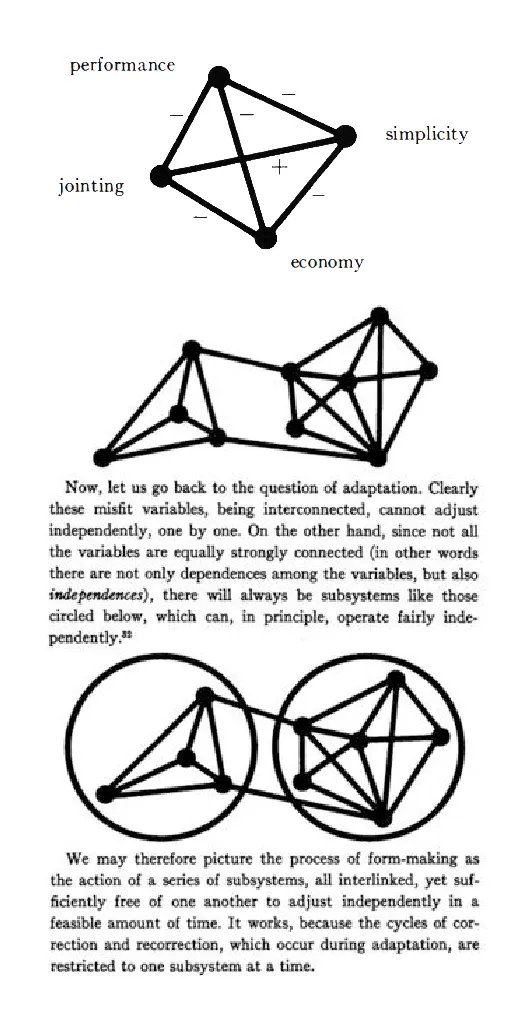
So achieving excellence is like solving of a hyper-dimensional problem. Each level requires a new bundle and a new way of life. It's similar to the way Christopher Alexander describes building a house in Notes on Synthesis of Form. You need to constantly adapt to resolve these internal tensions and enter the next world of skill.
So if you're interested in excellence you need to ask: What world do you want to be part of? And what do you need to change? What disciplines do you need to take on?
There are probably more transformations that are needed than you expect. But if you're willing to do it there's nothing stopping you.
Perhaps if there is something that the most excellent people have it's a willingness to connect with what's real. To be humble before what it actually take to succeed in their given field.
*All reflections on the paper: The Mundanity of Excellence: An Ethnographic Report on Stratification and Olympic Swimmers by Daniel F. Chambliss



English
@jacksondahl @DialecticPod @NotionHQ What a great pairing, congratulations (and happy birthday 🥳) Jackson!
English

I'm going full time on @dialecticpod with the support of @notionHQ.
A few thoughts on what the future holds, what Dialectic means to me, and why Notion is the perfect presenting partner:
A year ago, I started interviewing some of my smart friends without much of a strategy. I quickly realized that despite the lack of a grand plan, it was easy for me to *care* a lot about it, especially the preparation to make sure I could meet the guest deeply in their ideas and push them to go a bit further.
Over the course of the last year, I found Dialectic to be the ideal vehicle for me to:
(1) commit to something and compound in a specific direction
(2) still maximize serendipity and get to follow my curiosity in many different directions
(3) spotlight people I believe in and want to amplify
(4) produce something that, in its most aspirational sense, is of service: whether that is to my guests or my listeners, in helping them grow, expand, learn, or shine.
I'm so grateful that I get to pour all my energy into just that. As I look ahead, I've been reflecting. Dialectic isn’t always legible, but I’m starting to get a better sense of what defines it.
Not everyone I talk to explicitly makes things, but most of them do. While I don't deliberately pursue a specific kind of guest, there are a few themes that run across my conversations. I think they explain why Notion is such a perfect partner for me, but I'll get to that in a moment:
The first is about where ideas meet action. I love ideas, and I love reflective people. But I've increasingly come to appreciate the thinkers who make sure all that thinking results in doing. Introspection paired with agency. People who understand the power of ideas, but who care most about the ways they meet reality. People who seek to understand themselves as means toward asserting themselves upon the world.
The second is craft. Craft is always aspirational: it is what appears when we care just a little bit more. When our taste is deployed. A human touch. Craft can be the object of creation but it can also be the way we create. When the creator can really *feel* the work, they produce something that meets reality where it is, and better yet, where it is going.
The third is soul. There are other words one could use here, like authenticity, aliveness, or originality. The elements that make us human. When someone has found a way to line up their life, creativity, and work in a way that feels distinctly them. When they are willing to reach deep, and then naturally settle into a way of being that is inevitable.
I'm proud that Dialectic's audience seems to appreciate these themes too, and pursue them in their own lives. One of my favorite parts of all this is the audience -- that it seems like my kind of people are listening to and watching the show. I've made new friends amongst listeners, made the show better from their feedback, and I'm even lucky to call several of my guests fans.
I'm fortunate that one member of that audience is Notion's @akothari. When I began thinking about what it would look like to double down on Dialectic and make it my complete focus earlier this year, I started having conversations with potential partners. He was one the first people to reach out.
Notion makes beautiful tools for your life's work. I've always been a fan of creative tools (and have talked to several people who make them, including Notion's own @geoffreylitt!). The best tools amplify us. They meet us where we are and keep up with us as we grow.
In Notion's case, it is a tool first and foremost for turning ideas into action. For sharing them, tinkering with them, and building things with them.
Craft has always been an essential word for Notion: how do you build an entire system of dynamic building blocks that still feels cohesive? How do you design details that work for students and giant teams? By sweating every single one, and caring enough to raise the floor.
As for soul: well, perhaps that is in the eye of the beholder. But most software doesn't give mind to it, or to letting its users pour themselves into the tools they use. The rich and wide world of Notion's community, templates, remixing, and creative expression is evidence of software that feels alive.
So it really wasn't a hard decision at all, to team up with an organization, product, and brand that feels a lot like Dialectic.
Finally, looking ahead:
A lot more of the same. But better. It's simple, if not easy. I think I'm onto something. I want to speak to the most original, creative, inspiring, generative people in the world about the stuff that makes their eyes light up. That means creative technologists, thoughtful writers, pragmatic designers, and authentic investors.
But the aperture will widen too! I want to talk to people in 2026 that have me pinching myself, and to talk to people you and I have never heard of (yet). I hope to keep you guessing and nodding your head at the same time.
And there will be a lot more video, for those of you who've been asking. I have some other ideas too. I see Dialectic as a world I want to build, and I hope you come spend some time here. I hope I am lucky enough to keep creating this world with you for a long time.
In the meantime, please send me people you think I should talk to. People who love ideas, make things, care a lot, and put themselves into what they do.
And thank you to the wonderful team at Notion for being a partner to me on this journey.
Onwards!
English
Matt Achariam retweetledi

Care extends into the margins of our work
Hugo@hugosaintemarie
This new modal in @meshhq is 😗🤌✨
English