Indigenous Languages Action Forum

5K posts

Indigenous Languages Action Forum banner
Indigenous Languages Action Forum

Indigenous Languages Action Forum

@ActionLanguages

We promote the use & development of South African #indigenouslanguages Tswana| Sotho| Ndebele| Xhosa| Zulu| Khoekhoewab| Venda| Swati| Sepedi| Tsonga| Afrikaans

South Africa Katılım Mayıs 2019
1K Takip Edilen3.3K Takipçiler
Sabitlenmiş Tweet
Indigenous Languages Action Forum
Indigenous Languages Action Forum@ActionLanguages·
A Chemical Engineering PhD thesis in isiXhosa and read ngesiXhosa!!! 👏🏾🎊👏🏾🥳 Mqhayi said: "Will the cabbages not grow if I teach Agriculture in Xhosa?" Today, we say: "Will the chemicals not react if I teach Chemistry in Xhosa!" Sithi huntsu Gqirha Mabusela!🌟✨️ #BraaiOClock
English
36
860
2.8K
101K
sandile swana
sandile swana@sandileswana·
Mandela's DNA was reported on in 2007 and it's hoped that he had East African abd San or abaThwa genetics, he was about 1.84m tall, not short. The new Origins Centre at the University of the Witwatersrand is inviting South Africans and international tourists to have their DNA tested to determine their ancestry – and have the results exhibited alongside those of Nelson Mandela. Mandela had his genetic code analysed in 2004, with some surprising results. While he is Xhosa, his mitochondrial DNA shows that he can trace his maternal lineage back to the San Bushmen, the earliest inhabitants of Africa. Mitochondrial DNA is only passed from mother to child and undergoes no genetic mixing, so it’s one of the more common ways to test genetic ancestry. Mandela’s paternal line, on the other hand, was traced to a group of Africans from the Great Lakes area of East Africa. Most of SA’s African population originated from this region and migrated down the continent’s east coast to settle in South Africa. The Origins Centre, which opened in Johannesburg last week, is offering the DNA tests to illustrate one of its themes: “All human beings are related genetically and can trace their roots to a common ancestor who lived in Africa.” brandsouthafrica.com/108759/news-fa…
English
42
64
293
60.7K
Aidy
Aidy@AidyGM·
@sandileswana Pls note that Tat’ uMandela is not Xhosa but ǀXam bu !e now known as abaThembu. Although the language spoken depended on the region,a large majority of the |Xam bu !e spoke the |Xam dialect.Ironically Mandela’s clan name is uYem-Yem which is a soften click derived from /xam /xam.
English
1
0
2
836
History ZAR
History ZAR@HistorySAZAR·
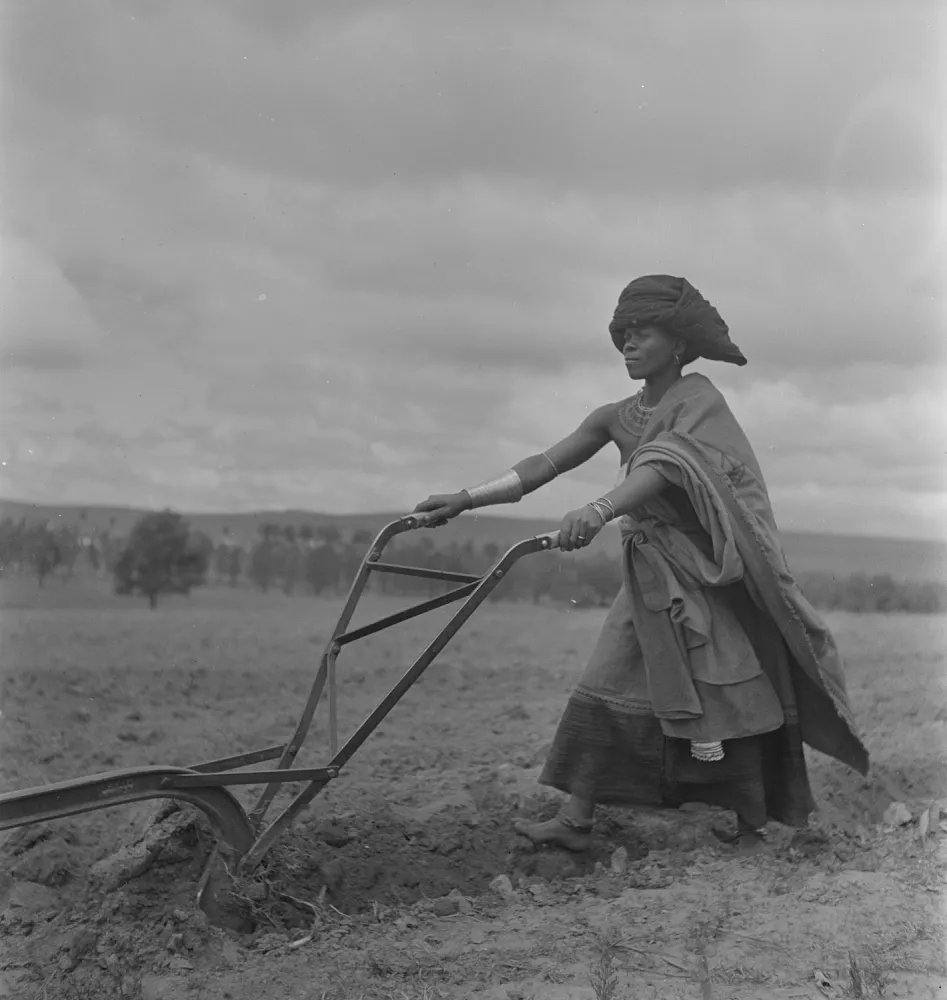
Xhosa woman plowing, Cape Province, South Africa, 1949. Credit: Constance Stuart Larrabee
History ZAR tweet media
English
49
717
3.2K
160.1K
Indigenous Languages Action Forum
Indigenous Languages Action Forum@ActionLanguages·
Imbali ebalulekileyo. Siyabulela ngembali ka tat'uPaul Xiniwe. Babesebenza!
History ZAR@HistorySAZAR

Paul Xiniwe (1857 – 1902) was a South African entrepreneur, educator, and political activist in the Cape Colony. He is best known as the founder of the Temperance Hotel in King William's Town (now Qonce), one of the earliest hotels established and operated by a Black South African, and for his involvement in early Black political organizations in the Eastern Cape. After graduating from Lovedale, Xiniwe became a teacher at Edwards Memorial School in Port Elizabeth. His school gained a reputation for high educational standards during his tenure. Xiniwe later resigned from teaching to pursue business ventures. He invested in property and established several general merchant stores in East London, Port Elizabeth, and King William's Town. In 1894, he bought a building for 2,000 pounds, and opened the Temperance Hotel in King William's Town.[6] The hotel became an important social and cultural center for Africans in the town, and was notable at a time when Black South Africans faced significant restrictions in commercial ownership. Xiniwe was regarded as a pioneer of Black entrepreneurship in the Cape Colony. Xiniwe was actively involved in early Black political and civic organizations. In 1887, he served as an executive member of Imbumba Eliso Lomzi Yabantsundu (Union of Native Vigilance Associations), a pioneering political conference that brought together African organizations in King William’s Town. He also participated in educational and political forums advocating for African political representation and civil rights. In 1884, he presented a paper at the Native Educational Society addressing African participation in parliamentary processes. His work formed part of the broader foundation of organized African political consciousness in South Africa. Paul Xiniwe and his wife, Eleanor Xiniwe (née Ndwanya), were members of the African Choir, a group of educated South Africans who toured Britain between 1891 and 1893. The choir sang both Christian hymns and traditional African music, and sought to raise awareness and financial support for a new technical college in the Cape Colony. In 1891, the Choir performed for Queen Victoria at Osborne House. Credit: London Stereoscopic Company, Wikipedia

Filipino
0
0
2
219
SABC News
SABC News@SABCNews·
WATCH | More than 50 people have left their families, jobs and, in some cases, medical treatment to join Ekhaya Labafundi bakaJehova in KwaMaphumulo, north of Durban. The founder says they are a holy nation.
English
104
103
262
66.9K
Kobayashi
Kobayashi@pecson007·
@SABCNews I think i get the gist of their argument. There is something wrong with the life that we are being forced to live
English
1
0
4
967
Newzroom Afrika
Newzroom Afrika@Newzroom405·
A member of the Ikhaya Labafundi faith mission says she rejected an opportunity to study medicine in Cuba because of Jesus Christ. Another member rejects the notion that the mission is a cult. The controversial faith-based organisation in Dabangu, KwaMaphumulo, has over 100 members who abandoned their careers, educational pursuits, personal assets, and some even medical treatments, hoping God will provide. Watch: tinyurl.com/599x52bs
English
696
704
2K
605K
Indigenous Languages Action Forum retweetledi
MANYAMBELA
MANYAMBELA@SkateRogers·
Don't Let African Literature Die
MANYAMBELA tweet media
English
7
126
536
7.7K
Indigenous Languages Action Forum
Indigenous Languages Action Forum@ActionLanguages·
There is a lot to mine out of the early black newspapers like Imvo which was written in isiXhosa. What can be discovered is how well off some of the Xhosa society were in the 1800s & early 1900s. In many ways, that generation was way ahead of us. This was shortly before 1913 act.
English
1
10
28
778